|
FOR IMMEDIATE RELEASE
June 2, 2020
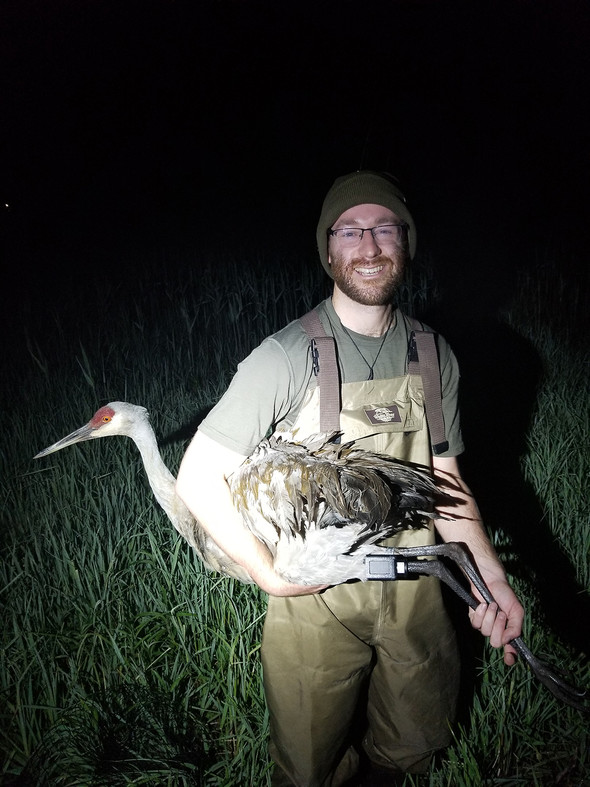
Research specialist Matt Garrick holds a sandhill crane at a Story County wetland on the morning of May 24. This is the first time a sandhill crane has been banded in Iowa. The tracking device will provide information on sandhill cranes in Iowa, nesting habits and where they spend their winters. Photo courtesy of the Iowa DNR.
The Iowa Department of Natural Resources (DNR) has outfitted a greater sandhill crane with a GPS transmitter as part of a small pilot study to learn more about this unique species that is increasingly calling Iowa’s wetlands home.
Matt Garrick, research specialist from the Iowa DNR’s Clear Lake office, said it’s the first time the DNR has placed a tracking device on a sandhill crane and hopes the study will help shed some light on the behavior patterns of these birds.
“We’re trying to learn more about Iowa cranes, the habitat they use here, where they nest and migration habits,” Garrick said.
Garrick placed the first of hopefully 10 GPS transmitters on a greater sandhill crane in Story County early on May 24. The crane was released unharmed, immediately after being fitted with the transmitter, and has resumed normal activity. Iowans are encouraged to report sightings and locations of nesting cranes to matt.garrick@dnr.iowa.gov.
Greater sandhill cranes were extirpated from Iowa in the late 19th century due to habitat loss and overharvest. As their historic wetland habitats returned and population recovered, the sandhills began to return to Iowa and were first documented successfully nesting here in 1992. Today, sandhill nests have been documented in 27 counties.
Sandhill cranes can live up to 35 years in the wild. They generally have small clutches – two eggs – and fewer than 30 percent survive to take flight.
The small pilot study is a partnership between the Iowa DNR and Iowa State University. Sandhill cranes are protected in Iowa.
Media Contact: Matt Garrick, Waterfowl Research Specialist, Iowa Department of Natural Resources, 641-425-2915.
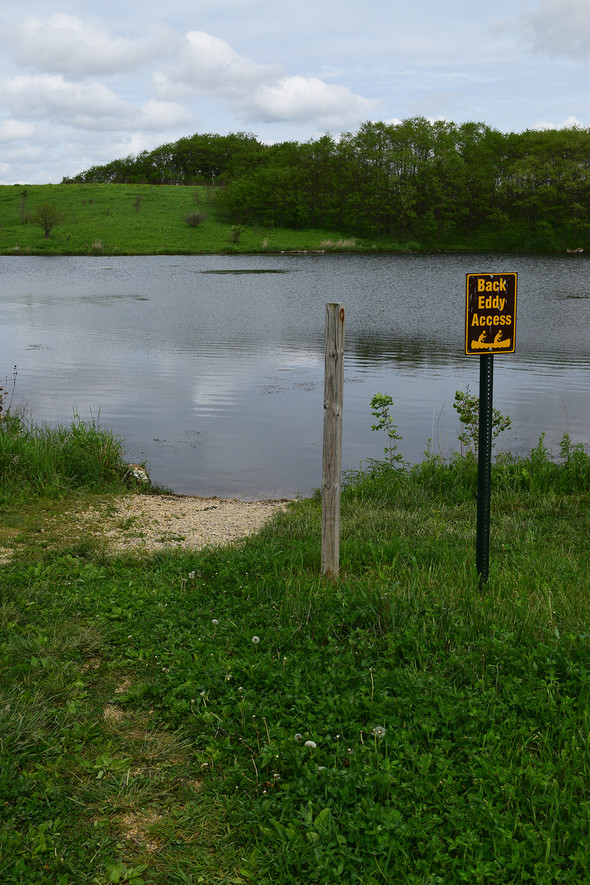 Lost Grove Lake offers paddlers a protected carry down access a few feet from a paved parking lot in Back Cast Bay. The bay has a trail along shore and offers excellent shore fishing access and a popular fishing jetty. Photo courtesy of the Iowa DNR.
Eastern Iowa’s newest pubic wildlife area is also one of its most popular.
“When you come there, you’re going to find a beautiful lake with clean, clear water, quality fishing, bird and wildlife viewing and a restored prairie on rolling hills,” said Curt Kemmerer, wildlife biologist with the Iowa Department of Natural Resources. “It’s a great place to recharge or connect with nature just a few miles from 400,000 people.”
Lost Grove Wildlife Area offers 1,300 acres of mostly rolling restored prairie surrounding a 400-acre highly productive lake designed with anglers and paddlers in mind.
At midday in the middle of the week in late May, Lost Grove Wildlife Area had nearly 40 vehicles in three parking lots with visitors fishing, paddling, hiking and even a few swimming as part of their triathlon training.
“There’s something here for everyone – fishing, hunting, trapping, hiking, paddling,” Kemmerer said.
Lost Grove Wildlife Area grew out of the hills of northern Scott County after a statewide study identified it as a location that was lacking in outdoor recreation. Once the site was selected, willing sellers began offering their land for sale almost immediately. The bulk of the land was acquired from 1988 to 1995, with the final parcel coming in 2003.
Drawing from a population based in the Quad Cities, Clinton and Cedar Rapids, Iowa State University’s Center for Agriculture and Rural Development estimated the economic impact of Lost Grove Wildlife Area and lake would be around $20 million annually.
Once completed, it didn’t take long for hunters, anglers, hikers, paddlers to fill the parking lots.
“There are days when there are more paddlers on the lake than motorized boats,” Kemmerer said. “It’s wildly popular among the paddlers.”
Tucked in the protected Back Cast Bay is a carry down access designed specifically for paddlers, a few feet from a paved parking lot. The bay has a trail along shore with few trees to snare a wayward bobber. It offers excellent shore fishing access and a popular fishing jetty.
Lost Grove Lake was stocked with bluegills, redear sunfish, crappies, largemouth bass channel catfish, walleye and muskellunge. With 13 sediment catching ponds and much of the watershed in prairie, the water clarity is excellent.
The lake was built with fishing in mind – gravel spawning beds, rock fields, hardwood trees placed throughout and miles of shoreline available to fish. The lake has universally accessible shoreline, three fishing jetties, three fishing platforms, three boat ramps each with a latrine and fish cleaning station. It also has a boat passage box culvert under the causeway providing the only access to “Causeway Impoundment” on the lakes upper end for boaters and paddlers.
While the lake receives most of the attention in the spring and summer, on Sept. 1, the focus shifts to hunting and specifically the dove fields.
“Every year we put in six or seven fields, some larger, some smaller – ranging from 2-4 acres up to eight acres. There’s a plot or two in every section. It helps to spread people out,” Kemmerer said. “Hunter turnout can be impressive on opening day. We had seven fields last year and the area hit the 100 vehicle mark on opening weekend.”
The popularity of dove season here is only exceeded by popularity of its pheasant season.
“There’s a good pheasant population out here and it gets an absolute ton of use during pheasant season,” he said. “Group after group, coming and going, all day long.”
The pheasant population is there because of the area’s focus on grassland management.
Most of the 1,300 acres consist of a diverse mix of wildflowers and native grasses creating high quality upland habitat. Kemmerer uses prescribed fire as a management tool burning 200-300 acres each year to rejuvenate the prairie and to keep the trees out.
“We’re not blessed with a lot of grassland acres in the part of the state so we’re working to keep the area in grass,” he said.
To manage an area of this size takes teamwork and at Lost Grove, the Iowa DNR’s Wildlife and Fisheries bureaus team up with Scott County Conservation Board who helps with the weekly maintenance.
Dog Trial Area
One unique feature at Lost Grove is its dog trial area.
The 100-plus acres at the furthest northwest part of the area is heavily used by professional dog trainers on down to someone who just wants to get their dog some exercise. A pond sits about 100 yards from the parking lot that is a popular place to train retrievers.
“There’s someone here every day,” Kemmerer said. “People are hungry for an area to work their dogs.”
Media Contact: Curt Kemmerer, Wildlife Biologist, Iowa Department of Natural Resources, 563-357-2035.
DES MOINES, IA – This week, more facilities are open in Iowa state parks according to the Governor’s proclamation. Here is a list of openings for the week of June 1:
- Lodges and shelter reservations can be made on the DNR’s park reservation system for June 6 and after. Groups are limited to 50 percent capacity of the facility and must follow social distancing protocols. To make a reservation, visit: https://iowastateparks.reserveamerica.com/
- Playgrounds are open, but user discretion is advised. Playgrounds will not be sanitized.
- Youth and group camps are open. Groups are limited to 50 percent capacity of the facility and must follow social distancing protocols.
- Some events are now able to take place with social distancing protocols. Please check iowadnr.gov/parks2020 for event updates.
- Campgrounds are now open to visitors of overnight campers.
State park museums and visitor centers have varying plans to re-open, depending on staffing and ability to implement social distancing protocols:
- Backbone State Park, Dundee – the CCC Museum at Backbone is closed until further notice.
- Bellevue State Park, Bellevue – The visitor center is closed until further notice.
- Cedar Rock State Park, Quasqueton – the Wallace Estate home will open June 3, offering tours on a reservation-only basis. Masks are encouraged and groups will be limited to 9 or less. For more details, visit http://www.friendsofcedarrock.org/
- Lewis and Clark State Park, Onawa – The visitor center will open June 8 with limited hours – Tuesdays through Fridays from 8 a.m. to noon.
- Loess Hills State Forest, Pisgah – The visitor center will open by June 10. Visit https://www.iowadnr.gov/Places-to-Go/State-Forests/Loess-Hills-State-Forest for hours.
- Maquoketa Caves State Park, Maquoketa – the Sager’s Museum is closed until further notice.
- Mines of Spain State Recreation Area, Dubuque – The EB Lyons Nature Center is closed until further notice. Look for updates at https://www.minesofspain.org/visitorcenter/
- Wildcat Den State Park, Muscatine – the Grist Mill is closed at least through June as the Friends Group determines its ability to provide staffing. The Melpine School will be closed for the 2020 season. Find updates on the Friends Group Facebook page: https://www.facebook.com/Pine-Creek-Grist-Mill-181915185162487/
According to DNR park staff, many visitor centers and museums are run by volunteer groups with people in higher-risk health groups, which limits ability to re-open.
For more details on park alerts and updates, visit: www.iowadnr.gov/Places-to-Go/State-Parks/Alerts-and-Closures
Preserve the memory of your child or grandchild hooking their first fish this summer with a special certificate. Print the certificate yourself from an electronic file posted online or request a printed certificate.
Apply for a first fish certificate online at www.iowadnr.gov/firstfish. It’s easy and free to participate. There are no size, species or age requirements – only that it is the very first fish the angler has successfully landed.
Family and friends can join in on the celebration by viewing the first catch photos of their kids and other budding anglers on the First Fish webpage once the entry is approved.
Give your kids a lifetime of BIG memories out on the water this summer. Follow the simple tips for taking kids fishing on the Iowa DNR website at fishing.iowadnr.gov to help keep the experience fun and positive for the whole family.
Media Contact: Holly Luft, Fisheries Bureau, Iowa Department of Natural Resources, 712-769-2587.
DAVENPORT, Iowa – Iowa Department of Natural Resources conservation officers will host an inspection day this weekend for anyone unable to get inspections completed during the Covid-19 pandemic.
The inspection day will be held on Saturday, June 6, 2020 in the Scott County Recorder’s Office parking lot at 600 West 4th Street in Davenport.
Officers will be inspecting boats, snowmobiles, ATVs and UTVs starting at 10 a.m. and will run as long as needed.
Media Contact: Jeff Harrison, DNR Conservation Officer, (563) 349-9418, Jeff.Harrison@dnr.iowa.gov
To celebrate the 100th anniversary of Iowa state parks, the Iowa Department of Natural Resources DNR partnered with three organizations, the Iowa Walking Club, the Nebraska Wander Freunde Trailblazers, and Iowa Parklands, to create 5k and 10k walking routes in 20 Iowa state parks. Maps and directions are free and available for download at https://www.iowadnr.gov/20walks
The 5k and 10k walks are intended for visitors to explore on their own or with a small group. Route starting points are marked with a Walk Box containing free maps, along with supplies for walking club members to submit donations as part of their membership. Walkers who are not members may use the maps and enjoy the walking routes as a free service for the 100th anniversary celebration.
The Iowa Walking Club and Nebraska Wander Freunde Trailblazers are non-profit organizations dedicated to physical fitness for all ages through long-distance walking and encourage social connections through membership. Both organizations are part of the American Volkssport Association. Iowa Parklands is an Iowa-based company that creates state park-themed maps and merchandise.
Parks included in 20 Walks in 2020 are:
- Beeds Lake
- Big Creek
- Geode
- Lake Anita
- Lake Darling
- Lake Macbride
- Lake Manawa
- Lake of Three Fires
- Ledges
- Lewis and Clark
- McIntosh Woods
- Mines of Spain
- Palisades-Kepler
- Pikes Peak
- Pilot Knob
- Prairie Rose
- Stephens State Forest
- Stone
- Volga River
- Waubonsie
The Iowa Department of Natural Resources is working with state and local officials to reduce the spread of COVID-19 and has transitioned employees to work remotely. DNR offices are closed to the public during this time and only available by appointment.
In other efforts to further reduce the spread of Covid-19, the DNR is encouraging the use of the online services for purchasing licenses, submitting applications, payments and other daily tasks and interaction with DNR staff.
The FREE Go Outdoors Iowa app is available at the App store and Google Play. The Go Outdoors Iowa app allows users to purchase and view hunting and fishing licenses and submit harvest and quota reports, all from your cell phone.
Full list of DNR’s online services: https://www.iowadnr.gov/about-dnr/about-dnr/online-services-databases.
Up-to-date information on DNR services, facilities and events impacted by Covid-19: https://www.iowadnr.gov/About-DNR/Covid-19.
Technical information for regulated businesses in regards to Covid-19: https://www.iowadnr.gov/About-DNR/Social-Media-Press-Room/Disaster-Assistance#3057321-covid---19-outbreak.
Thank you for your patience and flexibility during this time. If you need to contact DNR staff you can reach them by email or phone or by calling (515) 725-8200.
|