|
FOR IMMEDIATE RELEASE
April 14, 2020
Danville, Iowa – The Iowa Department of Natural Resources (DNR) extended the timeline to complete in-lake restoration work at Geode State Park due to poor working conditions throughout the winter. Current restoration activities will improve water quality at Lake Geode and enhance accessibility and recreational opportunities in the park.
An unseasonably warm winter prevented the DNR from completing all elements of the project in 2019 and early 2020. DNR’s current plan is to resume work late this summer to remove the remaining 40,000 cubic yards of excess sediment from the upper end of the lake. The lake will be allowed to re-fill starting February 2021.
If weather conditions this year do not allow for mechanical removal of sediment from the lake bottom, the DNR plans to hydraulically dredge the remaining 40,000 cubic yards in early 2021. Efforts to stabilize additional sections of shoreline will be completed via barge after the lake refills. Final in-lake work compliments a decade’s effort to protect future water quality at Lake Geode through implementation of Best Management Practices in the watershed.
Lake restoration construction work at Lake Geode began in January 2018. About 160,000 cubic yards of excess sediment has been removed from the lake, eroded shorelines have been stabilized, fishing jetties have been built, and fish habitat structures added. Local angling groups are helping with the restoration efforts by constructing and placing additional fish habitat features in the lake bottom.
Since construction started, the DNR has replaced the existing lake drain valve, completed maintenance work on the concrete spillway and finished a significant portion of the in-lake work. Construction will continue this spring on the terrestrial portions of the project, including final grading and armoring the shoreline.
From March 2018 through summer of 2019, the DNR also completed campground renovations. Improvements included a new shower building, pit toilet, dump station, and 14 campsites with full utility hook-ups, and 52 campsites with electrical hook-ups.
The DNR recently announced new changes to Iowa state parks due to COVID-19, including the closing of campgrounds and facilities for recreational use through April 30, 2020. Geode State Park is open for day use only, which includes roads and trails and open spaces such as grassy areas.
Lake Geode is one of the lakes in the state selected for lake restoration work designed to improve water quality, habitat, and provide a positive economic return to the community. Poor water quality has impacted the fish population and affected all water based recreation at the lake.
Media Contact: George Antoniou, Lake Restoration Program Coordinator, Iowa Department of Natural Resources; George.antoniou@dnr.iowa.gov; 515-725-8449.
MAQUOKETA -- The caves at Maquoketa Caves State Park will remain closed through April 30, in accordance with Governor Reynolds’ social distancing efforts. The trail system for the park’s most popular caves involves narrow boardwalks and handrails, making it difficult for visitors to maintain physical distances of at least six feet. Visitors can access the rest of the park while the caves are closed.
When planning a trip to an Iowa state park, be sure to check the DNR’s State Park Alerts and Closures page at www.iowadnr.gov/parkclosures for information on any seasonal, construction or weather-related closures that may impact your visit, along with COVID-19 related operational changes at Iowa state parks.
The recent news from the World Wildlife Fund and Mexico’s Comisión Nacional de Áreas Naturales Protegidas on monarch wintering numbers was an eye opener – the butterflies covered an estimated seven acres of forest canopy in Mexico – less than half of last year’s population. Experts estimate a long-term average of 15 acres of occupied forest canopy is necessary to sustain the eastern North America monarch population.
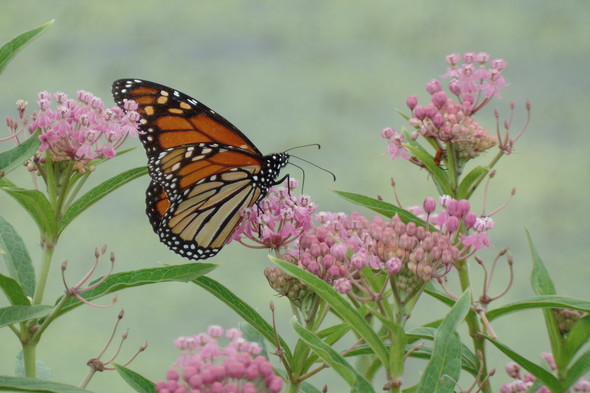
Already well on their way back to the Upper Midwest, the orange and black icon will again call Iowa home in the next four to six weeks.
Iowa fills an important role for monarchs hosting generation after generation through the summer until Mother Nature signals it’s time to produce the Super Generation that will make the 3,000 mile journey back to Mexico for the winter.
Iowans can welcome the summertime residents back by including pollinator friendly plants as a part of their annual spring gardening and landscaping.
“This is an opportunity for people, individually, to help monarchs, and that can be as small as planting a flower pot on an apartment balcony or as large as new pollinator-focused prairie,” said Karen Kinkead, coordinator of the Iowa Department of Natural Resource’s Wildlife Diversity Program.
Kinkead recommended using local native seeds and plants that are better suited to Iowa’s growing season and likely more readily available from local greenhouses. “It also serves as a way to support local small businesses,” she said.
The current Iowa Monarch Conservation Strategy seeks to establish between 480,000 and 830,000 acres of monarch habitat by 2038, through voluntary, statewide conservation efforts based on the best available science.
“When we have perfect weather conditions, we can produce enough monarchs, but weather can also work against monarch production and survival and to compensate for that requires more production areas,” Kinkead said. “We saw good egg production and adult numbers last year, but that didn’t overcome bad weather between here and Mexico. We need great egg production.”
Monarchs use different plants during different stages of its lifecycle and Kinkead suggests that a mixture of milkweed and native wildflowers be part of every planting, if possible.
Recommendations for Creating Habitat for Monarchs and Other Pollinators
-
Choose Native Plants- Iowa has a huge variety of native prairie and open woodland plants to choose from: they are beautiful, they are adapted to Iowa’s soil and environment and they are old friends to our native pollinators.
- Include Milkweed PLUS other species of wildflower. To provide food for both the caterpillar and adult stage you must include at least one species of milkweed plus a few other species of flowers. At a minimum, think about including a species of milkweed plus three species of wildflower (nine species total) that bloom during the early, middle and late portion of the summer. Throwing in a native grass or two rounds things out nicely. Variety is the spice of life and, in this case, has the best chance of attracting the most beneficial insects. Links to some species lists can be found
-
Be Patient especially if planting native plants. Prairie plants have huge root systems and most plants spend much of their energy in the first 1-3 years growing those roots. Once established they can concentrate on putting out showy flowers and lush foliage. You can speed the process up a little bit by using plugs rather than
-
Avoid Using Chemicals. Pesticides and herbicides can have negative impacts on monarchs and other beneficial insects so it’s best to avoid their use entirely or if you must use them, to use them in as targeted a manner as possible, following the application instructions
-
Register your habitat with Grow.Fly at the Blank Park Zoo. and inspire others!
Considerations for creating small patch of monarch habitat
The first thing to decide is whether you prefer something formal or you’re okay with a little mess. This will drive the plants and design of the garden. In many urban and suburban areas there may be rules or ordinances governing what plants are allowed or how tall and messy plantings can be, so be sure to check into this first if you want something a little more natural.
If you do want a natural look you can opt for either seed or prairie plant plugs. Plugs have the advantage of maturing faster but are more expensive. If you wish for a more formal garden look, there are plenty of prairie plants that are shorter in stature and do not aggressively spread. For example, butterfly weed, whorled milkweed and swamp (red) milkweed are all native species that will not overwhelm your garden like common milkweed would. The best time to plant plugs is in the spring after the last frost.
An example species list for a native plant home garden that is great for monarchs and pollinators is listed at the end of this document.
Whether you go for plugs or seed, it is best to start with bare ground just like any flower bed. Adding a little compost wouldn’t hurt but it’s not necessary and other kinds of amendments shouldn’t be needed – most prairie plants are used to making the most of poorer soil.
To keep the garden looking nice, you will need to weed, particularly in the first two years to give the native plants a chance to grow. Being familiar with what the plants look like as seedlings can be helpful for this. If you want to keep a more natural garden from looking too wild, you can add a nice border of rocks that can double as monarch sunning spots, or keep a mowed border around it.
There are really no broad-scale cost-share programs in Iowa to help private landowners putting in a smaller sized area of habitat. It would be worthwhile to do some research on local programs that may provide funding or plants for area homeowners and it’s always good to keep a look out for monarch events in your town as milkweed is often freely available. In contrast, there may be some funding or free plants available for schools, churches or municipal buildings.
Visit the DNR’s Website – www.iowadnr.gov/pollinators - for more information on Monarchs and Pollinators in Iowa.
Considerations for creating monarch habitat larger than one acre
Plots that are one acre or greater, the best and most economical way to go for a natural looking prairie is through a seed mix, rather than planting plugs. Iowa State University has developed an ideal recommended Monarch seed mix for Iowa which is a good place to start.
The best time to plant prairie seed is late October or November before the ground freezes and just before or after a light snow, but planting anytime during this period is fine. You want to plant the seed on bare ground so if you are replacing turf it’s best to kill this with chemical or by some other means. Prairie seed does best if drilled in and there are special drills (Truax Native Seed Drills is a popular brand) which you may be able to rent or it might be worth hiring a contractor to do your planting. The Tallgrass Prairie Center at the University of Northern Iowa may be useful in finding a contractor.
Maintenance in the first few years will be important to give the prairie plants the best chance to thrive. The area should be mowed 2-3 times during the growing season for the first two years. After this, prescribed burning or mowing every 3-5 years will keep the plants healthy and thriving and preserve the diversity of the seeding hut decreasing the amount of tree and shrub growth. Best times for mowing and burning for monarchs will be between October and the first of May. If you have concerns about the resident pollinators (which may spend winters on the property), on which burning and mowing can be hard, you may consider splitting the area and just doing a third of the field every three years.
For larger areas, you may be eligible for some financial assistance in establishing Monarch habitat. You can contact one of the DNR’s private lands biologists for guidance or consult the funding sources page provided by Plant.Grow.Fly. for more information.
Monarch Habitat Web Links
The Iowa DNR is part of the Iowa consortium, which is a group of 50 organizations, including agricultural and conservation associations, agribusiness and utility companies, universities and county, state and federal agencies. Roughly 40 percent of all monarch butterflies that overwinter in Mexico are estimated to come from Iowa and neighboring Midwestern states.
To learn more about the Iowa Monarch Conservation Consortium, visit http://monarch.ent.iastate.edu/ and follow @IowaMonarchs on social media.
 Credit: Bill Ohde, retired DNR wildlife district supervisor
It's as predictable as May flowers - from border to border, the Wildlife Baby Season has arrived in Iowa. From now until at least mid-June, DNR field offices across the state will be inundated with hundreds of phone calls and scores of deliveries regarding "orphaned wildlife."
Most calls begin with something like, "We were walking in the park when . . .," or "I looked out my window and saw. . ." In nearly every instance, the scenario ends with something [or several somethings] being rescued from their mother.
During a typical season, the species will range all the way from baby robins and squirrels to spindly-legged white-tailed fawns. At this time of the year it is not at all uncommon for staff to discover complete litters of baby raccoons, foxes, or even skunks have mysteriously appeared on their doorsteps.
Why this happens is no real mystery. From fuzzy yellow ducklings to tiny baby bunnies, nothing appears more cute and cuddly than a wildlife baby. But in reality, most of the wildlife reported to DNR field offices is not really orphaned at all. And while the people who attempt to "rescue" these babies have the best of intentions, they are in fact dooming the very creatures they intend to help.
The babies of most wildlife species leave their nests or dens well in advance of being able to care for themselves. Although broods or litters may become widely scattered during this fledgling period, they still remain under the direct care and feeding of their parents.
For many songbirds, the transition to independence comes quickly and may take as little as four or five days. For other species such as Canada geese, kestrels, or great horned owls, the young and parents may stay in contact for weeks -- even months.
At the beginning of the fledgling period, young birds appear clumsy, dull-witted, and vulnerable. The reason for this is because they really are clumsy, dull-witted, and vulnerable. But as the education process continues, the survivors smarten up fast, while slow learners quickly fade from the scene. Most birds have less than a 20 percent chance of surviving their first year. While this seems unfortunate or cruel, this is a normal occurrence in nature. In the real out-of-doors, it's just the way things are.
Most mammals employ a slightly different strategy when it comes to caring for their adolescents. Since most mammals are largely nocturnal, the mother usually finds a safe daytime hideout for her young while she sleeps or looks for food. Consequently, it is perfectly normal for the young to be alone or unattended during the daylight hours.
Nevertheless, whenever a newborn fawn or a nest full of baby cottontails or raccoons is discovered by a human, it quite often is assumed that the animals are orphaned. The youngster's fate is usually sealed when it is promptly "rescued from the wild."
Many wildlife babies die soon after capture from the stress of being handled, talked to, and placed into the unfamiliar surroundings of a slick sided cardboard box. Should the animal have the misfortune of surviving this trauma, they often succumb more slowly to starvation from improper nourishment, pneumonia, or other human caused sicknesses.
Whether they are adults or young, all species of wildlife have highly specific needs for survival. "Rescuing a baby from its mother" not only shows bad judgment, it also is illegal.
Observing wildlife in its natural habitat is always a unique privilege. Taking a good photo or two provides an even more lasting memory. But once you've done that, let well enough alone. Leave wildlife babies where they belong -- in the wild.
A list of wildlife rehabilitators is available online at http://www.iowadnr.gov/Conservation/Iowas-Wildlife.
Media Contact: Karen Kinkead, Wildlife Diversity Program Coordinator, Iowa Department of Natural Resources, 712-330-8461.
State Conservation Officer Tyson Brown, with the Iowa Department of Natural Resources serving Marshall and Grundy counties, was named the Officer of the Year by the Iowa chapter of the National Wild Turkey Federation.
Brown was recognized for his commitment to helping wounded veterans go turkey hunting and mentoring youth and novice adult turkey hunters. He was honored during the NWTF Iowa chapter winter convention.
The Iowa Department of Natural Resources is working with state and local officials to reduce the spread of COVID-19 and has transitioned employees to work remotely. DNR offices are closed to the public during this time and only available by appointment.
In other efforts to further reduce the spread of Covid-19, the DNR is encouraging the use of the online services for purchasing licenses, submitting applications, payments and other daily tasks and interaction with DNR staff.
The FREE Go Outdoors Iowa app is available at the App store and Google Play. The Go Outdoors Iowa app allows users to purchase and view hunting and fishing licenses and submit harvest and quota reports, all from your cell phone.
Full list of DNR’s online services: https://www.iowadnr.gov/about-dnr/about-dnr/online-services-databases.
Up-to-date information on DNR services, facilities and events impacted by Covid-19: https://www.iowadnr.gov/About-DNR/Covid-19.
Technical information for regulated businesses in regards to Covid-19: https://www.iowadnr.gov/About-DNR/Social-Media-Press-Room/Disaster-Assistance#3057321-covid---19-outbreak.
Thank you for your patience and flexibility during this time. If you need to contact DNR staff you can reach them by email or phone or by calling (515) 725-8200.
|





