|
FOR IMMEDIATE RELEASE
March 17, 2020
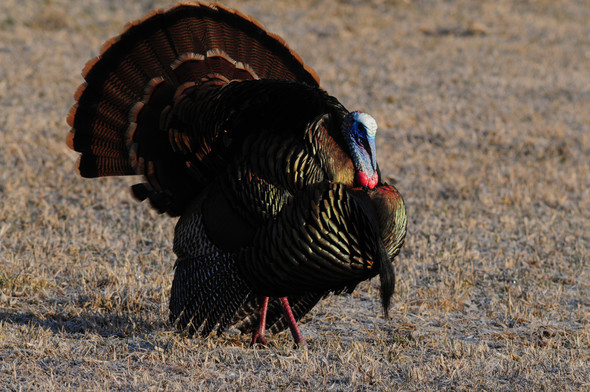 It’s the sound turkey hunters have been waiting for - wing tips dragging through dried grass and leaves - the Tom cautiously walks in out of view. His display begins – spitting and drumming, chest out, head back – in full strut, then all this gives way to the hair raising gobble that thunders through the timber. For spring turkey hunters the clock is ticking…. the season is a few weeks away. Photo courtesy of the Iowa DNR.
Enjoy those easy-to-see large flocks of turkeys feeding in the fields while you can. In the next few weeks, the winter flocks will break up, and where you saw them last weekend is not where they’ll be when spring turkey season opens in April.
Bagging a wild turkey is a challenge for even the most experienced hunters. Of the 50,000 licenses sold each spring, about 20 percent are placed on a bird.
“Turkeys have home field advantage. We go where they live and use calls that try to mimic the sounds of a hen. We are trying to reverse nature and get the Tom to come to the hen, which he knows is wrong. If you can frustrate the Tom enough that he ignores his instincts and goes looking for this fake hen, then as a hunter you have a chance,” said Jim Coffey Iowa DNR forest wildlife biologist. “Plus, they have excellent eyesight and hearing so not only do we have to sound realistic, we have to blend in with the landscape and stay motionless. That’s what makes turkey hunting such an intimate activity. Sounds easy.”
While heading home with and unfilled tag is common, what brings hunters back year after year is the experience of when the bird does come in.
The quiet spring morning is broken by the sound of a Toms’ wing tips dragging through dried leaves as he slowly walks in. He’s right behind you. His display begins – spitting and drumming, chest out, head back – in full strut, then all this gives way to the hair raising gobble that thunders through the timber. At this range, any movement will be noticed. Gotta stay calm and wait for the right moment.
The “dance” is what brings hunters back. And since predicting when the bird will come in is not possible, planning and preparing before the season arrives is an important step toward success.
Coffey said hunters should contact the landowner to make sure they still have access. They should also pattern their gun using the same choke and shot they will use during the season to know the gun and shot limitations.
“Nothing is more frustrating than shooting and missing at a turkey. We owe the bird the respect of only taking the best shot we can,” he said.
He also advises to start practicing calling so when the season begins hunters will be in midseason form.
“Scouting is also important and can greatly improve the chance of bagging a turkey,” Coffey said. “Spend some time in the timber or field you plan to hunt, identify roosting trees or which fields the birds are using, and look for activity signs like scratching, droppings or feathers.”
Iowa’s spring turkey gun/bow season begins with a youth season April 10-12, followed by four specific seasons. Season 1 is April 13-16, Season 2 is April 17-21, Season 3 is April 22-28 and Season 4 is April 29 to May 17. Hunters may purchase up to two spring turkey tags; one must be for fourth season. An archery only season is April 13-May 17.
Youth Season
An estimated 5,000 youth will participate in the Iowa April 10-12 spring turkey youth-only season. About one out of four of the youth will come home with a bird, which is a higher rate of success than during the regular spring turkey seasons.
“The youth season provides a wonderful mentored relationship much like learning how to drive where the parent helps them with the turning signals, brake pedals and keeping their excitement under control,” Coffey said. “Turkey hunting is an intimate experience done in close proximity between hunter and bird. It’s in that setting where the mentor will instruct and guide the youth on when to call, when to move or stay still. It’s passing on those woodsmanship skills learned over time.”
Hunters need to remember that any unfilled youth season tags will be valid until filled for the remaining spring seasons. The key is to make sure to purchase the youth tags before the youth season closes because once the season is over, that option is no longer available.
Reminder: Reporting Harvest is Mandatory
Successful hunters are required to report their harvest by midnight of the day after it is tagged. Be prepared to answer a few simple questions about your harvest, (county of harvest and spur length.) Hunters can report by going online to https://www.iowadnr.gov/Hunting/Report-Your-Harvest then clicking on the Harvest Report System button, by calling the phone number listed on the tag or by going through a license vendor. Be sure to write the harvest confirmation number on the harvest report tag. This allows the Iowa DNR to monitor annual harvest across the state.
Hunting Atlas Available Online
Hunters have a new tool that may improve their in the field experience even before opening day.
The Iowa hunting atlas is an interactive map that shows all available public hunting land that is managed by the state, county or federal governments. The atlas is online at www.iowadnr.gov/hunting. A mobile version is also available.
A click on an area will show basic information like size, habitat type and likely species available.
Media Contact: Jim Coffey, Forest Wildlife Research Biologist, Iowa Department of Natural Resources, 641-774-2958.
The Iowa Department of Natural Resources (DNR) in conjunction with Iowa State University is monitoring the wild turkey population for the presence of Lymphoproliferative Disease (LPDV), and is asking for hunters who harvest a bird this spring to provide one lower leg to be tested.
“We want hunters to be aware of this disease. Last year, we conducted a small project and had several birds test positive so we know it’s here. What we don’t know is the range and extent and if it’s having an impact on our turkey population,” said Jim Coffey, forest wildlife research biologist for the Iowa DNR.
Iowa’s current turkey population trend is mostly flat or slightly declining across much of the state. It’s a trend occurring not only in Iowa, but in other Midwestern states as well as nationally and experts are looking at different possibilities as to why the decline is occurring.
Illinois is researching the impact black flies may have on young turkey survival. Missouri researchers are studying predator’s relationship with nesting turkeys.
“We’re looking at the possibility of LPDV impacting the Iowa population and need hunter assistance to provide samples from across the state to test,” Coffey said.
To provide a sample, after hunters’ tag and report their bird, they can cut the lower leg off at the joint where the feathers end and the leg becomes scaly, wrap the leg in a paper towel, put it in a zip top bag and place it in the freezer. They can then go online to https://www.iowadnr.gov/Hunting/Turkey-Hunting and click on the Wild Turkey Sample Submission Form on the right side of the page. They will receive a postage paid envelope, instruction sheet with short questionnaire, and an additional zip top bag to use for submission. This will be an aggressive effort and all samples are welcomed, Coffey added.
Hunters are encouraged to send one whole lower leg, however if they would like to keep the spur it can be removed and the scaled portion above the spur can be submitted.
LPDV is a disease that does not impact people. Birds that test positive are still able to be consumed. Always use good meat handling and cooking protocols as with any other meat, poultry or wild game.
Media Contact: Jim Coffey, Forest Wildlife Research Biologist, Iowa Department of Natural Resources, 641-774-2958.
Spring turkey hunting success and safety comes down to the same thing – proper planning.
Be aware of what’s around you, even on private property, there could be other hunters out there who are coming to your call. Remember, turkey hunters are skilled in the art of concealment. Don’t shoot at movement; don’t shoot at sound; no turkey’s worth it. Be sure to positively identify the turkey’s beard before taking the shot.
Hunters who do shoot a turkey are encouraged to not carry it over their shoulder to avoid someone mistaking it for a live bird and take a shot. Hunters should consider using a blaze orange turkey transport harvest bag.
Practicing safe hunting becomes more crucial as the annual spring leaf out progresses. The later it gets in May, the harder it is to see. Hunters need to stay vigilant to identify the bird and the beard.
Tips
- Plan to wear blaze orange when moving from one spot to another because you never know if someone else is out there, even on private land.
- Avoid wearing patriotic colors – red, white, blue. These same colors are found in a turkey’s head.
- Be aware that mushroom hunters will be moving through the timber in late April and May. Mushroom hunters are encouraged to wear blaze orange and avoid red, white and blue.
- Plan to add bug spray and drinking water to the field bag
- A blind is good for concealment and when taking kids turkey hunting, but not for moving around. If you plan to be mobile, don’t bring the blind.
- If hunting private land, be sure you have permission and know the property boundaries.
- Even if hunting private property, the potential exists that someone else may be out there. Trespassing calls increase during turkey season.
- Be extremely careful if planning to use a turkey fan to hunt. Another hunter may mistake you for a turkey.
The popular trout stream stocking season starts on March 30. Find a list of stocked trout streams on the DNR trout stream map or the Iowa trout streams webpage. All trout stream stocking events will be unannounced due to COVID-19 precautions.
The DNR Trout Program offers Iowa anglers a variety of trout fishing opportunities, including announced catchable stockings, unannounced catchable stockings, fingerling stockings, wild trout, streams with restrictive regulations, easy universal access areas and remote streams with difficult access.
About 320,000 catchable-sized rainbow trout, 35,000 fingerling brook trout, and 20,000 fingerling brown trout will be stocked into hundreds of miles of northeast Iowa streams from the end of March through October. Funding to support the trout stocking program comes from the sale of hunting and fishing licenses and trout fees. About 40,000 Iowans and 5,000 nonresidents go trout fishing in Iowa each year.
Iowa’s trout streams, open year-round, meander through some of the most scenic areas of the state. Trout fishing information is available on the DNR website. All stockings are weather permitting and will be unannounced due to COVID-19 precautions.
Media Contact: Mike Steuck, Regional Fisheries Supervisor, Northeast Iowa, Iowa Department of Natural Resources, 563-927-3276.
Registration is open for spring Becoming and Outdoors Woman workshop, May 1-3, originating from Wesley Woods Camp & Retreat Center, south of Indianola.
While the focus of BOW is primarily for women, the workshop is an opportunity for anyone 18 years or older to learn outdoor skills.
“This workshop is all about introducing new participants to the outdoors and building social support networks so skills learned can be applied to other outdoor opportunities throughout the year,” said Rachel Alliss, with the Iowa Department of Natural Resources (DNR). “It’s an excellent opportunity to try activities under the guidance of our top-notch instructors.”
Workshop courses include foraged flavors, outdoor photography, intro to archery, kayaking basics, orienteering, pistol basics, Dutch oven cooking, kayak fishing, explore bowhunting, backpacking and hiking, intro to fishing, canning, BOW mentored turkey hunt, camping and more. Attendees taking intro to fishing, kayak fishing or the mentored turkey hunt are required to have purchased a valid Iowa license prior to arrival.
Friday night activity, Wild Game and Wine with Summerset Winery at the Annett Nature Center, is sponsored by Milo Locker, Summerset Winery and the National Wild Turkey Federation. The Saturday night activity is Gourmet S’mores and Stargazing.
Prior to April 1, the cost of the workshop is $280, which includes program materials, equipment, lodging and meals. There is a $250 no lodging option. After April 1, registration is $300 and will not include lodging. Enrollment is limited to 100 participants.
“Make sure to choose one class for each session, each class will show the number of seats still available and once a class has filled, it will be closed. Attendees will know what sessions they are in at the completion of the registration process,” Alliss said.
Early registration is encouraged as workshop spaces and lodging fill quickly. Go to https://www.iowadnr.gov/Things-to-Do/Camps-Workshops/Becoming-an-Outdoors-Woman to download the catalog, registration link, select classes and for more information on applying for a scholarship.
The event is sponsored by the Iowa DNR.
For more information, contact Rachel Alliss at 515-729-6037 or Rachel.alliss@dnr.iowa.gov.
The Marshall County Conservation was awarded a George H.W. Bush Vamos A Pescar™ Education grant to engage diverse audiences, including Hispanic families, in fishing and kayaking this summer in the Marshalltown area.
Program partners include Pheasants Forever, Izaak Walton League, Tri-County Bass Club, and Marshalltown High School Envirothon Team.
The grant is sponsored by the Iowa Department of Natural Resources’ Fish Iowa! angler education program and the Recreational Fishing and Boating Foundation’s (RBFF) Vamos A Pescar program.
Media Contact: Barb Gigar, Iowa Department of Natural Resources, 515-494-3891 or Emily Herring, Marshall County Conservation, 641-752-5490.
|





