|
A reminder that the coliform bacteria holding time remains at 30 hours for drinking water samples. The holding time is the time from when the sample is collected to when the laboratory begins the analysis.
In a pre-publication notice announced February 20th, that will be published soon in the Federal Register, EPA has made a positive regulatory determination to regulate perflurooctanesulfonic acid (PFOS) and perfluorooctanoic acid (PFOA) in drinking water.
Also in the proposal is the negative regulatory determination for six other chemicals: 1,1-dichloroethane, acetochlor, methyl bromide, metolachlor, nitrobenzene, and hexahydro-1,3,5-trinitro-1,3,5-triazine (RDX, or Royal Demolition Explosive). A negative determination means that EPA will not pursue regulation at this time for those six chemicals.
All eight chemicals were part of the Unregulated Contaminant Monitoring Rule (UCMR), in which all community systems serving at least 10,000 people and selected smaller systems participated.
The purpose of the UCMR is to obtain occurrence data of specific unregulated contaminants nationally in public water supply systems (where the contaminant is found and at what levels), in an effort to determine whether national regulation is warranted.
Once the data is compiled, a regulatory determination is made, where three things are determined: (the following is excerpted from EPA’s website)
“1. whether a contaminant may have adverse health effects,
2. whether a contaminant is found or substantially likely to be found in public water systems with a frequency and at levels of concern, and
3. whether, in the sole judgment of the EPA Administrator, there is a meaningful opportunity for health risk reduction through a national drinking water regulation.
EPA publishes preliminary regulatory determinations for public comment and considers those comments prior to making a final regulatory determination. If EPA makes a positive regulatory determination for any contaminant, it will begin the process to establish a national primary drinking water regulation, which typically includes a Maximum Contaminant Level (MCL).”
From EPA Water Security Division, 2/25/2020
The EPA has created a tutorial video to assist water utilities in complying with America’s Water Infrastructure Act (AWIA) Section 2013: Risk & Resilience Assessment and Emergency Response Plan certification requirements. The You-Tube video demonstrates step-by-step instructions on how a water utility can certify electronically through EPA’s website.
See the EPA website for more information on how to develop the assessment and plan, due dates, etc.
Reminder: all community water systems serving more than 3,300 people (including consecutive population) are required to conduct the assessment and develop the ER Plan.
From EPA Water Security Division, 2/25/2020
“Throughout 2020, the U.S. EPA will be partnering with water sector associations on a webinar series entitled “Partnering for Security and Resilience.”
Join EPA and AWWA for the next webinar on Tuesday, March 24, from noon – 1:00 p.m. CDT. The webinar, “Operationalize Your ERP with Resource Typing” will share the benefits of AWWA’s recently released Water Sector Resource Typing Guidance.”
Registration
 |
|
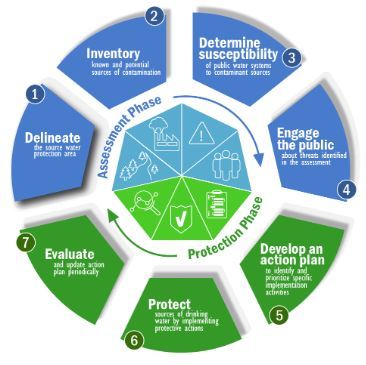
EPA launched its new Source Water Protection website last week that teaches the basics of source water protection, describes components of a source water protection program, and highlights new opportunities for funding and partnerships. This site is designed to inspire stakeholders to take action, and to help them find the resources to do it. |
|
From EPA Water Security Division, 2/25/2020
The EPA developed an activity book entitled “Water Operators: Delivering Safe Water Every Day,” to inform children in grades 3 – 8 about the importance of the services provided by water utility operators and their role as first responders. The 16-page book can be used by water utilities and school teachers during field trips and community day events. On the website, there is both a .pdf to print to a standard printer, and a .pdf that is for commercial printing.
|
|
 |
Please note: This is for wastewater permittees and their labs, and not drinking water permittees.
Each year, major wastewater permittees under the National Pollutant Discharge Elimination System (NPDES) program are required to participate in the annual Discharge Monitoring Report–Quality Assurance (DMR-QA) study. This study evaluates the analytical ability of laboratories that perform self-monitoring analyses required by an NPDES permit.
The 2020 EPA DMR-QA Study documents will be emailed or mailed to major permittees in late March or early April. Permittees are reminded to coordinate with the laboratories that analyze their compliance samples to ensure the complete report is sent to EPA by the due date.
The Iowa DMR-QA Coordinator is:
Bryant C.Harris
U.S. EPA Region 7, ECAD/WB
11201 Renner Blvd
Lenexa, KS 66219
Email: harris.bryant@epa.gov Telephone: 913-551-7770
For more information on the program, please visit the EPA's DMR-QA website.
Iowa DNR staff in the water supply program areas are scheduled to speak at the following events. The date, sponsor and event, location, subject, and contact for more information are listed.
- March 11, 2020, IA-AWWA Region 5 Conference, Newton, “Floods of 2019; Iowa DNR WS Rules Update; Manganese panel.” Agenda and registration available.
- March 18, 2020, IA-AWWA Region 6 Conference, Washington, “Iowa DNR WS Rules Update; Operator Integrity.” Agenda and registration available.
- March 25, 2020, IA-AWWA Region 4 Conference, Atlantic, “Manganese; Iowa DNR WS Rules Update.” Agenda and registration available.
- April 7 – 8, 2020, IA-AWWA Spring Short Course, Ankeny, “Iowa DNR WS Rules Update; Source Water Protection and Available Funding.” Agenda and registration available.
For other professional development opportunities, see the “Training Calendar” at programs.iowadnr.gov/opcertweb/.
|





