|
FOR IMMEDIATE RELEASE
January 16, 2020
MEDIA CONTACT: Jen Kurth, DNR, 515-725-8201 or jennifer.kurth@dnr.iowa.gov; Stephen Hopkins, DNR, 515-725-8390 or stephen.hopkins@dnr.iowa.gov
DECORAH -- The Upper Iowa River seemed an unlikely candidate for Iowa’s impaired waters list, noted for its exceptional water quality and stellar outdoor recreation opportunities. Still, native freshwater mussels were struggling to survive in the river - until a local effort stepped in to make major changes on the land. That effort was just recognized as a water quality success story by the U.S. Environmental Protection Agency.
The Upper Iowa River boasts numbers of stream miles designated as having exceptionally better quality beyond levels listed in Iowa’s water quality standards, in addition to having significant recreational and ecological importance. It’s the only Iowa river to be nominated for the national Wild and Scenic Rivers Program, and canoeing the Upper Iowa River has been listed as one of the top 100 adventures in the United States by National Geographic Adventure magazine.
But in 2002, three segments of the river landed on the impaired waters list. With increasing amounts of soil washing in, the scenic Upper Iowa River was struggling to support the native freshwater mussels living in its waters.
Studies showed the mussel population declined between 1984 and 1998, largely due to extra sediment and nutrients washing into the river from row-cropped fields in the watershed (the area of land that drains to the river). A freshwater mussel survey done in 1984 found 13 species of mussels in the river, while a follow-up in 1998 only found four.
Concerns about water quality in two coldwater trout streams that feed the river - Coldwater and Pine creeks - as well as in the Upper Iowa River, led to the creation of the Coldwater/Pine Creek Watershed Project in 2006.
The partnership effort, based out of the Winneshiek County Soil and Water Conservation District in Decorah, worked with almost 50 landowners to adopt conservation practices on their land that would help protect and improve water quality. Landowners and farmers installed grassed waterways, filter strips, cover crops, streambank protection and more practices to slow erosion and filter runoff before it could enter the streams.
“Even more than a decade later, most of these practices are still in place, demonstrating the commitment of the landowners to conservation,” said former Coldwater/Pine Creek Project Coordinator Corey Meyer.
As a result, there’s now about 6,223 fewer tons of sediment reaching the river each year, enough to fill 415 dump truck loads annually. That’s been a boon to mussels and other aquatic life. A Statewide Mussel Survey in 2012, led by the DNR and funded by U.S. EPA Section 319, found that the number of mussel species in the Upper Iowa River segment just downstream from Coldwater and Pine creeks had rebounded from zero in 1998 to six in 2012, including the creek heelsplitter (Lasmigona compressa), a threatened species in Iowa. In response, the aquatic life impairment was removed from the state’s list of impaired waters for one segment of the Upper Iowa River in 2014.
“Mussels are good indicators of the health of a stream system, so the fact that they are making a comeback after the efforts of the watershed project shows the value of these projects for our lakes and rivers,” said Jen Kurth, DNR biologist.
Life outside the stream has taken note, too - the Upper Iowa River continues to draw tens of thousands of people annually for recreational activities including canoeing, kayaking, tubing, bicycling, hunting, fishing, wildlife watching and camping.
Additional partners and funding sources involved in the Coldwater/Pine Creek project include the Iowa DNR, Iowa Department of Agriculture and Land Stewardship, U.S. Department of Agriculture Natural Resources Conservation Service, Iowa Resource Enhancement Assistance Program funds and the U.S. Environmental Protection Agency.
To learn more about the Upper Iowa River and its success story, visit the U.S. EPA’s website:https://www.epa.gov/nps/success-stories-about-restoring-water-bodies-impaired-nonpoint-source-pollution#ia
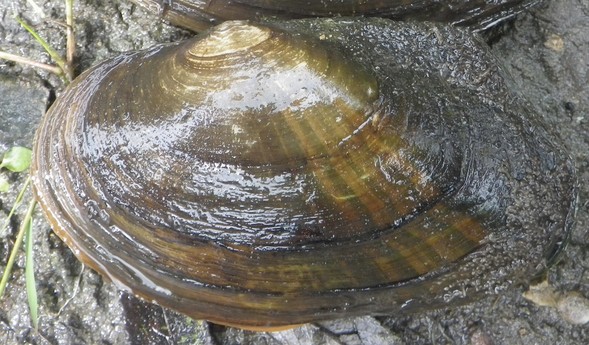 Creek heelsplitter freshwater mussel (Lasmigona compressa), a threatened species in Iowa.
MEDIA CONTACT: Jerah Sheets at 515-313-8909 or Jerah.Sheets@dnr.iowa.gov.
DES MOINES – Departing from its usual Tuesday meetings, the Environmental Protection Commission will meet at 1 p.m., Jan. 22, in the Wallace State Office Building auditorium, second floor, 502 E. Ninth St. in Des Moines.
The commission’s business meeting follows the annual joint meeting with the Natural Resources Commission, scheduled for 10 a.m. in the second floor north conference room of the Wallace building. Both meetings are open to the public.
Each commission will share highlights from 2019 at the joint meeting, followed by updates on current topics, including animal diseases and the Iowa Nutrient Reduction Strategy.
Commissioners will be asked to approve three contracts at the EPC’s business meeting. The first contract is with Iowa State University to monitor water quality as part of a federal/state effort to track progress and success of pollution reduction strategies.
A watershed planning contract in Des Moines County will address concerns about algal growth in Big Hollow Lake.
A third contract addresses the need for education on household hazardous materials. Results of a DNR survey showed young adults aren’t sure which materials are hazardous or how to properly dispose of them. Improper storage can increase the risk of accidents and poisonings. Public health records show nearly 7,500 accidental exposures and almost 3,600 children were poisoned by household hazardous materials in 2018. The contract would provide a multimedia campaign to increase residents’ ability to identify and safely dispose of these materials.
The meeting is open to the public. There is no scheduled public participation. Written comments may be submitted up to one day before the meeting to Jerah Sheets at Jerah.Sheets@dnr.iowa.gov or to DNR, 502 E. Ninth St., Des Moines, IA 50319.
The complete agenda follows:
Approval of Agenda
Approval of the Minutes
Monthly Reports
Director’s Remarks
Contract with Iowa State University
Contract with Des Moines Soil and Water Conservation District
Contract with Project 7 Design, Inc.
Notice of Intended Action: Chapters 9 and 50
General Discussion
Items for Next Month’s Meeting
- 18 – EPC Business Meeting – Polk County
- March 17 – EPC Business Meeting – Polk County
Find more information at http://www.iowadnr.gov/About-DNR/Boards-Commissions.
Commissioners include: Ralph Lents, Menlo, chair; Harold Hommes, Windsor Heights, vice chair; Bob Sinclair, Sigourney, Secretary; Stephanie Dykshorn, Ireton; Amy Echard, Farmersburg; Lisa Gochenour, Logan; Rebecca Guinn, Bettendorf; Howard Hill, Cambridge; and Tim Kaldenberg, Albia. Kayla Lyon is the DNR director.
Any person attending the public meeting who has special requirements such as those related to mobility or hearing impairments should contact the DNR or ADA Coordinator at 515-725-8200, Relay Iowa TTY Service 800-735-7942, or Webmaster@dnr.iowa.gov, and advise of specific needs.
MEDIA CONTACT: Lori Hanson, DNR, at 515-725-9525 or Lori.Hanson@dnr.iowa.gov for Title V permits.
DES MOINES – The DNR Air Quality Bureau has the following draft permits up for review. The permits help protect Iowans’ health and air quality. DNR’s permitting staff review each permit application to ensure facilities comply with state and federal air quality requirements. We encourage public comments on draft permits, providing help on how to make effective comments. Submit written comments to the assigned permit writer before 4:30 p.m. on the last day of the comment period. DNR considers public comments before finalizing the permits.
Title V Operating Permits
Title V Operating permits are reviewed and re-issued every five years. Facilities with a Title V permit have the potential to emit large amounts of air pollutants compared to other facilities. The five-year reviews are a federal requirement and ensure adequate monitoring is included in the permit. The DNR plans to issue Title V Operating Permits for the following facilities. Find permit details at www.iowadnr.gov/titlev-draft.
Jackson County
Maquoketa Municipal Electric Utility – 505 N. Old Highway 61, Maquoketa.
The application was submitted to operate their existing Electric Services facility. The public comment period ends Feb. 15.
|





