|
January 21, 2020
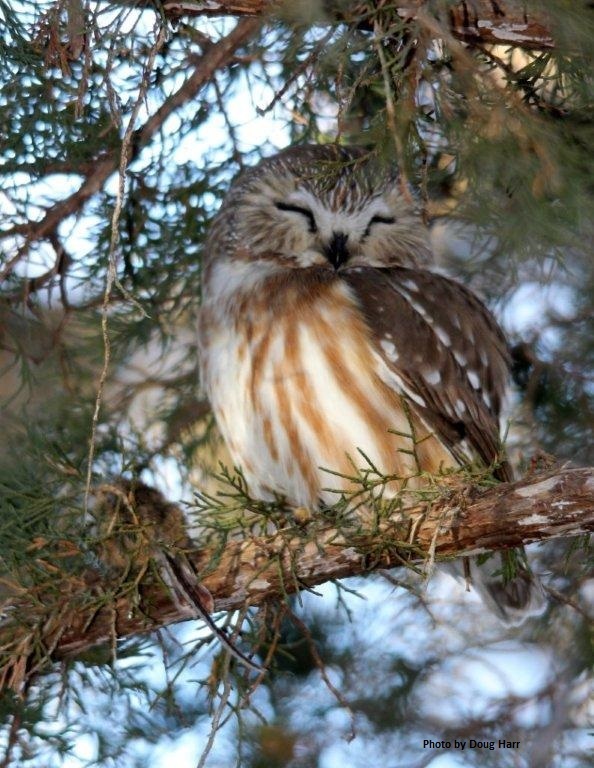
Northern Saw-whet Owls breed in the northern and western US and Canada and in the western Sierra Madre Mountains of Mexico. They prefer dense forests and nest in holes in dead trees excavated by woodpeckers. The female is responsible for incubation while the male is responsible for feeding the young. Once the chicks are about 18 days old, the female leaves and the male continues to raise them.
In winter, many Saw-whets move south, with some spending their time in Iowa. Saw-whet Owls can be found in Iowa from November to March each year. During the day, the owls roost in dense conifer trees, like young cedars, sitting still and silent as they hide among the branches. In some years, greater numbers of Northern Saw-whet Owls move south in search of better food resources. These high-density owl years are called irruptions.
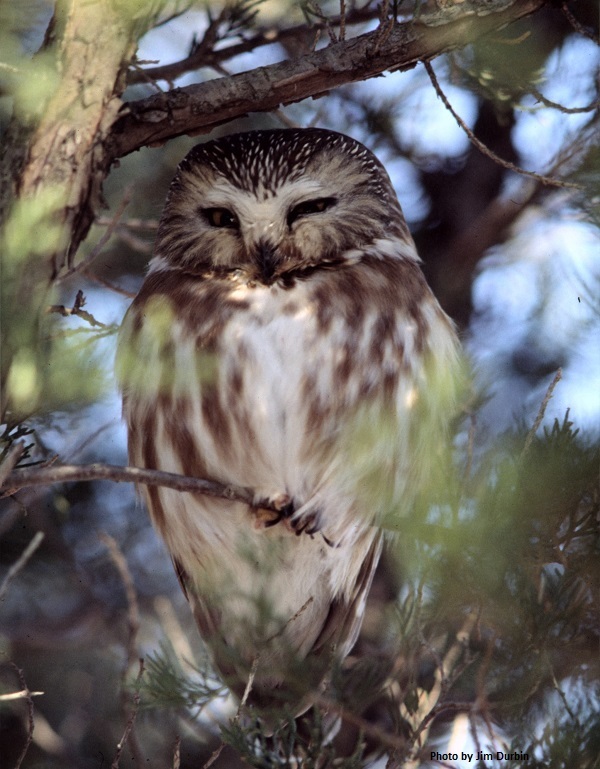
Northern Saw-whet Owls may appear cute, but they are fierce predators. They are nocturnal and only hunt at night. They perch low to the ground and swoop down to catch small mammals like mice and voles with their sharp talons.
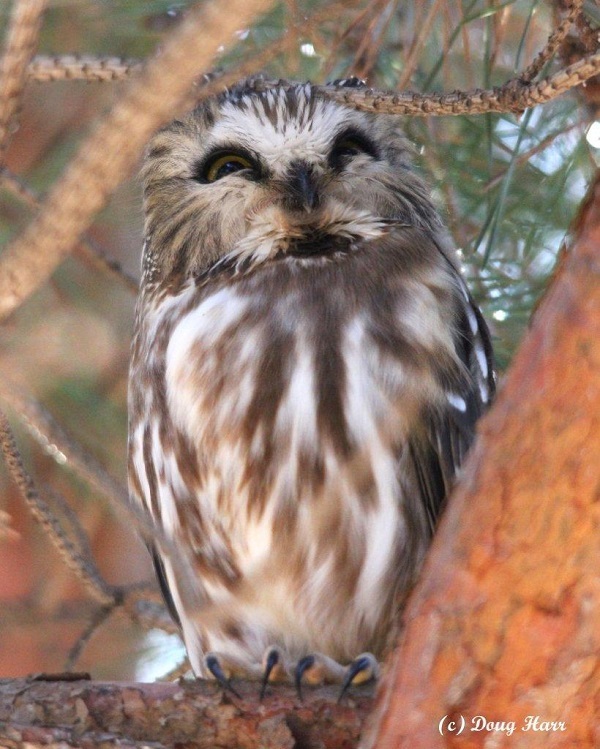 Although nine species of owls can be found in Iowa, Northern Saw-whet Owls are Iowa’s smallest with an average weight less than 3 ounces. Saw-whet owls are sexually dimorphic, meaning you can tell males and females apart by a physical difference in traits. As with many species of hawks and owls, Saw-whet Owl sexual dimorphism is a difference in size rather than color, with females being larger than males.
Northern Saw-whet Owls are also unique because they are less “picky” than some species and are often found in towns and other heavily used areas. Next time you see a dense conifer tree, take a close look and you just might find a Saw-whet Owl!
|





