|
FOR IMMEDIATE RELEASE
November 11, 2019
Hundreds of yellow ovals offset the brown and green coloration of each female brown trout ready to spawn at the Manchester Fish Hatchery. The splashes of color are signs that trout spawning season is in full swing.
Brown trout are currently being spawned. Brood trout are brought to the hatchery from French Creek in Allamakee County. They are held at the hatchery across two spawning cycles then released back in French Creek, supplementing earlier generations of brown trout.
All brown trout are stocked as 2-inch fingerlings. “Anglers like these ‘wild’ stream raised fish. They are harder to catch than our put-and-take stocked fish,” explains Mike Steuck, Iowa DNR fisheries supervisor for interior streams. “Many of the public streams have lots of brown trout in them.”
Brook trout, Iowa’s only native trout, give up their eggs in late October and early November. Eggs are taken streamside from wild South Pine Creek Brook Trout, fertilized and taken back to the Manchester Fish Hatchery to be raised and stocked as 2-inch fingerlings in June.
“As a part of DNR’s Brook Trout Restoration Program, we’re working to re-establish populations of Iowa ‘wild’ Brook Trout in streams with suitable habitat and excellent water quality,” said Steuck.
Rainbow trout, the backbone of Iowa’s trout program, take up much of December and January. Roughly 750,000 eggs will be collected this season.
Crews check for ripe female brood stock once a week. After a quick sedative bath to quiet them, each big trout is held firmly over a plastic bowl, as one of the workers rolls a hand down her belly to force out a stream of orange-golden eggs—up to 4,000 to 6,000 per fish. Mixed in quickly is the milk-white sperm from two males. Water is added to activate the eggs and sperm allowing fertilization to occur. The ingredients are gently stirred with a turkey feather to avoid bruising the eggs.
The fertilized eggs are poured into an incubator tray and slid into their place below a stream of 50 to 52 degree water until they hatch. Tiny sac-fry hatch about 30 days after fertilization. Dark clouds of tiny fish grow in raceways at the hatchery. The fish are “trained” to eat from automatic feeders.
As the trout develop and grow, they are monitored and transferred to larger tanks, then raceways. The fingerlings will be kept at Manchester or transferred to Iowa’s two other stations, near Elkader and Decorah, to be raised for future stocking. In 13 to 15 months, they will be a half-pound and ready to be stocked. Nearly 50 put-and-take streams throughout nine northeast Iowa counties and almost 20 community locations are stocked through the cold weather months.
“We stock about 380,000 catchable rainbow trout from the hatcheries,” said Steuck. “We also stock about 100,000 brook, brown and rainbow trout fingerlings each year to grow in the streams.”
There’s natural spawning, mostly brown trout and some brook trout, in more than 75 northeast Iowa streams thanks to improved habitat and trout genetics, and an extended period of above average annual rainfall. Most trout caught, though, are spawned under the eyes of hatchery workers at Manchester. These coldwater fish are great fighters and beautiful in their spawning colors this time of year.
Find more information about Iowa trout streams and tips for trout fishing on the DNR website at www.iowadnr.gov/trout.
Media Contact: Mike Steuck, regional fisheries supervisor, northeast Iowa, Iowa Department of Natural Resources, 563-927-3276.
RUNNELS, Iowa - It was a good half-mile hike back to the 40-acre section of timber on the Red Rock Wildlife Area that gave Jeremy Cochran and Todd Gosselink time to explain their plans to improve the forest resource on this heavily used public area.
“It’s a common misconception that the way to manage a forest is to leave it alone. Leaving it alone is a management choice, but it is one of the factors leading to oak decline in Iowa,” said Cochran, district forester with the Iowa Department of Natural Resources (DNR) Wildlife Bureau. “What we specifically did here was a crop tree release. We identify which tree species to favor based on the goals for the timber, and then release it from the competition.”
In this section of Red Rock’s Walnut Creek Unit, walnuts, hickories and oaks are the favored species. From moths and butterflies to flickers, pileated woodpeckers, squirrels, turkeys and deer – Iowa wildlife depends on oaks. And of all the oak species, the white oak is the most preferred because of its more palatable acorn. The amount of white oak acorn production varies over 3-5 years and during the years when production is down, red oak and bur oak acorns fill the need.
On this ridge overlooking Lake Red Rock, the signs of a crop tree release project are everywhere. Crop trees to keep are sprayed with orange paint; the nonnatives and non-target trees have two cuts around the trunk about a foot apart.
The process follows the same script – step one is to write a timber plan about a year in advance, walk the section and mark the crop trees to save, and then non target trees are eliminated using a method called girdling or felling. Girdling is where the tree is cut through the sap-wood of a tree, but not completely through, to sever the connective tissue and sap flow.
Although the tree is dead, it can be up to two years before it succumbs to the girdling. The tree is allowed to remain standing to provide valuable habitat for woodpeckers and, later, for bats.
There are times when oaks, walnuts or hickories are cut in the crop tree release because there’s either not enough diversity among the nut producers or the timber stand is too crowded and the foresters have to make a choice.
The ultimate outcome of the crop tree release is to thin the canopy and allow more sunlight to the crown of the trees which can increase nut production up to seven fold and can double the annual diameter growth.
“By improving the vigor of trees, we can improve the overall health of the forest,” Cochran said.
A contractor can double girdle about five acres of trees per day. Much of the timber management is done after the hunting seasons close and before the dormant season ends.
While Gosselink and Cochran were focused on 40 acres of the Red Rock Wildlife Area, more than 2.2 million forested acres in Iowa is in private ownership. Cochran said foresters with the Iowa DNR are available to meet with landowners, walk the timber and put together a management plan to improve the overall forest health. Local forestry contractors are important to help execute the improvements.
Media Contact: Jeremy Cochran, District Forester, Iowa Department of Natural Resources Wildlife Bureau, 641-774-8733 or Todd Gosselink, Wildlife Biologist, Iowa Department of Natural Resources, 515-238-6936.
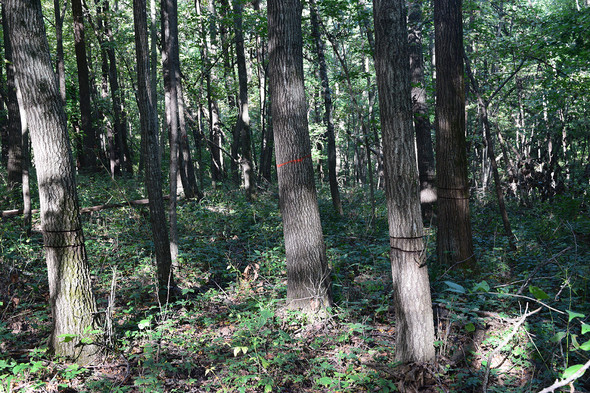 Crop tree release project begins with writing a timber plan where the district forester will walk timber. Once the plan is written, crop trees to be saved are marked and the nonnatives and non-target trees are eliminated using a method called girdling. Girdling is where the tree is cut through the sap-wood of a tree, but not completely through, to sever the connective tissue and sap flow. Photo courtesy of the Iowa DNR
|





