|
FOR IMMEDIATE RELEASE
Oct. 22, 2019
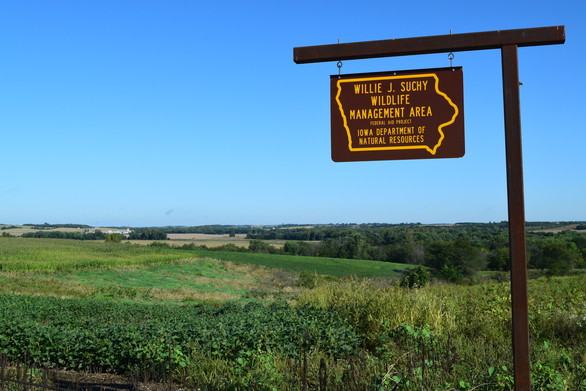 The two year old Willie J Suchy Wildlife Area is transitioning away from crop fields to prairie, using soybeans to prepare a soil bed for a prairie seeding. Once the beans come out, the Sugema wildlife unit staff will broadcast a mix of native plants with the seed mix geared to attract pollinators and will be managed primarily for upland game. Photo courtesy of the Iowa DNR.
Heading north off U.S. Hwy 63 east of New Sharon, it’s less than a mile before the gravel road dead ends in the west parking lot at the 225-acre Willie J Suchy Wildlife Area.
The area, named after nationally recognized white tailed deer expert and longtime employee of the Iowa Department of Natural Resources (DNR), was the acquired in 2017. It is being transitioned from crops to native prairie and will be managed primarily for upland game.
“For such a small area, it’s pretty rich with wildlife,” said Jeff Glaw, wildlife biologist with the Iowa DNR.
And that fact hasn’t gone unnoticed.
Glaw has been fielding calls from nonresidents who are looking for a place to hunt pheasants. “The area is new and hasn’t been hit hard yet,” he said. “But now it’s listed on the hunting atlas so it’s out there and I expect the use to increase.”
The rolling hills give way to bottomland timber where a startled young doe bounds away from her loafing spot. Down here, beavers have been busy building a dam on a small stream.
With the habitat work underway and plans for the near future, the value of the Suchy Wildlife Area to wildlife will only increase.
Oak trees will be planted on the side hills and locust, honeysuckle and other non-target and invasive trees will be removed. The soybean field is being used to prepare a soil bed for a prairie seeding. Once the beans come out, the Sugema wildlife unit staff will broadcast a mix of native plants with the seed mix geared to attract pollinators.
“I can’t wait to get the seeding on here,” he said. “In five years, it won’t look anything like this.”
On this early fall morning, a merlin glided over the old prairie seeding.
Two nearby county managed public areas to the north increases the public land footprint to nearly 1,000 acres. The mix of trees and grasslands along with the North Skunk River, this complex attracts neotropical birds, eagles and hawks.
“This would be a great place to come watch the spring and fall migration,” Glaw said.
Reforestation effort jump started by Hy-Vee
Hy-Vee, Inc. sponsored a reforestation project at the Willie J Suchy Wildlife Area in spring 2018. Proceeds from the sale of Hy-Vee One Stop paper products were used to purchase 3,000 trees and seedlings to be planted around the state.
In partnership with the Arbor Day Foundation and the Mahaska County Pheasants Forever chapter, 20 Hy-Vee volunteers planted cottonwood, river birch, sycamore, silver maple, bur oak, pin oak, swamp white oak, shagbark hickory, shell bark hickory and black walnut.
Kimberly-Clark presented a $10,000 check to assist in the reforestation funding.
Willie Suchy, technician, biologist, scientist, administrator, educator, mentor
Willie Suchy was a nationally recognized leader in white-tailed deer management and it was under his tenure as Iowa’s deer biologist that Iowa’s deer herd became nationally recognized as the premier herd in the country. While he was most often associated with deer, Suchy spent his early career working with pheasants, quail and wild turkeys. He spent 31 years working for Iowa Department of Natural Resources most recently as the Wildlife Research Section supervisor.
Suchy, 58, died unexpectedly on Nov. 11, 2015.
The North Skunk Wildlife Area was renamed the Willie J Suchy Wildlife Area on Oct. 11, 2018, as a way to honor and remember the impacts he made during his career. He grew up on a farm in nearby Poweshiek County.
Etcetera…
- On the hill northwest of the west parking lot is a foundation from an early settler cabin that had burned down. Old sewing machines and insulators have been found on that site. There is an excellent view of the valley below.
- There are two parking lots on the area – one on the west side and one on the east, paid for by Resource Enhancement and Protection funds.
- Wildlife diversity on the area includes deer, turkey, mourning doves, pheasant, quail, beavers, otters, and more. Once the prairie is established, grassland birds like bobolinks, meadowlarks and dickcissels should return.
- There’s a half acre pond in the middle of the area.
- Has the potential to be a good mushroom hunting spot
Media Contact: Jeff Glaw, Wildlife Biologist, Iowa Department of Natural Resources, 319-293-7185.
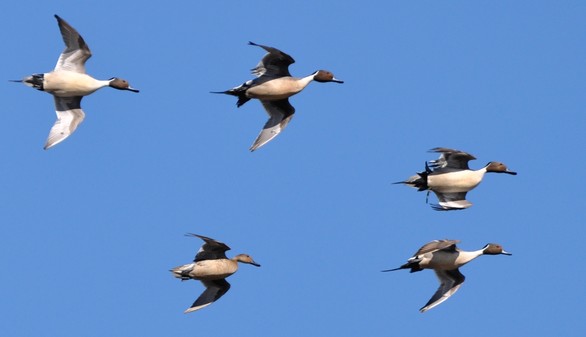 Pintails pass a north Iowa wetland. Photo courtesy of Lowell Washburn, Iowa DNR.
The September rain was a game changer for Iowa duck hunters, improving habitat conditions across most of the state by creating a number of shallow water areas where food is available.
“The continuous rains have really changed the habitat from the early teal season,” said Orrin Jones, state waterfowl biologist for the Iowa Department of Natural Resources. “Habitat that didn’t have water before has it now.”
Add in an active weather pattern up north that sent a large migration push into Iowa recently, creating a nice mix of early and midseason ducks. The combination of quality habitat and available birds will give hunters an opportunity for success.
“We’re hearing about large numbers of ducks at Red Rock and at Riverton, as well as other areas,” Jones said. “And while that’s good news, the bulk of the migration and hunting activities has yet to occur.”
Duck season is open in the north zone through Dec. 3, in the south zone through Dec. 10, and will be open in the Missouri River zone from Oct. 26-Dec. 17. The Iowa DNR posts a weekly duck migration report on its website at https://www.iowadnr.gov/Hunting/Migratory-Game-Birds.
Hunter input wanted – discussion on waterfowl seasons and zones for 2021-25 continues
Iowa waterfowl hunters have two more opportunities to hear what the Iowa Department of Natural Resources (DNR) has come up with for its proposed waterfowl season and zone structure for the 2021-2025 waterfowl hunting seasons.
Staff will present information including the results from the statewide hunter survey, the federal rules and guidelines that govern waterfowl hunting and the proposed season and zone structure.
All meetings are scheduled from 6-8 p.m. The remaining meetings are scheduled for:
- Oct. 22, Story County Conservation Center, McFarland Park, near Ames
- Oct. 23, Alta Community Center, in Alta
Feedback collected at all five meetings will be reviewed before an official proposal is submitted to the Natural Resource Commission for consideration. If approved, the rule would have an open comment period before going in front of the commission again for a final vote.
The U.S. Fish and Wildlife Service allows states to make changes to their waterfowl zones and boundaries once every five years. Any changes will be reflected in the 2021-2025 waterfowl seasons.
Any person attending the public meeting and has special requirements such as those related to mobility or hearing impairments should contact the DNR or ADA Coordinator at 515-725-8200, Relay Iowa TTY Service 800-735-7942, or Webmaster@dnr.iowa.gov, and advise of specific needs.
Media Contact: Orrin Jones, State Waterfowl Biologist, Iowa Department of Natural Resources, 641-357-3517.
Last year, Iowa pheasant hunters bagged more roosters than they had in the last decade. With that fresh in their memory, how will the 2019 pheasant season measure up?
It will be about the same, said Todd Bogenschutz, upland wildlife research biologist with the Iowa Department of Natural Resources.
Iowa’s pheasant population is similar to last year, except in south central and southeast Iowa, where bird numbers are down significantly after a late arriving winter and cool rainy spring. While the population is down slightly, overall Bogenschutz expects the 2019 pheasant season to be a good one.
“I think the biggest hurdle for pheasant hunters on opening weekend will be amount of crops still in the field. We will see some birds harvested this weekend, but it will likely be more difficult,” he said. “But I think the potential is there for us to have another good year hunting pheasants.”
The 2019 August roadside survey is nearly identical to 2008 when Iowa hunters harvested 400,000 roosters. “We have a pheasant population to support a harvest of 400,000 birds, but our lower hunter numbers will likely produce a harvest of closer to 200,000 birds,” he said.
Hunters who prefer to hunt later in the year may benefit from the later harvest, Bogenschutz said.
“There is a segment of our pheasant hunters who only hunt the first two weekends of the season so hunters who like to hunt later could find a population of birds that had been using the standing corn as a refuge. As those fields come out, they could see some really good late season hunting,” he said.
The one-two combination of a bad winter and wet cool spring hit the quail population to the tune of a 36 percent decline. After riding a few years of 30-year high, Iowa’s quail population dropped closer to the 10-year average, which is still pretty good, Bogenschutz said. Iowa’s quail range is across the southern three tiers of counties.
“There’s definitely quail out there but not as abundant as the past few years,” he said.
With weekend temperatures in the low to mid 60s, hunters will need to dress in layers and make sure that they – and the dogs - are well hydrated.
Iowa’s annual August roadside survey is online at https://www.iowadnr.gov/Hunting/Pheasant-Small-Game. Iowa’s pheasant and quail seasons begin Oct. 26.
Media Contact: Todd Bogenschutz, Upland Wildlife Research Biologist, Iowa Department of Natural Resources, 515-979-0828.
Furharvesters take note: the outlook is pretty decent for most of the commonly targeted species ahead of Iowa’s furbearer hunting and trapping season.
“Over the past five years, coyotes have become the new hot thing,” said Vince Evelsizer, furbearer wildlife research biologist for the Iowa Department of Natural Resources. Last year, more than 18,000 coyotes were harvested, easily surpassing the previous record harvest of 15,347.
“The market has been strong for coyotes and the outlook for this fall looks good again,” Evelsizer said. “Our coyote population remains stable to increasing across the state with indications from our surveys the highest population is in southwest Iowa.”
Coyotes have become the number one furbearer species people are pursuing because the fur market is good, and it’s featured more than ever on television shows and videos. The hunting industry is also producing new products specifically for coyotes, he said. However, with that popularity the number of issues have also arisen. Evelsizer stresses that anyone pursuing coyotes make an extra effort to respect land ownership, property boundaries and use fair-chase ethics.
Iowa ranks in the top five states for the number of licensed furharvesters per capita, averaging around 14,500 per year for the last three years. When the fur market was strong, like in 2013, the number of licensed furharvesters was nearly 21,000.
Raccoons, along with muskrats, are two species targeted by beginning furharvesters.
Iowa’s raccoon population continues to be high – too high. Unfortunately when populations reach high levels, the prevalence of disease outbreaks increase. For raccoons, outbreaks of distemper often occur which has been the case this year. Pelt prices are trending up slightly this fall, especially for large prime raccoons.
Iowa’s muskrat population is variable, but the long-term population trend continues to decline.
“There are some areas that have muskrats, but statewide, the population is extremely variable. Scouting will be important. Huts have already begun to show up in Iowa’s wetlands and will rapidly increase wherever muskrats and ideal water levels with aquatic vegetation occur,” Evelsizer said. “However, we still don’t see the widespread distribution of muskrats across the state like we used to.”
The fur market outlook for muskrats indicates pelt prices from last season may trend up slightly for the 2019-20 season because inventories are low going into the season thus increasing market demand for those harvested this year.
Red fox numbers are trending up slightly in some regions of the state, which is positive. However, red fox continue to deal with mange. Pelt prices are expected to remain fairly similar to last year.
Iowa’s beaver population is trending higher. While the pelt prices on the fur market is low, prices for beaver castor (glands) is high. The number of nuisance complaints often increases with the population.
Badger numbers are stable across Iowa and increasing in western Iowa likely due to lighter and dryer soils and grasslands. Pelt prices are likely to be similar to last year.
The river otter population has trended upward in eastern and southern regions of Iowa. The bag/possession limit for river otters is two. Pelt prices are expected to be stable to up slightly.
Iowa’s bobcat population is up across southern Iowa and continues to expand into new areas of north Iowa; specifically northeast Iowa. The fur market should be similar to up slightly compared to last year.
New this year is a three bobcat bag limit across three tiers of counties in southern Iowa.
Iowa’s bobcat harvest is divided into three zones – a three bobcat bag limit zone (southern Iowa), a one bobcat bag limit zone and a zone closed to bobcat harvest. Only one bobcat may come from the one bobcat zone regardless of the county in that zone it was taken from, the remaining cats must come from the three cat zone. No more than three bobcats total can be legally harvested by a furharvester this season.
Furharvesters are reminded of the requirement to contact a conservation officer within seven days of taking an otter or bobcat to receive a CITES tag. The CITES tag must remain with the animal until it is processed or sold.
Gray fox populations remain low but are rarely targeted by trappers. We are watching the gray fox population closely,” Evelsizer said. A proposal has been submitted to study gray fox populations, including what they’re dying from – cause specific, as well as looking at their habitat needs. This population decline is not unique to Iowa, it’s a Midwest trend, he said, we are hopeful about getting this funding to carry out this research on gray fox.
Space available in upcoming beginning trapper workshops
Two beginning trapper workshops are scheduled in October. Activities vary by workshop, but participants can expect to learn the basics of trapping, ethical and responsible techniques, proper gear, skinning/fur handling methods, trap types and more.
The importance of being a responsible trapper will be emphasized throughout the workshop. Workshops are scheduled for:
- Oct. 24, 5-9 p.m.: Learn to Trap: Furharvesting Workshop, Butch Olofson Shooting Range, near Polk City
- Oct. 26, 10 a.m. – 2 p.m.: Buchanan County Wildlife Seminar: Iowa Furharvesters, Fur Buyers and Taxidermists, Cedar Rock Visitor Center, near Quasqueton
There is more information on the Oct. 24 and 26 workshops online, including registration forms, at https://register-ed.com/programs/iowa/154-iowa-advanced-skills-and-opportunities
Iowa’s furbearer hunting and trapping seasons begin Nov. 2.
DNR reaches out to furharvesters with a survey
Iowa furharvesters can help the Iowa Department of Natural Resources (DNR) with furbearer management by participating in a furharvester survey.
The Iowa DNR is sending this survey out to 5,000 licensed furharvesters prior to this year’s trapping season. This survey is purposely designed to be in the form of a diary so our furharvesters can use it throughout the long season to record their activities as they go. That way the information they record is accurate - similar to surveys filled out by bow hunters each fall. This is the second year of the survey.
“This diary will give us valuable information on trapper and fur hunter effort. Things like how much time they are pursuing furbearers, when they are doing it – and what species they are targeting. Based on harvest, and last year’s furharvester diary survey, we are able to see that in today’s world, coyotes are our number one most pursued species and that wasn't anywhere near the case 20 or 30 years ago.” Evelsizer said. “A survey like this had never been done in Iowa until last year. We’re excited to work directly with our furharvesters to collect this information and hope to see more of them return the diaries.”
Based on the survey results from last year, the most trapping effort occurs during the first two weeks of November and effort goes down later in the season, but there's a slight increase during the holidays. Survey respondents indicated that coyotes were the number one species targeted for trapping followed by raccoons, mink and muskrats. The average number of days spent trapping was 27 per trapper. Hunters spent an average of 26 hours pursuing furbearers.
Jennifer Swanson, assistant wildlife research biometrician for the Iowa DNR, said the information from the survey will help with population estimates for several of the more secretive furbearer species that are otherwise more difficult to count, like badgers and gray fox.
“Only three percent of the surveys were filled out and mailed back last year. For the effort to be worthwhile and to have good information, we’d like that return rate to be much higher,” Swanson said.
The survey will not be used to measure if a trapper is good or not, or for law enforcement purposes.
“If a trapper receives a fur diary survey and won't be trapping/hunting this season, it is okay to give it to someone else that will be active. Just make a note of the transfer in the survey,” she said. “The information collected from this survey is important because it provides a direct link of feedback from our furharvesters that helps us manage furbearers in Iowa.”
Furharvesters who have questions about the survey should contact Evelsizer at 641-357-3517 or vince.evelsizer@dnr.iowa.gov.
Media Contact: Vince Evelsizer, furbearer wildlife research biologist, Iowa Department of Natural Resources, 641-357-3517.
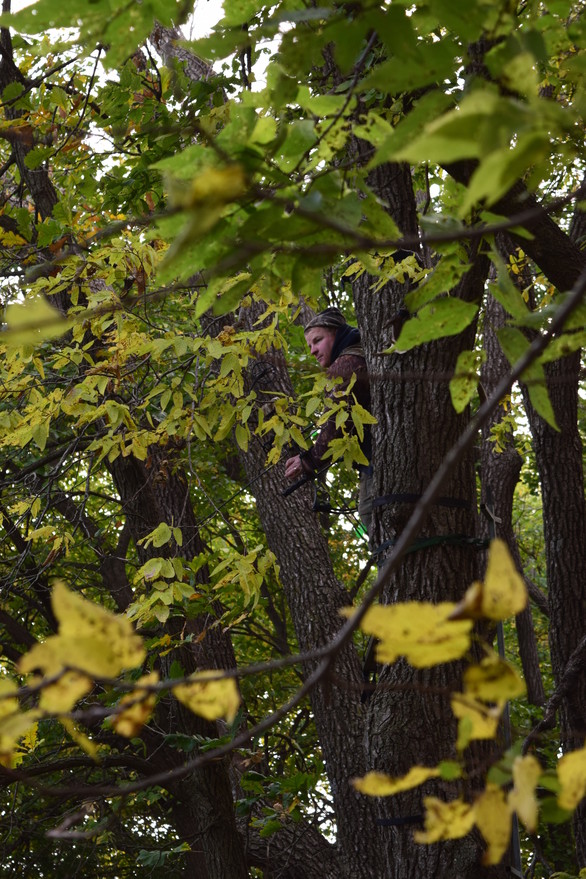 A bowhunter hides among the branches and leaves. The prime season for Iowa bowhunters is finally here. Photo courtesy of the Iowa DNR.
Iowa’s deer hunting intensity will ratchet up in the next few weeks as the peak of the rut approaches and archery hunters cash in vacation days to spend as much time as possible in the timber.
“If we can get Mother Nature to cooperate I expect we will have another good year of deer hunting across Iowa,” said Tyler Harms, with the Iowa Department of Natural Resources. “Last year, wet conditions during the fall delayed the crop harvest and that impacted hunting during the rut, and then we had another round of rough weather during the first shotgun season. It would be nice to avoid that again.”
Even with those challenges, hunters reported harvesting nearly 109,000 deer, and Harms said he expects 2019’s harvest to be similar. Iowa’s deer population is stable to slightly increasing over much of the state.
“Our herd remains within the statewide population goal thanks in part to our hunters and landowners who work together to harvest does as a means of managing the herd at the local level,” Harms said. “What we need from hunters is to be sure to report their harvest. I can’t stress enough how important this is. Besides being required by law, it is some of the most important information we have for tracking the deer population in the state. It only takes a couple of minutes, and hunters can report online, by phone, or using the DNR’s new Outdoors Iowa app.”
Epizootic Hemorrhagic Disease (EHD)
Hunters in specific local areas in south central Iowa could see fewer deer this fall due to hemorrhagic disease, but there shouldn’t be much variation in the overall population across the region, Harms said.
The Iowa DNR has received reports of nearly 1,800 suspected deer mortalities due to hemorrhagic disease in 2019.
“We expect to receive additional reports as crops are harvested and hunters head to the timber, but the number of new dead deer should start to decrease as colder temperatures and frost starting to settle in across much of the state, killing the midges carrying the virus. We want hunters and landowners to continue reporting dead deer they find,” Harms said.
While this is the most significant outbreak of EHD in recent years, it is still below the outbreak of 2012 that totaled nearly 3,000 deer. The current outbreak has been most severe in Warren, Madison, Monroe and Clarke counties, but has been reported in nearly 60 counties in the state.
“We will monitor the population in the affected areas closely and could make some changes to our antlerless quotas based on the results from the deer surveys and harvest reports from the area,” Harms said. “We won’t make any projections until the spring when we have all the data in.”
Harms pointed out that while hemorrhagic disease can have significant local impacts, it is often short lived. “Outbreaks tend not to be in the same part of the state year after year which allows local herds to recover,” he said.
Chronic Wasting Disease
The ongoing battle against the spread of chronic wasting disease continues to be high priority to the Iowa DNR. The DNR has established four special deer management zones in the primary focus areas where increased harvest and deer tissue sample goals have been established to monitor for and prevent the spread of the always fatal disease.
Zones are set up around the cities of Dubuque, Harpers Ferry, Elkader and Corydon. The licenses within the zones are antlerless only and available from local license vendors. Hunters using one of these zone specific licenses must provide a tissue sample. There is more information online at https://www.iowadnr.gov/Hunting/Deer-Hunting/Deer-Disease-Information or in the deer hunting section of the 2019 Iowa Hunting, Trapping and Migratory Game Bird regulations.
While the main focus will be in the areas surrounding where deer have tested positive for the disease, the DNR will be collecting tissue samples from every county in the state. The DNR has a goal of collecting 7,000 tissue samples for the 2019 deer season. Hunters who are successful and wish to submit a tissue sample should contact their local wildlife biologist to see if samples are still needed for the county where the deer was harvested.
“Hunters have been excellent partners in this effort and we’d like the collaboration to continue,” Harms said. “We’ve been working to shorten the time from when the tissue sample was collected, submitted to the lab, and when the results are available on our website with a goal of getting that to happen in two weeks. It could take longer depending on when the samples get to the lab.”
Hunters who are awaiting the testing results are encouraged to keep that deer separate from others being processed in the event that it tests positive.
Iowa has been testing deer for chronic wasting disease since 2002. To date, more than 70,000 wild deer have been tested with 46 coming back as positive.
Media Contact: Tyler Harms, Biometrician, Wildlife Bureau, Iowa Department of Natural Resources, 515-777-5378.
The Iowa Department of Natural Resources State Parks Bureau will be hosting an open house to collect comments on future planning for the building site at the former Camp Aldersgate.
The open house is scheduled from 4:00 - 7:00 PM on Wednesday, November 6, 2019 at the Viking Lake restaurant concession building located within Viking Lake State Park 2780 Viking Lake Road Stanton, Iowa 51573.
For more information or for special accommodation, contact staff at the park office at 712-829-2235.
DES MOINES – Ramsey Subaru of Des Moines has donated $2,500 to purchase bike racks at five Iowa state parks. The dealership will present the check at a small ceremony at Big Creek State Park on Friday, Oct. 25 at 2 p.m.
“We appreciate the support of Ramsey Subaru and know the bike racks will provide a great service to visitors of parks in central Iowa,” said Chad Kelchen, district supervisor in the DNR Parks, Forests and Preserves Bureau.
The five parks to receive bike racks are: Big Creek State Park, Walnut Woods State Park, Pine Lake State Park, Lake Ahquabi State Park and Banner Lakes at Summerset State Park.
The check ceremony will take place just inside the Big Creek State Park main entrance (corner of NW Madrid Drive and NW Big Creek Drive outside of Polk City) at the shelter area on the right side of Big Creek Drive. The public is welcome to attend.
Media Contact: Chad Kelchen, District Supervisor, State Parks, Forests and Preserves Bureau, Iowa Department of Natural Resources, 515-984-9320.
|





