- Bruce Trautman, Deputy Director of DNR, retires today, after seven years with the DNR.
- Tammie Krausman has been named the legislative liaison for the DNR, including both Conservation and Recreation Division and the Environmental Services Division.
From EPA Region 7
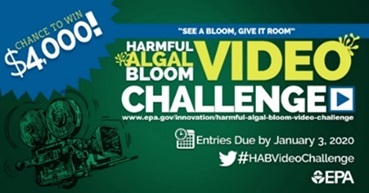
“EPA Regions 7 and 8 are excited to announce the opening of our ‘See a Bloom, Give it Room’ High School Video Challenge! EPA is calling on high school students in both regions to help us promote awareness of harmful algal blooms through creative filmmaking.
Harmful algal blooms (HABs) are overgrowths of algae in waterbodies that can affect water quality and aquatic life. Some HABs can produce toxins that can be very dangerous, causing harm to people, animals, and the local environment. We want your help educating people about harmful algal blooms – especially people who live and play near the water such as families, pet owners, swimmers, fisherman, and boaters.
The Challenge: Make an informational video about:
1) How to spot harmful algal blooms, and
2) How to be safe around them.
The Incentive: Winning individuals or teams for each state and two regional tribal winners will receive a $2,000 cash prize. Two grand prize winners will also be selected to receive $4,000. Not too sHABby!
In addition to cash prizes, winning videos will be posted on the EPA web page, used for educational outreach, and announced on February 5th, 2020 during the EPA Harmful Algal Blooms Workshop in Lenexa, Kansas.
Eligibility: Entrants must be students in grades 9‐12 and reside in EPA Region 7 or Region 8, which includes Iowa, Kansas, Missouri, Nebraska, Montana, North Dakota, South Dakota, Wyoming, Utah, Colorado, and 36 tribal nations.
Note: Students should NOT expose themselves to potentially dangerous HABs in the making of their video. Stock photos, video and resources are available for their use at the contest webpage.
Deadline: January 3, 2020 10:00 PM CT
Be creative, have fun, and be part of the solution! Learn how to enter at www.epa.gov/innovation/harmful-algal-bloom-video-challenge.
For questions, you can contact R7PublicAffairs@epa.gov.
|
The Iowa Environmental Protection Commission approved the Clean Water State Revolving Fund (CWSRF) and Drinking Water State Revolving Fund (DWSRF) Intended Use Plan (IUP) updates for second quarter of fiscal year 2020 (July 1, 2019-June 30, 2020). The Commission took the action on September 17, 2019 at their meeting at the Capitol.
Clean Water State Revolving Fund
Drinking Water State Revolving Fund
For more information, please contact Theresa Enright, SRF Coordinator, Iowa Department of Natural Resources, 515-725-0498 or theresa.enright@dnr.iowa.gov.
From EPA Region 7, Sept. 25, 2019
EPA has started to notify systems that are required to conduct the Risk and Resiliency Assessments, and to include the needed action in their Emergency Response Plans. While neither the assessment nor the ER plan will be sent to EPA, the system must certify each at the end of the process. That certification must be repeated every five years.
The first notifications have gone out to systems serving 50,000-99,999 and those serving at least 100,000 people. The notification is being done via email. The notification for systems serving 3,301 to 49,999 is anticipated to be completed by the end of November.
If you have questions, should have received a notice and haven’t, need to correct information pertaining to your water system, etc., please contact EPA directly at dwresilience@epa.gov. Include your PWSID number with any inquiry.
The AWIA requirements and tools are all available on this EPA webpage.
From EPA’s Water Security Division, Sept. 18, 2019
“Brace for cold weather by using the Extreme Cold and Winter Storms Incident Action Checklist. Cold weather brings with it the potential for freezing temperatures, heavy snowfall and ice incidents that can impact your drinking water and wastewater utility in many ways. The Incident Action Checklist provides strategies for utilities to prepare for, respond to and recover from extreme cold."
Incident Action Checklist (in .pdf)
From EPA’s Water Security Division, Sept. 18, 2019
“EPA's Creating Resilient Water Utilities (CRWU) Resilient Strategies Guide is a user-friendly introduction to resilience planning for utilities; it provides background material on why and how to build resilience and descriptions of potential utility priorities and strategies, as well as a detailed, customized report built from user selections. CRWU's Resilient Strategies Guide”
From EPA Region 7, Sept. 25, 2019
“This webinar will provide drinking water, wastewater and stormwater utilities with practical tools, training and technical assistance needed to increase resilience to extreme weather events. The speakers will share information about EPA Water Security Division’s free adaptation resources for water utilities including resources to plan for extreme weather, tools to assess risks of extreme weather, and provide a utility testimonial.
Date and Time: November 13, 2019, noon - 1:00 pm CT
Registration”
Iowa DNR staff in the water supply program areas are scheduled to speak at the following events. The date, sponsor and event, location, subject, and contact for more information are listed.
- October 9, IA-AWWA Region 3, Storm Lake, “DNR WS Update; Manganese testing.” Registration is available.
- October 10, IA-AWWA Region 2, Mason City, “DNR WS Update.” Registration not yet available.
- October 15-16, IRWA – Dubuque, “MO River Flooding & Drinking Water Experience; Manganese testing; DNR WS Update.” Information and registration.
- October 22-24, IA-AWWA Annual, Ames, “The Good, the Bad, and the Really Ugly – 2019 Flooding Experience; DNR WS Update.” Information and registration.
- November 19-21, IAMU Water and Wastewater Operator’s Workshop, Des Moines, “Southwest Iowa Flooding Event; Manganese testing.” Information and registration.
- January 30, 2020, Iowa Water Quality Association’s Winter Meeting, Des Moines, “Manganese: Emerging Contaminant of Concern and City of Bagley Case Study.” Information and registration not yet available.
For other professional development opportunities, see the “Training Calendar” at programs.iowadnr.gov/opcertweb/.
|





