|
FOR IMMEDIATE RELEASE
September 3, 2019
Ask yourself the following questions, then read the articles to test yourself on how much you know about pollutants and releases. Sorry, we don’t have any prizes to give out.
- Which month has the highest number of fish kills in Iowa?
- How much is a part per million? A part per billion?
- Who should you call if you have a release or spill? What’s the phone number?
- Just exactly what is a release?
Good luck. We hope you scored 100 percent correct!
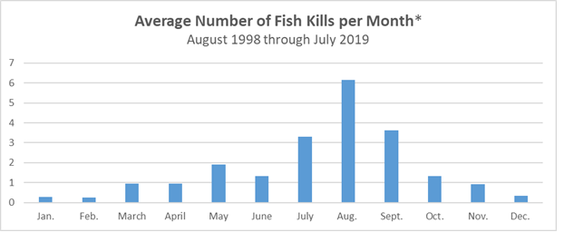 * Includes only fish kills caused by human activities.
Avoiding a fish kill starts with understanding why they happen most often during mid- to late summer. Several factors contribute, but remember fish and aquatic animals like crayfish, frogs and beneficial insects are most vulnerable during hot, dry weather. Usually stream and pond levels are lower, vegetation and algae levels are higher and water temperatures are warmer. These factors combine to reduce dissolved oxygen levels, stressing aquatic animals.
When fish and other aquatics are stressed, they are more susceptible to pollutants. So, while you should always be careful, first and foremost, please take extra caution when mixing and land applying chemicals and nutrients especially during the dog days of summer. DNR staff offer the following tips to help you avoid a fish kill:
- Read and follow chemical labels. Some chemicals are toxic in very small amounts (parts per million—four drops of ink in a 55-gallon barrel of water—or parts per billion—one pinch of salt in a 10-ton bag of potato chips or one pound in 120 million gallons of water).
- Avoid applying near water, including near pond and stream banks.
- Check the weather and avoid application before a rain storm.
- Look for and avoid application near small feeder streams and grassed waterways where runoff could enter a stream or pond.
- Make sure rinse water is properly disposed of and doesn’t reach a stream or lake.
- If chemicals are applied by aerial spraying, check locations of small streams and ponds before application, watch wind speeds and drift, and shut off application when crossing small bodies of water.
- Take care with nutrient application. Whether manure or fertilizer, ammonia levels of only 3 parts per million can cause a fish kill, depending upon the pH in the water.
Finally, report fish kills to DNR field offices or to the 24-hour spill line at 515-725-8594.
State laws require producers and manure applicators to report spills to the Iowa DNR. Not only is reporting required, but the sooner you report, the more likely DNR technical staff can help. DNR staff have experience with many spills. They may be able to offer ideas that you don’t think of—preventing a worse situation or a fish kill. Play it safe and call it in.
Here’s a quick reminder of state rules on reporting releases, especially manure releases:
Iowa producers are required to report manure and other releases. Chapter 65.2 (9) of the Iowa Administrative Code requires: Producers and those who store, handle, transport or land apply manure from a confinement (totally roofed) feeding operation to notify DNR as soon as possible but not later than six hours after the onset or discovery of the release. Report the release by calling DNR’s 24-hour spill line at 515-725-8694 or notifying the nearest DNR field office during business hours.
What is a “release?” A release is an actual, imminent or probable discharge of manure from an animal feeding operation structure to surface water, groundwater, drainage tile line or intake, or to a designated area resulting from storing, handling, transporting or land-applying manure.
Very similar rules exist for open feedlots: IAC 65.101(9). However, the definition of reportable releases also includes process wastewater, manure, open feedlot effluent, settled open feedlot effluent, or settleable solids from an open feedlot operation structure.
In both cases, if the release involves a public roadway and could threaten public safety, it should also be reported to the local police department or county sheriff.
Other spills that must be reported include: chemicals, wastewater discharges and underground storage tank failures—basically anything that is a hazardous substance or causes a hazardous condition. Find more information on DNR’s emergency release page.
|





