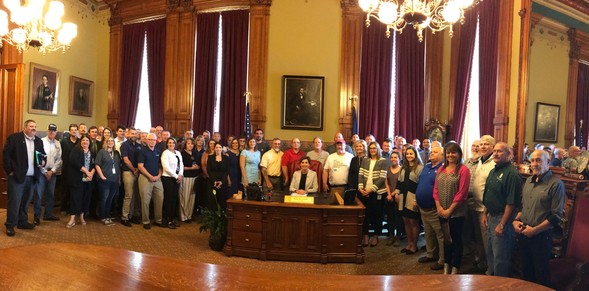
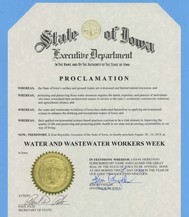
On June 20, 2019, Governor Reynolds signed a proclamation declaring August 18 - 24 as Water and Wastewater Workers week - a week set aside to honor water and wastewater workers of the State of Iowa. The Governor chose to issue this proclamation in recognition of the workers that have dedicated themselves to applying environmental science to enhance drinking and recreational waters of Iowa and to improving the quality of life for all Iowans by preserving and protecting public health and promoting sustainability.
|
The Iowa Wastewater and Drinking Water Treatment Financial Assistance Fund was created in 2018 to give grants to water and wastewater projects. The Fund was established by Senate File 512 and is described in Iowa Code Section 16.134.
The application for the first grant awards is now available. Applications must be submitted to the Iowa Finance Authority (IFA) by September 13, 2019.
The grant priorities are:
- Disadvantaged communities (Note: communities must have received disadvantaged designation)
- Projects that will significantly improve water quality in the watershed
- Projects that use alternative wastewater treatment technologies (Note: all projects proposing alternative technologies must be approved by the Iowa DNR)
- Communities with the highest sewer or water rates
- Projects that use technology to address nutrient reduction
- Projects that will improve source waters for drinking water utilities
The grant awardees are determined by a committee consisting of the Iowa Secretary of Agriculture (or designee), the Executive Director of the Iowa Finance Authority (IFA) (or designee), and the Director of the Iowa DNR (or designee). Awards will be announced in October.
The application form and more information are available at the IFA website.
The revised agenda brief that will be used to present the annual water use permit fee to the Environmental Protection Commission at their August 20th meeting is available as Item 8 on the August EPC meeting agenda. Included in the revised brief is more description about what was considered, and a simpler way to explain how the fee was derived.
U.S. Geological Survey NAWQA, 8/13/2019
“A new USGS study assesses the quality of untreated groundwater from this critical water resource, which underlies parts of 25 northern U.S. states.
The study reports that naturally occurring inorganic constituents—trace metals, iron, sulfate, and dissolved solids—occur in untreated groundwater at high concentrations (that is, exceeding a human-health benchmark or non-health guideline) across 20 to 50% of the glacial aquifer system, depending on the constituent. In particular, more than 4 million people may be relying on drinking water whose source is groundwater with high concentrations of the trace metals manganese and/or arsenic.
Anthropogenic contaminants—those related to human activities—occur in smaller proportions of the glacial aquifer system but still could affect large numbers of people. Groundwater with a high concentration of one or more organic contaminants, such as pesticides and volatile organic compounds, is a source of drinking water for an estimated 870,000 people, and about 740,000 people are estimated to obtain their drinking water from groundwater with high concentrations of nitrate.
The study analyzed the hydrogeologic settings where high concentrations of contaminants in groundwater are most likely to occur. For example, high manganese and arsenic concentrations occur at a range of depths and primarily in areas underlain by thick, stratigraphically complex, fine-grained glacial sediment, where groundwater has low concentrations of dissolved oxygen (“reducing conditions”). In contrast, high concentrations of anthropogenic contaminants more commonly occur at shallow groundwater depths and tend to be limited to areas near where people live and use or release such chemicals.
The untreated groundwater assessed for this study is a source for both public-supply and domestic (private) wells. Water from public-supply wells is required to be tested by the well operator on a routine basis, and—if necessary—treated, to help assure that the water provided to consumers meets Federal and State water-quality standards. Routine testing of water from domestic wells is typically not required. Homeowners are responsible for testing, maintenance, or treatment of the water from their domestic well.
Citation: Erickson, M.L., Yager, R.M., Kauffman, L.J., and Wilson, J.T., 2019, Drinking water quality in the glacial aquifer system, northern USA: Science of the Total Environment, vol. 694: 133735 .”
In Iowa, private well owners can contact their local county environmental health specialist to arrange well water sampling and testing for arsenic, manganese, coliform bacteria, and nitrate. In most cases, this testing is free under a program managed by the Iowa Department of Public Health called the Grants to Counties Well Program. Water testing is the only way to know that your well and water system provides safe water.
To find your local county contact who can assist with water testing
To learn more about private well testing on the Iowa DNR Private Well webpages
Iowa DNR staff in the water supply program areas are scheduled to speak at the following events. The date, sponsor and event, location, subject, and contact for more information are listed.
- August 27-28, IA-AWWA Fall Short Course, DMACC-FFA Center, Ankeny “Ethics and the Value of What You Do; DNR WS Rules Update; Using Temporary Water Lines During Water Main Construction Projects Panel; Manganese Sampling Protocol.” Agenda and registration
- September 17-18, IRWA – Okoboji, “MO River Flooding & Drinking Water Experience; Manganese testing; DNR WS Update.” Information and registration.
- October 9, IA-AWWA Region 3, Storm Lake, “DNR WS Update; Manganese testing.” Registration not yet available.
- October 10, IA-AWWA Region 2, Mason City, “DNR WS Update.” Registration not yet available.
- October 15-16, IRWA – Dubuque, “MO River Flooding & Drinking Water Experience; Manganese testing; DNR WS Update.” Information and registration.
- October 22-24, IA-AWWA Annual, Ames, “The Good, the Bad, and the Really Ugly – Flooding Experience; DNR WS Update.” Information and registration not yet available.
- November 19-21, IAMU Water and Wastewater Operator’s Workshop, Des Moines, “Southwest Iowa Flooding Event; Manganese testing.” Information and registration not yet available.
For other professional development opportunities, see the “Training Calendar” at programs.iowadnr.gov/opcertweb/.
|





