|
FOR IMMEDIATE RELEASE
April 16, 2019
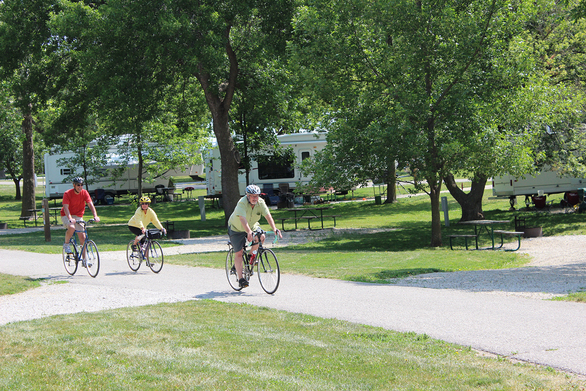 Iowa’s Camping Kickoff celebration, May 3-5, marks the official launch of the summer 2019 camping season and the countdown to the 100th anniversary of Iowa state parks in 2020. More than 30 state parks will host volunteer events and special activities over the weekend, including park clean-ups, tree planting, fun runs, kayaking clinics and more. Photo by Alan Foster, Iowa DNR.
DES MOINES ⎯ As Iowans eagerly anticipate warmer temperatures, state park staff are preparing for the start of the 2019 camping season. The first weekend of May marks the official launch of the summer camping season with Iowa State Parks’ annual Camping Kickoff celebration.
“Year of the Volunteer” is the focus of this year’s Camping Kickoff celebration as the Iowa Department of Natural Resources (DNR) anticipates its 100th anniversary in 2020.
“We greatly appreciate our parks volunteer’s support and assistance as we prepare for our centennial anniversary next year,” said Todd Coffelt, chief of State Parks Bureau for the Iowa DNR. “Camping Kickoff is our way of showing appreciation for our campers, and this year’s events focus on volunteerism and activities the entire family can enjoy.”
More than 30 state parks will host volunteer events and special activities the weekend of May 3-5, including park clean-ups, tree planting, fun runs, kayaking clinics and more. A list of parks and their programs is available online at www.iowadnr.gov/campingkickoff.
Camping Kickoff weekend campers will also receive a free issue of the Iowa DNR's Iowa Outdoors magazine.
Those wanting to join the Camping Kickoff celebration are encouraged to make their reservation soon. Iowa has more than 4,700 state park campsites; 75 percent of which may be reserved in advance. A link to the reservation site is available off the State Parks webpage at www.iowadnr.gov/stateparks.
“Iowa state parks are beloved overnight destinations for many people,” says Coffelt. “We offer campsites that appeal to a broad range of campers, from the more rustic hike-in sites to those with all the popular amenities.”
If camping isn’t your style, there are 93 cabins available to rent across 19 state parks, reminds Coffelt. In the off season from Labor Day to Memorial Day, cabins can be rented for a two-night minimum stay. During the peak of summer, most cabins require a seven-day minimum visit.
By mid-April, most state parks have water turned on, with shower and restroom buildings open for campers. For the latest state park news, updates and information about campsites, cabins, events and more, visit www.iowadnr.gov/stateparks and sign up for the Iowa State Parks electronic newsletter.
Media Contact: Todd Coffelt, Chief of Iowa DNR State Parks Bureau, 515-725-8485.
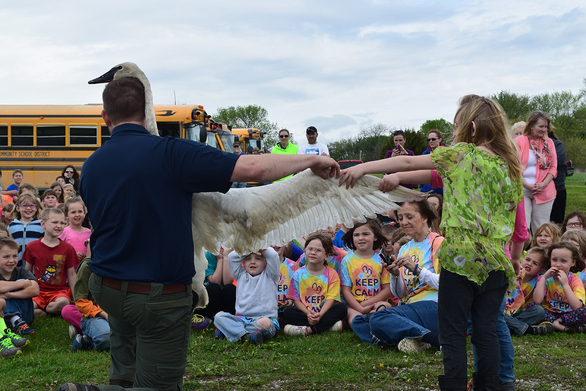 Trumpeter swans were once common in Iowa but were gone from the state by the late 1880s. The Iowa Department of Natural Resources has been releasing trumpeter swans at select locations since 1993 as part of a statewide effort to restore trumpeter swans to its historic range. Photo courtesy of the Iowa DNR.
The Iowa Department of Natural Resources (DNR) will release 14 trumpeter swans at three locations in southwest Iowa as part of the effort to create a self-sustaining population of swans south of Interstate 80. All releases will occur rain or shine.
- Six swans will be released on the north side of Lake Icaria at the east boat ramp on May 9 at 9:30 a.m., in partnership with the Adams County Conservation Board.
- Two swans will be released at Viking Lake near the restaurant/beach area on May 9 at 1 p.m.
- Six swans will be released at Lake Anita on May 10 at 1:30 p.m., in partnership with the Cass County Conservation Board.
These releases are part of the Iowa DNR’s statewide effort to restore trumpeter swans to Iowa that began in 1993. Trumpeter swans were once common in Iowa, but were gone from the state by the late 1880s. By the early 1930s, only 69 trumpeter swans remained in the lower 48 states.
It takes six years, on average, before trumpeter swans successfully nest. Last year, Iowa was home to 54 pairs of nesting trumpeter swans; however, only two of those nesting pairs were south of I-80. Dave Hoffman, wildlife research technician with the Iowa DNR, said the goal is to raise that number to eight, which would likely create a self-sustaining population.
“We are hopeful to get them nesting here in a year or two,” Hoffman said. “We had swans displaying some territorial signs at Lake Icaria, which is encouraging.”
As the largest North American waterfowl, these all-white birds can weigh up to 32 pounds and have an 8-foot wingspan. The trumpeter swans being released are young and flightless and will imprint on the area where they learn to fly, returning each year as open water is available. The swans were donated to the project from zoos in Cleveland, Kansas City, Green Bay, Wis., Oklahoma City, Bronx, Anchorage, Alaska and Maryland.
Each event includes a swan and wetland presentation, an opportunity to touch and view the swans up close, and a photo opportunity with the kids. Staff from the Kansas City Zoo will be on hand offering educational activities, and filmmaker Steve Harryman may be at these releases collecting footage for an upcoming documentary “Return of the Trumpeter Swans, in partnership with the Trumpeter Swan Society.
For more information, contact David Hoffman at David.Hoffman@dnr.iowa.gov or 641-425-0737.
For the Lake Icaria release, contact Travis Paul, Adams County Conservation Board, at 641-322-4793; for the Viking Lake release, contact Todd Carrick or Iowa Department of Natural Resources Viking Lake State Park at (712) 829-2235; for the Lake Anita release, contact Joshua Peach, Iowa Department of Natural Resources Lake Anita State Park, (712) 762-3564 or Lora Kanning, Naturalist Cass County Conservation Board (712) 769-2372.
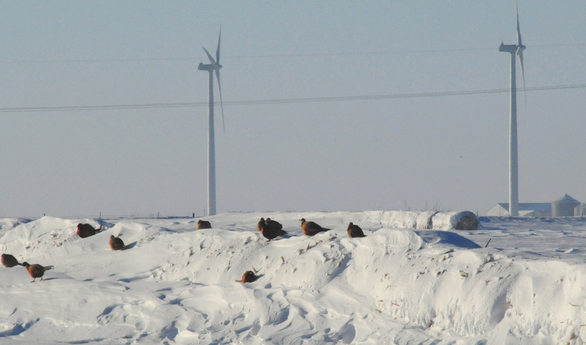 A well designed food plot can withstand heavy snow storms that often flatten grass habitats, and provide food for pheasants, quail, deer, turkey, partridge, squirrels, songbirds and more. Photo by Lowell Washburn, Iowa DNR.
BOONE – Each winter, food plots of corn, sorghum, or other grains are used by all kinds of wildlife for survival.
A well designed food plot can provide additional shelter for pheasants, quail and other wildlife, and withstand heavy snow storms that often flatten grass habitats, like the late February blizzard that left eight foot snow drifts across portions of north Iowa closing Interstate 35 for more than 24 hours.
“There have been few documented cases of pheasants actually starving to death in Iowa,” said Todd Bogenschutz, upland wildlife research biologist with the Iowa Department of Natural Resources. “Virtually all of Iowa’s winter mortality is attributed to persistent snows or blizzards with the birds dying of exposure to predators or the weather.” With next winter in mind, now is the time to begin planning food plots.
So why plant food plots for pheasants if they seldom starve in winter?
First, food plots provide winter habitat as well as food. In fact, if properly designed and large enough, the habitat created by a food plot is much more beneficial to wildlife than the food itself. Second, food plots allow pheasants to obtain a meal quickly thereby limiting their exposure to predators and maximizing their energy reserves.
“If hens have good fat supplies coming out of the winter, they are more likely to nest successfully,” said Bogenschutz. Food plots also provide habitat and food for many other species like deer, turkey, partridge, squirrels, and songbirds.
Bogenschutz offers the following suggestions for planning shelterbelts and food plots for pheasants and quail:
- Corn provides the most reliable food source throughout the winter as it resists lodging in heavy snows. Sorghum or milo provides better winter habitat. Pheasants prefer corn to sorghum as a food source. Half corn and half sorghum plots make the best of both worlds - cover and food - for pheasant and quail.
- Place food plots next to wetlands, CRP fields, and multi-row shrub-conifer shelterbelts that provide good winter habitat and away from tall deciduous trees that provide raptors with a place sit and watch food plots.
- Size of food plots depends upon where they are placed. If the plot is next to good winter cover the plot can be smaller but at least two acres minimum. If winter cover is marginal, like a ditch, then plots must be larger – 5 to 10 acres – to provide cover as well as food.
- Depending on the amount of use some food plots can be left for two years. The weedy growth that follows in the second year provides excellent nesting, brood rearing, and winter habitat for pheasants and other upland wildlife. Food plots that have heavy deer use generally need to be replanted every year.
Cost-share assistance or seed for food plot establishment is available from most county Pheasants Forever chapters or local co-ops. People can also contact their local wildlife biologist for information on how to establish and design shelterbelts or food plots that benefit wildlife. More information is available at http://www.iowadnr.gov/privatelands
Media Contact: Todd Bogenschutz, Upland Wildlife Research Biologist, Iowa Department of Natural Resources, 515-979-0828.
NEW MARKET, Iowa - The Iowa Department of Natural Resources has relaxed the fishing regulations at Windmill Lake, near New Market, to allow anglers to more freely harvest fish before the lake is renovated this fall to eliminate common carp.
Anglers with a valid fishing license may harvest any size or number of largemouth bass, channel catfish, and all other fish species from Windmill Lake. Any number of fishing poles or jug fishing will be allowed, but anglers must stay in sight of these lines at all times, and follow all other fishing regulations and area rules.
Trot lines will be allowed (name and address must be attached), but no more than five trotlines per angler with a valid fishing license. These trot lines cannot have more than 15 hooks total. Trot lines may not be set across the entire water body.
Nets, dynamite, poison, electric shocking devices, or any stupefying substances are not allowed. It is illegal to sell fish or stock captured fish into public waters. All navigation rules still apply.
Liberalized fishing regulations for Windmill Lake will be in effect from now through October 15, 2019. Specific regulation changes include:
- Removal of bag and length limit restrictions on largemouth bass.
- Removal of bag limit on channel catfish.
- Removal of bag limit on crappie and bluegill.
- Removal of the two line/two hook fishing restriction, but anglers must stay in sight of these lines at all times.
Media Contact: Andy Jansen, Fisheries Management Biologist, Iowa Department of Natural Resources, 641-464-3108.
|





