|
FOR IMMEDIATE RELEASE
March 19, 2019
Davenport – Anglers who catch trout left over from a previous community trout stocking at Lake of the Hills during the relaxed fishing regulations are still required to have a valid trout fee to keep any trout.
Liberalized fishing regulations for Lake of the Hills will be in effect from April 1 until the lake’s water levels are lowered, starting on July 15. Specific regulation changes include:
- Removal of bag limit on trout.
- Removal of bag and length limit restrictions on largemouth bass.
- Removal of bag limit on channel catfish.
- Removal of bag limit on crappie and bluegill.
Anglers with a valid sport fishing license may harvest all sizes and unlimited quantities of any species of fish from Lake of the Hills. Any number of poles will be allowed, but anglers must stay in site of these lines at all times.
Nets, dynamite, trotlines, poison, electric shocking devices, or any stupefying substances are not allowed. It is illegal to sell fish or stock captured fish into public waters.
Lake of the Hills is currently listed on the State’s list of Impaired Waters due to high levels of algae. The overall goal of this restoration project is to improve water quality and recreational opportunities at West Lake Park and remove the lake from the Impaired Waters List.
Media Contact: Chad Dolan, Fisheries Management Biologist, Iowa Department of Natural Resources, 319-694-2430.
The Iowa Department of Natural Resources is postponing trout stockings scheduled for Friday, March 22 at Wilson Lake in Fort Madison, and at the Discovery Park Pond in Muscatine, due to heavy ice cover preventing fisheries staff from stocking trout.
Both trout stockings will be rescheduled when the lakes have open water and weather conditions are favorable.
Media Contact: Chad Dolan, Fisheries Management Biologist, Iowa Department of Natural Resources, 319-694-2430.
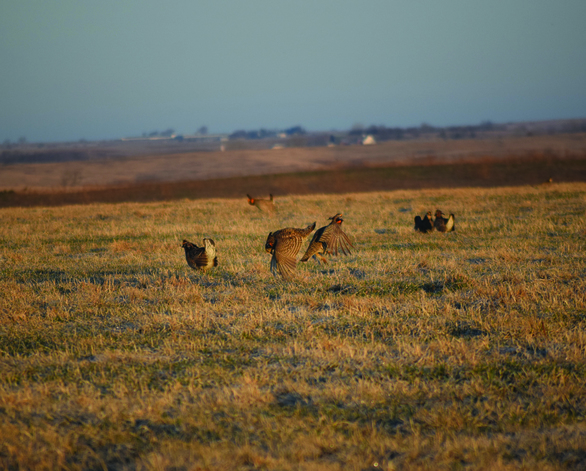 A glimpse at our pre-settlement history - Prairie Chicken Day is an event where visitors can watch and hear wild prairie chickens as they display and conduct their annual spring ritual. The Kellerton Bird Conservation Area, in Ringgold County, is the only public booming ground in Iowa. Photo courtesy of the Iowa DNR.
Kellerton, Iowa - The first rhythmic and haunting cooing begins as the night sky fades and sunrise begins. The short grass prairie booming grounds prepares for a display found nowhere else in Iowa.
This is prairie chicken country and April 6 will mark the 16th Annual Prairie Chicken Day at the Kellerton Wildlife Management Area, in Ringgold County. Activities begin around 6 a.m., originating from the elevated viewing platform on 300th Avenue, southwest of Kellerton.
This annual ritual begins as early as mid-March and lasts through April. Male prairie chickens meet at the booming grounds every morning to display, spar and fight with other males trying to catch the eye of the females watching nearby.
“They will be out there until 8 or so, when they begin to slow down,” said Stephanie Shepherd, wildlife biologist with the Iowa Department of Natural Resources’ Wildlife Diversity Program.
She said there are typically 20-40 birds that use the lek at Kellerton, and they will display each morning regardless of the weather.
“Some mornings you can hear them and some you can’t. They are out there every day, but are less active if it’s raining or really cloudy,” she said. While there will be some spotting scopes available to use, attendees are encouraged to bring their own or a set of binoculars.
The prairie chicken population at Kellerton has benefited from a collaboration between the states of Iowa, Missouri and Nebraska, and the Nature Conservancy, Blank Park Zoo and the Ringgold County Conservation Board. The collaboration extended to area cattle producers who help manage 30 percent of the grasslands through grazing.
“There has been a lot of collaboration to improve the landscape across the state line to recreate 160,000 acres of rolling hills of grass with few trees,” Shepherd said. “This partnership benefits not only the prairie chicken, but other grassland species as well.”
One grassland species in particular, the Henslow’s sparrow, has benefited from this partnership. The Henslow’s sparrow is listed as a state threatened species in Iowa but the population at Kellerton is so large the area has been recognized as globally important for this species.
The Kellerton Wildlife Management Area was dedicated as Iowa’s first Bird Conservation Area in 1999 when it simultaneously became the first grassland Bird Conservation Area in the country. It was formally dedicated as a Globally Important Bird Area in 2018.
Media Contact: Stephanie Shepherd, Wildlife Biologist, Iowa Department of Natural Resources Wildlife Diversity Program, 515-230-6599.
Stanton – The Iowa Department of Natural Resources (DNR) will host a public meeting at 7 p.m., April 2, at the Viking Lake concession building, to discuss plans to lower the water level at Viking Lake, in Montgomery County to improve the fish population in the lake.
The DNR will lower the water level eight feet at Viking Lake starting July 5th. Viking Lake is a 136 acre lake in the middle of the 1,000 acre state park. It has a maximum depth of 40 feet and an average depth of 15 feet. The water level will be lowered in stages over two weeks to avoid any downstream impacts.
A water level draw-down is a common fisheries management technique used to improve the size of panfish. “Viking Lake has an abundance of seven inch bluegills that lack the quality anglers are looking for,” said Bryan Hayes, Iowa DNR fisheries biologist. The reduced lake surface area crowds panfish into a smaller area making them more susceptible to predation by largemouth bass and reduces the number of small bluegills in the lake to improve growth in the coming year.
The draw-down will limit access to the lake. The DNR will extend the boat ramp(s) to make them usable. Viking Lake will be open to the public during the draw-down. The beach will be closed, but all other park facilities will be open. Viking Lake will be allowed to refill starting in September.
Any person attending the public meeting and has special requirements such as those related to mobility or hearing impairments should contact the DNR or ADA Coordinator at 515-725-8200, Relay Iowa TTY Service 800-735-7942, or Webmaster@dnr.iowa.gov, and advise of specific needs.
Media Contact: Bryan Hayes, Fisheries Management Biologist, Iowa Department of Natural Resources, 712-769-257.
A healthy pond needs aquatic plants, but too many plants can limit the pond’s use and cause imbalances in the fish population. If you had problems using your pond last year, you could have similar problems this year.
In an existing pond, mechanical and chemical control methods are the best options for immediate control. They usually work best if you start early, when plant growth is not at its maximum level. If you wait until growths are thick, control will be difficult, take longer and could cause water quality issues that harm fish.
Mechanical methods include bottom blanketing, shading, removal and lowering water levels. Temporarily blanket the bottom of a private pond and leave it in place for 30 days early in the season to limit plant growth in fishing or swimming areas. Use weighted commercial weed barrier products or thick black plastic (punctured to allow gases to escape).
To shade a pond, apply a pond dye in April to reduce the amount of light needed for plants to grow. This works best in ponds with a small watershed. Many blue and black pond dye products are available for pond beautification; Aquashade® or Admiral®, both blue dyes, are the only products labeled by the EPA to limit plant growth. Re-apply the product at a reduced rate throughout the spring and summer since inflowing water can dilute it and ultra-violet light can decompose it.
Removal is a low-cost way to take out plants from high-use areas. It can be done by hand or with rakes and cutters (purchase from retail outlets).
Lowering water levels is another way to control aquatic plants. Let water out of the pond this spring (or winter) to expose aquatic plants to drying (or freezing) conditions to limit their growth after water is allowed to refill the pond.
Herbicides will control pond plants chemically, but you may need to reapply during the summer to get season-long control. Follow these five steps when you apply any herbicide: 1) correctly identify the plant you want to control; 2) measure the area you are going to treat (surface area and average depth); 3) read the herbicide label to determine the correct timing and amount to apply; 4) identify possible restrictions on uses of the water (e.g., irrigation or watering animals) and 5) apply according to label directions. All aquatic herbicides work best if applied on a calm, sunny morning.
Find more information on aquatic plants in ponds on the DNR website at www.iowadnr.gov/ponds.
Media Contact: Darcy Cashatt, Fisheries Biologist, Iowa Department of Natural Resources, 641-647-2406.
|





