|
FOR IMMEDIATE RELEASE
March 12, 2019
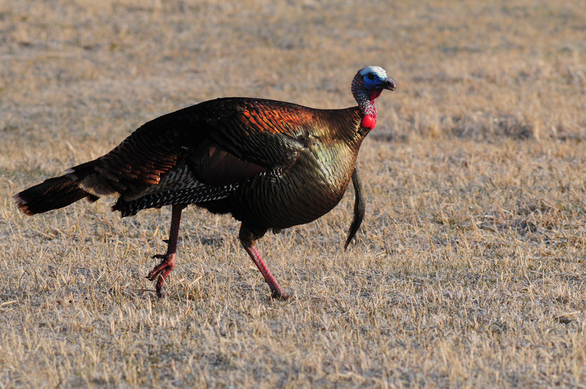 It’s Turkey Time: A mature Iowa gobbler cautiously crosses a field. Bagging a wild turkey is a challenge for even the most experienced hunters. Of the 50,000 licenses sold each spring, about 20 percent are placed on a bird. Photo courtesy of the Iowa DNR.
Enjoy those easy-to-see large flocks of turkeys feeding in the fields while you can. In the next few weeks, the winter flocks will break up, and where you saw them last weekend is not where they’ll be when spring turkey season opens in April.
Bagging a wild turkey is a challenge for even the most experienced hunters. Of the 50,000 licenses sold each spring, about 20 percent are placed on a bird.
“Turkeys have home field advantage. We go where they live and use calls that try to mimic the sounds of a hen. We are trying to reverse nature and get the Tom to come to the hen, which he knows is wrong. If you can frustrate the Tom enough that he ignores his instincts and goes looking for this fake hen, then as a hunter you have a chance,” said Jim Coffey, forest wildlife research biologist for the Iowa Department of Natural Resoruces. “Plus, they have excellent eyesight and hearing so not only do we have to sound realistic, we have to blend in with the landscape and stay motionless. That’s what makes turkey hunting such an intimate activity. Sounds easy.”
While heading home for a bowl of unfilled tag soup is common, what brings hunters back year after year is the experience of when the bird does come in.
The quiet spring morning is broken by the sound of a Toms’ wing tips dragging through dried leaves as he slowly walks in. He’s right behind you. His display begins – spitting and drumming, chest out, head back – in full strut, then all this gives way to the hair raising gobble that thunders through the timber. At this range, any movement will be noticed. Gotta stay calm and wait for just the right opportunity.
The “dance” is what brings hunters back. And since predicting when the bird will come in is not possible, planning and preparing before the season arrives is an important step toward success.
Coffey recommends hunters pattern their gun using the same choke and shot they will use during the season to know the gun and shot limitations.
“Nothing is more frustrating than shooting and missing at a turkey. We owe the bird the respect of only taking the best shot we can,” he said.
He also advises to start practicing calling so when the season begins hunters will be in midseason form.
“Scouting is also important and can greatly improve the chance of bagging a turkey,” Coffey said. “Spend some time in the timber or field you plan to hunt, identify roosting trees or which fields the birds are using, and if you have not yet gotten permission, be sure to contact the landowner before entering their property.”
Iowa’s spring turkey season begins with a youth season April 5-7, followed by four specific seasons. Season 1 is April 8-11, Season 2 is April 12-16, Season 3 is April 17-23 and Season 4 is April 24 to May 12. An archery only season is April 8-May 12.
“Hunters will notice the youth season dates were changed back to the traditional three day season, but any unfilled youth season tags will be valid until filled for the remaining spring seasons. The key is for the youth tags to be purchased before the youth season closes because once the season is over, that option is no longer available,” Coffey said.
In addition to the youth license change, the shot size regulation changed from last year. Shot sizes for lead and nontoxic are now inclusive for all sizes from #4-#8. This replaces the individual listing of legal shot sizes.
Reminder: Reporting Harvest is Mandatory
Successful hunters are required to report their harvest by midnight of the day after it is tagged. Be prepared to answer a few simple questions about your harvest, (county of harvest and spur length.) The easiest way to report is to log on to www.iowadnr.gov. Other ways to report are by calling the phone number listed on the tag or by going through a license vendor. Be sure to write the harvest registration number on the harvest report tag. This allows the Iowa DNR to monitor annual harvest across the state.
Hunting Atlas Available Online
Hunters have a new tool that may improve their in the field experience even before opening day.
The Iowa hunting atlas is an interactive map that shows all available public hunting land that is managed by the state, county or federal governments. The atlas is online at www.iowadnr.gov/hunting. A mobile version is also available.
A click on an area will show basic information like size, habitat type and likely species available.
Media Contact: Jim Coffey, Forest Wildlife Research Biologist, Iowa Department of Natural Resources, 641-774-2958 ext 1.
Spring turkey hunting success and safety comes down to the same thing – proper planning.
“Be aware of what’s around you," said Jeff Barnes, recreation safety officer with the Iowa Department of Natural Resources. "Even if you’re on private property, there could be other hunters out there who are coming to your call. Remember, turkey hunters are skilled in the art of concealment. Don’t shoot at movement; don’t shoot at sound; no turkey’s worth it. I encourage hunters to only shoot after they see the turkey’s beard. Being safe is important because the people we hunt with are our family and close friends.”
Hunters who do shoot a turkey are encouraged to not carry it over their shoulder to avoid someone mistaking it for a live bird and take a shot. Barnes suggested hunters use a blaze orange turkey transport harvest bag.
Practicing safe hunting becomes more crucial as the annual spring leaf out progresses.
“The later it gets in May, the harder it is to see. Hunters need to stay vigilant to identify the bird and the beard,” he said.
Tips
- Plan to wear blaze orange when moving from one spot to another because you never know if someone else is out there, even on private land.
- Avoid wearing patriotic colors – red, white, blue. These same colors are found in a turkey’s head.
- Be aware that mushroom hunters will be moving through the timber in late April and May. Mushroom hunters are encouraged to wear blaze orange and avoid red, white and blue.
- Plan to add bug spray and drinking water to the field bag
- A blind is good for concealment and when taking kids turkey hunting, but not for moving around. If you plan to be mobile, don’t bring the blind.
- If hunting private land, be sure you have permission and know the property boundaries.
- Even if hunting private property, the potential exists that someone else may be out there. Trespassing calls increase during turkey season.
- Be extremely careful if planning to use a turkey fan to hunt. Another hunter may mistake you for a turkey.
Media Contact: Jeff Barnes, Recreation Safety Officer, Iowa Department of Natural Resources, 515-290-4907.
1,864 archers from 88 Iowa schools participated in the National Archery in the Schools Program (NASP) state tournament March 9-10, in Des Moines.
Katherine Yeomans, from Solon High School, won the girls bullseye competition with a score of 291. Lilly Machart, from Anamosa High School, won the girls 3D competition with a score of 294. Yeomans and Machart were each awarded a bow for winning the respective competition.
Drew Crump, St. Johns & St. Athanasius School, won the boys bullseye competition with a score of 297. Crump also won the boys 3D competition with a score of 295. He was awarded two bows for winning the respective competitions.
Scholarships were awarded to the top scoring 12th grade boys and girls in each category.
Senior boys scholarship winners were Alex Brittan, from Eddyville-Blakesburg-Fremont Jr/Sr High School, who received $1,500 for highest 3D score and Michael Harter, from Eddyville-Blakesburg-Fremont Jr/Sr High School, received $1,000 scholarship for second highest 3D score among seniors. Conor Myers, from Mount Vernon High School, received $1,500 for highest score and Collin Hallier, Mount Vernon High School, received $1,000 scholarship for second highest score among seniors in the bullseye competition.
Among senior girls, Kaden Gray, from Chariton High School, received $1,500 scholarship for highest 3D score and Mackenzie Yoder, of Central City High School, received $1,000 for second highest 3D score among seniors. Katherine Yeomans, from Solon High School, received $1,500 scholarship for highest score and Kaden Gray, from Chariton High School, received $1,000 scholarship for second highest score in the bullseye competition.
NASP archers who scored highest league scores plus the highest state tournament scores were named All State Archers.
Boys All State Archers
Drew Crump, St. Johns and St. Athanasius School
Connor Myers, Mount Vernon High School
Hunter Lagrange, Springville Community Schools
Lane Mollenhauer, Springville Community Schools
Adam Larson, Lawton-Bronson Jr/Sr High School
Tristen Liebe, North Linn Community Schools
Girls All State Archers
Lilly Machart, Anamosa High School
Lauren Dettbarn, Valley High School
Katherine Yeomans, Solon High School
Kaden Gray, Chariton High School
Jasmine Lagerquist, Center Point-Urbana Middle School
Makenna Hewitt, Prairie Point High School
High All-Around Champions were named based on their total combined scores from the state 3D & Bullseye Tournaments. Lilly Machart, from Anamosa High School, with a total combined score of 584 and Drew Crump, from St. Johns and St. Athanasius School, with a total combined score of 592. Both were awarded $750 scholarships.
Over 3,600 archers from more than 300 schools participated in Iowa’s National Archery in the Schools Program. The NASP season was Dec. 1 to Feb.23.
3D results are available online at https://nasptournaments.org/TournamentDetail.aspx?tid=4612
Bullseye results are available online at https://nasptournaments.org/TournamentDetail.aspx?tid=4405
The state tournament was sponsored by the Iowa Bowhunters Association, Whitetails Unlimited, the Iowa State Archery Association, Rocky Mountain Elk Foundation and Safari Club International.
Media Contact: Megan Wisecup, Hunter Education Administrator, Iowa Department of Natural Resources, 515-238-4968.
Davenport – The Iowa Department of Natural Resources will relax the fishing regulations at Lake of the Hills, Railroad Lake, Lambach Lake and Bluegrass Lake at West Lake Park starting April 1st to allow anglers to more freely harvest fish before the lakes’ water levels are lowered this summer.
West Lake Park lakes will be under construction through 2020. Excess sediment will be removed from the lakes, shorelines will be stabilized and new fish habitat structures will be added.
The Lake of the Hills community trout stocking scheduled for March 22 has been cancelled. The trout program at Lake of the Hills is expected to return Fall 2021.
Anglers with a valid sport fishing license may harvest all sizes and unlimited quantities of any species of fish from West Lake Park lakes. Any number of poles will be allowed, but anglers must stay in site of these lines at all times.
Liberalized fishing regulations for West Lake Park lakes will be in effect from April 1 until the lakes’ water levels are lowered, starting on July 15. Specific regulation changes include:
- Removal of bag and length limit restrictions on largemouth bass.
- Removal of bag limit on channel catfish.
- Removal of bag limit on crappie and bluegill.
Nets, dynamite, trotlines, poison, electric shocking devices, or any stupefying substances are not allowed. It is illegal to sell fish or stock captured fish into public waters.
Lake of the Hills is currently listed on the State’s list of Impaired Waters due to high levels of algae. The overall goal of this restoration project is to improve water quality and recreational opportunities at West Lake Park and remove the lake from the Impaired Waters List.
Media Contact – Chad Dolan, Fisheries Management Biologist, Iowa Department of Natural Resources, 319-694-2430.
A national campaign is encouraging boaters to Spring Aboard by enrolling in a boater education course before the kickoff to the boating season.
The Iowa Department of Natural Resources (DNR) works with BoaterExam and Boat-Ed to offer online boater education courses and during Spring Aboard campaign week March 17-23, these companies will be offering 50 percent off the price of their on-line course. Use the code SpringAboard2019 to receive the discount.
“March is the perfect time to take a course. The summer boating season will be here before we know it and all of us could benefit from a refresher course,” said Susan Stocker, boating law administrator for the Iowa DNR.
The exam covers required equipment, boating basics, navigation rules, environmental stressors, aids to navigation and takes about six hours to complete. Once a student has passed the test, they can print off their course completion certificate.
An estimated 231,346 boats are registered in Iowa. Last year, there were 32 boating incidents reported on Iowa waters.
Media Contact: Susan Stocker, Boating Law Administrator and Education Coordinator, Iowa Department of Natural Resources, 515-725-8477.
The Iowa Hunter Education Instructors Association was awarded a George H.W. Bush Vamos A Pescar™ Education grant to engage diverse audiences, including Hispanic families, in fishing this summer and fall in the Des Moines Metro and other Central Iowa communities, as well as the Cedar Falls/Waterloo area.
Program partners include Iowa State University Extension and Outreach in Dallas and Black Hawk Counties, the Iowa Latino Center, Johnston Parks and Recreation and Des Moines Parks and Recreation along with several local organizations and businesses.
The grant is sponsored by the Iowa Department of Natural Resources’ Fish Iowa! angler education program and the Recreational Fishing and Boating Foundation’s (RBFF) Vamos A Pescar program.
Media Contact: Barb Gigar, Iowa Department of Natural Resources, 515-494-3891.
|





