|
FOR IMMEDIATE RELEASE
March 5, 2019
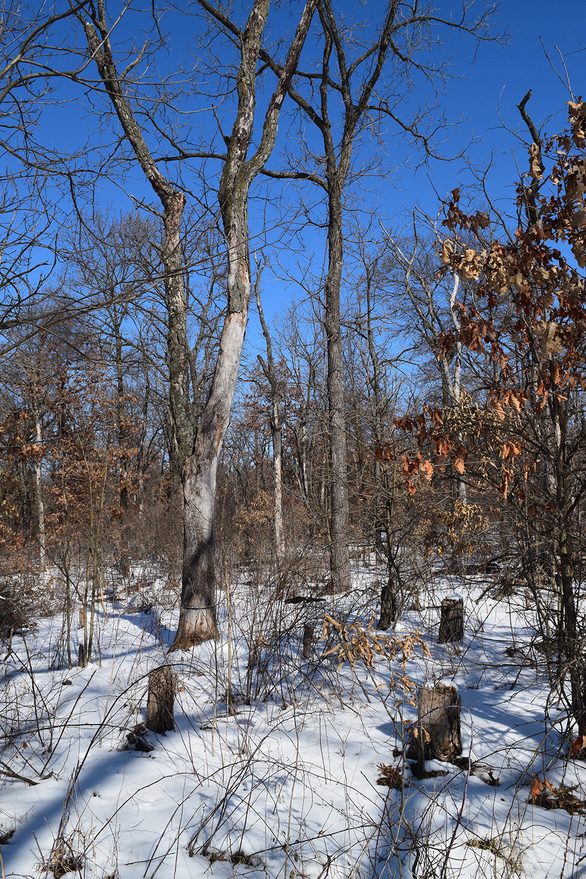 Stumps and standing dead trees are all that remain of the nonpriority trees on this timber stand at the Soap Creek Wildlife Area in northern Davis County. The priority trees, mainly oaks, but also hackberries, walnuts, cherries and other mast producers, respond to the added sunlight and lack of competition with increased growth and increased mast production. Photo courtesy of the Iowa DNR.
The tracks jumped out from the old, crusty snow - they were big - likely from a trophy - and some of the largest Jeff Glaw has seen.
“That’s a pretty good sized tom turkey that left these tracks,” said the long-time wildlife biologist with the Iowa Department of Natural Resources (DNR). Glaw was visiting the 780-acre Soap Creek Wildlife Area with district forester and co-worker Ray Lehn to check on an area that had its tree make up manipulated as part of their forest stewardship plan.
Lehn and Glaw have partnered on forest stewardship plans at Soap Creek and the Eldon wildlife areas, in northern Davis County, in an effort to perpetuate the oaks in the forest and encourage other mast producing species, like walnuts, hackberries and cherries.
Forest stewardship plans stretch long into the future and each one begins with inventorying what trees are currently on the area. Tree inventories are broken down by tree stands, which are simply natural breaks in the landscape, fences, ravines, or where the tree make up changes. At the Eldon area, its 800 acres of forest is broken into 88 individual stands. And the stands are prioritized.
Once the forest stewardship plan is written, approved and discussed at a public meeting, the work begins.
Most of the timber stand improvement is achieved by identifying mast producing trees, like oaks and walnuts, or other target trees and getting rid of the trees around it that are competing for sunlight. This technique is called crop tree release and the competing trees can either be felled or girdled. Girdling is a method where the tree is cut around but not completely through and although it’s dead, is allowed to remain standing to provide valuable habitat for woodpeckers and, later, for bats.
Lehn occasionally uses another technique called shelterwood harvest that removes the understory and mid story stems in combination with a partial harvest of overstory trees, leaving oak trees with the best genetic material in the timber to naturally regenerate. The purpose of shelterwood harvest is to put sunlight on the forest floor to promote oak seedlings becoming established in the understory. After about five years, the remaining overstory is removed to allow the young oaks to thrive.
Timber harvest is limited along rivers or roads and where threatened and endangered species may be found. Wildlife staff does some of this timber stand improvement work, but most is contracted to private forestry contractors who submit bids to purchase the timber.
Money from these projects is deposited into the Wildlife Forest Fund which is used to pay for some of the additional timber improvements. To date, nearly $110,000 has been invested to improve the forests at Soap Creek and Eldon wildlife areas with the majority of the cost paid by this fund. The National Wild Turkey Federation Super Fund and Wildlife Diversity habitat grants have also been used to help pay for timber improvements on both areas.
The stewardship plan identified fragmentation in the timber, like old farm fields, and calls for these areas to be planted with state nursery stock trees to connect the forests. Eliminating this fragmentation reduces the impact of cowbird parasitism on the nests of songbirds.
As an agency, the Iowa DNR has placed a priority for promoting oaks in the public timber because of the mast production benefits for wildlife and added benefits found on an oak floor versus the floor of a shade tolerant timber.
A forest with a healthy mast production will benefit acorn eaters, like deer, turkey, squirrels, woodpeckers and quail. A healthy oak timber is also attractive for resident and migrating neotropical birds.
The Eldon and Soap Creek wildlife areas are part of the Soap Creek-Stephens Forest Bird Conservation Area which has identified 256 bird species, including 88 listed as a species of greatest conservation need. It is also home to all nine Iowa bat species, including nursery colonies of the federally endangered Indiana bat. The wildlife diversity on these areas is extensive.
Private landowners can discuss forest stewardship plans by contacting their local district forester. There may be funding available to help offset the cost for doing the work.
While the forest stewardship plan is being carried out at the Eldon and Soap Creek wildlife areas, Lehn has turned his attention to mapping timber stands at the Selma and Van Buren wildlife areas in Van Buren County. The process of improving forests in southeast Iowa continues with new drafts, of new comprehensive forest stewardship plans, for new areas.
“Through these plans, we are doing what’s best for the timber and what’s best for the wildlife,” Lehn said.
Media Contacts: Ray Lehn, District Forester, Wildlife Bureau, Iowa Department of Natural Resources, 641-472-2370 or Jeff Glaw, Wildlife Biologist, Wildlife Bureau, Iowa Department of Natural Resources, 319-293-7185.
The Iowa Department of Natural Resources fisheries staff will release between 1,000 to 2,000 rainbow trout in ten lakes across Iowa in March and April as part of its cool weather trout program.
The spring urban trout stockings are a great place to take kids to catch their first fish. A small hook with a nightcrawler or corn under a small bobber to casting small simple spinners such as a panther martin or mepps is all you need to get in on the fun.
Bringing trout to cities and towns offers a “close to home” option for Iowans who might not travel to northeast Iowa to experience trout fishing. Most locations also host a family friendly event to help anglers have success and fun while fishing.
The popular program is supported by the sales of the trout fee. Anglers need a valid fishing license and pay the trout fee to fish for or possess trout. The daily limit is five trout per licensed angler with a possession limit of 10.
Children age 15 or younger can fish for trout with a properly licensed adult, but they must limit their catch to one daily limit. The child can buy a trout fee which will allow them to catch their own limit.
Once you buy your trout fee, you can fish for trout all year long at any of the community trout lakes and trout streams in northeast Iowa. Find tips on how to fish for trout on the DNR website at www.iowadnr.gov/trout.
2019 Spring Urban Trout Stocking Schedule
March 22
10 a.m.: Discovery Park, Muscatine
Noon: Wilson Lake, east of Donnellson
March 30
11 a.m.: Ottumwa Park Pond, Ottumwa
11 a.m.: Liberty Centre Pond, North Liberty
April 6
Noon: Banner Lake South, north of Indianola
1 p.m.: Terra Lake, Johnston
April 13
10 a.m.: Heritage Pond, Dubuque
11 a.m.: North Prairie Lake, Cedar Falls
April 20
10 a.m.: Prairie Park (Cedar Bend), Cedar Rapids
Noon: Sand Lake, Marshalltown
Media Contact: Mike Steuck, Regional Fisheries Supervisor, Northeast Iowa, Iowa Department of Natural Resources, 563-927-3276.
The Iowa Department of Natural Resources will be offering discounted trees through the DNR Residential Tree Program at three locations this spring.
Any resident of Iowa can purchase up to two trees per planting address at $30 per tree. Order forms can be found at: www.iowadnr.gov/trees. Tree pick-up days and locations are listed below:
- Tuesday, April 16 in Iowa City
- Saturday, April 27 in Council Bluffs
- Thursday, May 2 in Cedar Rapids
The second program that offers discounted trees is the Operation ReLeaf Program. The DNR partners with many private partners to provide a mixture of hardwoods, low-growing ornamental and evergreen tree species.
This program is only available to Alliant Energy customers and the trees are $25. The order forms can be found at www.iowadnr.gov/trees. Tree pick-up dates and locations are listed below:
- Saturday, April 20 in Marion
- Tuesday, April 23 in Clarinda
- Thursday, April 25 in Atlantic
Media contact: Gabriele Edwards, Urban Forestry Program Specialist, (515) 725-8456 or gabriele.edwards@dnr.iowa.gov.
An estimated 1,900 Iowa students from fourth through 12th grade will be at the Iowa State Fairgrounds March 9-10 competing in the Iowa State Archery Tournament.
The two-day bullseye competition will be held in the Richard O. Jacobson Exhibition Center while the one-day 3-D competition will take place in the Elwell Family Food Center.
“We are really fortunate to have so much interest in this program and event,” said Donise Petersen, archery coordinator for the Iowa Department of Natural Resources. “Archery really levels the playing field allowing students of all sizes and abilities to participate and excel.”
The tournament features a full field of 88 teams shooting for $16,800 in scholarships and other prizes and a chance to go to nationals later this spring. Results will be posted online at http://nasptournaments.org.
The state tournament is sponsored by the Iowa Bowhunters Association, Whitetails Unlimited, Iowa State Archery Association, Raised At Full Draw, Individual Shooting Code, Haney Family and the Rocky Mountain Elk Foundation.
The tournament is again partnering with the Food Bank of Iowa to help those in need. Anyone contributing nonperishable food or monetary donations will be entered into a drawing for prizes, including targets and a bow.
Tickets are available for $5 at the door. Attendees may receive a $1 discount by showing their hunting or fishing license. 17 and younger get in free. The admission on Saturday includes access to the bullseye and 3-D tournament.
Spirit Lake - Invasive curlyleaf pondweed has become a common site in the spring on portions of the Iowa Great Lakes in recent years. The 2019 plan for managing this plant will be similar to 2018, but treat more acres.
A team of leaders from the county, local cities, lake associations, drinking water utilities, Iowa Lakeside Lab, and the Iowa Department of Natural Resources (DNR) have been working together over the past two years to manage this invasive aquatic plant that has caused water access and navigation issues on portions of the Iowa Great Lakes.
“Curlyleaf pondweed has been in our lakes since the middle of the last century, but conditions have allowed it to gain a foothold growing to form dense mats impacting recreation and access,” said Mike Hawkins, Iowa DNR fisheries biologist. “This plant is common throughout the Midwest, causing similar issues on hundreds of lakes.” Unlike native plants, curlyleaf pondweed germinates in the fall, grows under the ice and hits the surface by early May. It dies back naturally in late June.
Terry Wilts, with the East Okoboji Lakes Improvement Corporation, has helped spearhead the management effort over the past few years and explains there are no easy options to solve this problem.
“This plant impacts hundreds of acres. As a team, we realize we can’t treat all of it, but should prioritize our funds and efforts,“ Wilts said. “The 2019 plan builds on efforts from past years. We’ve taken what we’ve learned and are applying this knowledge to maximize our impact.”
The 2018 project treated 61 acres of curlyleaf with a combination of mechanical harvesting and the use of a aquatic herbicide. The 2019 plan includes a similar combination, but an increase in treatment area to 85 acres. The team was able to increase the number of acres while keeping the overall cost the same.
The 2018 project was considered successful. Boater access was improved and the project stayed on budget and on-time despite the late ice out. Twenty acres along the shoreline was treated with an aquatic herbicide and 41 acres (1 million pounds) was harvested using a mechanical plant harvester. The herbicide was used more than five miles from any drinking water intake even though water testing at the treatment area showed levels well below the drinking water standard right after treatment. The 2019 plan increases the herbicide treatment to 60 acres while still proposing mechanical harvesting of 25 acres.
The DNR and project partners want to emphasize the importance of not illegally applying herbicides.
“We can’t tolerate lakeshore residents illegally applying herbicides. Iowa law restricts their use and only the DNR has the authority to treat plants in the lake with a herbicide. Everyone living or vacationing in this area gets their drinking water from our lakes. Not following the law endangers that precious resource,” said Eric Stoll, with Milford Utilities, which supplies drinking water for thousands of customers in the region states.
Funding for the project will come from local contributions to the East Okoboji Lakes Improvement Corporation and the DNR’s Marine Fuel Tax Fund which is dedicated to improving boater access in Iowa.
Media Contact: Mike Hawkins, Fisheries Biologist, Iowa Department of Natural Resources, 712-336-1840.
|





