|
FOR IMMEDIATE RELEASE
February 12, 2019
The Iowa Department of Natural Resources is hosting a series of town hall-style meetings where local staff will provide updates on recently completed hunting seasons, discuss possible changes to hunting rules and regulations, and address other topics as requested.
“We want people to come out to these meetings, listen to the hunting seasons reviews, ask questions and hear directly from our staff,” said Todd Bishop, chief of the Iowa DNR’s Wildlife Bureau. “Part of the meeting will be devoted to discussing potential rule changes and collecting feedback as we work through the rules process.”
The meetings are open to the public. Comments collected from these public meetings will be considered along with other related comments received by the Iowa DNR prior to proposing changes to hunting rules and regulations. Proposed rules will be presented to the Natural Resource Commission during a regular public meeting for consideration and additional public comment.
These meetings replace the one night listening session held in late winter over the past 15 years.
Meeting date, time and location
Burlington, Feb. 20, 7 p.m., Starr’s Cave Nature Center, 11627 Starr’s Cave Road
Dubuque, Feb. 20, 7 p.m., Swiss Valley Nature Center
Ventura, Feb. 20, 7 p.m., Clear Lake Wildlife Unit headquarters, 15326 Balsam Ave.
Bloomfield, Feb. 21, 7 p.m., Pioneer Ridge Nature Center, 1339 Hwy. 63
Chariton, Feb. 21, 7 p.m., Pin Oak Lodge, 45996 Hwy. 14
Creston, Feb. 21, 7 p.m., Multi-Purpose Room adjacent to the YMCA, Southwestern Community College
Algona, Feb. 25, 7 p.m., Waters Edge Nature Center, 1010 250th Street
Waverly, Feb. 25, 7 p.m., Waverly Public Library, 1500 W Bremer Avenue
Sac City, Feb. 26, 7 p.m., Sac County Conservation Center at Hagge Park, 2970 280th Street
Council Bluffs, Feb. 26, 7 p.m., Fish and Game Club, 531 Commanche Street
Okoboji, Feb. 26, 6:30 p.m., Dickinson County Nature Center, 22785 Nature Center Road
Des Moines, Feb. 26, 7 p.m., Des Moines Izaak Walton League, 4343 George Flagg Pkwy
Jefferson, Feb. 27, 7 p.m., The Jefferson Depot, 509 East Lincoln Way
Iowa City, Feb. 27, 7 p.m., ISU Extension Office, 3109 Old Hwy. 218 South
DeWitt, Feb. 28, 7 p.m., DeWitt Community Center, 512 10th Street
Salix, Feb. 28, 7 p.m., Lakeport Gun Club, 3089 Calhoun Avenue
Toledo, March 7, 7 p.m., Tama County Nature Center, Otter Creek Lake Park, 2283 Park Road
Decorah, March 7, 7 p.m., Decorah City Hall, 400 Clairborne Drive
Any person attending the public meeting and has special requirements, such as those related to mobility or hearing impairments, should contact the Iowa DNR or ADA Coordinator at 515-725-8200, Relay Iowa TTY Service 800-735-7942, or Webmaster@dnr.iowa.gov, and advise of specific needs.
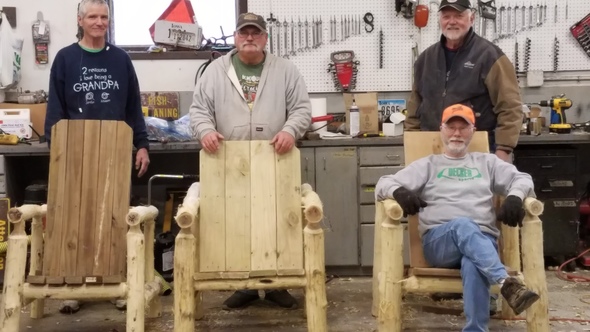
POLK CITY, Iowa – A pilot program is in its first year at Big Creek State Park utilizing Black Locust trees to build wooden chairs.
Chad Kelchen, DNR Park Manager of Big Creek State Park, began a program that gathered interested locals to learn about Black Locust trees—which are considered invasive species—and at the same time, learn how to utilize the wood that is produced by them. So far, two volunteer groups have participated in constructing three log chairs contributing forty hours of volunteer service. Each chair has been hand-made in a learning process and will go to Springbrook State Park cabins.
The program focuses on educating people how to build wooden chairs, but also more importantly, how to remove Black Locust trees and finding common use for them. These chairs do not fit as ordinary templates and have to be pieced together as each individual piece wood is different in dimensions. State law allows trees to removed from state parks only by an issued permit.
Black Locust trees are considered invasive species and had tendencies to spread aggressively. Black Locus trees are native to Illinois but are commonly found in the Midwest and can span up to 50 feet tall and 35 feet wide. The high-density wood produced from Black Locust trees is used for fence posts, outdoor furniture, decks and other projects that require weatherproof materials.
This will be a winter season program taking advantage of locust trees that are still somewhat green and workable. Volunteer events will be scheduled through the end of February 2019 and limited to one program per week of up to five participants.
“This has been a pilot program to test the feasibility of creating a use for a tree species that dominates the landscape and prevents other tree species from being established as a part of a healthy ecosystem. Ideally, this program will continue in the future as a partnership with private groups, businesses or individuals. Our goal is to create a demand for a species that causes harm to our ecosystems.”
For further information contact Big Creek State Park at big_creek@dnr.iowa.gov
Media Contact: Chad Kelchen, Big Creek State Park Manager, (515) 984-6473, Chad.Kelchen@dnr.iowa.gov.
AMES, Iowa — This week, the World Wildlife Fund released its 2018-2019 overwintering monarch population report. Adult monarch butterflies covered approximately 15 acres of forest canopy in Mexico, a doubling of last year’s population, and a level not seen since 10 years ago.
The report provides hope, say leaders of the Iowa Monarch Conservation Consortium.
“Although the number of monarch butterflies overwintering in Mexico has rebounded considerably, turning this encouraging one-year population response into a consistent long-term trend depends on advancing conservation efforts that are critical to help monarchs survive and reproduce in Iowa and the Upper Midwest,” said Steve Bradbury, professor of natural resource ecology and management at Iowa State University.
Monarch butterflies face many challenges including the loss of milkweed and nectar plant habitat in its spring and summer breeding ranges. Female monarchs lay eggs exclusively on milkweed plants. National and state efforts focus on establishment of new milkweed habitat to reach conservation goals.
"This year's high watermark is very encouraging, and Iowa has a critical role to play in providing summer breeding habitat for the monarch for years to come," said Bruce Trautman, acting director of the Iowa Department of Natural Resources. "We have a really strong group with broad expertise working together to support the monarch recovery in Iowa and beyond."
Habitat plantings include milkweed and a diverse array of blooming species to provide nectar for adult monarchs throughout their life cycle and seasonal migrations. The current Iowa Monarch Conservation Strategy seeks to establish approximately 480,000 to 830,000 acres of monarch habitat by 2038. Iowa’s strategy, combined with those of neighboring states, is designed to consistently maintain a yearly population of 225 million adult monarchs, or about 15 acres of occupied forest canopy.
"The monarch butterfly population numbers are encouraging and serve as a reminder of the importance and impact of our ongoing conservation efforts," said Mike Naig, Iowa Secretary of Agriculture. "Iowa's long-term strategy includes expanding habitat for monarchs on our agricultural land, urban areas, roadsides and other public land."
The Iowa consortium is a group of 50 organizations, including agricultural and conservation associations, agribusiness and utility companies, universities and county, state and federal agencies. Roughly 40 percent of all monarch butterflies that overwinter in Mexico are estimated to come from Iowa and neighboring Midwestern states. Expanding monarch habitat in Iowa will play a major role in the recovery of the species.
“Progress always starts with good science, and our researchers continue to make strides to understand what it takes to improve and increase monarch habitat through a deeper understanding of biology and the environment,” said Daniel Robison, Endowed Dean of the College of Agriculture and Life Sciences at Iowa State University. “Our extension and outreach efforts, in coordination with regional, national and private partners, are doing much to provide the science-based information and education that ensures approaches to monarch conservation are as effective as they can possibly be.”
The Iowa strategy — developed by consortium members — guides the implementation and documentation of voluntary, statewide conservation efforts based on the best available science. Their approach fosters habitat improvements in rural landscapes that do not conflict with agricultural production, are sufficient in scale to support improved monarch breeding success and strive to complement other conservation programs.
To learn more about the Iowa Monarch Conservation Consortium, visit www.iowamonarchs.info
|





