 It’s no secret that 2018 produced quite a whirlwind of activity for CASA Staff, Advocates and Coaches. Here are a just a few of the many highlights experienced during this past year:
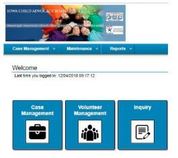
The Child Advocacy Match System (CAMS) data
management system went live after years of
procurement and development. Staff, advocates and
coaches continue to learn how to navigate the system,
while administration continues to work out the kinks.
Everyone has been incredibly patient in this endeavor
and helpful in passing along tips and tricks that have
been discovered along the way.
Also in 2018, policy related to training new Advocates was revised after learning the importance of “on the job” training for new advocates. Advocates in their first year of service on a case are now provided timely training through a first-year
training curriculum to build upon key advocacy skills such as gathering information, writing reports, monitoring a case and advocating with a trauma-informed lens.
|
 This past summer, the Iowa Child Advocacy Board
earned certification as a Service Enterprise Initiative
(SEI) Organization with Volunteer Iowa and Points of
Light. SEI Organizations harness the power of
volunteerism at all levels of the organization to
increase efficiency and effectiveness. Service
Enterprise volunteers are already at work helping the CASA Program with marketing, public awareness and social media.
Also in 2018, CASA Coordinators across the state acquired assistance with tasks and job duties, from data entry and schedule management to interviewing and onboarding potential advocates, with the appointment of several new CASA Assistants (CA), Associate Coordinators (AC) and Administrative Assistants (AA).
Thanks to all our wonderful assistants and associates!
● Mary Bottger, CA, assigned to the Sioux City and Storm Lake area
● Jan Brewer, AA, assigned to the Northeast Iowa area
● Carmen Cameron, AA, assigned to the Spencer area
● Madeline Christensen, CA, assigned to Davenport and Council Bluffs areas
● Mandy Dahlen, AC, assigned in the Des Moines area
● Ann Empen, AA, assigned to the Clinton and Muscatine areas
● Katie Greving, CA, assigned to the Mason City area
● Heidi Gruca, CA, assigned to Des Moines area Coordinators
● Leah Price, AC, assigned in the Iowa City area
● Lori Wilfong, CA, assigned to the Cedar Rapids area
ICAB renewed its promise to providing staff development opportunities by hosting three staff learning exchange opportunities in 2018. Staff participated in Trauma-Informed Advocacy and Self-Care training, Crucial Conversations®, and an ICAB Volunteer Management Series training in 2018. Bringing staff together, especially several times per year, hasn’t always been possible in the last several years due to budget constraints. Many thanks to the National CASA Association for their support of Iowa CASA Programming through funding a grant specifically for staff development.
|
 Finally, we all know that working in the human services field can be a challenge. The hours can be long and the work itself, while rewarding can be heartbreaking and emotionally draining. Our CASA Advocates and Coaches humbly step forward as volunteers; as ICAB’s small army of “unpaid staff” who undertake hours of training and step into courtrooms armed with knowledge of their case as they do their best to advocate for the needs of a child. They step forward because they identified a need in their community. Their work is inspiring, selfless, important and stirs a respectful gratitude in many of the people they encounter. Thank you to all our CASA Advocates and Coaches. Best wishes to you all this holiday season!
|
2018 FCRB Year in Review
 |
 Foster Care Review Board (FCRB) programming remains active for 50 counties throughout Iowa. Volunteers from around the state continue to put forth great efforts to review case permanency planning for children residing in out-of-home placements. Several milestones that have enhanced the FCRB program were achieved in 2018 thanks to the collaborative efforts between staff, contract facilitators and FCRB volunteer members.
- All 28 local boards are now trained and transitioning to using a less-paper system to review case files and prepare for reviews. This effort has been ongoing for about two years as we slowly staggered the transition for our volunteers. Using a less-paper system minimizes the amount of hard copy confidential information shared with the volunteers and also is more cost effective long-term for the agency. A special thanks to the volunteers for keeping an open-mind about this shift in process and for learning the Google Drive system to make this transition possible. We know this has been a huge undertaking and we appreciate the time you continue to give to your FCRB volunteer work. Also, thank you to the staff who continue to provide support to contract facilitators and volunteers.
- In July 2018, FCRB implemented three new report templates to include findings, barriers and recommendations that are more specific to the permanency goals of the cases that come up for review. By capturing data and barriers at the case level, Boards are better informed to make recommendations to support and enhance case planning for children. The FCRB program is better positioned to collect data from individual reviews for further analysis of potential systemic issues in child welfare and juvenile court processes.
- During this past year, the FCRB program was able to offer facilitator contracts for many of the 28 local boards. We are fortunate to have the following individuals as part of the FCRB facilitation team: Rebecca Hoyle, Jamie Panning, Bill Sackett, Amy Combs, Lindsey Schmidt and our newest addition, Amanda Avenarius. These individuals bring knowledge and guidance to the review process and are instrumental in producing timely FCRB reports.
As we look ahead to 2019, we will continue to focus efforts on: conducting thorough and quality case reviews; making effective recommendations for case permanency planning and monitoring execution of case plan action steps in order to achieve timely permanency for children in out-of-home placements.
|
Waterloo CAB Coordinator, Meg Campbell
The Child Advocacy Board is pleased to announce that Meg Campbell has recently accepted the CAB Program Coordinator position for the Waterloo area. Meg has been active with the CASA program since 2011 as an advocate. In addition, she has served as a CASA Coach, the CASA Assistant for the Waterloo office and has facilitated local foster care reviews in Black Hawk County. In addition to her knowledge of the CASA and FCRB programs, Meg has a Juris Doctor degree and a Bachelor’s degree in Journalism, as well as prior experience as a volunteer manager. Her education and experiences will serve her well as she transitions to her new role as Program Coordinator on December 14th.
Meg demonstrates a strong commitment to the CASA and FCRB programs and has done a tremendous job of stepping up to support the volunteers during these past few months as an interim coordinator. She has continued to “wear many hats” in an effort to make the transition as seamless as possible for the volunteers as they continue to do great work and serve on behalf of children and families. We look forward to working with Meg in her new role!
For FCRB Members & CASA Advocates: How Gratitude Rewires Our Brain
 Researchers have discovered that gratitude has some incredible health benefits and that a daily practice literally rewires the brain and body for health and joy.
"Something as simple as writing down three things you're grateful for every day for 21 days in a row significantly increases your level of optimism, and it holds for the next six months. The research is amazing," stated Shawn Achor, Harvard researcher and author.
Gratitude is the healthiest of all human emotions. The more you express gratitude for what you have, the more likely you will have even more to express gratitude for. – Zig Ziglar
Your hypothalamus is the part of your brain that regulates critical bodily functions such as your appetite, sleep cycles and blood pressure and heart rate. A National Institutes of Health study found that when you express kindness or feel gratitude, your hypothalamus floods your brain with dopamine. This gives you a natural high, motivating you to do good and express gratitude even more. UCLA’s Mindful Awareness Research Center found that regularly expressing gratitude changes the molecular structure of your brain, keeps your gray matter functioning, and makes you healthier and happier.
Other compelling benefits of gratitude include:
- Gratitude improves your sleep, increasing the quality of sleep, decreases the time it takes to fall asleep and lengthens the duration of our sleep.
- Gratitude decreases pain levels.
- Gratitude improves your self-esteem by reducing social comparisons.
- Gratitude improves your mental health. This includes reduction in anxiety and depression.
- Gratitude improves your mental strength.
- Gratitude provides natural stress relief by reduction in the prominent stress hormone cortisol.
- Gratitude also helps improve resiliency, with faster recoveries from physical and mental traumatic events.
- Gratitude improves your physical health and energy levels.
The researchers described these 'profound' and 'long-lasting' neural effects as 'particularly noteworthy, psychology writer Christian Jarrett explains for Science is Us blog. The result is interesting for neuroscientists, but it's also potentially useful for the rest of us. It "suggests that the more practice you give your brain at feeling and expressing gratitude, the more it adapts to this mindset -- you could even think of your brain as having a sort of gratitude 'muscle' that can be exercised and strengthened... the more of an effort you make to feel gratitude one day, the more the feeling will come to you spontaneously in the future."
In short, practicing gratitude seems to kick off a healthful, self-perpetuating cycle in your brain -- counting your blessing now makes it easier to notice and count them later. The more “good” you see in your life, the happier and more successful you're likely to be. It also potentially helps explain another established finding, that gratitude can spiral: The more thankful we feel, the more likely we are to act pro-socially toward others, causing them to feel grateful and setting up a beautiful virtuous cascade.
Or, as Jarrett sums up the research: "The more you practice gratitude, the more attuned you are to it and the more you can enjoy its psychological benefits."
|
 What are easy ways to increase gratitude in your life?
- Keep a daily gratitude journal.
- Practice telling others how you sincerely appreciate them.
- Look in the mirror and be grateful for something you accomplished or something about your character.
- Practice mindfulness.
- Reduce judgments, meaning quieting your inner critic, and decide how you will view your day, your situation, and your list of gratitudes. Remember that you determine what things mean, as gratitude is “a state of mind.”
For additional reading or to sign up for a newsletter, consider going to the Greater Good Magazine, Science-Based Insights for Meaningful a Life. https://greatergood.berkeley.edu/
“Thankfulness is the beginning of gratitude. Gratitude is the completion of thankfulness. Thankfulness may consist merely of words. Gratitude is shown in acts.” – Henri Frederic Amiel
“No one who achieves success does so without the help of others. The wise and confident acknowledge this help with gratitude.” – Alfred North Whitehead
“At times, our own light goes out and is rekindled by a spark from another person. Each of us has cause to think with deep gratitude of those who have lighted the flame within us.”
– Albert Schweitzer
As 2018 draws to an end, the Training Team and all the Iowa Child Advocacy Board Staff share our abundance of gratitude for all the effort each and every one of our volunteers demonstrates for the children and families we serve in addition to all the “behind the scenes” work ranging from learning new computer programs, to attending trainings, to working collaboratively with the many professionals in the system, that help our CASA and FCRB programs grow and thrive. Thank you. We are grateful for you!
|

For CASA Advocates: In-Service Training Credit
To build upon your core advocacy knowledge and skills for working with older youth, we offer multiple options to further explore effective advocacy. Adolescent Trauma and Substance Abuse, our one-hour independent study addresses the basics about traumatic stress and substance abuse in teens and the complex interplay between the two along with charts and resources to enhance your advocacy efforts. CASA Advocates can request this independent training from their Local Coordinator or the ICAB State Training Specialist at lesa.christianson@dia.iowa.gov.
|
Staff Corner:
 KEPRO EAP On-Demand Webcast
Topic: Holidaze: How to Enjoy the Holidays and Minimize Holiday Stress
Is stress getting in the way of your holiday enjoyment? Explore ways to minimize the tension and increase
the fun for all involved.
Broadcast Length: 50 Minutes How to Access: Go to the EAP website at http://www.EAPHelpLink.com. Enter your Iowa Employee code and look for Online Seminars within the scrolling tab area on the homepage or you can search for them by title.
For login code information, contact your State Training Specialist.
|
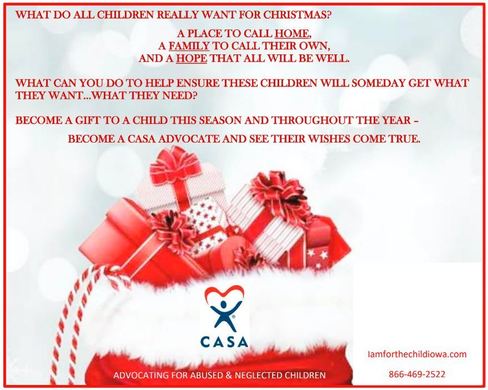
"Please give the gift of a CASA to a child. Print this off and give it to a friend who may be interested in becoming a CASA! Thank you."
Iowa Child Advocacy Board
321 East 12th Street
4th Floor Lucas Building
Des Moines, IA 50319
childadvocacy@dia.iowa.gov
|