 Deer hunters will soon be trading in their bows for shotguns and body harnesses for blaze orange vests as the calendar turns to December and the first of Iowa’s three main gun seasons begin. And based on reports, it looks like hunting will be good, if the weather cooperates.
“Our deer population is similar to last year and they are definitely moving right now,” said Tyler Harms, wildlife biometrician with the Iowa Department of Natural Resources (DNR). “The recent colder weather and rut activity have things looking positive for our shotgun seasons.”
First shotgun season is Dec. 1-5, followed by second shotgun season Dec. 8-16. Late muzzleloader season is Dec. 17-Jan. 10, which it shares with the reopening of the bow season.
The bulk of the deer harvest, and hunter participation, occurs during the shotgun seasons. The Iowa DNR expects about 60,000 hunters in each shotgun season, plus 30,000 in the late muzzleloader season. The traditional technique in shotgun season is to drive and post where some members of the group post the end of the timber, while other walk through driving deer towards them.
With all that activity in the timber, Harms advised hunters to keep safety at the top of their hunting plan. The hunting plan identifies where each hunter will be and how the hunt will unfold. The plan should also include checking the blaze orange and replace any that has faded over time. Hunters are required to wear one article of external solid blaze orange clothing: vest, jacket, coat, sweatshirt, sweater, short or coveralls. An orange hat alone doesn’t suffice.
“You want to be seen by other hunters so it would be a good idea to wear more than the minimum amount of blaze orange required,” Harms said.
Hunters will notice few regulations changes from 2017. The DNR has added a January antlerless season in four counties and new deer management zones near Harpers Ferry, Elkader and Seymour. Unfilled youth deer licenses are now valid for any remaining seasons, but are still mentor licenses and they must follow all other rules specified for each season.
Iowa’s overall deer harvest across all seasons last year was 105,578 and the 2018 harvest should be similar.
Media Contact: Tyler Harms, Wildlife Research Biometrician, Iowa Department of Natural Resources, 515-777-5378.
Report your harvest
The deer is down, tagged and on its way to the truck. But the harvest is not complete until the deer is registered; either online, over the phone or at a license vendor.
Online, it takes just a couple minutes. Go to www.iowadnr.gov/hunting and click on the orange ‘Report Your Harvest Online’ bar in the middle of the page. From there, scroll down and follow instructions. Be ready to enter your tag’s nine-digit harvest report number. By phone? Call 800-771-4692.
The deer should be reported by the hunter whose name is on the tag…and it must come before midnight, the day after the deer is tagged.
Reporting your harvest is important because harvest numbers are used to manage Iowa’s deer herd annually and it is required by law.
Safety reminder
Hunters are encouraged to use safe hunting practices and to discuss the hunting plan so each member of the hunting group knows where the others will be at all times during the hunt.
Tips
- Treat every gun as if it is loaded
- Wear plenty of blaze orange
- Be sure of the target and what’s behind it
- Don’t shoot at running deer
Turn in poachers
See something in the field that doesn’t look right? Report hunting violations to Turn in Poachers as soon as possible by calling 1-800-532-2020. Provide as much information as possible like a description of the individual(s), vehicle and time and location of the violation.
You can remain anonymous.
Chronic wasting disease
The Iowa DNR has launched a new online system where hunters who provide samples for chronic wasting disease testing can check on the test results themselves. Go to www.iowadnr.gov/hunting and click on the CWD reporting system link on the right. There, they can enter either their hunter identification number or the nine digit registration number on the deer tag. Results should be available in 2-3 weeks.
The Iowa DNR is continuing to monitor for the always fatal disease with increased focus areas along the Nebraska border, northeast and north central Iowa, and Wayne, Appanoose, Davis, and Keokuk counties.
New deer management zones were added in Allamakee, Clayton and Wayne counties this year to increase deer tissue samples in the area where chronic wasting disease has been confirmed in the wild herd and allow hunters an additional opportunity to go deer hunting.
Hunters using a management zone license are required to provide a tissue sample and hunt within the zone boundaries. Licenses are available locally. More details are available at www.iowadnr.gov/cwd.
January antlerless season
The DNR has added an antlerless deer season January 11-27, 2019, in four counties: Allamakee, Clayton, Wayne and Appanoose. Licenses are available until the season ends, or the quotas fill, whichever comes first. Hunters may use a bow, muzzleloader, handgun, shotgun, straight wall cartridges or centerfire rifles shooting .24 caliber or larger in this season. Each of the participating counties has more than 1,000 antlerless licenses available.
Youth license
New this year – an unfilled youth deer season license is valid for the remaining deer seasons until filled. The youth hunter must follow the method of take for that season. The youth license is still a mentored license where they must hunt under the supervision of a licensed adult.
Help Us Stop Hunger – HUSH
Have an extra deer at the end of the hunt? Maybe you bought an extra tag, to hunt longer? Consider donating to Iowa’s HUSH program. HUSH (Help Us Stop Hunger) works with 66 participating lockers to provide high quality meat to needy Iowans, through the Food Bank of Iowa.
Field dressed deer are skinned, de-boned and ground into two-pound packages…then distributed to local needy families. The program is funded by hunters, who pay a dollar surcharge with each deer tag purchase.
HUSH has provided meat from nearly 74,000 deer to those who need it—nearly 3,800 last year. Processors receive $75 for their end of the work. The Food Bank of Iowa picks up $5, as it oversees distribution.
Each locker will accept whole deer, asking the hunter to fill out a Hunter HUSH card. There is no fee paid at the locker. A list of participating lockers is available in the Iowa Hunting Regulations and online at www.iowahush.com.
Donated deer hides benefit disabled veterans
Hunters donated more than 3,300 deer hides to Elks Lodges across Iowa last year that were used by the Veterans Leather Program to make professionally-crafted leather gloves for veterans in wheelchairs, and turned in to leather used for therapy programs for recovering veterans.
The Veterans Leather Program relies on the charity of hunters to donate their deer hides. Hunters willing to donate their hides are encouraged to contact the local Elks Lodge for drop off locations or visit www.elks.org to find the nearest lodge. The therapeutic kits and gloves are distributed at no cost to the veterans. Contact Lisa Widick at 208-360-6294 or lwidick@theperrychief.com for more information.
Don’t wait until the last minute to purchase deer licenses
Deer hunters are encouraged to avoid the last minute rush and buy their deer licenses soon. An estimated 60,000 deer hunters are expected to participate in each of the two shotgun seasons.
Deer licenses are available at nearly 750 license vendors across the state.
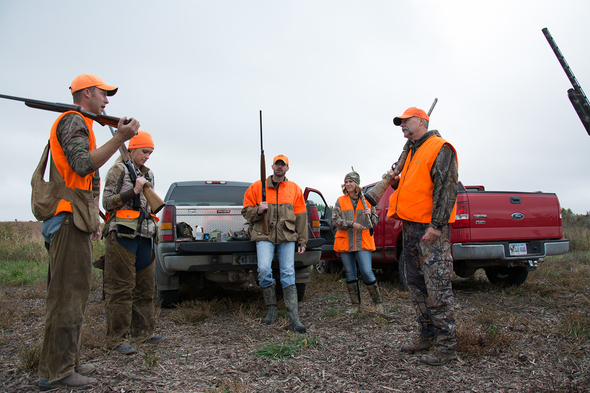 Three weeks into the pheasant season and hunters are finding success similar to the August roadside survey forecast – good hunting in central and north central Iowa; spotty hunting in southern Iowa.
Southern Iowa success – or lack thereof – has likely been influenced by the amount of corn still in the field. According to the most recent survey, southwest Iowa has completed 78 percent and south central 83 percent of the corn harvest. Statewide, the corn harvest is estimated at 91 percent complete.
“If you can find a CRP field or a wildlife area next to a corn field that had just been harvested, you will find birds that haven’t been hunted much and I would expect there to be really good hunting. I wouldn’t pass up that opportunity,” said Todd Bogenschutz, upland wildlife research biologist with the Iowa Department of Natural Resources.
Thanksgiving and pheasant hunting have been paired like pumpkin pie and whipped cream for generations and this year is setting up nicely. While pheasant hunting has been going well, success with quail has been lagging. But that might change with the onset of cold weather.
“Cold weather will put quail into coveys and in the habitat where we expect to find them,” Bogenschutz said. “Our bird numbers are good. Spend a day or two with your family outdoors hunting and don’t be afraid to knock on doors to ask for permission. Landowners are pretty receptive.”
Join the hunt - Apprentice license allows experienced hunters to share their skills with novice hunters
Hunting is as much a part of Thanksgiving as cranberries, football and the inevitable afternoon nap. As friends and family gather this holiday, take the opportunity to share the experience and extend an invitation to new hunters to join the group.
The Iowa Department of Natural Resources offers individuals age 16 and older an opportunity to try hunting under the direct supervision of an experienced, licensed adult without completing hunter education.
The apprentice hunting license includes the habitat fee and is available to residents for $30 and nonresidents for $123. There must be one licensed adult mentor hunter for each apprentice hunter. The apprentice hunting license may be purchased up to two times without having completed hunter education.
Resident apprentice licenses may be used to pursue small game and as the hunting license requirement for deer and turkey licenses and waterfowl stamps. A person hunting with an apprentice license must shoot and tag their own deer or turkey.
The nonresident apprentice hunting license is not allowed as a license for nonresidents to hunt deer or turkey.
More information is available online at www.iowadnr.gov/learntohunt.
|





