|
FOR IMMEDIATE RELEASE
October 16, 2018
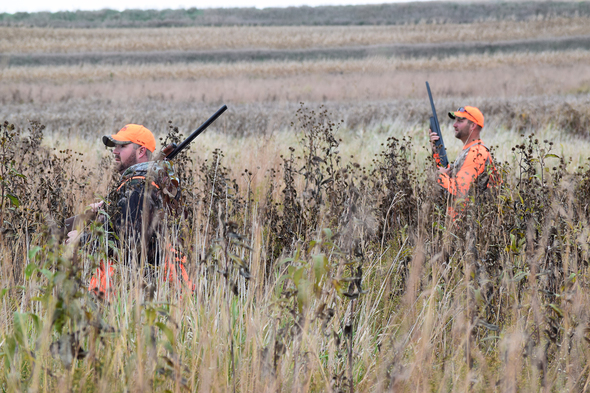 Iowa’s 2018 pheasant season opens Oct. 27, and harvest is predicted to exceed 2017. Pheasant population has increased statewide. Pheasant survey map is available at www.iowadnr.gov/pheasantsurvey. Photo courtesy of the Iowa DNR.
Thousands of hunters in blaze orange
will take to the fields when Iowa’s pheasant season opens Oct. 27. And with the
second highest pheasant population in a decade, hunters can afford to be
optimistic.
“We have good pheasant hunting across
the state where we have good habitat,” said Todd Bogenschutz, upland wildlife
research biologist with the Iowa Department of Natural Resources.
Based on the results from the August
roadside survey, hunters can expect to harvest 250,000 to 300,000 roosters this
fall. Last year, an estimated 55,000 hunters harvested 221,000 roosters. That’s
2,000 fewer hunters than in 2016.
“We have the birds to support a harvest of
400,000 but we need more hunters to reach it,” Bogenschutz said. “We have a
similar pheasant population estimate as 2007 when we shot 600,000 roosters but
the difference between 2007 and today is 30,000 pheasant hunters. Until more
hunters return, we won’t see our harvest match what the population can support.”
Participation bottomed out in 2013 and
while today’s hunter numbers have improved, it’s a far cry from the 200,000 pheasant
hunters less than two decades ago.
“I’ve talked to hunters who hunted Iowa
on their way home from South Dakota last year and said they had better hunting
in Iowa. The opportunity is here,” Bogenschutz said.
Hunters have options when it comes to
pursuing pheasants. Much of Iowa’s public land is managed to benefit pheasants,
plus, landowners in Iowa are friendly to hunting if hunters are willing to
knock on some doors, Bogenschutz said. “And we have our Iowa Habitat and Access
Program partnership between the two where we work with participating landowners
to provide public hunting access to private CRP land,” he said.
Iowa’s youth only pheasant season is set
aside for hunters age 15 and younger. The two days season is Oct. 20-21. The
regular season opens Oct. 27 and this year, early success will likely be
impacted by the crop harvest that has been delayed by up to three weeks in
certain areas because of the wet fall.
Iowa Pheasant
Season
Iowa’s pheasant season is Oct. 27-Jan.
10, 2019, shooting hours are 8 a.m. to 4:30 p.m. The daily bag limit is three
rooster pheasants with a possession limit of 12. Hunters must have a valid
hunting license and habitat fee.
Hunters are required to wear at least
one article of external clothing with at least 50 percent of its surface area
solid blaze orange: hat, cap, vest, coat, jacket, sweatshirt, shirt or
coveralls. The same blaze orange rule applies while hunting quail, gray
partridge and ruffed grouse.
Places to Hunt
The Iowa DNR’s online hunting atlas
lists nearly 700,000 acres of public hunting land, including more than 25,000
acres of land enrolled in the popular Iowa Habitat and Access Program (IHAP)
allowing hunter access to private land.
Each area on the atlas includes a link
to a map with property boundaries, the size of the area, habitat type, species
of wildlife likely found, if nontoxic shot is required and more. The map is
available as a downloadable pdf that can be printed or saved to a smartphone.
To view the atlas, go to www.iowadnr.gov/hunting
and click on Places to Hunt and Shoot in the left column.
Media Contact: Todd Bogenschutz, Upland Wildlife Research Biologist, Iowa Department of Natural Resources, 515-979-0828.
Think
safety before opening day
Hunters
heading to the field for the opening weekend of pheasant season are encouraged
to review safe hunting practices before they head out.
Megan
Wisecup, hunter education administrator with the Iowa Department of Natural
Resources, said hunters should get reacquainted with the techniques used to
hunt pheasants – be sure to walk in a straight line and know where members of
the hunting party are at all times, especially in low visibility areas like
terraces, tall switch grass and standing corn.
“Go
through the zones of fire with each member of the hunting party, talk about
avoiding target fixation and swinging on game,” Wisecup said. “Wear plenty of blaze
orange especially on the upper one third of your body. We are encouraging
hunters to wear more blaze orange than the minimum required. The goal is to be seen by other hunters.
“The
top pheasant hunting incidents all are related to not being seen. The shooter
swings on a rooster, the victim is out of sight of the shooter or the rooster
flew between the shooter and the victim.”
Wisecup
said safety also extends to the canine companions.
“Avoid
low shots to prevent injuring your hunting dog,” she said.
“The
hunting plan and safety practices are all part of a responsible hunt. The goal
at the end of the day is for everyone to return home safely.”
Tips
for a Safe Hunt
- Iowa
law requires hunters to wear at least one of the following articles of visible,
external apparel with at least 50 percent of its surface area solid blaze
orange: hat, cap, vest, coat, jacket, sweatshirt, shirt or coveralls.
- Hunters
should stay in communication with each other and to stay in a straight line
while pushing a field.
- Discuss
the hunting plan that spells out how the hunt will take place, each person’s
role in the hunt and where each person will be at all times.
- Know exactly where standers will
be located, especially when hunting standing corn or tall switch grass to avoid
having the standers get shot by the pushers as they near the end of the field
and the birds begin to flush.
- Make
sure to unload the gun when crossing a fence or other obstacle to avoid it accidentally
discharging.
- Properly
identify the target and what is beyond it especially if hunting in fields that
still have standing corn.
- If
hunting with a dog, never lay a loaded gun against a fence. Hunting dogs are usually excited to be in the
field and could knock the gun over causing it to discharge.
- Hunters
bringing dogs into Iowa must have in their possession a health certificate
verifying rabies and other vaccinations of their dogs.
- Share
the hunt. Take someone new along to help
keep Iowa’s great hunting tradition alive.
Media Contact:
Megan Wisecup, Hunter Education Administrator, Iowa Department of Natural
Resources, 515-238-4968, or Jeff Barnes, Recreation Safety Officer, Iowa
Department of Natural Resources, 515-290-4907.
CLAY COUNTY, Iowa – On October 14, the Iowa Department of
Natural Resources was notified of a single-person hunting incident on Barringer
Slough in Clay County, Iowa.
A 22-year-old man from Spencer was waterfowl hunting and
suffered minor injuries to his hand from his firearm. The man was
later treated at a local medical facility and released. This
incident remains under investigation.
Media Contact:
Joe Yarkosky, Conservation Officer, (712) 260-1004, Joseph.Yarkosky@dnr.iowa.gov.
Another busy camping year in Iowa state
parks is coming to an end and staff are preparing for the first freezing
temperatures of the fall.
State parks began winterizing their
facilities in the past week, including shutting off water in the campgrounds
and closing shower houses.
Campers can check the status of water
availability in a particular park by going to iowadnr.gov/parkclosures.
The page is updated regularly by park staff.
If campers have any questions about
water or other facilities during the time of their stay, they should contact
the park directly.
“We have a number of fall campers
who visit parks after the water is off and they use the RV dump facilities at
Iowa rest areas,” said Todd Coffelt, chief of State Parks for the Iowa DNR. A
list of rest areas with RV facilities is available at iowadot.gov/maintenance/restareas.html
Iowa state park campgrounds are open all
year long. While water may be shut off, visitors are encouraged to continue
camping and enjoying park amenities. Additionally, several parks have
year-round cabins for overnight stays. To learn more and to make a reservation,
visit: https://iowastateparks.reserveamerica.com/welcome.do
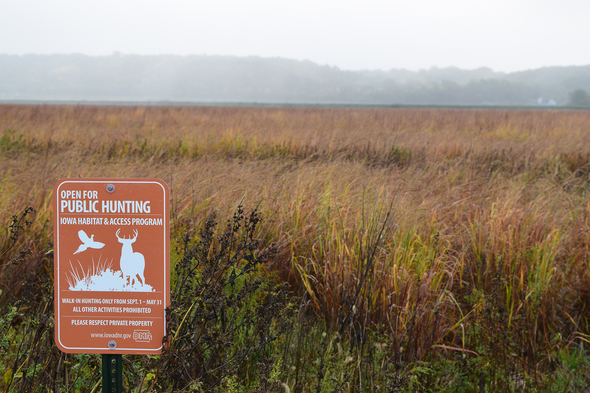 More than 4,900 acres of private land on 26 sites was opened to hunters in Harrison County since 2016 and pheasant numbers have increased 200 percent around these sites from 7 in 2016 to 21 this year. Photo courtesy of the Iowa DNR.
PERSIA,
Iowa - A few weeks ago, Terry Plummer noticed that just around sunset, the trees
in his yard were filling with monarchs that had stopped for the night on their
2,000 mile annual migration to central Mexico. Plummer, who spent his life
farming in Harrison County, didn’t recall that happening before.
Plummer, from rural Persia, has been
noticing more unusual things recently, thanks, in part, to the nearly 400 acres
of prairie he installed on two of his farm fields in 2017, when he signed up
for the Iowa Habitat and Access Program.
The two year old prairie has been a
discussion topic with his neighbors, as has the increased sightings of
pheasants along the road. And it’s not just the neighbors who’ve noticed,
hunters have as well.
“It’s turned out better than I’ve
imagined, so far,” Plummer said.
Acre after acre, field after field, mile
after mile, young prairies in Harrison County are coming in to their own. These
prairies, seeded with a mix of native plants to benefit pollinators, wetland
and upland species, have grown out of difficult to farm fields that are
enrolled in the USDA’s Conservation Reserve Program (CRP).
Four years ago, funding became available
through the Voluntary Public Access and Habitat Incentive Program, which is
part of the federal Farm Bill, to improve habitat on private land in exchange
for allowing hunting access and in a short time, more than 4,900 acres of
private land on 26 sites was opened to hunters.
“The landowners made the decision to
enroll in CRP. We approached them and said the program will help fund the
habitat improvements and we will do all the maintenance from mowing to tree
removal to burning. All you need to do is allow hunter access,” said Brian
Hickman, private lands program coordinator for the Iowa Department of Natural
Resources (DNR). “Needless to say, it was well received.”
A number of fields adjoin each other,
creating miles of connected habitat that benefits wildlife and can support lots
of hunters. Habitat work began with winter-seeding in 2016 and 2017. These
fields are starting to mature and on this gray October day, their value to
wildlife and hunters was evident.
Two northern harriers were flying low
over the prairie looking for a meal as they migrate south. Pheasants, shaking
off the morning mist, fled the roadside to the safety of taller vegetation
along a prairie edge. Ducks dodged early morning hunters and deer were loafing
at the opposite end of a field.
The Iowa DNR has been monitoring these
IHAP areas for pheasants collecting anecdotal information on the local
population since the project began. Based on the survey, pheasant numbers have increased
200 percent, from 7 in 2016, to 13 in last year, to 21 this year.
“I expect good pheasant hunting on these
areas,” Hickman said. “I’d be disappointed if it wasn’t.”
Partnerships
key to success
Staff with USDA’s Farm Service Agency
and the Natural Resources Conservation Service worked with Hickman to identify
and make contact with landowners interested in the program.
Hickman, who at the time was working at
the local private lands biologist for the Iowa DNR in western Iowa, met with
the landowners and signed agreements to manage their land for 9 or 10 years,
which is the maximum length of the contract. The land remains privately owned
and hunters are allowed access for the length of the contract. There was more
demand for the program than funding available.
Iowa Habitat
and Access Program (IHAP)
Iowa was selected as a pilot state in
2011 and from its inception the Iowa Habitat and Access Program (IHAP) has
drawn strong landowner interest securing all available funding and providing
hunter access to more than 25,700 acres of private land.
The program is also popular with hunters
who have focused much of their efforts on these orange-signed areas. Each site
has a survey box to collect comments from hunters.
Based on survey responses, hunters are
traveling 76 miles and spending an average of $70 per trip to hunt IHAP sites.
And most of them enjoyed it – 76 percent had a positive experience and 99
percent said they would hunt an IHAP site again. Pheasants were the most hunted
species.
These areas are regularly patrolled by
Iowa DNR conservation officers and are treated like public hunting ground, with
the noted exception that it is private property, and trapping and fishing on
the area is not allowed.
“This program is only available because
landowners were willing to participate in it. Hunters should respect private property,
stay on the land enrolled in the program and pick up after themselves,” Hickman
said.
Site maps are available at www.iowadnr.gov/ihap
showing boundaries, which species would be most likely attracted to the habitat
and the location of a checkout box where hunters are asked to leave their
comments on the program.
Walk-in public hunting through IHAP is
available between September 1 and May 31. The IHAP is supported with money from
Federal Farm Bill and Habitat Stamp.
As the cool fall weather is upon us, it’s time to start
pruning oak trees with minimal to no risk of spreading oak wilt. The best way to prevent the spread of oak
wilt is to prune during the trees dormant season.
“There have been several days in a row that were at or near
freezing and the risk of oak wilt is very minimal,” says Tivon Feeley, DNR
Forest Health Program Leader. For that
reason, the DNR suggest that you start pruning your oak tree now until late
winter.
Oak wilt is caused by a fungus and has been present in Iowa
for many years. The disease is most commonly found in red, black and pin oak
trees, but it can also be found in white and bur oak. On most occasions, if red, black, or pin oak
are affected by the fungus they usually parish within the same summer they become
infected. But, white and bur oak can
often take several years before they parish.
A healthy tree can be infected by the fungus two different
ways: 1). The fungus can be carried by a small beetle to an open wound of
healthy tree and cause the disease. 2). A healthy oak can get the fungus
through root grafts if it is located near an infected tree.
A common symptom of oak wilt includes leaves turning a
bronzed brown along the outer margins of the leaves. The best way to avoid the
spread of oak wilt is to prevent any wounding to oak trees during the growing
season. If a tree is wounded from storm damage or pruning is required during
the growing season, treat the wounds immediately with a wound dressing such as
acrylic paint. The DNR Forestry experts
recommend avoiding pruning paints or sealants as they tend to slow the tree’s
ability to heal the wound.
For more information on oak wilt prevention and control follow
the link below: http://na.fs.fed.us/pubs/howtos/ht_oakwilt/identify_prevent_and_control_oak_wilt_print.pdf
Media Contact: Tivon
Feeley, DNR Forestry Section, (515) 725-8453, Tivon.Feeley@dnr.iowa.gov.
JOHNSTON, Iowa -- The Iowa
Department of Natural Resources will stock trout at
1:00 p.m. on Oct. 24 at Terra Lake, as the trout program’s community fisheries
expands its central Iowa stockings to Johnston.
Terra Lake,
a new lake owned by the City of Johnston, is in Terra Park at 6300 Pioneer
Parkway.
Lake
Petocka in Bondurant, Banner Lake near Indianola and Ada Hayden Heritage Park
Lake in Ames will also be stocked this fall. Check the fall community trout stocking
calendar at www.iowadnr.gov/fishlocal
for dates and details.
Anglers must have a valid fishing
license and pay the trout fee to fish for or possess trout. The daily limit is five trout per licensed
angler with a possession limit of 10.
Children age 15 or younger can fish for trout with a properly licensed
adult, but they must limit their catch to one daily limit. The child can buy a trout fee which will
allow them to catch their own limit of five trout.
Media Contact: Ben Dodd, Fisheries Biologist,
Iowa Department of Natural Resources, 641-891-3795.
LANSING - The Village Creek public boat ramp,
south of Lansing, has reopened with new improvements. The ramp was closed for construction
July 5 through the first week of October.
Improvements
included grading and paving the roadway and boat ramp parking, installing a
vault restroom, building sidewalks and adding ramp extensions to improve ramp
access during low water conditions.
The project was a joint project between
Iowa Department of Natural Resources Fisheries and State Parks Bureaus and the
Marine Fuel Tax program. The
area is managed through an agreement with Allamakee County Conservation.
|





