|
Of the nearly 400 different species of birds that can be
found in Iowa, whether common or rare, a number of them can only be seen when
they are migrating between their summer breeding grounds and their wintering
grounds.
Even though Canada geese can be seen all year round in Iowa,
their classic V-formation flights often seem to signal the changing of the seasons
and the migratory period for a wide number of birds.
Whether you are a hunter, birdwatcher, or casual
naturalist watching waterfowl in Iowa during fall is an amazing experience! Some
of the geese, ducks, and other similar species that migrate through Iowa in
fall and spring include:
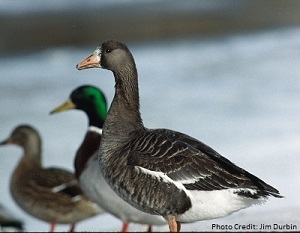 Greater White-fronted
Goose (Anser albifrons): A medium sized goose, with a small bill, short neck, and stocky
legs, the greater white-fronted goose can be found foraging in wet sedge
meadows, lakes, ponds, and wetlands. They are mostly brown and have a
pinkish-orange bill.
Snow Goose (Anser caerulescens): A
medium sized white bodied goose with black wingtips that are barely visible
while the goose is on the ground, but noticeable in flight. There is also a
blue morph, which has a white face and a dark brown body. During migration they
particularly like agricultural lands and will feed on waste grain, though they
are also found marshes.
Ross’s
Goose (Anser rossii): Essentially
a smaller version of the snow goose.
Cackling Goose (Branta hutchinsii): A
smaller version of the Canada goose that nests farther north and west. It also
has a much higher-pitched voice than the familiar honking of the Canada goose.
Gadwall (Mareca strepera): About
the same size as mallards, these dabbling ducks mainly eat submerged
vegetation, but are also known to steal food from diving ducks. They are mostly
brown, but the males have a black patch at the tail and the females a thin
orange edge to their dark bills.
|
 American Wigeon (Mareca americana): A
dabbling duck, the American wigeon spends most of its time during migration on marshes,
inland lakes and ponds. It eats a wide-variety of aquatic plants, but is also
known to steal food from coots or diving ducks. It is known by its distinctive
white crown.
Northern Shoveler (Spatula clypeata): A
dabbling duck, with a distinctive large spoon-shaped bill. It will occasionally
breed in northern Iowa. It prefers alkaline lakes, fresh marshes and shallow
waters. It can often be found on stagnant or polluted waters that are not
preferred by other ducks.
Northern Pintail (Anas acuta): The
males are easily identifiable by their long and pointed tails; though present
on all northern pintails it is most prominent on the males. They have an
elegant slender profile and their wings are long and narrow in flight.
Green-winged Teal (Anas crecca): The
smallest dabbling duck in North America. During migration they are generally
found on shallow wetlands. During flight it is possible to see the green wing
patches that both sexes have. Males are grey with a chestnut head and green
streak whereas females are brown.
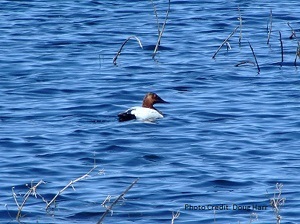
Canvasback (Aythya valisineria):
The largest diving duck. Males have a chestnut
head and neck, a black chest and rear, and a white body. Females have a light
greyish body and a slightly darker head, chest and rear. During migration it
can mostly be found on large lakes
|
 Ring-necked Duck (Aythya collaris): A
compact diving duck with a unique head shape - a sloping forehead and a peaked
rear crown that flattens when diving.
During migration they can be found on ponds, lakes, or slow-moving
rivers.
Lesser Scaup (Aythya affinis): A
medium sized diving duck that migrates relatively late in fall. From a distance
the males look black and white though a closer view reveals an iridescent
purple or green sheen to the head. When out of breeding season the males have
grey brown body and a black head. Females are brown all over with a dark
head.
Bufflehead (Bucephala albeola): A
small duck that is less sociable than most other ducks. It is almost never seen
in large flocks and instead prefers small flocks or traveling in pairs. Its
name comes from the term “buffalo head,” which refers to the odd puffed shape
of the male’s head.
Red-breasted
Merganser (Mergus serrator): Very similar to the common merganser, which overwinters in Iowa,
but nests further north and winters further south. Both males and females share
a shaggy head.
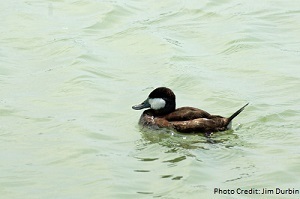
Ruddy Duck (Oxyura jamaicensis): Known
in summer and spring migration for the male’s bright blue beak, in the winter
and fall migration its beak is grey. It has a dark cap and a solid white cheek.
|
Seeing the sometimes vast flocks of migratory birds can be
an amazing sight whether a hunter or birdwatcher!
|





