|
FOR IMMEDIATE RELEASE
September 4, 2018
LEHIGH, Iowa – A man was shot on Saturday, September 1, while
squirrel hunting at the Brushy Creek State Recreation Area.
Sao Bunpan, 55, was shot in the upper body by Khor Bunpan,
50, both of Webster City. The two brothers were hunting together with a party
of four at Brushy Creek during opening day of squirrel hunting.
Sao Bunpan was taken to a Webster City hospital and then
transported to a Des Moines hospital with non-life threatening injuries.
DNR conservation officers are investigating, but initially
believe this is an accident and no charges have been filed.
Media Contact: Bill Spece, DNR Conservation Officer, (515)
571-0127, William.Spece@dnr.iowa.gov.
Several state parks are experiencing impacts from the recent heavy rainfall forcing closures of the parks and many trails.
Currently, George Wyth State Park is completely closed due to flooding. The Cedar River is expected to crest midweek, likely causing flooding and cleanup throughout the weekend. DNR officials advise the trails are covered by water and should be avoided for possible washouts or sinkholes.
Other parks impacted by the flooding include:
- Backbone State Park - north gate closed, trout stream bridges and areas near the river are closed off, trails are still open and campgrounds outside of gated area are open along with the south gates.
- Brushy Creek State Recreation Area - trails are closed due to wet conditions
- Lake of Three Fires - trails are closed due to wet conditions
- Ledges - Canyon Road is closed
- Stephens State Forest - equestrian trails are closed due to wet conditions
- Volga River State Recreation Area - equestrian trails are closed due to wet conditions
-
Yellow River State Forest - the equestrian trails, Little Paint campground, Frontier equestrian campground, and Creekside equestrian campground are closed due to flooding
For a complete list of park closures or impacts, visit www.iowadnr.gov/Places-to-Go/State-Parks/Alerts-and-Closures.
Media Contact: Alex Murphy, Director of Communications, Iowa Department of Natural Resources, (515) 729-7533 or Alex.Murphy@dnr.iowa.gov.
 The
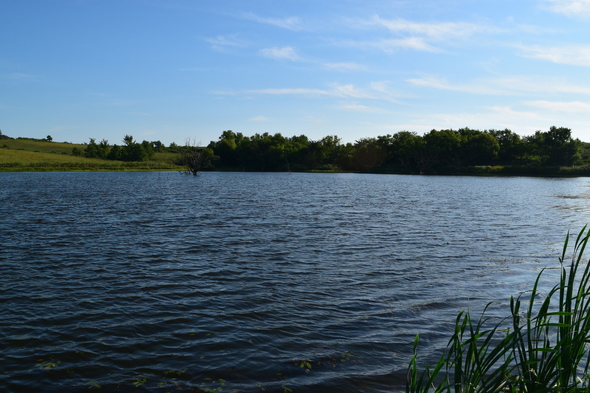
Ringgold Wildlife Area, south of Mount Ayr on the Missouri border, is 2,600
acres of prairie, timber, oak savannas and floodplains with a handful of
fishable ponds mixed in.
“We’re
pretty fortunate to have an area of that size,” said Chad Paup, wildlife
management biologist for the Iowa Department of Natural Resources. “It’s one of
my favorite areas.”
The
Ringgold Wildlife Area is home to a host of bird species, including an occasional
prairie chicken wandering over from the nearby Kellerton. Five turkeys were
lazily bugging in a field. A sharp shinned hawk flies low and tight to a row of
shrubs looking for a meal. Goldfinches seem to be everywhere.
The
area features reconstructed prairie as well as some prairie that’s never been plowed.
Its forb heavy which benefits pollinators and birds who dine on the bugs
attracted to the flowers.
Grassland
management is the focus here; converting fields of brome grass into prairie. It
requires a lot of attention to carry out the rotation of strip disking and
spraying.
A
field of seed producing common ragweed has appeared next to the row of shrubs
on a part of Ringgold near the state line. Common ragweed produces seeds; shrub
patch provides escape and winter cover.
“It’s
a perfect mix for bobwhite quail and mourning doves,” he said.
Food
plots dot the area rotating yearly from soybeans to sorghum to being left
alone. Paup gets calls from nonresidents who want to know more about Ringgold
as well as nearby Sand Creek and DeKalb wildlife areas as they prepare to apply
for a deer license.
“They
are using the hunting atlas to look at Ringgold from above and see the draws
and valleys and the large timber tracks with grassy areas,” he said. “It
catches their attention.”
Camping and
fishing
Tucked
in Ringgold’s rolling hills area a series of small ponds – some managed as a
fishery and others are not. Visitors can drive right to some of the larger
ponds with rustic boat launches and parking lots. Other ponds are only
accessible by foot. These areas are open to fishing and no frills camping and
paddling.
No
street lights, road noise or neighbors. This is the definition of getting away
from it all.
Large IHAP site
borders Ringgold
Adjoining
the Ringgold area on the northeast side is 300-acre site enrolled in the Iowa
Habitat and Access Program that allows hunter access to private land in
exchange for improving the habitat on their property. It’s marked with a series
of orange IHAP signs.
Barn owl boxes
The
recent increase in the number of barn owls across southern Iowa spurred a
network of barn owl boxes to crop up on many areas, including Ringgold, as part
of a coordinated effort to provide nesting to this state threatened species.
Barn
owls have a long nesting season stretching from spring into the fall.
Grassland
management research
The
Ringgold area has been testing the rotational technique called patch burn
grazing for vegetation management of using cattle grazing on one third of the
area, burning one third of the area and allowing one third to recover and
rotating every three years.
“We’re
trying to create grass and flowers of different heights for grassland birds,
reptiles, amphibians and other wildlife. It’s a challenge because tall fescue
invaded southern Iowa a long time ago and it really impacts our native
grasslands,” he said.
“We
are working with several management techniques in order to keep tall fescue at
bay.”
Research
is wrapping up on the nine year study.
Media Contact: Chad Paup, Wildlife Management Biologist, Iowa Department of Natural Resources, (515) 238-5708.
Have
the cattails in your pond taken over your favorite fishing spot or crowded you
from one side of the dock or swimming area?
Late summer or early fall is the best time to kill cattails, Lotus lily and
other emergent or floating-leaved plants that are on the pond’s edge or are
above the water. Spraying herbicides this time of year will kill the entire
plant, and it will not regrow next spring. Since these plants die-back every
year at this time and decompose slowly over the coming months, there is little
risk of depleting the oxygen in the pond with treating these plants.
Starting in late summer, these plants move food to their roots to survive the
winter, making systemic herbicides most effective. The most common active
ingredient to use is glyphosate (a few brand names with labels for aquatic use
include Aqua Neat, Aqua Pro, Aquamaster, GlyphoMate 41, Pond Master, Rodeo,
Shore Klear and Touchdown Pro). Find these at local hardware, farm supply or
garden stores or try an online search for “aquatic glyphosate.”
Many of these herbicides need a surfactant or spreader-sticker added to the mix
to help it stick to the plant’s leaves.
Read the label and check with your local or online retailer to select a
surfactant that you can use in ponds. Spray
the above-water portion of the plant until just wet and follow other
instructions on the product label.
When you compare product brands, consider the amount of active ingredient, if a
surfactant is needed, and size of the container. A product with a higher amount
of active ingredient or one that does not need a surfactant added may provide a
better value. The convenience of a
ready-to-use (RTU) product that you do not have to mix or add a surfactant may outweigh
price considerations.
Be careful to:
- Always
read and follow the product label for application instructions and precautions.
- Spray
when calm, or when winds are low and out of a favorable direction to avoid
accidentally spraying other plants valuable to landscaping. Increase the droplet size of the spray to
reduce drift.
- Spray
early in the day with full sunlight to get the best results.
- Obey
State law. Shoreline owners on public
waters may not use herbicides to control aquatic vegetation without a permit. Contact the DNR fisheries office near you for
rules and instructions for removing vegetation from public waters.
Learn
more about aquatic plants in ponds at www.iowadnr.gov/pondplants.
Media Contact: Darcy Cashatt, Fisheries Technician,
Iowa Department of Natural Resources, (641) 647-2406.
|





