|
FOR IMMEDIATE RELEASE
August 28, 2018
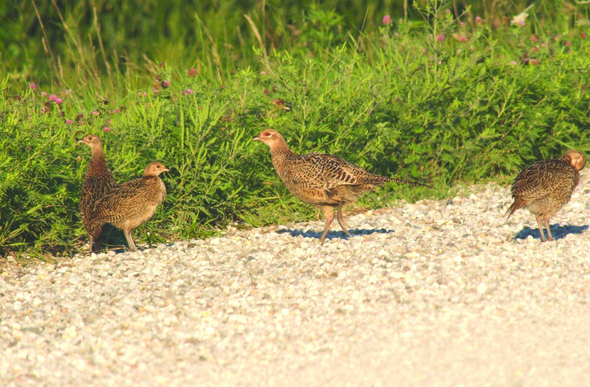 Young pheasants dry off the morning dew along the edge of an Iowa gravel road. Iowa’s statewide average of 21 pheasants per route is second highest in a decade. Only 2015 with its statewide average of 23 birds per route was higher. Photo courtesy of the Iowa DNR.
BOONE - Iowa’s pheasant hunters can expect to find more birds this fall
when they head to the fields, predict state wildlife experts. That forecast is
based on the recently completed statewide population survey of pheasants, quail,
partridge, cottontail rabbits and jackrabbits.
Iowa’s pheasant population increased in every nine county region
except northwest where it was similar to last year. The survey counted a state
average of 21 birds per 30 mile route which translates to a statewide harvest
estimate of 250,000 to 300,000 roosters this fall.
The August roadside survey is tool used by the Iowa Department
of Natural Resources (DNR) to physically record the number of upland game seen
while driving the survey routes. It’s a product of 218 30-mile routes across
that state that are conducted Aug. 1-15 beginning at sunrise. The survey has
used the same routes since 1962.
“We weren’t sure what to expect from the survey this year
because the spring weather was all over the board and it likely impacted some
nesting success,” said Todd Bogenschutz, upland wildlife research biologist for
the Iowa DNR. April started cold with 10-20 inches of snow across northern Iowa
and then switched to warm and dry by the end of May.
“The take home message is, if you had good hunting last year,
you can expect similar hunting or better hunting across most of the state this
year,” he said.
The 2018 count was an increase over the 15 birds per route in
2017. However, Bogenschutz said dry conditions in 2017 likely did not
accurately reflect the pheasant population and when adjusted for the lack of
dew the population would be similar, but still slightly lower than 2018.
Another positive for hunters is the quail and cottontail rabbit
populations, both at present day highs.
“Anyone who has ever had an interest in quail hunting or hasn’t
hunted quail recently – this would be a good fall to go,” Bogenschutz said.
Iowa’s quail range is across the southern third of the state. Rabbits
are abundant in all parts of Iowa with the highest populations in southern and
east central regions.
Partridge population is similar to 2017 with the highest
population in central and northern Iowa.
The lone exception is jackrabbits which have seen its numbers
fall likely due to a landscape that shifted from producing small grains and
fields of short grasses to larger fields of corn and soybeans.
The August roadside survey and game distribution maps are
available online at www.iowadnr.gov/pheasantsurvey.
- Pheasant season is Oct. 27 to Jan. 10, 2019
- Quail season is Oct. 27 to Jan. 31, 2019
- Partridge season is Oct. 13 to Jan. 31, 2019
- Cottontail rabbit season is Sept. 1 to Feb. 28, 2019
- Jackrabbit season is closed.
Media Contact: Todd Bogenschutz,
Upland Wildlife Research Biologist, Iowa Department of Natural Resources,
515-979-0828.
The Iowa Department of Natural
Resources (DNR) recently confirmed that zebra mussels are in Storm Lake.
The DNR collects water samples and deploys
settlement samplers in lakes across the state each summer to monitor for the
invasive zebra mussel. Young zebra
mussels (called veligers) were found in an August water sample, and further
investigation discovered juvenile and adult zebra mussels in several locations
around the lake. DNR staff will conduct additional monitoring at Storm Lake this fall and next summer to determine the abundance and
distribution of zebra mussels.
The documentation of zebra mussels
in another lake highlights the spread of aquatic invasive species in Iowa
waters. “The zebra mussels in Storm Lake probably arrived on or in a boat that
had picked up the mussels from an infested water body, like the Spirit/Okoboji
chain of lakes or the Missouri River,” said Kim Bogenschutz, the DNR’s Aquatic Invasive
Species Program coordinator.
Zebra
mussels look like small, D-shaped clams that have alternating light and dark
bands. Most are less than one inch long. They are filter feeders that can form
dense clusters as they attach to hard underwater surfaces. Large
infestations may interfere with aquatic food chains, kill native mussels, clog
water intakes, increase algae blooms, and cover beaches with dead shells.
Currently there is no effective treatment to control zebra mussels once they
have infested a lake.
Young
zebra mussels are microscopic and can be unintentionally transported with water
in live wells, bilges, ballast or bait buckets. Adult zebra mussels can
attach to boats, trailers and aquatic vegetation.
It
is illegal to possess or transport prohibited aquatic invasive species, such as
zebra mussels, in Iowa. Boaters must also drain all water from boats and
equipment before leaving a water access and must keep drain plugs removed or
opened during transport.
“Boaters
and anglers can unintentionally spread zebra mussels and other aquatic invasive
species if they do not take the proper precautions - clean, drain, dry - after
each time out on the water,” said Bogenschutz.
- CLEAN
any plants, animals or mud from boat and equipment before you leave a water
body.
- DRAIN
water from all equipment (motor, live well, bilge, transom well, bait bucket)
before you leave a water body.
- DRY
anything that comes into contact with water (boats, trailers, equipment, boots,
clothing, dogs). Before you move to another waterbody either:
- Spray
your boat and trailer with hot, high-pressure water; or
- Dry
your boat and equipment for at least 5 days.
- Never
release plants, fish or animals into a water body unless they came out of that
water body and empty unwanted bait in the trash.
“Draining all water is a critical step in preventing the spread
of zebra mussels,” said Bogenschutz.
Find more information about aquatic invasive species and a list
of infested waters in the 2018 Iowa Fishing Regulations booklet or on the DNR’s
website at www.iowadnr.gov/ais.
Media Contact: For more information, contact Kim Bogenschutz, Boone Wildlife Research
Station at 515-290-0540 or Ben Wallace, Black Hawk Fisheries Office at
712-657-2638.
Hunter
Education Classroom courses are offered by knowledgeable and certified
volunteer instructors and Iowa Department of Natural Resources Conservation
Officers. Classroom courses are typically 12-15 hours in length and are held
over 2 to 3 sessions (days). In order to receive certification, a student must
attend all sessions and pass the final exam.
Iowa
law requires that anyone born after January 1, 1972 must be certified in hunter
education before they are eligible to purchase an Iowa hunting license.
Upcoming
Hunter Education Classes
Sept. 6, New Hampton, Fredericksburg Sportsmans
Club
Sept. 6, Knoxville, Marion County Sportsman Club
Sept. 8, Swisher, America Legion
Sept. 8, Muscatine, Muscatine County Conservation
Board, Environmental Learning Center
Sept. 8, Blue Grass, Oak Hills Gun Club
Sept. 8, Madrid, Madrid High School
Sept. 8, Shenandoah, Elks Lodge
Sept. 8, Lenox, Lenox Fire Station
Sept. 8, Aplington, Aplington Community Center
Sept. 10, Polk City, Butch Olofson Shooting Range
Sept. 11, Marcus, Grace Methodist Church
Sept. 11, DeWitt, Wapsi Valley Ikes
Sept. 12, Palo, Palo Outdoors
Sept. 13, Tipton, Cedar County Conservation Board
Office
Sept. 15, Waterloo, Hawkeye Community College
Sept. 15, St. Charles, Hutton Taxidermy
Sept. 15, Mt. Ayr, Dragoon Trace Nature Center
Sept. 15, Quimby, Peterson Family Farm
Sept. 17, Clarinda, American Legion
Sept. 18, Osceola, Clarke Elementary School
Sept. 19, Exira, Audubon County Conservation Board
Sept. 19, Independence, Buchanan County Wildlife
Association
Sept. 20, Dubuque, EB Lyons Interpretive Center -
Mines of Spain
Sept. 20, Waukon, Allamakee Sportsmans Club
Sept. 20, Iowa City, Fin and Feather
Sept. 22, Sigourney, Keokuk County Sportsman Club
Sept. 25, Toddville, Wickiup Hill Learning Center
Sept. 27, Peosta, North Iowa Community College
Sept. 29, Mount Pleasant, Henry County Nature
Center
Oct. 1, Polk City, Butch Olofson Shooting Range
Oct. 1, Sioux City, Elks Lodge #112
Oct. 6, Waterloo, Hawkeye Community College
Oct. 13, Keswick, Keswick Fire Station
Oct. 15, Polk City, Butch Olofson Shooting Range
Oct. 16, Nevada, Gates Hall
Oct. 19, Osage, Mitchell County Nature Center
Oct. 23, Bellevue, Bellevue State Park Lodge
Oct. 23, Ottumwa, Izaak Walton League – Ottumwa
Nov. 5, Polk City, Butch Olofson Shooting Range
For
more information on these and other hunter education opportunities, go to www.iowadnr.gov/huntered
The campaign to reduce and
eliminate tree stand accidents by raising awareness of this issue and providing
education about safe tree stand hunting best practices appears to be getting
positive results.
Nationally, the estimated
number of falls from tree stands requiring emergency room visits decreased by
28 percent in 2017.
“That’s a significant, positive
move on the tree stand injury prevention front but we still have room for
improvement,” said Megan Wisecup, hunter education administrator for the Iowa
Department of Natural Resources.
Nearly all of tree stand
incidents are preventable by implementing three simple measures: First, inspect
your equipment. Second, wear a full-body harness and third, stay connected from
the time your feet leave the ground. It really is that simple.
Tree stand accidents can happen to
deer hunters of all skill levels and result in serious injury or death. In Iowa
last year, there were four tree stand incidents and all resulted in injury.
“Hunters should
take tree stand safety seriously, every time you hunt from, hang, or move a
tree stand,” Wisecup said.
Since
September is traditionally a busy time for deer hunters who are preparing for
the upcoming hunting season; it has been chosen as Tree Stand Safety Awareness
Month.
To
help prevent injuries, the Iowa DNR in partnership with TSSA, is promoting a
new awareness campaign called the “ABC’s of Tree Stand Safety.”
Always remove and inspect your
equipment
Buckle on your full-body harness
Connect to the tree before your
feet leave the ground
“By
performing these three simple steps, tree stand users can virtually eliminate
their risk of falling to the ground as the majority of falls occur outside the
stand,” Wisecup said.
Tree stand safety awareness month is
national campaign by tree stand manufacturers, retailers, media, natural
resource agencies and deer hunters to reduce the estimated number of tree stand
incidents by 50 percent by 2023.
Media
Contact: Megan Wisecup,
Hunter Education Administrator, Iowa Department of Natural Resources, 515-238-4968
or Jeff Barnes, Recreation Safety Officer, Iowa Department of Natural
Resources, 515-290-4907.
Marengo, Ohio - Iowa action shooters won six
categories at the National Championship of the Scholastic Action Shooting
Program, in Marengo, Ohio, led by Dysart’s Nate Gibson who captured top honors
in Rimfire Pistol, Pistol Caliber Carbine and Iron Rifle.
More
than 500 athletes from 19 states competed in the week-long championship July
14-21 at the Cardinal Shooting Center. Participants shoot a series of steel
targets in the least amount of time using an optics rifle, iron rifle,
centerfire pistol, rimfire pistol or 1911 model pistol.
Iowa
was represented by five teams and individual shooters totaling 120 athletes.
For
information on how to form a team, contact Rachel Ladd, Hunter Education and
Shooting Sports Program, Iowa Department of Natural Resources, 515-729-6037 or Rachel.ladd@iowa.dnr.gov
Iowa Place Winners
Rimfire Pistol - Men's
Division 1st place
Nate
Gibson, Dysart, 31.58 match time
Centerfire Pistol - Collegiate
Open Division 2nd place
Steel
Shooters of Traer - squad time 342.39
Matt
Whannel, Traer,
Tanner
Calderwood, Traer
Centerfire Pistol- Women's
Senior Varsity Division 2nd place
Megan
Carty, Dysart, 60.08 match time
Optics Rifle - Collegiate
Open Division 2nd place
Steel
Shooters of Traer - squad time 342.39
Matt
Whannel Traer
Tanner
Calderwood, Traer
Optics Rifle - Men's
Division 2nd place
Nate
Gibson, Dysart, 29.68 match time
Optics Rifle - Men's
Intermediate-Entry Division 2nd place
Kaleb
Klein, Dysart, 36.18 match time
Iron Rifle -
Intermediate Division 2nd place
Steel
Shooters of Traer - squad time 201.09
Sydney
Vavroch
Kaleb
Klein, Dysart
Nate
Gibson, Dysart
Alexander
Meggers, Traer
Iron Rifle - Collegiate
Open Division 2nd place
Steel
Shooters of Traer - squad time 346.09
Matt
Whannel, Traer
Tanner
Calderwood, Traer
Iron Rifle - Men's
Division 1st place
Nate
Gibson, Dysart, 28.21 match time
1911 - Collegiate Open Division 1st
place
Steel
Shooters of Traer - squad time 339.8
Matt
Whannel, Traer
Tanner
Calderwood, Traer
1911 - Men's Intermediate-Advanced
Division 1st place
Nate
Gibson, Dysart, 72.81 match time
1911 - Men's Collegiate Division
2nd place
Tanner
Calderwood, Traer, 60.56 match time
1911 - Women's Senior Varsity
Division 2nd place
Megan
Carty, Dysart, 64.44 match time
Pistol Caliber Carbine - Collegiate
Open Division 1st place
Steel
Shooters of Traer - squad time 339.8
Matt
Whannel, Traer
Tanner
Calderwood, Traer
Pistol Caliber Carbine -
Intermediate Division 2nd place
Steel
Shooters of Traer - squad time 339.8
Nate
Gibson, Dysart
Sydney
Vavroch
Kaleb
Klein, Dysart
Alexander
Meggers, Traer
Pistol Caliber Carbine - Men's
Intermediate Entry Division 2nd place
Kaleb
Klein, Dysart, 46.60 match time
Pistol Caliber Carbine - Men's
Intermediate Advanced Division 1st place
Nate
Gibson, Dysart, 33.61 match time
Pistol Caliber Carbine - Men's
Collegaite Division 2nd place
Tanner
Calderwood, Traer, 45.39 match time
|





