|
FOR IMMEDIATE RELEASE
July 17, 2018
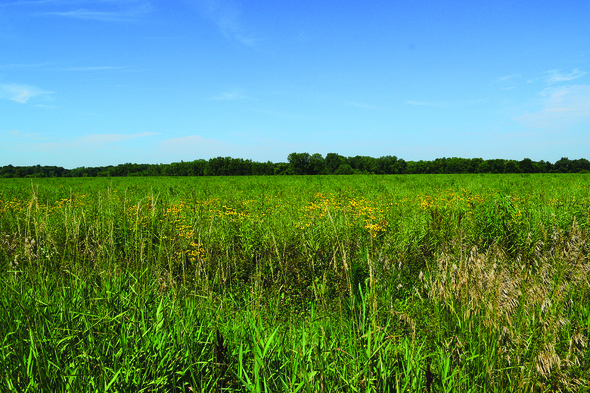 This prairie, in its second year, is starting to find its identity. Two years removed from being a soybean field, wild bergamot, black-eyed Susan and more native plants have returned. The Oxford Junction area is alive with redwing black birds, grasshoppers, goldfinches, butterflies, dragonflies and pheasants. Photo courtesy of the Iowa DNR.
Oxford
Junction, Iowa - The Oxford Junction Wildlife
Area in southeast Jones County might be hard to find on a map made before 2017.
That’s because it didn’t exist.
Oxford Junction wildlife area is only two
years old.
The 450-acre public area, split into
two parcels, emerged from the Wapsipinicon River floodplain because the river
has a habit of leaving its banks. It will grow by 66 acres, possibly as early
as this fall, when an adjacent floodplain forest is added.
“We don’t often get to start a new
area,” said Curt Kemmerer, wildlife management biologist with the Iowa
Department of Natural Resources. “Here, we’re getting in on the ground floor.
Two years ago, this was 80 acres of soybeans. Looking at it today is an amazing
change.”
The sea of young prairie is alive with
redwing black birds, grasshoppers, goldfinches, butterflies, dragonflies and
pheasants.
Establishing a prairie takes time and
commitment. In year one, the young plants need to be mowed at certain stages to
promote growth. In year two, Kemmerer has allowed the prairie to begin finding
its identity and over time, he said, the native plants will out-compete the
annuals. Out popped wild bergamot, black-eyed Susan and more.
One benefit of creating an area from
scratch is ability to place habitat strategically to help save time and money down
the road. Kemmerer added lanes of clover where pheasants and other wildlife
will go bugging and will serve as firebreaks when it’s time to burn.
“Floodplains want succession,” he
said. “We will need use fire regularly to keep the grassland and prevent canary
grass and willows and cottonwoods from taking over.”
His development plan also identified
four different areas that were planted with a half-acre of plum, dogwood and
high bush cranberry shrubs to expand the habitat diversity. The shrubs will
provide a fall and winter food source and winter cover for pheasants and quail.
Pollinators will use the blossoms.
He plans to restore a few small
pockets along the river from canary grass to oaks, with some sycamores and
river birch for diversity.
“We have some big majestic oaks here
and we will manage for them which will add the forest component,” he said. He plans to plant seedlings on six acres and
go from there.
“Having a diverse bottomland forest
would be great. There’s an active bald eagle nest in a large cottonwood on the
east parcel,” he said.
Wetlands by the river naturally
fluctuate and he hasn’t done much management yet because the area is so new.
“We need to learn the area so we understand
how it’s going to react to certain management practices,” Kemmerer said.
“Because this area floods regularly, what you want to do and what you can do
have to jive.”
Partnerships
made Oxford Junction
The Oxford Junction Wildlife Area is
here because a who’s who of eastern Iowa conservation partners rolled up their
sleeves to make it happen.
One partner in particular, Eastern
Iowa Conservation Foundation, of Dubuque, purchased 80 acres that they enrolled
in USDA’s Conservation Reserve Program pollinator practice, and the Iowa
Habitat and Access Program last year. After all the paperwork was done, they
donated the land for everyone to use.
The Dubuqueland chapter of Pheasants
Forever donated landscaping fabric, a machine to install the fabric and about a
dozen volunteers to plant the shrubs. Using fabric prevents other plants from
outcompeting young shrubs and allows them to become established. In year two,
the shrubs are looking good.
On Columbus Day last year, 15 service
members from the Dubuque National Guard Armory volunteered their time and
equipment to remove an acre or so of cottonwood trees. The area is now prairie.
This group has been in contact with Kemmerer about making this an annual event.
“It’s cool what you can get done with
determined volunteers,” he said.
The Twin Rivers Chapter of Pheasants
Forever has been hands on partners as have the Dubuque County Conservation
Society. In fact, the broad partnership includes Wapsi Bottoms Whitetails
Unlimited, Delaware County Pheasants Forever, Jones County Conservation Board,
Linn County Pheasants Forever, National Whitetails Unlimited, Grant Wood Loop,
Matt McQuillen, the Iowa Natural Heritage Foundation and the Iowa Department of
Natural Resources.
Residents’
fears eased, hunters’ pleased
Oxford Junction’s northwest property
boundary is within the city limits which brought concerns from residents about
hunting and safety.
Merle Tank, 82, has been the Mayor of
Oxford Junction for 10 of the last 12 years. He said members of the city
council had concerns about the area but after they saw how it was designed,
those concerns were put to rest.
“I think it’s a good area,” Tank said.
Located within 40 miles of Dubuque, Clinton,
Davenport, Iowa City and Cedar Rapids, the young area will likely be a busy
place once the word gets out and Tank said he anticipates the gun dealer and
convenience store in town will benefit from those visitors, some who have
already stopped by.
“We had really positive hunter
feedback,” Kemmerer said. “They were excited to be here, satisfied with the
areas. It’s been a popular place.”
The food plots have been popular
places for hunters. One plot in particular hosted two tree stands last year and
Kemmerer expects more will find the spot this fall. “It’s a long hike but a
unique experience with trees along both sides,” he said.
Bird
watching, fishing
The Wapsipinicon River corridor is heavily
used by birds during the migration. Kemmerer plans to work with the district
forester to create a forest stewardship plan which should make the area
attractive to birds and bird watchers.
There are two, three-acre ponds on the
east tract that offers good fishing for those willing to explore. The ponds are
very different – one is surrounded by trees with little shore fishing access,
the other is surrounded by sand deposits with a fish population heavily
influenced by the river and little shade. These ponds would also be a good
place to take a kayak.
Management
There are a lot of wet spots in the
area and it has a history as a pasture. Kemmerer said he plans to continue
using a local producer to graze the east section to keep the canary grass down.
What has emerged are sedges, bulrush and iron weed – all good native plants. Cattle
would be in the area from first week of May to Sept. 1, to minimize conflicts
with hunters.
Down the road, the pasture area will
be enhanced by creating an oak savanna.
Media
Contact: Curt Kemmerer, Wildlife Management
Biologist, Iowa Department of Natural Resources, 563-357-2035.
Colo – The Iowa Department of Natural
Resources has relaxed the fishing regulations at Hickory Grove Lake to allow
anglers to more freely harvest game fish before the lake is renovated.
The
lake is scheduled to be drained for restoration in early September. This is part of a larger project to improve the water quality
and habitat in the lake.
Anglers with a valid fishing license are allowed to harvest any
size or number of all species from Hickory Grove Lake. Any number of fishing
poles or jug fishing is allowed. Anglers must remain in sight of these lines at
all times, and follow all other fishing regulations and area rules. Trot lines
will be allowed (name and address must be attached), however lines may not be
set across the entire water body.
Liberalized fishing regulations for Hickory Grove Lake will be
in effect from July 10 until the lake is fully drained. Specific regulation
changes include:
- Removal of bag and length limit restrictions on largemouth bass.
- Removal of bag limit on channel catfish.
- Removal of bag limit on crappie and bluegill.
Nets, dynamite, trotlines, poison, electric shocking devices, or
any stupefying substances are not allowed. It is illegal to sell fish or stock
captured fish into public waters. The normal park hours of 5:00 a.m. until
10:30 p.m. will remain in effect.
Media
Contact: Ben Dodd, Fisheries Biologist, Iowa Department of
Natural Resources, 641-891-3795.
|





