|
FOR IMMEDIATE RELEASE
July 10, 2018
CLEAR
LAKE, Iowa – The Iowa Department of Natural Resources is releasing the names of
the juveniles involved in Friday’s crash on Clear Lake involving two personal
watercrafts.
Kyle
Olberding, 15, of Glidden, was operating the personal watercraft that struck a second personal watercraft with McKenna Holahan, 17, Wynee Bond,
17, and Ellie Shimp, 17, all of Cedar Falls, onboard. Shimp was transported
to a hospital in Rochester, Minn.
Olberding’s passenger was Grant Borkowski, 16, of
Carroll.
Olberding was
charged with Reckless Use of a Watercraft – Iowa Code chapter 462A.12(1) and
Operation of a Watercraft by an Underage Person Without Boating Education –
Iowa Code chapter 462A.12(6).
DNR
conservation officers remind those operating personal watercraft to stay at a
safe distance from other personal watercraft and avoid what they commonly see
on Iowa waters of one personal watercraft trying to splash nearby personal
watercrafts.
Regardless
of age, the DNR encourages everyone who will operate or ride as a passenger on
a motorboat or personal watercraft to take an online boater education course,
which can be found here: http://www.iowadnr.gov/Things-to-Do/Boating/Boater-Education.
Note: A
criminal charge is merely an accusation and a defendant is presumed innocent
until proven guilty.
Media
Contact: Ben Bergman, DNR Conservation Officer, 641-425-0828, Ben.Bergman@dnr.iowa.gov.
An estimated 55,000 hunters harvested
more than 221,000 roosters in Iowa last fall; a slight decline from 245,000
harvested in 2016. Hunters reported good success across the entire northwest
quarter of Iowa.
An early look at the 2018 pheasant
forecast begins with nesting success which is likely a mixed bag.
Parts of southern Iowa are dry while
northern Iowa has been inundated with rain. Combined with a late arriving
winter is a recipe for a stable to declining pheasant population.
“Our best indicator for the pheasant
population is the August roadside survey, but our weather model gives us a
pretty good guess what the population trend might be,” said Todd Bogenschutz,
upland wildlife research biologist for the Iowa Department of Natural
Resources.
Bogenschutz bases his prediction on a
series of statewide weather indicators. The model uses historic correlations
between roadside counts and winter snowfall, spring temperature and rainfall to
predict this fall’s population trend based on current weather. The model has
been used since 2002 and accurately predicts the population trend more than 80
percent of the time.
The statewide thresholds that predict
an up or down population are 30 inches of snow, eight inches of rain and an
average spring temperature of 54 degrees. Much of the state crossed the rainfall
line and was cooler than preferred, but not all.
“It’s not all bad news,” Bogenschutz said. “We
have a lot of mixed data especially in southern Iowa. That region didn’t
receive much snow, and two of the three southern zones were at or below the
rainfall totals that impact nesting. Anecdotally, we’ve received reports of more
roosters crowing and male bobwhite calling in this area, which is a sign of
good overwinter survival. Bobwhite could be abundant in southern Iowa this fall.”
More than 8,500 quail hunters
harvested nearly 27,000 quail in 2017
The August roadside survey of upland
populations takes place Aug. 1-15. Staff will drive more than 6,000 miles of
survey routes across the state to assess bird trends. Results will be posted
around Sept. 10 at www.iowadnr.gov/pheasantsurvey.
Media Contact: Todd
Bogenschutz, Upland Wildlife Research Biologist, Iowa Department of Natural
Resources, 515-979-0828.
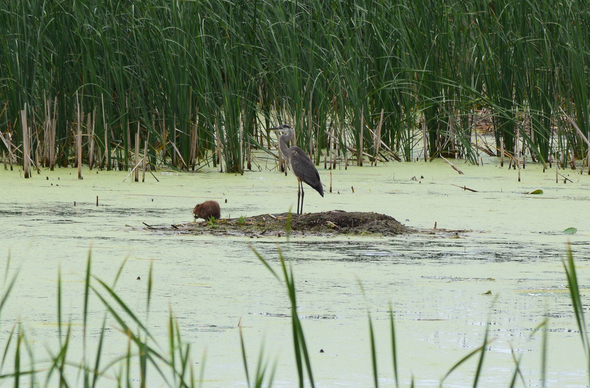 A great blue heron is resting on a muskrat hut at Willow Slough Wildlife Area after a mid-morning fish snack. The resident architect is chomping on a cattail nearby. Photo courtesy of the Iowa DNR.
Willow
Slough Wildlife Area is the solution to the problem of what to do with land too
wet to farm.
The
popular marsh in northeast Mills County has been drawing duck and goose hunters
from southwest Iowa and eastern Nebraska, and deer hunters from the surrounding
communities since it was acquired in 1959.
But
after the seasons close, it gets pretty quiet.
Like
most state managed wildlife areas, 600-acre Willow Slough is open for
recreation all year long. Pulling onto its west access lane, the miles of corn
and beans give way to towering cottonwood trees, nervous deer bound away and
mourning doves are quick to take wing.
Walking
down the concrete boat ramp to the 150-acre marsh, the water begins to jump
with frogs escaping to the safety of the water. Its west edge is covered with
broad-leafed lotus in full bloom, hiding birds and bullfrogs looking to score
an easy meal. There’s a real quietness here if you don’t count the chorus of
bullfrogs croaking at full throttle.
The
water surface is smooth as glass.
“I
see a lot of potential here for kayaking, hiking and bird watching,” said Matt
Dollison, wildlife management biologist for the Iowa Department of Natural
Resources.
He
said hikers could use the two-mile long dike or the access lane for a hill-free
experience. Given its location near the Missouri River, Willow Slough attracts
a large number of bird species and waterfowl during the spring and fall
migration.
Finding the prairie
Dollison
has been responsible for managing Willow Slough for the past five years and
over that time he has seen the area evolve.
He
partnered with the Mills/Fremont chapter of Pheasants Forever to clear 29 acres
of invasive bush honeysuckle near the southwest access lane and what returned
was native prairie plants, like prairie blazing star. He plans to expand the reclaimed
prairie to the east by removing more bush honeysuckle and cottonwood trees.
“Pheasants
Forever has been a really good partner on this project,” he said.
This
same reclaimed prairie was once home to a small, isolated population of western
massasauga rattlesnakes, last found here in 2007 by a professor at the
University of Nebraska-Omaha.
“There
are a lot of rumors about snakes out here, most of which are not correct with
regards to safety,” Dollison said. “The western massasauga is a really docile
snake and we’re not even sure if it’s still here.”
An
extensive search of a small section of Willow Slough after it was burned in
2016, found no evidence of the snake.
There’s
a restriction of burning Willow Slough after April 1, to avoid killing the
snake after it emerges from hibernation. Snakes are frequently found on areas
post burn, because the dark background warms their body, and they’re easier to
see. He would like to search again only on a larger scale.
Teeming with life
Marshes
support all kinds of life from the smallest insects to the top of the food
chain predator and Willow Slough is no exception.
A
great blue heron shares a muskrat hut with the resident architect. The heron enjoys
a mid-morning fish snack on one side, while the muskrat is chomping on a
cattail on the other. It’s also home to wood ducks, cedar wax wings, green
herons, bitterns, pileated woodpeckers, painted turtles, northern shrikes and
more. A bald eagle is nesting here and peregrine falcon has been spotted here. Dollison counted 125 muskrat huts last year.
The
primary purpose of Willow Slough is for waterfowl, but it occasionally provides
bluegill and bass fishing.
Hunting tip
The
east side of the slough is full of cattails making it a magnet for pheasants
wanting to escape a late season snow and for hunters looking for late season
roosters.
Summer tip
Bug
spray is strongly advised.
Media Contact: Matt
Dollison, Wildlife Management Biologist, Iowa Department of Natural Resources,
712-350-0147.
|





