|
FOR IMMEDIATE RELEASE
July 3, 2018
The U.S. Geological Survey gauging stations put the water levels
on the Iowa Great Lakes at its highest since 1993. Although lake levels are far
from 1993s record levels, there are concerns about shoreline erosion and
property damage.
Dickinson County Emergency Management, the Iowa Department of
Natural Resources (DNR), lake protective associations and shoreline property
owners are asking boaters to consider the effects of their boat wakes and slow
down. Any boat traveling over 5 mph or
greater than idle speed can cause damaging wakes on flooded shorelines.
Emergency Rules have been placed on the Iowa Great Lakes
limiting boat speeds. Boaters are asked to travel at 5 mph or less on all areas
of the lakes when possible.
“Boaters need to be aware of their wake and the damages they could
cause to low shorelines and sensitive infrastructure,” said emergency management
coordinator, Mike Ehret. “People are encouraged to enjoy the water, but to do
it at a lower speed.”
Mike Hawkins, Iowa DNR fisheries biologist, said some shoreline
areas are experiencing erosion. “Most
erosion is likely occurring from saturated soils and wind and wave action, with
some of those waves coming from boats,” says Hawkins.
“Enforcement of the emergency rules has been a challenge, and
officers are working their best to respond to calls and concerns,” said Jeff
Morrison, Iowa DNR conservation officer. Morrison explained that boaters need
to use common sense and be courteous during this time. “With the holiday week
upon us, there will be many people on the water enjoying the lakes. Plenty of
activities can be enjoyed at speeds that limit your wake.”
Ehret, Morrison, and Hawkins stress that boaters should
limit their speeds and protect shorelines.
Media Contacts: Mike Hawkins, DNR
fisheries biologist, 712-330-1849, Michael.Hawkins@dnr.iowa.gov, Greg Harson, DNR
law enforcement supervisor, 712-260-1040, Gregory.Harson@dnr.iowa.gov or Mike
Ehret, Dickinson County Emergency Management Coordinator, 712-336-3987,
mehret@co.dickinson.ia.us.

Ottumwa
- Iowa’s newest bird conservation area includes two public wildlife areas steeped
in pioneer history and important to generations of Sac and Fox tribes. The
Eldon Wildlife Area and Fox Hills Wildlife Area, near the Des Moines River
southeast of Ottumwa, provide nearly 2,700 acres of public land to hike, hunt,
birdwatch, fish and camp.
Anyone looking for quiet can find it
here - the only sounds are birds and insects – no phones, no cars, no nothing.
“This is a bird watchers and nature
lovers’ paradise,” said Jeff Glaw, wildlife management biologist for the Iowa
Department of Natural Resources (DNR). “With the habitat and food available, it
should be a mecca for hunters, too.”
Bird watchers are coming thanks to the
Soap Creek Bird Conservation Area. Hunters are another story.
While the area has excellent
populations of deer, turkey, squirrels and other game, access is somewhat
limited. Of the two, Eldon has better access and that is reflected in hunter
numbers. During bow season, the Eldon parking lots will fill with mostly out of
state hunters during the rut. But that can be deceiving – full parking lots
could mean 12 hunters – or about 100 acres per hunter. Not exactly shoulder to
shoulder.
The Eldon Wildlife Area ironically
began as a quail study area in 1942-43 but over time, trees came in changing
the area from brushy to forest. This new habitat began attracting neotropical
birds, deer, squirrels, turkey, bobcats, and more. Glaw has been working with district
forester Ray Lehn to enhance the benefits by improving the timber stands.
Lehn began a forest stewardship plan
by walking the entire 1,290-acres, grouping the trees into 88 stands and prioritizing
the stands according to the goal of managing for oaks. The plan called for
removing some of the understory and thinning the canopy to allow sunlight to
hit the forest floor, which is important for oak regeneration. The understory work
has been going on for about the last five years.
“We’re making great progress getting
all the high priority stands ready for harvest,” Lehn said. However, selective harvest is a small part of
the overall forest stewardship plan.
While some trees are scheduled to come
out, there are places where trees are going in.
“Fragmentation of timber is
detrimental to interior forest bird species, causing problems like cowbird
parasitism,” Glaw said. They added more than 100 trees this past year in
certain areas to fill in the gaps and are replanting old crop fields with oaks,
the later project was possible because of an Arbor Day grant.
Not all of the management focus is on
timbered areas, however. Glaw is also working on a quail habitat component.
Quail prefer disturbed areas with bare
ground plus shrubs, like wild plum, nearby for cover. The bare ground will be provided
by dove hunting plots.
Across the river, the Fox Hills
Wildlife Area has fewer access points and fewer hunters. It’s nearly 1,350
acres is divided into two sections separated by a half mile. The west section
has a small lake that most likely does not receive much fishing pressure.
Fox Hills is on the same bluff as
Garrison Rock Resource Management Unit which is managed by the Wapello County
Conservation Board.
Board director Kurt Baker said the
302-acre Garrison Rock Unit was probably a high value site due to its location
overlooking the Des Moines River.
Garrison Rock is home to a pioneer
cemetery, a high quality oak hickory timber, hayfields that are being converted
back to native prairie, more than 1-1/2 miles of hikable Chief Wapello Trail, and
Horse Thief Cave.
Local folklore says Jessie James and
his gang hid in Horse Thief Cave after stealing, you guessed it, horses. As for
the story’s authenticity, Baker is skeptical. He said a lot of communities have
similar stories but it makes for good campfire fodder. The cave collapsed 50-plus
years ago and is now a series of rock depressions.
Bat-tastic
habitat
Eldon, Fox Hills and Garrison Rock are
home to all the common bat species in Iowa, plus the federally endangered
Indiana bat. “It’s a great area for bats to form summer maternal colonies under
the bark of living or dead trees right here along the river,” Glaw said.
Rare dragonflies, new species of orchid identified
An Iowa DNR survey crew
found 30 species of dragonflies and damselflies using a small pond on the west
side of the Eldon area in 2012.
Little ladies tresses was identified
last fall and while this is fairly common occurrence in Missouri, it is the
first time this orchid has been documented in Iowa.
Winter
spectacle
The Des Moines River section between
the wildlife areas stays ice-free in the winter which attracts thousands of
geese and hundreds of trumpeter swans. It’s a great spot to watch bald eagles
as they survey the flocks for a potential meal. Some eagles have taken up
residence year round
Nothing goes
to waste
Visitors will notice dead trees in the
tree canopy. Some are ash trees that died at the mouths of the emerald ash
borer. Others were intentionally girdled and left to stand.
Dead trees open the canopy that allows
sunlight to reach the forest floor, provide resources and create habitat used
by wildlife, and woodpeckers in particular. The area is home to the three
species most common to Iowa – redhead, pileated and downy – and to lesser known
species like red bellied woodpecker and hairy woodpecker.
Media Contact:
Jeff Glaw, Wildlife Management Biologist, Iowa Department of Natural Resources,
319-293-7185.
The Recreational Boating and Fishing Foundation (RBFF) announced last week that Backbone State Park is currently ranked 6th in their Top 10 Mom-Approved Places to Fish and Boat sweepstakes.
Backbone, Iowa's oldest state park, is located three miles south of Strawberry Point. Dedicated in 1919, the 2,001-acre park is named for a narrow and steep ridge of bedrock carved by a loop of the Maquoketa River originally known as the Devil's Backbone.
Vote today (https://www.takemefishing.org/momapproved/) to make Backbone State Park a Top 10 U.S. destination.
RBFF has extended voting to July 20. You can vote daily. Each vote is entered for a chance to win a family fishing/boating trip in Florida.
Hunters can help the Iowa Department
of Natural Resources (DNR) with its annual population estimates by reporting
all the turkeys seen in July and August.
The DNR has mailed survey cards to
select turkey hunters who are asked to provide the date and county in which the
turkey was seen, if it was an adult female or adult male (males
have beards on their breast), and whether there are young poults (baby turkeys).
There is a link to an online survey
and survey card at http://www.iowadnr.gov/Hunting/Turkey-Hunting
for those who did not receive a card.
Annual
population surveys conducted by the DNR are an important component of the
species management plans, which includes providing hunting opportunities. Hunter
participation is appreciated.
Media Contact: Jim
Coffey, Forest Wildlife Biologist, Wildlife Bureau, Iowa Department of Natural
Resources, 641-774-2958.
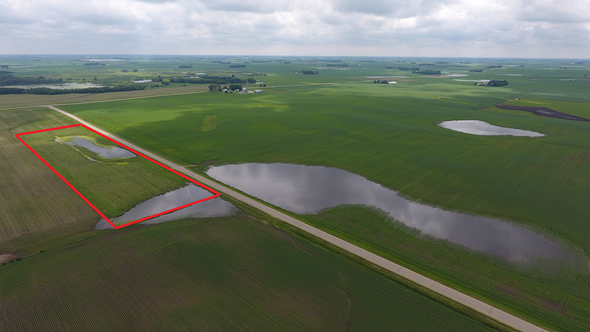 The Divan family enrolled a wetland basin in the northwest corner of their farm in Winnebago County that was prone to ponding into the Farmable Wetland Program (highlighted) a few years ago and have been enjoying the benefits ever since. Photo courtesy of Jeff Divan.
Heavy rainfall in late spring and early summer has caused
widespread ponding and flooding in northwest and north-central Iowa, but a
recently announced continuous Conservation Reserve Program (CRP) signup provides
farmers a well-timed opportunity to find long-term solutions for these problem
spots in their fields.
The statewide CRP continuous signup 51 is targeting
key water quality conservation practices, including wetland restoration,
farmable wetlands, shallow water area for wildlife and saturated riparian
buffers, said Amanda DeJong, state executive director of the Iowa Farm Service
Agency (FSA). CRP is voluntary program conservation program administered by the
FSA, an agency within the United States Department of Agriculture.
“Along with water quality and wildlife benefits,
these practices can help improve a farmer’s net rate of return by reducing
replanting, herbicide and fertilizer costs all while providing a consistent
source of income through rental payments,” she said. “Using CRP to target less
profitable areas of your farm can help improve and simplify the overall
management of your operation.”
These practices can also provide farmers a wider
planting window on the remaining areas of their fields.
“If the wettest areas are enrolled into Continuous
CRP, farmers can plant much sooner, boosting their chances for healthier crops
and higher yields at harvest,” said Curt Goettsch, chief agricultural conservation
specialist for Iowa FSA.
Other water quality practices available in this
signup include:
-
Grass Waterways, non-easement
-
Filter strips
-
Denitrifying bioreactor
-
Farmable Wetland Programs
Signup
Details
Eligible landowners must submit their CRP offers by
Aug. 17. Because developing a suitable offer takes multiple steps, FSA suggests
interested participants should visit with their local office no later than Aug.
1 to begin the process, said Goettsch.
Under CRP continuous signup, FSA provides eligible
participants with annual rental payments and cost-share assistance. Signup and
practice incentives, as well as certain rental rate incentives, are not
available for this signup period. Continuous signup contracts are 10 to 15
years in duration.
Eligible land must be cropland that is planted or
considered planted to an agricultural commodity four of the six crops years
from 2008 to 2013, and is physically and legally capable of being planted in a
normal manner to an agricultural commodity. A producer must have owned or
operated the land for at least 12 months prior to submitting the offer.
Interested producers should visit their local FSA
office.
MADRID - The Iowa
Department of Natural Resources and the Iowa Wildlife Center are partnering in
three events focusing on living with Iowa wildlife. The events are free and open to all ages.
The Learning Live at
WildWay series will focus on turtles and snakes on July 8, followed by bats on
Aug. 12 and raptors on Sept. 9. All events are held from 2-4 p.m., at the Iowa
Wildlife Center’s WildWay, just south of Ledges State Park, at 1518 260th
Street, Madrid. Directional signs will be posted on the day of the event.
Participants should
dress to be outdoors, bring a lawn chair and water bottle. Due to the nature of
this series, pets are not allowed. The event will move to the Oak Shelter at
Ledges State Park if the weather or field conditions do not allow.
“We’re happy to
provide the opportunity for people to learn and interact with these remarkable
animals,” said Marlene Ehrisman, executive director for Iowa Wildlife Center.
For more information
and event updates, go to https://iowawildlifecenter.org/
|





