|
For Immediate Release: Friday, June 22, 2018
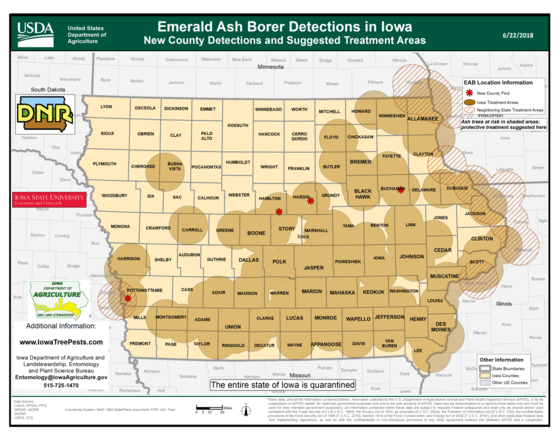
Invasive pest confirmed in Buchanan, Hamilton,
Hardin, and Pottawattamie counties
DES MOINES – A destructive pest of ash trees has now been
confirmed in Buchanan, Hamilton, Hardin and Pottawattamie counties. The Emerald ash
borer (EAB), an exotic pest from Asia, was first found in Iowa in 2010 and has
now been detected in 61 Iowa counties.
Insect samples were collected from ash trees in Winthrop
(Buchanan County), a rural area east of Randall (Hamilton County), Eldora
(Hardin County), and Council Bluffs (Pottawattamie County). The samples were
submitted to the USDA’s Animal and Plant Health Inspection Service, which confirmed
them positive for EAB. Buchanan and Hardin Counties involved ash trees on
private property, whereas Hamilton and Pottawattamie County findings occurred
in the right-of-way along I-35 and I-80, respectively.
“June is typically the time of year we receive a surge in
phone calls about poorly looking ash trees. We urge people to continue to
report suspicious symptoms in counties that are not yet known to be infested,”
said Mike Kintner, Iowa Department of Agriculture and Land Stewardship EAB and
gypsy moth coordinator. “People can really help minimize the spread of this
pest by not giving it a ride in infested firewood between counties or from home
to campsite.”
Since the dispersal of this beetle by natural flight is
limited to only short distances, people serve as the mode of transportation involving
longer distances. Beneath the bark in the larval stage EAB can unknowingly be
transported in firewood. Numerous
other insects and diseases can also hitchhike in firewood. Iowans are
encouraged to use locally sourced firewood, burning it in the same county where
it was purchased.
Adult
beetles begin to emerge from May to June and can be found throughout the summer
months. The metallic-green beetle is slender and approximately 1/2 inch long.
After emerging from a tree the beetle leaves behind a telltale D-shaped exit
hole approximately 1/8 inch in diameter.
EAB-infested ash trees can include branch
dieback in the upper crown, water sprouts along the trunk and main branches,
vertical bark splits, D-shaped emergence holes, S-shaped tunneling under loose
bark, as well as woodpecker damage. EAB
larvae kill ash trees by tunneling under the bark and feeding on the part of
the tree that moves nutrients up and down the trunk. Starved trees usually die
within 2-4 years.
The
State of Iowa continues to track the movement of EAB on a county-by-county
basis. Citizens who suspect an EAB infestation in ash trees in their area are
encouraged to contact one of the following:
·
Iowa Dept. of
Agriculture & Land Stewardship, State Entomologist
Office: 515-725-1470
·
Iowa
Department of Natural Resources: 515-725-8453
·
Iowa State University Extension
and
Outreach, Entomology: 515-294-1101
At
this calendar date, the treatment window for soil-applied preventive treatment
measures (soil injection, soil drench, or granular application) and basal bark
sprays has ended. Trunk injections can be done now through the end of August if
a landowner is interested in protecting a valuable and healthy ash tree within
15 miles of a known infestation.
Good
ground moisture is essential for systemic insecticide movement in a tree. Full
details are available in Iowa State University Extension and Outreach
publication PM2084: https://store.extension.iastate.edu/product/13114.
To find a certified applicator in your area, download PM3074 and follow the
steps: https://store.extension.iastate.edu/product/Finding-a-Certified-Pesticide-Applicator-for-Emerald-Ash-Borer-Treatment
To
learn more about EAB and view maps of its distribution, please visit
http://www.iowatreepests.com. A FAQ on EAB is available here.
For
more information contact any of the following members of the Iowa EAB Team:
·
Mike
Kintner, IDALS EAB coordinator, 515-745-2877, Mike.Kintner@IowaAgriculture.gov
·
Robin Pruisner, IDALS state entomologist, 515-725-1470, Robin.Pruisner@IowaAgriculture.gov
·
Jeff Goerndt, DNR state forester, 515-725-8452, Jeff.Goerndt@dnr.iowa.gov
·
Mark Shour, ISU Extension and
Outreach entomologist, 515-294-5963, mshour@iastate.edu
·
Tivon Feeley, DNR forest health program leader, 515-725-8453, Tivon.feeley@dnr.iowa.gov
·
Donald
Lewis, ISU Extension and Outreach entomologist, 515-294-1101, drlewis@iastate.edu.
·
Laura Iles, ISU Extension and Outreach entomologist, ISU
Plant
and Insect Diagnostic Clinic, 515-294-0581, ljesse@iastate.edu
·
Jeff
Iles, ISU Extension and Outreach horticulturist, 515-294-3718, iles@iastate.edu
·
Jesse Randall, ISU Extension
and Outreach forester, 515-294-1168, Randallj@iastate.edu
 -30-
For more information, contact Dustin Vande Hoef, (515) 281-3375 or (515) 326-1616 (cell) or Dustin.VandeHoef@IowaAgriculture.gov
|