|
FOR IMMEDIATE RELEASE
June 19, 2018
Biolife Plasma Services of Ankeny and the Friends of Cedar Rock,
from Quasqueton, are recipients of 2018 Governor’s Volunteer Awards.
Employees of Biolife Plasma Services will receive a Group Volunteer
Award for work at Big Creek State Park.
During the last two years, volunteers removed invasive honeysuckle, autumn olive and multiflora
rose from more than one acre of shoreline and fixed a jetty by removing seven tons of rock and installing a staircase that improved its accessibility to the lake.
The company is receiving its award Tuesday, in Des Moines.
The Friends of Cedar Rock also were selected for a Group
Volunteer Award for restoring the last remaining original Frank Lloyd Wright
river pavilion. The friends group raised nearly $200,000 for the project and will
receive its award at a ceremony on July 30 in Marion.
“We
greatly appreciate the hours of hard work and dedication these two organizations
provided to care of state parks,” said Todd Coffelt, DNR parks bureau chief.
“Both of these organizations exemplify the importance of volunteerism and we
thank them for their service.”
Coordinated
by Volunteer Iowa, the Governor's Volunteer Award program—now in its 35th year— recognizes the dedicated people who
volunteer their time and talent to help fulfill the missions of Iowa
nonprofits, charitable organizations, and government entities. The program
provides an easy way for these organizations to honor their volunteers with a
prestigious, state-level award.
More than 500 awards are being presented this year during
ceremonies held at several locations around the state. It is estimated
that more than 20,000 hours of service, with an economic impact of nearly
$500,000, were served by this year’s honorees during the past 12 months. More
information is available at https://volunteeriowa.org/awards
Backbone State Park, south
of Strawberry Point, has been recognized among the Top 50 Mom-Approved Places to
Fish and Boat, according to the
Recreational Boating and Fishing Foundation (RBFF).
A
nationwide survey of thousands of moms revealed the list of favorite fishing
spots in each state that have everything a family needs to experience the great
outdoors – play areas and family-friendly amenities, picnic areas, safe water and
boat access and of course, plenty of fish to catch.
Vote today
(www.takemefishing.org/momapproved/) for Iowa to win a place on the
Top 10 Mom-Approved Places to Fish and Boat in the Nation list. You can vote
daily through June 29. Each vote is entered for a chance to win a family fishing/boating
trip in Florida.
About RBFF
RBFF is a nonprofit
organization whose mission is to increase participation in recreational angling
and boating, thereby protecting and restoring the nation's aquatic natural resources.
RBFF's recently announced 60 in 60 effort strives to attract 60 million anglers
to the sport by the end of 2021. To help recruit, retain and reactivate participants,
RBFF developed the award-winning Take
Me Fishing™ and
Vamos A Pescar™ campaigns creating awareness about boating, fishing
and conservation, and educating people about the benefits of participation. These
campaigns help boaters and anglers of all ages and experience levels learn, plan
and equip for a day on the water.
BLUEGRASS
–The Iowa Department of Natural Resources (DNR) and the Scott County
Conservation Board (SCCB), in coordination with FYRA Engineering, will host a
public meeting at 5 p.m., June 28, at the Blue Grass Public Safety Building
(606 Mayne Street) to discuss plans for
improving water quality and recreational opportunities at West Lake Park.
Restoration
activities planned for the park will be presented at the meeting, along with an
opportunity for the public to express their comments and ask questions about
the long term management and improvement plan.
Water
quality at the lakes has deteriorated in recent years due to sedimentation, an
overabundance of undesirable fish species, and high concentrations of nutrients
and bacteria. The SCCB started working with the DNR in 2016 to develop a
comprehensive restoration plan for the park and watershed that would improve
water quality and opportunities for recreation at Lake of the Hills, Bluegrass
Lake, Railroad Lake and Lambach Lake.
Construction
planned for the park includes restoring several ponds within the park, as well
as adding new ponds to trap nutrients and sediment from the watershed and
prevent them from entering the lakes.
Planned
in-lake restoration work includes removing excess sediment from the lakes in the
West Lake Park Complex, stabilizing the shoreline, fish habitat improvements,
and updating the lakes’ outlet infrastructure. Work in the watershed is scheduled
to start this fall and will likely be completed in the next two to four years.
Lake
of the Hills, located within the park, is currently listed on the State’s list
of Impaired Waters due to high levels of algae. The overall goal of this
restoration project is to improve water quality and recreational opportunities
at the park and remove the lake from the Impaired Waters List.
West
Lake Park is a very popular local recreational destination, hosting thousands
of campers each year, and receiving over a ½ million visitors annually. The
park is also home to local and national disc golf championships and the Quad
Cities Triathlon. Park improvements are expected to increase visitation at the lake
and provide better recreational opportunities to visitors.
Any
person attending the public meeting and has special requirements such as those
related to mobility or hearing impairments should contact the DNR or ADA
Coordinator at 515-725-8200, Relay Iowa TTY Service 800-735-7942, or
Webmaster@dnr.iowa.gov, and advise of specific needs.
Media Contact – George
Antoniou, Lake Restoration Program Coordinator, Iowa Department of Natural
Resources, 515-725-8449.
SPIRIT LAKE – Swimmer’s itch is
starting to make its presence known in the Iowa’s Great Lakes and surrounding
northwest and north central Iowa lakes.
The condition, common in clear water
lakes around the world, is caused by a microscopic parasitic flatworm.
The flatworm eggs are transferred to water by bird droppings. The eggs hatch
and infect snails, from which the free swimming form of the flatworm larvae
emerges. Without a suitable host such as a bird, the parasite will try to
penetrate the skin of humans, and quickly dies after that, causing an allergic
reaction and itchy rash.
To help
prevent swimmer’s itch, avoid swimming or wading in marshy areas where snails
are commonly found, reduce the amount of time in the water, avoid
beaches that have been pounded by waves over the past few days and quickly rinse
or dry off when after getting out of the lake. Use of waterproof sunscreen has been
reported to help protect skin from swimmer’s itch.
The welts and itching caused by the little
parasitic pest can last for several days to about a week and usually don't
require a visit to the doctor. You can treat the affected areas with an
antihistamine along with calamine lotion.
Visit the following websites for more
information on swimmer’s itch:
http://www.cdc.gov/parasites/swimmersitch/
http://www.mayoclinic.com/health/swimmers-itch/DS00902
Media
Contact: Mike Hawkins, fisheries biologist,
Iowa Department of Natural Resources, 712-336-1840.
The
Iowa Department of Natural Resources (DNR) is encouraging all boaters and
anglers to check for unwanted hitchhikers on their boats and equipment this Fourth
of July to help protect Iowa lakes and streams.
Aquatic
invasive species, everything from zebra mussels to Eurasian watermilfoil, move
from one waterbody to another by hitchhiking on boats, in bait buckets and on
other equipment used in the water.
“Aquatic
invasive species can create serious problems for Iowa waters by reducing native
species and making lakes and rivers unusable for boaters, anglers and swimmers," said Kim Bogenschutz, aquatic invasive species coordinator for the Iowa DNR.
These invasive
species often grow quickly and spread fast when brought to new lake or stream
due to lack of natural controls.
“Boaters
and anglers can help prevent the spread of aquatic invasive species to new
waterbodies by cleaning, draining and drying their boat and equipment after
each time on the water,” said Bogenschutz.
- CLEAN
any plants, animals, or mud from your boat and equipment before leaving a
waterbody.
- DRAIN
water from all equipment (motor, live well, bilge, transom well) before leaving
a waterbody.
- DRY
anything that comes into contact with water (boats, trailers, equipment, boots,
clothing, dogs). Before transporting to
another waterbody either: Spray your boat and trailer with hot, high-pressure
water; or Dry your boat and equipment for at least 5 days.
- DISPOSE
of unwanted bait in the trash. Never release plants, fish or animals into a
water body unless they came out of that water body.
It is
illegal to possess or transport prohibited aquatic invasive species or to
transport any aquatic plants on water-related equipment in Iowa. Signs posted at public accesses remind
boaters to stop aquatic hitchhikers and identify infested waters.
Boaters
must also drain all water from boats and equipment before leaving a water
access and must keep drain plugs removed or opened during transport. It is also
illegal to introduce any live fish, except for hooked bait, into public waters.
Find more
information about aquatic invasive species and a list of infested waters in the
2018 Iowa Fishing Regulations booklet.
Media Contact: Kim Bogenschutz, Fisheries Bureau’s Aquatic
Invasive Species Program, Iowa Department of Natural Resources, 515-290-0540.
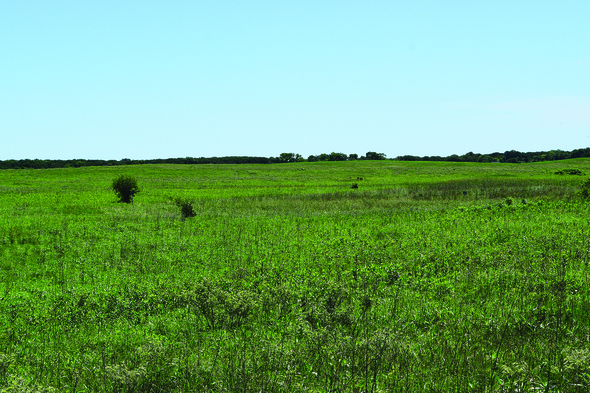 The rarest of rare Iowa landscapes, remnant prairie is found in certain locations on the Kettleson Hogsback wildlife area. Its high quality and diverse prairie plants have been the seed source used to establish other Iowa prairies. Photo courtesy of the Iowa DNR.
SPIRIT LAKE - Dickinson County is home
to a unique Iowa glacial area that has been attracting thousands of visitors a
year, some from as far away as California, just to enjoy the scenery.
The 2,040-acre Kettleson Hogsback
Wildlife Management Area is home to Grover Lake, West Hottes Lake, Welch Lake,
East Hottes Lake, Sunken Lake and Little Spirit Lake, plus a series of marshes,
native prairie, oak forest and grasslands that reaches from the west shores of
Big Spirit Lake northwest to the Minnesota state line.
Native prairie in Iowa is extremely
rare, with less than one tenth of one percent remaining, and parts of Kettleson
Hogsback have this never-been-plowed treasure. White lady slippers, prairie
fringed orchid, prairie bush clover, wooly milkweed and porcupine grass call
this land home. The wide diversity of prairie plants here has provided seed
used to establish other Iowa prairies.
Kettleson Hogsback isn’t just a public
wildlife area; it’s also working to protect another popular area attracting thousands of visitors each year – Big Spirit
Lake and the rest of the Iowa Great Lakes. Its marsh and shallow lake system slows
water from 4,225 acres, removing nutrients and sediment before it enters the
chain of lakes.
“It’s a glacial hidden gem that people
can forget about,” said Chris LaRue, wildlife management biologist with the
Iowa Department of Natural Resources. “West Hottes Lake is one of the most
important lakes we have in Dickinson County.”
The lakes at Kettleson Hogsback
benefited from a significant water quality project that brought together the
Big Spirit Lake Protective Association, the Iowa DNR, Ducks Unlimited,
Dickinson County, Iowa Department of Agriculture and Land Stewardship, Natural
Resources Conservation Service and private citizens. The project was designed
using a practical, science-based approach that allowed LaRue to manipulate the
water levels to encourage aquatic vegetation growth and to restrict carp
reproduction, which makes for a healthy system.
“This project provides critical
watershed protection that was designed to last for generations,” LaRue said.
Construction began in the fall of
2014.
Heavy equipment moved gingerly through
this sensitive area to install two large pump station water control structures.
Talented semi-truck drivers had to thread their 45 foot trailer back through the
narrow pathway as much as three-fourths of a mile to deliver their equipment
and materials. More than a mile of electrical cable was trenched in to get power
to the pumps. Screens with 1-1/2-inch openings were placed as barriers to
restrict adult fish from moving into these shallow lakes and marshes to spawn.
The construction phase was completed
in the winter of 2015. LaRue drew the water down, vegetation appeared, and then
brought it back to pool in 2016. The established vegetation has been actively
using nutrients from the water just as planned.
The improved water quality is
preferred by muskrats that are closely followed by muskrat trappers. A large
family of active beavers has made its home near where West Hottes Lake flows
into East Hottes Lake. There is evidence that a raccoon had a nice meal of
turtle eggs on the berm separating the two lakes. This area also attracts
thousands of migrating birds and waterfowl each spring and fall.
“This project has allowed us to
significantly improve the water quality in these once degraded, shallow lakes and
provide valuable fish and wildlife habitat,” LaRue said. “Gone are the days of
blue green algae.”
And that improvement hasn’t gone
unnoticed.
More than 270 different species of
birds has been identified at Kettleson Hogsback with more likely to be seen.
“The thing that makes it such a great
area, I think, is, it is one of the most bird-rich of any area of the state,”
said Doug Harr, president of Iowa Audubon. “It has absolutely every kind of
habitat in northwest Iowa.”
Harr said it has been the historic
home to black terns, Forster’s terns, black-crowned night-herons and oak timber
has been an important stop for warblers in the spring.
“It’s just hard to find a place like
that anywhere else,” Harr said.
Fortunately, for visitors, Kettleson
Hogsback is easy to find.
During the peak times of the busy
summer season, kayakers and hikers can use the area to get away from the noise,
traffic and crowds that fill beaches and boat ramps.
For kayakers, about 900 acres of the 2,040
acre area is lakes, shallow lakes or marshes. Most of the lakes have boat
gravel boat ramps perfect for small watercrafts. Hikers can take a quick detour off the paved
roads and in the winter the area is used by cross country skiers.
Colorful history
- Hottes Lake was one location used for
commercial waterfowl hunting that sent thousands of ducks to markets in Chicago
and larger cities on the east coast.
- Iowa’s State Archeologist brings a
class to Dickinson County and specifically to Kettleson Hogsback every year.
Given its location, the area has key archeological sites.
- It was named for the glacial plateau (hogs
back) that divides two of its lakes - Marble Lake and West Hottes Lake.
- Currently, the area has more than 30
species listed as either threatened or endangered.
Media Contact:
Chris LaRue, Wildlife Management Biologist, Iowa Department of Natural
Resources, 712-330-4543.
|





