|
FOR IMMEDIATE RELEASE
May 15, 2018
Campsites will be hard to come by this Memorial Day
weekend.
Most electrical and full hookup sites were reserved months ago,and of the 370 campsites still available, most are non-electric. There
are around 1,200 non-reservable sites available on a first come basis, but not likely
for much longer. To reserve a campsite, visit: http://www.iowadnr.gov/Places-to-Go/State-Parks/Make-a-Reservation.
The Memorial Day weekend camping is traditionally the start of
Iowa’s busy outdoor summer recreation season and the second busiest weekend of
the year next to July 4 for Iowa’s state parks.
“Campers are itching to get outside and enjoy the beautiful weather
after a long winter inside,” said Todd Coffelt, chief of the Iowa Department of
Natural Resources State Parks Bureau. “Our parks offer a variety of activities
for all enthusiasts from hiking the trails to fishing and swimming. There’s
something for everyone while enjoying the outdoors.”
For an up-to-date list of park and trail closures due to
renovations and construction projects or weather related, visit: http://www.iowadnr.gov/Places-to-Go/State-Parks/Alerts-and-Closures
Campers are urged to help take care of the parks by cleaning up
their campsite after themselves. Park managers encourage campers to be
cognizant of others camping nearby and obey all park rules and quite hours.
“We hope that campers enjoy their time and make memories while
staying in our parks and recreational areas, and do so safely and return
again,” Coffelt said.
Tips
-
Keep track of the weather
and have a plan in case of severe weather
-
Pack bug spray, sun screen
and a basic first-aid kit
-
Check the registration
kiosk for activities in the area
-
Don’t burn trash
-
Don’t bring fireworks
-
Be a good neighbor.
Observe quiet hours and pick up after yourself
Firewood
The Iowa Department of Agriculture and Land Stewardship requires
all firewood sold or acquired in Iowa to have the county and state of harvest
location on the label of packages and the delivery ticket for bulk
firewood. The rules were added to prevent the spread of invasive
species.
The rules only apply to firewood sold and acquired in Iowa.
The rule also requires the Iowa DNR to collect firewood from
campers that does not have a label.
Parks closed for
renovation
Ledges, Lacey Keosauqua, Geode, Maquoketa Caves and Marble
Beach state parks and recreation areas are closed while they undergo
renovation.
Media Contact: Todd Coffelt, DNR Parks Bureau Chief,
515-725-8485, Todd.Coffelt@dnr.iowa.gov.
WEBSTER CITY - New
bridge construction, just downstream from the Bevers Bridge Access, on the
Boone River in Hamilton County is creating a dangerous hazard for paddlers this
summer. Thousands of paddlers use this access each year as they paddle down this
popular water trail.
Six culverts
spanning the river are creating an extreme hazard and some re-circulation on
the downstream side is possible at certain water levels.
"All river
users should avoid this area for the summer season," said Nate Hoogeveen, Iowa
DNR River Programs Coordinator. "From upstream, take out at the Albright
Canoe Access or Bever Bridge Access or put in your watercraft at Tunnel Mill Canoe
Access downstream."
A map of the Boone
River Water Trail is available on the Iowa DNR website at www.iowadnr.gov/Things-to-Do/Canoeing-Kayaking/Water-Trail-Maps-Brochures
Media Contact:
Todd Robertson, Iowa DNR River Programs Outreach Coordinator
at 515-243-3714.
The unofficial beginning to summer is just days away and that
also marks the unofficial beginning of Iowa’s boating season. Boaters across
the state are anxious to get out on the lake after the long winter and are
preparing their watercraft for the long holiday weekend.
Susan Stocker, boating law administrator and education
coordinator for the Iowa Department of Natural Resources, said safety should be
the top priority for all boaters.
“Now is the time to review Iowa boating laws and plan to have
patience at the ramp and on the water,” she said.
In 2017, there were 41 reported boating incidents on Iowa
waters: 22 of those were personal injury; 15 were property damage incidents and
4 resulted in fatalities.
“With the recent storms
across the state, boaters should use extra caution for floating debris and
higher waters,” she said.
Stocker advised to have someone on your watercraft be a lookout for
large debris that is often under the water with only a small portion showing
above water. It is easy to miss and can cause major damage to your vessel. Be
sure to check ahead that the boat ramps are open before heading out.
Just like any party on land, boaters should plan ahead to have a
designated sober operator that is cautious with speed and on the lookout for
other vessels.
Another way boaters can stay on the water is by inspecting their
vessels prior to heading to the lake.
Lifejackets should be in good condition and the right size for
each person onboard. Check the fire extinguisher, boat and trailer lights,
whistle, and throwable floatation.
Boaters are reminded about the requirement that drain plugs and
other water draining devices must be removed and/or remain open during
transport to avoid spreading invasive species. Anglers leaving with fish are
recommended to put them on ice, whether in a cooler, a bucket or a live well
(plug must still be removed and/or opened).
Iowa has more than 231,000 registered boats.
Boating
safety tips
-
Alcohol and boating don’t
mix. Wind, sun glare and heat can enhance the effects of alcohol hindering the
operator’s ability to make decisions.
-
Check for open ramps or
water hazards before heading out.
-
Before leaving the house,
check the trailer lights, wheel bearings and the hitch.
-
Make sure there is a
current fire extinguisher and horn/whistle, a wearable life jacket for everyone
and a Coast Guard approved flotation device onboard.
-
File a float plan with a
friend, including your destination, expected time of return and type of
boat.
-
Wear your lifejacket - it
floats, you don’t.
-
Inflatable lifejackets
are light weight, comfortable and Coast Guard approved. Wear it.
-
Take a boater education
course available online at http://www.iowadnr.gov/Things-to-Do/Boating/Boater-Education. It has valuable
information and many insurance companies will offer a discount on boat
insurance. Familiarize yourself with Iowa’s boating laws.
-
Top two safety violations
in Iowa are having inadequate life jackets and operating too fast and too close
to other vessels.
MEDIA CONTACT: Susan Stocker, Boating
Law Administrator and Education Coordinator, Iowa Department of Natural
Resources, 515-313-6439.
This
year’s unusual cold, late spring delayed walleye collection efforts to some of the
latest dates in the history of the Iowa Department of Natural Resources (DNR)
walleye season.
“Mother
Nature presented many challenges this year, but we still met our walleye egg
collection goal thanks to the dedication and adaptability of our fisheries
staff,” said Jay Rudacille, DNR Warm and Coolwater Fish Culture supervisor at
Rathbun.
Crews
are usually busy collecting walleyes at Rathbun Lake, Storm Lake, Clear Lake
and Spirit Lake within the same couple of weeks in early April. This year, netting
operations ended at Rathbun Lake on April 15, a week before netting started at
the Iowa Great Lakes (East Okoboji, Big Spirit and West Okoboji) and Clear
Lake.
Crews
at Storm Lake ended their netting operations on April 24, much later than most
years. They netted for three nights, had to stop for a week with the return of
winter weather, and netted another four nights. “We usually do not have to stop
netting due to poor weather conditions, maybe only taking off a night or two,” said
Ben Wallace, fisheries biologist at Lake View. “Taking off a whole week in the
middle of the walleye spawn is very unusual.”
“We
collected over 100 quarts in a single day this year from Storm Lake, we have
never done this before,” said Wallace. He
said the 2018 walleye egg collection was excellent at Storm Lake, totaling the
second highest amount collected ever.
Ice
went out on all three of the Iowa Great Lakes on April 29, breaking the
previous records set in 1951. “All three of the Iowa Great Lakes have never gone
out of ice on the same day before,” said Mike Hawkins, fisheries biologist at
Spirit Lake.
Winter’s
ice-covered hold on the Iowa Great Lakes limited walleye netting to East
Okoboji Lake only. “Seven crews were ready to net here this year, but only two
crews were needed with the persistent ice,” Hawkins said. Staff collected male
and female broodstock walleye from the spillway between Big Spirit Lake and East
Okoboji Lake.
With
little natural reproduction by walleye in Iowa, walleye populations rely
heavily upon stockings. Walleyes are
stocked throughout Iowa into natural lakes, interior rivers, flood control
reservoirs and selected larger man-made lakes.
Iowa
is one of the top producers of walleye fry (newly hatched fish) in the United
States, second only to Minnesota. The DNR will release more than 151.5 million
walleye fry this spring. While the majority of walleyes are stocked as fry,
some are cultured in hatcheries and stocked at different sizes. More than 1.1 million two-inch walleyes are
expected to be stocked into lakes, rivers, and streams across the state this
summer. An additional 340,000, 6-to 9-inch
fingerlings will be stocked in lakes later this fall.
Media Contact: Jay Rudacille, DNR Warm and
Coolwater Fish Culture Supervisor, 641-647-2406.
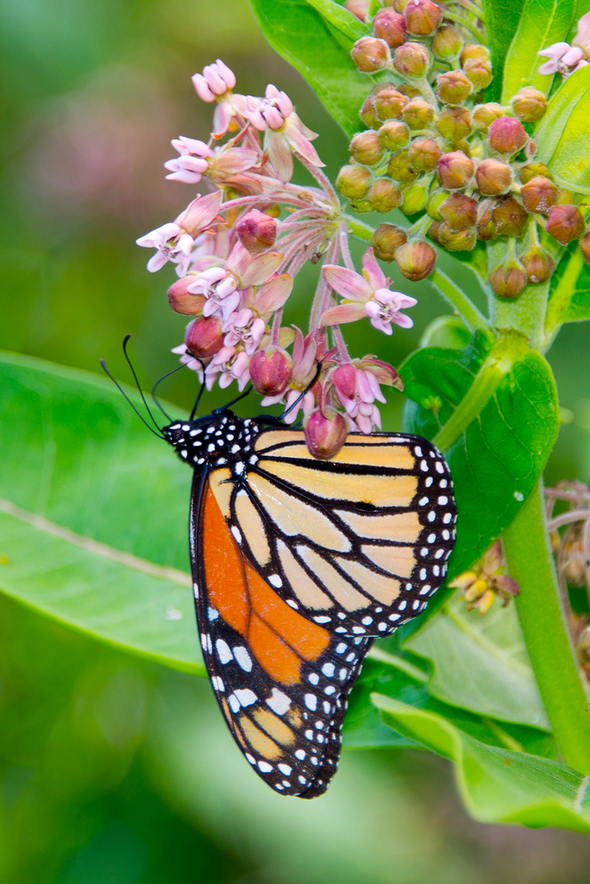 Monarch butterfly on common milkweed plant. Photo courtesy of Edward K. Boggess, monarch conservation liaison for the Midwest Association of Fish and Wildlife Agencies, Minnesota Department of Natural Resources.
The Midwest Association of Fish and Wildlife
Agencies (MAFWA) welcomes public comments through May 31 on a draft conservation
plan that provides a blueprint for reversing the decline of the eastern monarch
butterfly population.
The draft plan, called the Mid-America Monarch
Conservation Strategy, builds on existing efforts of state,
federal, and local agencies and private organizations and individuals. It
covers a 16-state region stretching from Texas to the Upper Midwest that
encompasses the primary production and migratory habitat areas for eastern
monarchs (see map). Other eastern monarch states are also collaborating with the
plan.
The draft plan identifies conservation goals and
strategies for improving habitats in various sectors or categories of land use
such as natural areas, agricultural lands, urban lands and rights of way. State
wildlife agencies and partners will be working to add milkweed plants where
lacking and to ensure diverse, nectar-plant-rich landscapes with blooming
species during seasons when monarchs are present.
“In addition to their beauty, pollinators such as butterflies,
bees, and other species provide important pollination services critical to our
food supplies and economies,” said Terry Steinwand, MAFWA president. “This is
the first phase of a long-term strategy that will require increased commitment
of people and resources to support enhanced monarch and pollinator conservation
and monitoring efforts by many partners over the next 20 years.”
Eastern monarchs, those found east of the Rocky
Mountains, have declined by more than 80 percent over the past 20 years
primarily due to habitat loss, including reduced milkweed required for
reproduction and fewer nectar plants. In 2014 the monarch was petitioned for
listing under the federal Endangered Species Act, and a decision on whether
listing is warranted is expected in 2019.
Monarchs produce multiple generations each year and
undertake a lengthy fall migration from the U.S. and southern Canada to the forested
mountains of central Mexico where they overwinter. The goal of the strategy is
to coordinate state and partner efforts to restore and enhance habitat to
support an average overwintering population in Mexico occupying about 15 acres,
consistent with international goals.
The plan primarily focuses on voluntary and
incentive-based habitat restoration and enhancement efforts, but also includes
priority education and outreach, research, and monitoring needs related to
monarch conservation.
For more information, a copy of the draft strategy,
and how to submit comments, visit the MAFWA website at Mid-America Monarch
Conservation Strategy.
The
Iowa Department of Natural Resources (DNR) reminds all boaters and anglers to
“Clean, Drain, and Dry” their boats and equipment this Memorial Day weekend to
protect Iowa lakes and rivers from aquatic hitchhikers.
Aquatic
hitchhikers are invasive species – everything from zebra mussels to Eurasian
watermilfoil – that move from one waterbody to another by hitchhiking on boats,
in bait buckets and on other equipment used in the water. They often grow
quickly and spread fast when brought to another lake or stream due to lack of
natural controls.
“The
best way to control the negative impacts of aquatic invasive species in Iowa is
to prevent their spread to new waterbodies,” said Kim Bogenschutz, aquatic
invasive species coordinator for the Iowa DNR.
These
aquatic invasive species can create serious problems for Iowa waters by
reducing native species and making lakes and rivers unusable for boaters,
anglers and swimmers.
Boaters
and anglers can unintentionally spread aquatic hitchhikers if they do not take
the proper precautions each time they leave a lake or river.
- CLEAN
any plants, animals, or mud from your boat and equipment before you leave a
waterbody.
- DRAIN
water from all equipment (motor, live well, bilge, transom well) before you leave
a waterbody.
- DRY
anything that comes into contact with water (boats, trailers, equipment, boots,
clothing, dogs). Before you move to another waterbody either: Spray your boat
and trailer with hot, high-pressure water; or Dry your boat and equipment for
at least five days.
- Never
release plants, fish, or animals into a water body unless they came out of that
waterbody and empty unwanted bait in the trash.
It
is illegal to possess or transport prohibited aquatic invasive species. It is
illegal to transport any aquatic plants on water-related equipment in Iowa. Signs
posted at public accesses remind boaters to stop aquatic hitchhikers and
identify infested waters.
Boaters
must also drain all water from boats and equipment before they leave a water
access and keep drain plugs removed or opened during transport. It is also
illegal to introduce any live fish, except for hooked bait, into public waters.
Find
more information about aquatic invasive species and a list of infested waters
in the current Iowa Fishing Regulations
or at www.iowadnr.gov/ais.
Media Contact: Kim Bogenschutz, Fisheries Bureau’s Aquatic
Invasive Species Program, Iowa Department of Natural Resources, 515-290-0540.
Iowa
residents can try fishing without buying a license on June 1, 2 and 3 as part
of the Iowa Department of Natural Resources (DNR) free fishing weekend. All
other regulations remain in place.
“This is a great
time
to take kids fishing or invite a neighbor or friend to
come along,” said Joe Larscheid, chief of the Iowa DNR’s Fisheries Bureau. “You’ll have a
buddy forever and someone to always back up your big fish stories.”
Outdoor
fun awaits at hundreds of Iowa lakes, thousands of miles of rivers or a nearby
pond. “Grab your family and your poles, get away from daily life stresses and
create special memories,” Larscheid said.
Several fun, hands-on fishing events will
be offered across Iowa to help families new to fishing
get started.
Check the general fishing calendar on the DNR website at www.iowadnr.gov/fishing for a list of
free fishing events.
Get
tips for taking kids fishing and catching crappie, bluegills and yellow bass on
the DNR website at www.iowadnr.gov/Fishing/Fishing-Tips-How-Tos.
Media
Contact: Joe Larscheid, Chief of Fisheries, Iowa Department
of Natural Resources, 515-201-3376.
|





