|
Foster Kids Beating the Odds
CASA program helps abused and neglected Children
Years ago, long time CASA volunteer, Autumn Smelser, was assigned to a case of 4 children. Schelby was the 2nd oldest and a teenager who displayed the most concerning behaviors at the time. The children achieved permanency through guardianship with their maternal grandparents. However, due to Schelby being admitted to a PMIC facility, Autumn was ordered to remain Schelby's advocate during her stay at Children's Square U.S.A. where she visited every week to ensure things were going well with Schelby. Autumn was that one constant connection for Schelby; and she encouraged her to reach her goals by making positive choices for herself such as focusing on her mental health, finishing high school and taking college courses.
https://www.3newsnow.com/news/local-news/helping-foster-care-kids-beating-the-odds
ICAB Book Nook
April 2018
As an opportunity to
extend your learning, each month starting in April, ICAB will highlight a book
that we hope will enhance and inspire your service to children and their
families. Our first book, The Glass
Castle, was released as a film in 2017, starring Woody Harrelson, Brie
Larson and Naomi Watts.
 The Glass Castle, Author: Jeanette Walls
Enjoy this preview
from a National CASA newsletter
In her childhood memoir, The Glass Castle,
Jeannette Walls offers a blow-by-blow description of growing up with parents
whose capacity for loving their children is greater than their ability to care
for them. Jeannette and her three siblings spend their childhoods on the road.
The itinerant family travels around the West in a series of broken-down cars,
following their alcoholic father’s wild dreams and money-making schemes. Though
he was a brilliant and (at times) charismatic man, Rex Walls’s inability to
hold a job—along with a penchant for spending what money did come in at the local
bars—leaves the family in a perennial state of poverty. Jeannette’s mother,
Rose Mary—a preoccupied artist and self-described “excitement addict”—shares
her husband’s intellect and taste for adventure. She also possesses a
laissez-faire approach to parenting and a conviction that suffering would build
character in her children. This theory was perpetually tested by Jeannette and
her siblings, who frequently went hungry and suffered a series of injuries due
to their parents’ neglect. What sets The Glass Castle apart from many
contemporary, “tell-all” family memoirs is that while Jeannette Walls’s story
is one of extreme neglect, it is also one of her parents’—particularly her
father’s—love for the children. “My father’s love for me—flawed as it was—was pretty
much what kept me going when I was a kid. I had to believe in him or I had
nothing,” the author wrote in an
Amazon.com forum. “I actually think that in many
ways I was incredibly lucky because I did feel loved and my parents both put a
huge emphasis on education and self-esteem,” she commented in another online
forum. But by the second half of the book, when they finally settle down in Rex
Walls’s hometown of Welch, West Virginia, the family is in an extreme state.
Rex disappears on drinking binges for days at a time; Rose Mary is present but
increasingly withdrawn, consumed by her own needs and her art. The family is
living in a dilapidated home with no indoor plumbing and a garbage pit in the
backyard. It is at this point that Jeannette—now a teenager—realizes that she
and her siblings must take control of their lives and escape from their
parents. Jeannette Walls kept her early life a secret, until finally sharing
her story when she published The Glass Castle in 2005.
|
 |
CASA Advocates, with at least one year of experience, may receive 2 hours of continuing education for reading
this book. Please contact Lesa Christianson, State Training Specialist, at lesa.christianson@dia.iowa.gov for a list of questions and
instructions.
2018 Judicial Survey Summary
From mid-February until March 16th, there was an open Judicial Survey for the CASA and FCRB Programs through SurveyMonkey. The purpose of the survey was to elicit judicial input and feedback regarding specific areas for CASA and/or FCRB depending on which programs are available in their coverage areas. Judges were asked to weigh-in on general child welfare issues along with more targeted questions about quality and content of program reports to court, role of program volunteers/process and overall satisfaction with the programs.
A total of 56 judges were invited to complete the CASA/FCRB survey.
18 judges responded to the survey;
- 18 respondents have CASA programming in their area
- 10 respondents have FCRB programming in their area
Court Appointed Special Advocate
Respondents were asked to rate a number of areas using the scale: 4-Excellent; 3-Good; 2-Fair and 1-Poor. Average scores are based on responses from 18 judges. The rating for the overall quality of CASA reports is 3.56. This segment included questions about relevant content, details, reports being clear and concise and recommendations being supported by the content contained in the reports. Overall satisfaction with the CASA program is 3.50. Responses from the judiciary indicate an overall positive case impact is made when a CASA Advocate is appointed. Based on input from the judges, some recommendations for improving the CASA program include:
- Using the CASA report template to capture case information, identify strengths and concerns that lead to more specific recommendations that may impact the outcome of the case; and
- Working with local judges and DHS to establish agreed upon procedures for case referrals to appoint CASA advocates.
The CASA Program will continue to strive towards recruitment and training of the most effective voices possible for children in need.
Foster Care Review Board
Similar to the CASA segment of the survey, respondents were asked to rate a number of areas for the FCRB Program using the scale: 4-Excellent; 3-Good; 2-Fair and 1-Poor. Average scores are based on responses from 10 judges. The rating for the overall quality of FCRB reports is 2.75. This segment included questions about relevant content, details, reports being clear and concise and recommendations being supported by the content contained in the reports. Overall satisfaction with the FCRB program is 3.10.
The responses from the judges validates the need to make some changes to the FCRB process and reports to be more relevant in today’s juvenile court process and DHS case planning. FCRB Program improvements include:
- Moving forward with implementation of case specific FCRB questions and reports and providing training to all local FCRB Members and facilitators;
- Identifying barriers in cases at the child level in addition to statewide collection of data;
- Working with facilitators on report writing and how to capture testimony provided during foster care reviews; and
- Scheduling reviews to occur prior to court hearings as often as possible.
The Child Advocacy Board appreciates the input from the judges who responded to the survey. Thank you to all those who took the time to offer feedback. The input and comments are being utilized as program planning continues for FY2019.
 2018 National Court Appointed Special Advocate Association Conference:
Working Together for Their Best Interest
With both beautiful, spring-like weather and a historic nor’easter in sight, the nine members of Iowa’s delegation to the National CASA Association annual conference boarded planes on March 9th, headed to Boston, MA. The theme of this year’s conference “Working Together for Their Best Interest” showed in the many offerings. General session speakers demonstrated the link between poor outcomes for children in care and potential future outcomes, including health issues, poverty and prison. Early childhood experiences including attachment and connections and ACES (Adverse Childhood Experiences) were also brought to the forefront as we learned more about brain science and resilience.
This year over 1,200 participants participated in six general sessions, 51 different topics for break out sessions and a formal evening at the Awards of Excellence banquet honoring the best of the best within the CASA/GAL organization.
The National CASA Association is quickly becoming a nationally respected thought-leader in improving outcomes for children involved in the child welfare system and a model for government and non-profit agency leadership. As in years past, Iowa participated in the State Directors Workshop where we learned more about the new state and local program standards that will be released in 2018. We are also very fortunate to have Judge William Owens from the 8th Judicial District serving on the National CASA Association Judicial Leadership Council. Judge Owens was able to spend a day in Boston meeting with other council members creating the plan for the future work of the Judicial Leadership Council.
Other Iowa CASA staff involved in National CASA Leadership Committees include Jim Hennessey, Administrator, serving on the State Leadership Council, Shirley Hoefer, Deputy Administrator serving on the Performance Measurement Committee and Amy Carpenter, Deputy Administrator and Aprile Goodman Local CASA Program Coordinator, both serving on the National CASA Conference Committee.
Thank you to the Iowa delegation who attended this year’s conference:
Kayla Eckerman, CASA Advocate
Deb Pumphrey, CASA Advocate and Coach
Dawn Bliss, CASA Advocate and Coach
Sarah Thayer, CASA Advocate and Coach
Crystal Engstrom, Local CASA Program Coordinator, Mason City and Fort Dodge
Aprile Goodman, Local CASA Program Coordinator, Ottumwa
Amy Carpenter, Iowa CASA Program Manager
Mark Hargrafen, Iowa Child Advocacy Board Chair
Judge William Owens, 8th Judicial District
|
For FCRB Members & CASA Advocates:
Increased public awareness on the issue of Child Abuse occurred in the 1960’s following Dr. Kempe’s 1962 publication of the blockbuster article, The Battered Child Syndrome. Medical professionals, the media, professional research and writings on child abuse captured the public’s attention and cry for justice. This generated increased emphasis on Congress to put into place new protection services for children and their needs for safety.
The first Federal child protection legislation, the Child Abuse Prevention and Treatment Act (CAPTA), was passed in 1974 to meet the need to further define and outline how states will ensure the safety and welfare of children. While CAPTA has been amended many times over the years the purpose of the original legislation remains intact.
In the early 1980s, Congress made a further commitment to identify and implement solutions to child abuse. Recognizing the alarming rate at which children continued to be abused and neglected and the need for innovative programs to prevent child abuse and assist parents and families affected by maltreatment eventually led to April being declared Child Abuse Prevention Month by President Ronald Reagan in 1983.
|
 To find Iowa specific data on the numbers of abused and neglected children go to: https://dhs.iowa.gov/reports/child-abuse-statistics. To read more how Iowa children fare in multiple areas of well-being, go to: Annie E. Casey Foundation 2017 Kids Count Data Book.
“The true character of a society is revealed in how it treats its children.”
- Nelson Mandela
A body of research has identified factors known to prevent and reduce child abuse and neglect. These factors—including parental resilience, nurturing and attachment, social connections, knowledge about parenting and child development, social and emotional competence of children, and concrete supports for parents—are outlined in Preventing Child Maltreatment and Promoting Well-Being: A Network for Action 2017 Resource Guide, developed by the Children's Bureau. For more information go to website to find additional resources: National Resources
What can Advocates and Board Members do within the scope of their individual role? Every volunteer for the Iowa Child Advocacy Board can become more aware of the signs of abuse and neglect to be better equipped to advocate for intervention if its occurring. To address known abuse or neglect within each program, volunteers advocate via recommendations to the court for services, programs, or exploration of creative avenues to build upon the protective and promotive factors of individuals and families. In essence, it’s advocating for resilience.
|
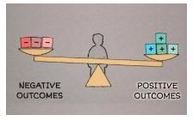 The Center for the Developing Child at Harvard University distinctively explains that to understand the development of resilience one only needs to visualize a seesaw or balance scale. “Protective experiences and coping skills on one side counterbalance significant adversity on the other. Resilience is evident when a child’s health and development tips toward positive outcomes-even when a heavy load of factors is stacked on the negative outcome side.
|
 The single most common factor for children who develop resilience is at least one stable and committed relationship with a supportive parent, caregiver, or other adult. These relationships provide the personalized responsiveness, scaffolding, and protection that buffer children from developmental disruption. They also build key capacities—such as the ability to plan, monitor, and regulate behavior—that enable children to respond adaptively to adversity and thrive. This combination of supportive relationships, adaptive skill-building, and positive experiences is the foundation of resilience.”
To learn more and watch accompanying videos visit and explore:
https://developingchild.harvard.edu/science/key-concepts/resilience/
Some of the most effective and useful recommendations that a CASA Advocate or FCRB Member can make will include both veins of recommendations: Those that help build the child’s resilience, and those that improve the protective factors of the parents and family so that the family continues on without the need for protective services in place.
Apply the Concepts to Case Scenarios:
Visit the site using the link below to read six scenarios that illustrate how multiple protective factors support and strengthen families.
https://www.childwelfare.gov/topics/preventing/preventionmonth/resources/protective-factors-in-practice/
|
 For CASA Advocates: In-Service Training Credit
National CASA requires all advocates to complete an annual training on Abuse and Neglect. We offer multiple options to meet this requirement. What is Neglect is our most recently released training that advocates can request from their Local Coordinator or the ICAB State Training Specialist at lesa.christianson@dia.iowa.gov.
|
 KEPRO EAP On-Demand Webcast
Topic: Everything in Its Place: Getting Organized
Disorganization can waste precious time and create chaos in life. Learn skills to help minimize stress and maximize tranquility by organizing and putting everything in its place. Date: Available on demand beginning January 16, 2018.
Broadcast Length: 50 Minutes
How to Access: Go to the EAP website at http://www.EAPHelpLink.com. Enter your Iowa Employee code and look for Online Seminars in the lower right-hand corner of this homepage or you can search for them by title.
For login code information, contact your
State Training Specialist.
|
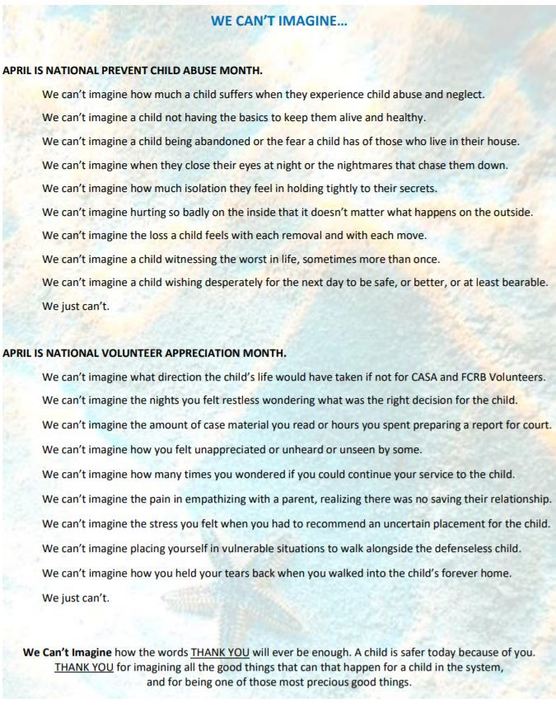
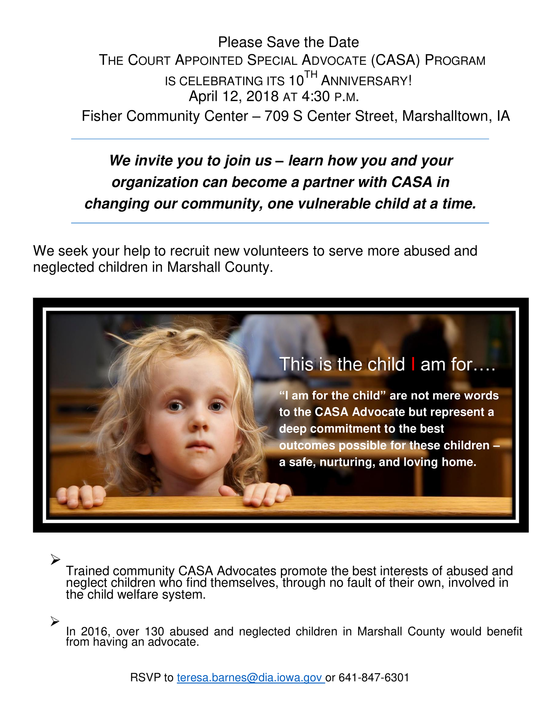
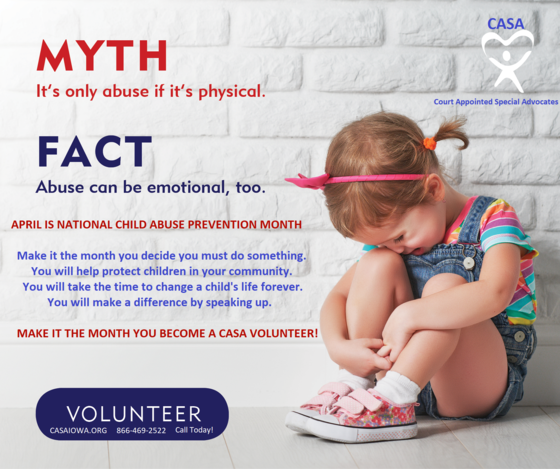
In this National Child Abuse Prevention Month, please consider reproducing this page of the newsletter and placing it in key locations in your community so that our desire to serve more children will become a reality. Thank you.
 Iowa Child Advocacy Board
321 East 12th Street
4th Floor Lucas Building
Des Moines, IA 50319
childadvocacy@dia.iowa.gov
|