|
The
popular trout stream stocking season starts April 2. By Saturday, April 7, every stocked stream
will have received at least one stocking of 10-12 inch trout.
“There
are all kinds of opportunities to catch trout,” said Dan Rosauer, Manchester
Trout Hatchery Manager. “Go fishing and
have fun!”
The
DNR Trout Program offers Iowa anglers a variety of trout fishing opportunities,
including announced catchable stockings, unannounced catchable stockings,
fingerling stockings, wild populations, streams with restrictive regulations,
easy universal access areas and remote streams with difficult access.
Trout
have excellent vision, so keep your line light (6-pound test or less) and your
hook small. In the wild, trout eat
minnows, worms, insects, insect larvae and fish eggs. Artificial flies imitating recent insect
hatches are good for fly fishers; but, anglers of all abilities can catch trout
on a variety of baits including a chunk of worm, salmon eggs, sweet corn or
cheese baits on a small hook. Whatever gear
you choose, toss your artificial lure or bait upstream and let the current
carry it downstream to entice the wary trout.
Iowa’s
three trout hatcheries produce and stock about 310,000 catchable-sized rainbow
or brook trout and 110,000 fingerling brown trout into hundreds of miles of northeast
Iowa streams April through October. Find a list of stocked streams on the DNR
trout map or trout stream webpage.
Funding
to support the trout stocking program comes from the sale of fishing licenses
and trout fees. Anglers must have a valid fishing license and pay the trout fee
to fish for or possess trout. Last year, 43,324 Iowans and 5,336 nonresidents fished
for trout. The daily limit is five trout per licensed angler with a possession
limit of 10.
Iowa’s
trout streams, open year-round, meander through some of the most scenic areas
of the state. “Whether you are an experienced fly fisherman or you picked up your
gear at a local discount store, a day spent on a trout stream is a good day,”
Rosauer said.
Media Contact: Dan Rosauer, Trout Hatchery
Manager, Iowa Department of Natural Resources, 563-927-3276.
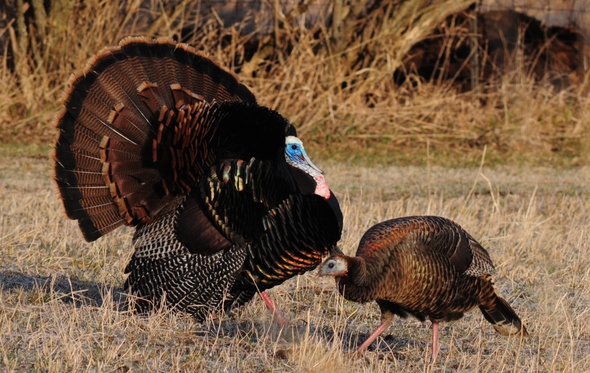 An estimated 50,000 hunters will purse wild turkeys during Iowa' spring turkey hunting season. Photo courtesy of the Iowa DNR.
Thunderous calls from competing Toms trying
to out-do one another for the affection from nearby hens will be rattling through
Iowa’s timber later this month marking the beginning of the wild turkey breeding
season.
This spring ritual is witnessed
annually by about 50,000 Iowa hunters who attempt to mimic the call of a lonely
hen, and then wait for a frustrated Tom to come searching her out.
That’s no easy task.
Iowa’s spring turkey hunting begins
April 7 with a youth only season, followed by five individual seasons beginning
April 16.
“Do your scouting before the season
and be prepared for all types of weather. It doesn’t guarantee success, but you
will be in much better position to bag a gobbler,” said Jim Coffey, forest
wildlife research biologist with the Iowa Department of Natural Resources. “We
are in the turkey’s territory. They live there, this is their home field and
they have the advantage.”
Coffey said reports are coming in of
groups with 3-5 gobblers, which means it should be another good year for
hunters.
“Statewide, we are on par with recent
years population-wise. Bird numbers will vary by landscape. We are seeing an
increase in the number of turkeys in north central and northwest Iowa, and a
stable population but a long-term downward trend in the southeast. Even with
the downward trend though, turkey numbers are still excellent in southeast Iowa,”
he said. “Try hunting mixed habitat with timber, pasture and ag landscapes.
Those areas tend to have better turkey numbers. Or step out of the oak-hickory
comfort zone and try riparian areas or pastures.”
Roughly 25 percent of Iowa turkey
hunters harvest a bird, which totaled around 12,000 turkeys last year.
“Turkey hunting in the spring is a
unique experience. It’s very personal, intimate and exciting sitting in the
timber, listening to the woodcocks and whippoorwills call and watching the
sunrise,” Coffey said. “Success is not measured by whether or not the tag is filled,
but by the experience. Share that experience and knowledge with someone, they
will be glad you did.”
Watch for
other hunters
Turkey hunters spend a lot of time and
money on gear to blend in to the background. When going out, never assume that
you are the only hunter in the timber, even if hunting on private land.
“Ask the landowner if anyone else has
permission to be on their ground and if they do, try to find out where they
will be hunting so to avoid disturbing each other,” Coffey said.
Hunters are encouraged to brush up on
safety tips, including avoiding wearing clothes with patriotic colors (red
white or blue) as those colors are also found in the head of a Tom. Be sure to
see the turkey’s beard and look beyond the bird before taking the shot.
Part of any hunt should be a hunting
plan that includes where you are going, who you are hunting with and when you
plan to return. Hunters should also review the turkey hunting regulations
covering legal shooting hours, open seasons, allowed shot size and more. Don’t
forget the bug spray.
Report your harvest
The
turkey is down, tagged and on its way to the truck. But the harvest is not
complete until the turkey is registered; either online, over the phone or at a
license vendor.
Online,
it takes just a couple minutes. Go to http://www.iowadnr.gov/Hunting/Report-Your-Harvest. From there, scroll down and follow
instructions. Be ready to enter your tag’s nine-digit harvest report number. By
phone? Call 800-771-4692.
The
turkey should be reported by the hunter whose name is on the tag and it must
come before midnight, the day after it
is tagged.
2018 Spring Turkey
Seasons
Youth (residents only): April 7-15
Season 1: April 16-19
Season 2: April 20-24
Season 3: April 25-May 1
Season 4: May 2-20
Resident Archery-only Season: April 16-May 20
Shooting
Hours: One-half hour before sunrise to
sunset
License
Requirements: Hunters must have a hunting license
and habitat fee in addition to their turkey license. Hunters may purchase two
spring turkey licenses, one of which must be for fourth season.
Media Contact: Jim Coffey, Forest Wildlife
Research Biologist, Iowa Department of Natural Resources, 641-774-2958.
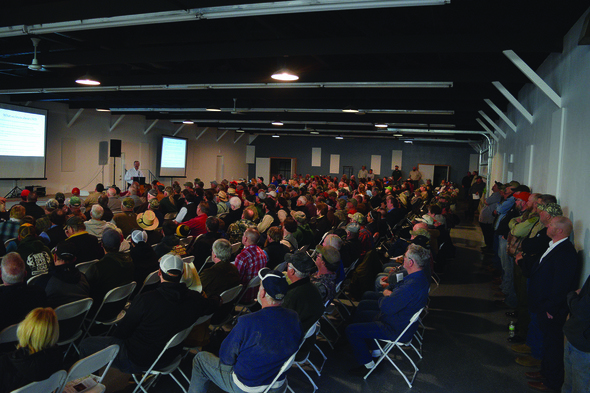 Nearly 300 people filled the 4H Building at the Wayne County Fairgrounds March 15 to learn more about chronic wasting disease (CWD) after a hunter harvested wild deer from last December’s first shotgun season tested positive the always fatal disease. It was the first wild deer to test positive outside northeast Iowa. CWD only affects deer and is confirmed in every state around Iowa. Photo courtesy of the Iowa DNR.
Corydon,
Iowa - They began arriving nearly an hour before the meeting started and by
6:30 p.m. nearly 300 people filled the 4H building at Wayne County Fairgrounds
in Corydon to learn more about chronic wasting disease and what it
means now that it has been found here in a wild deer taken during first shotgun
season Dec. 4.
Deer
hunting is important to residents of Wayne County. It is also important to
hunters from more than 400 different towns in Iowa and across the country who
harvested a deer in this county on the Missouri border.
Chuck
Gipp, director of the Iowa Department of Natural Resources (DNR), set the tone
for the meeting by thanking those who came.
“Your
attendance at this meeting tonight is evidence of your passion for deer hunting
and we’re here to ask for your help to fight a fatal disease,” Gipp said.
Chronic
wasting disease is an always fatal disease that affects deer, elk, moose,
caribou and reindeer. It is caused by a misshapen protein called a prion that
can live for years in the environment, where it can re-infect deer long after
the source is gone. It is spread through urine, blood and saliva from infected
deer and directly by deer to deer contact.
Terry
Haindfield, wildlife biologist for the Iowa DNR who is coordinating the state’s
effort to monitor for the disease, provided an update on the history of the
disease in Iowa, its progression in surrounding states and answered dozens of questions
from the audience well past the meeting’s 8 p.m. conclusion.
“The bottom line is we are going to tackle
this disease together. We need help from you to provide tissue samples for
testing, especially in those early seasons. Those are local deer and the most
important for our monitoring effort before the shotgun seasons start and the
deer start moving around,” he said.
“A
common concern we hear from hunters is that we are going to shoot all the deer
to wipe out the disease and the answer is no, we are not going to shoot all the
deer. We are using tools available to manage this disease in partnership with
you, the hunters and landowners. We need you to provide additional deer tissue
samples from deer that you are already harvesting that will help us to get a
better handle on the extent that it is on the landscape,” Haindfield said.
He
told the audience they can also help by not moving the deer carcass to a new
area or leave it on the landscape and report any sick-looking deer to the local
conservation officer or area wildlife biologist.
“We
know we have one positive deer in Wayne County,” Haindfield said. “One big
thing you can do to help slow the spread is to remove any feed or mineral sites
from the landscape, remove the soil from around the site and replace it with
soil that does not have any residual minerals in it. These artificially
concentrate deer creating hot spots that can really accelerate the rate of
disease transmission.
“Our
goal is to try to slow the spread of chronic wasting disease to allow science
an opportunity to develop more tools to help us in this fight,” he said. “We
want you to keep hunting. Deer hunting is an important family tradition and
working together we can provide this great tradition for our grandchildren and
their grandchildren.”
Media Contact: Terry
Haindfield, Wildlife Biologist, Iowa Department of Natural Resources,
563-546-7960.
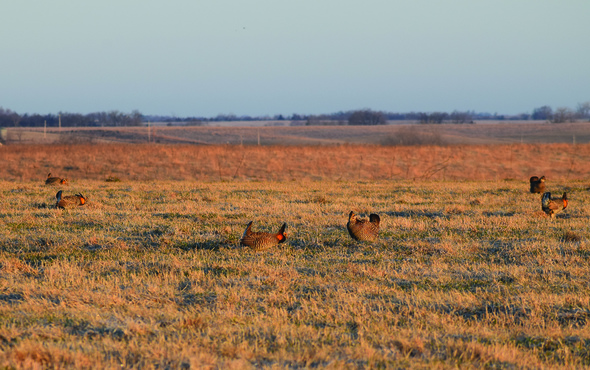 Kellerton - Male prairie chickens meet at the booming grounds every morning before sunrise to display, spar and fight with other males trying to catch the eye of the females watching nearby. The annual ritual begins as early as mid-March and lasts through April. Prairie Chicken Day is April 7. Photo courtesy of the Iowa DNR.
Kellerton,
Iowa - The first rhythmic and haunting cooing begins as the night sky fades and
sunrise begins. The short grass prairie booming grounds prepares for a display
found nowhere else in Iowa.
This is prairie chicken country and on
April 7, it will be the 15th Annual Prairie Chicken Day at the
Kellerton Wildlife Management Area, in Ringgold County. Activities originate from
the viewing platform on 300th Avenue, southwest of Kellerton.
The annual ritual begins as early as
mid-March and lasts through April. Male prairie chickens meet at the booming
grounds every morning to display, spar and fight with other males trying to
catch the eye of the females watching nearby.
“They will be out there until 8 or so, when
they begin to slow down,” said Stephanie Shepherd, wildlife biologist with the
Iowa Department of Natural Resources’ Wildlife Diversity Program.
She said there are typically 20-40
birds that use the lek at Kellerton, and they will display each morning
regardless of the weather. The area has an elevated viewing platform to help
see all the action.
“Some mornings you can hear them and
some you can’t. They are out there every day, but are less active if it’s
raining or really cloudy,” she said. While there will be some spotting scopes
available to use, attendees are encouraged to bring their own or a set of
binoculars.
The prairie chicken population at
Kellerton has benefited from a collaboration between the states of Iowa,
Missouri and Nebraska, and the Nature Conservancy, Blank Park Zoo and the
Ringgold County Conservation Board. The collaboration extended to area
producers who help to manage 30 percent of the grasslands through grazing.
Some of the partners captured and relocated
prairie chickens from Nebraska to the Kellerton area and the Dunn Ranch in
northern Missouri to increase bird numbers and introduce new genetics to the
population. While others worked to reestablish the rolling grasslands in the
area.
“There has been a lot of collaboration
to improve the landscape across the state line to recreate 160,000 acres of
rolling hills of grass with few trees,” Shepherd said. “This partnership
benefits not only the prairie chicken, but other grassland species as well.”
One grassland species in particular,
the Henslow’s sparrow, has benefited from this partnership. The Henslow’s
sparrow is listed as a state threatened species in Iowa but the population at
Kellerton is so large the area has been recognized as globally important for
this species.
Kellerton
Area recognized as Globally Important Bird Conservation Area
The Kellerton Wildlife Management Area
was dedicated as Iowa’s first Bird Conservation Area in 1999 when it
simultaneously became the first grassland Bird Conservation Area in the
country.
On April 7, it will be formally
dedicated as a Globally Important Bird Area, in partnership with Audubon Iowa.
The dedication will occur after the prairie chickens display concludes.
Media Contact: Stephanie Shepherd, Wildlife
Biologist, Iowa Department of Natural Resources Wildlife Diversity Program,
515-432-2823 ext 102.
For those interested in learning outdoor skills that go
“back to the basics,” join DNR Park Ranger Michael Strauser and volunteer instructors
at a one-day class at Pilot Knob State Park near Forest City, on Sat., April 28
from 7:30 a.m. – 5:00 p.m.
According to Strauser, attendees will participate in
hands-on activities such as fire-starting in adverse conditions with natural
materials and a ferro rod and striker (other techniques will be demonstrated),
water purification, knot tying, knife and hatchet handling, using a tarp as a
temporary shelter, and more. This is a fun one-day event for adults at any
skill level. Youth aged 12-17 are welcome to attend if accompanied by an adult.
Strauser started the camp last year because of his own
enjoyment in back-country camping, and wanted to share techniques with people
who may have never tried it.
Participation in the outdoor skills class is limited to
twelve people with pre-registration on a first-come, first-serve basis by
either emailing: Pilot_knob@dnr.iowa.gov or by calling: 641-581-4835.
More than 3,600 Iowa trout anglers participated
in the 2016 Trout Angler Survey, sharing their trout fishing preferences and
experiences. Eighty percent of respondents are very satisfied with the trout
program.
The popularity of the urban trout
fishing program continues to increase, with 99,444 trout fishing trips taken in
2016 compared to 70,202 in 2011. Thirty percent of trout anglers bought their
trout stamp specifically to fish an urban trout lake. Heritage Pond, Prairie
Park Pond, Terry Trueblood Lake and Ada Hayden Lake are the most popular urban
trout lakes.
Iowa trout anglers spent about 489,455
days trout fishing and made 720,611 trips to trout waters in 2016. The most
popular trout stream is North Bear Creek, near Highlandville in Winneshiek
County, with 35,286 visits in 2016.
Media
Contact: Jeff Kopaska, Fisheries
Research Biometrician, Iowa Department of Natural
Resources, 515-432-2823 ext. 109.
Although
pond plant growth is not always the same each year; if you had problems using
your pond last year, you could have similar problems this year. A healthy pond
needs aquatic plant habitat, but too many plants can limit the pond’s use and
cause imbalances in the fish population.
In
an existing pond, mechanical and chemical vegetation control are the best
options for immediate control. They usually work best if you start early, when plant
growth is not at its maximum level. If you wait until growths are thick,
control will be difficult, take longer and could cause water quality issues
that harm fish.
Mechanical
methods include bottom blanketing, shading, removal, and water draw-down. Temporarily
blanket the bottom of a private pond and leave it in place for 30 days early in
the season to limit plant growth in fishing or swimming areas. Use weighted commercial
weed barrier products or thick black plastic (punctured to allow gases to
escape).
To
shade a pond, apply a pond dye in April to reduce the amount of light needed
for plant growth. This works best in ponds with a small watershed. Many blue
and black pond dye products are available for pond beautification; Aquashade®
or Admiral®, both blue dyes, are the only products labeled by the EPA to limit plant
growth. Re-apply the product at a reduced rate throughout the spring and summer
since inflowing water can dilute it and ultra-violet light can decompose it.
Removal
is a low-cost way to take out plants from high-use areas. It can be done by
hand or with rakes and cutters (purchase from retail outlets). Draw-down is
another method of control. To use this method, let water out of the pond this
spring (or winter) to expose aquatic plants to drying (or freezing) conditions
to limit their growth in future months after water is allowed to refill the
pond.
Herbicides
will control pond vegetation chemically, though retreatment may be needed to
get season-long control. Follow these five steps with any herbicide
application: 1) correctly identify the plant to be controlled; 2) measure the
area to be treated (surface area and average depth); 3) read the herbicide
label to determine the correct timing and amount to apply; 4) identify possible
restrictions on uses of the water (e.g., irrigation or watering animals) and 5)
apply according to label directions. All aquatic herbicides work best if
applied on a calm, sunny morning.
Find
more information on aquatic plant identification and control on the DNR website
at www.iowadnr.gov/ponds.
Media Contact: Darcy Cashatt, Fisheries
Biologist, Iowa Department of Natural Resources, 641-647-2406.
|





