|
Channel catfish move close to shore and are eager
to bite in many lakes and the large reservoirs across Iowa. After eating light
during the winter, channel catfish go on a feeding frenzy in early spring cleaning
up small fish that died over the winter.
When the ice goes off, a winter’s worth of dead forage
fish drift into shallow water for channel catfish to devour. Search for
actively feeding fish on the windblown shorelines and points where dead fish are
piled up and the shallow water warms quickly. Keep the wind in your face and
try different locations until you find actively feeding fish.
Use cut bait or shad sides fished on the bottom. To
keep the bait on the hook, try using a 1/0 to 3/0 bait holder hook and enough
weight (3/8th to ½ ounce) to cast into the wind. Bring along disposable latex
gloves to handle the bait and help keep the smell off your hands.
Ice out catfishing can be good in any lake that
has an abundant catfish population.
Iowa’s flood control reservoirs, Rathbun, Red Rock, Coralville and
Saylorville usually offer the best action. Try catfishing in Storm Lake, East
Okoboji, Clear Lake or Black Hawk Lake in northwest Iowa soon after the ice is
gone. Small impoundments in southern
Iowa, like Greenfield City Reservoir, Big Creek, Lake Darling, Green Valley or Lake
Icaria, also offer good early spring catfishing.
Catfish are one of the most abundant game fish in
Iowa and can be found in almost every body of water across the state. Check the
weekly
fishing report to find out where the catfish are
biting.
Media
Contact: Bryan Hayes, Fisheries Biologist, Iowa Department of
Natural Resources, 712-769-2587.
1,750 archers from 86 Iowa schools
participated in the National Archery in the Schools Program (NASP) state
tournament March 10-11, in Des Moines.
Lilly Machart, from Anamosa, won the girls
bullseye competition with a score of 297. Cassie Allen, from Holstein Ridge View,
won the girls 3D competition with a score of 293. Machart and Allen were each awarded a bow for
winning the respective competition.
Jatin Moore, Eddyville-Blakesburg-Fremont,
won the boys bullseye competition with a score of 293. Kade Butterwegge, from
West Des Moines Stilwell, won the boys 3D competition with a score of 290. Moore
and Butterwegge were each awarded a bow for winning the respective
competitions.
Scholarships were awarded to the top
scoring 12th grade boys and girls in each category.
Senior boys scholarship winners were Eli
Kempema, from Sergeant Bluff Luton, who received $1,000 for highest 3D score and
Brandon Lochner, from Mount Vernon, received $500 scholarship for second
highest 3D score among seniors. Tanner Bowman, from Johnston, received $1,500
for highest score and Jack Waskow, Alburnett, received $1,000 scholarship for
second highest score among seniors in the bullseye competition.
Among senior girls, Brooke Paris, from
Ottumwa, received $1,000 scholarship for highest 3D score and Lauryn Jansen, of
Sergeant Bluff Luton, received $500 for second highest 3D score among
seniors. Robyn Stillmunkes, from
Bellevue, received $1,500 scholarship for highest score and Nyla Kahl, from
Bellevue, received $500 scholarship for second highest score in the bullseye
competition.
NASP archers who scored highest league
scores plus the highest state tournament scores were named All State Archers.
Boys All
State Archers
Connor Myers, Mount Vernon
Alex Brittain, Eddyville-Blakesburg-Fremont
Jatin Moore, Eddyville-Blakesburg-Fremont
Owen Lerg, West Des Moines Valley
Adam Larson, Lawton
Collin Hallier, Mount Vernon
Girls All
State Archers
Lilly Machart, Anamosa
Makenna Hewitt, Cedar Rapids Prairie Point
Paige Emig, Mount Vernon
Samantha Mellinger, Washington
Breann Holtz, Lawton
Haley Schwenneker, Spencer
High All-Around Champions were named based on
their total combined scores from the state 3D and bullseye tournaments. Lilly Machart, from Anamosa, with a total
combined score of 588 and Alex Brittain, from Eddyville – Blakesburg – Fremont,
with a total combined score of 578.
Nearly 3,600 archers from more than 300 schools
participated in Iowa’s National Archery in the Schools Program. The NASP season
was Dec. 1 to Feb. 24.
3D results are available online at https://nasptournaments.org/TournamentDetail.aspx?tid=2897
Bullseye results are available online at https://nasptournaments.org/TournamentDetail.aspx?tid=2896
The state tournament was sponsored by the Iowa
Bowhunters Association, Whitetails Unlimited, the Iowa State Archery
Association, Rocky Mountain Elk Foundation and Safari Club International.
Media Contact:
Megan Wisecup, Hunter Education Administrator, Iowa Department of Natural
Resources, 515-238-4968.
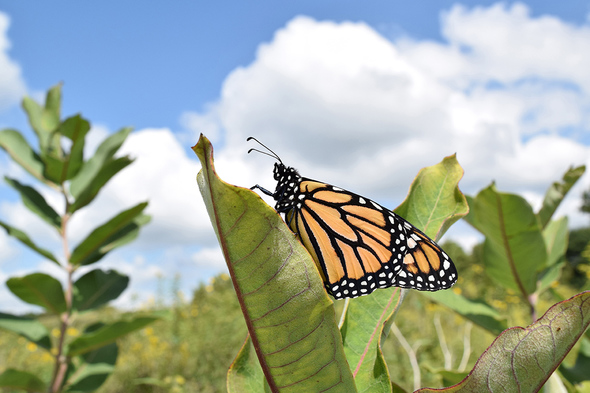 Female monarchs lay eggs exclusively on milkweed plants so national efforts focus on establishment of new milkweed stems for conservation goals. The North Central states in the monarch’s northern breeding grounds will collectively establish 1.3 billion new milkweed stems over the next 20 years. Iowa’s strategy estimates 127 to 188 million new stems will be established within Iowa.
The Iowa Monarch Conservation Consortium has set a goal
of acres devoted to monarch butterfly habitat in the state by 2038.
“The consortium has worked collaboratively with diverse
stakeholders to develop a comprehensive plan to expand habitat on our
agricultural land, urban areas, roadsides, and other public land. We appreciate
the many partners that have been involved and are encouraged by the work
already underway,” said Mike Naig, Iowa Secretary of Agriculture.
The updated Iowa Monarch Conservation Strategy seeks to establish approximately 480,000
to 830,000 acres of monarch habitat by 2038.
The strategy — developed by the consortium members —
guides the implementation and documentation of a voluntary, statewide conservation
effort based on the best available science. The consortium is a group of 40 organizations,
including agricultural and conservation associations, agribusiness and utility
companies, universities and county, state and federal agencies.
Iowa’s
habitat goals are included in the Mid-America Monarch Conservation Strategy draft,
released by the Midwest Association of Fish and Wildlife Agencies on March 12,
2018. The Mid-America strategy draft describes how the North Central states in
the monarch’s northern breeding grounds will collectively establish 1.3 billion
new milkweed stems over the next 20 years. Iowa’s strategy estimates 127 to 188
million new stems will be established within Iowa.
“Iowa falls entirely within the monarch’s northern
breeding core. This means that every patch of milkweed habitat added in Iowa
counts, and Iowa is perfectly situated to lead the way in conservation efforts
for the monarch butterfly,” said Chuck Gipp, director of the Iowa Department of
Natural Resources. “The recovery cannot succeed without Iowa.”
Female monarchs lay eggs exclusively on milkweed plants
so national efforts focus on establishment of new milkweed stems for
conservation goals. However, habitat plantings are expected to include a
diverse array of nectar species to provide forage for adult monarchs throughout
their life cycle and seasonal migrations.
“Recent research demonstrates that an ‘all hands on deck’
approach is necessary for successful monarch conservation. The dominance of
agriculture within Iowa means that agricultural land must be a part of the
solution,” said Joe Colletti, interim endowed dean of the College of
Agriculture and Life Sciences at Iowa State University. “This means that
consortium members are looking at all options on agricultural and
non-agricultural lands for adding habitat including augmenting existing
conservation practices, establishing habitat patches in underutilized, grass-dominated
areas, and adding habitat in urban locations such as parks, industrial and
school properties.”
The monarch population has declined by more than 80
percent during the last 20 years in North America. Surveys of the 2017-2018 overwintering generation of monarchs indicate the numbers are still
less than half of the size needed to ensure a sustainable population.
The U.S. Fish and Wildlife Service has until June of 2019
to determine whether the monarch should be listed under the Endangered Species
Act. The consortium seeks to demonstrate how voluntary efforts can support
species recovery and avoid the need to list the monarch.
Information on how to support monarch conservation is
available at www.iowamonarchs.info.
The Iowa Monarch Conservation Consortium formed in 2015
in response to monarch population declines. More information about consortium is
available at www.iowamonarchs.info.
Contacts:
Steve Bradbury, Natural
Resource Ecology and Management, (515) 294-7315, spbrad@iastate.edu
Jacque Pohl, Entomology, (515) 294-9980,
jpohl@iastate.edu
##
Iowa Monarch Conservation Consortium members and partners
include:
Iowa Department of Agriculture and Land Stewardship; Iowa
Department of Natural Resources; Iowa State University; Alliant Energy; BASF,
Bayer CropScience; Blank Park Zoo; Bur Oak Land Trust; Central College; DuPont
Pioneer; Environmental Defense Fund; Iowa Association of Electric Cooperatives;
Iowa Association of Electric Cooperatives; Iowa Cattlemen’s Association; Iowa
Corn Growers Association; Iowa County Conservation System; Iowa Farm Bureau
Federation; Iowa Natural Heritage Foundation; Iowa National Guard; Iowa Nature
Conservancy; Iowa Pork Producers Association; Iowa Soybean Association; Iowa
Renewable Fuels Association; Iowa Turkey Federation; Iowa Wildlife Federation;
ITC Midwest; Luther College; Monarch Watch; Monsanto; Muscatine Island Research
Farm Association, Fruitland; Northeast Iowa Agricultural Experimental Association,
Nashua; North Central Iowa Research Association, Kanawha; Northwest Iowa
Experimental Association, Sutherland; Pheasants Forever; Practical Farmers of
Iowa; Sand County Foundation; Soil and Water Conservation Society; Southeast
Iowa Agricultural Research Association, Crawfordsville; Syngenta; Trees
Forever; Western Iowa Experimental Farm Association, Castana; University of Minnesota
Monarch Butterfly Laboratory; University of Northern Iowa Tallgrass Prairie
Center; U.S. Department of Agriculture Agricultural Research Service Corn
Insects and Crop Genetics Research Unit; Wallace Foundation for Rural Research
and Development, Lewis; Whiterock Conservancy; and Women Food & Ag Network.
Iowa-based U.S. Department of Agriculture Farm Service Agency, U.S. Department
of Agriculture Natural Resources Conservation Service and US Fish and Wildlife
Service are ex officio partners.
|





