|
DES
MOINES -- Free, guided hikes will take place in 26 Iowa state parks on New
Year’s Day as part of America's First Day Hikes initiative. Hikers can expect
to be surrounded by the quiet beauty of nature in winter, and experience
spectacular views, beautiful settings and the cultural treasures offered by
Iowa’s state parks.
All
50 states will participate in the seventh annual national event that encourages
everyone to celebrate the New Year with a guided outdoor exploration.
“We
are excited to host First Day Hikes again as part of this effort to get people
outdoors and into our parks,” says Todd Coffelt, chief of the Iowa Department
of Natural Resources State Parks Bureau. “These hikes are a great way to get
outside, exercise, enjoy nature and welcome the New Year with friends and
family.”
Last
year, more than 1,200 people began the year in an Iowa state park, hiking more
than 1,100 total miles.
Staff and volunteers will lead First Day Hikes in Iowa’s 26
participating state parks. Some hikes will include wildlife viewing and hot
beverages. Hikes will average one to two miles or longer depending on the
location. Details about the hikes can be found at www.iowadnr.gov/firstdayhikes. To see a
comprehensive national map of First Day Hikes, visit www.stateparks.org Participants are encouraged to share their
adventures on social media with #FirstDayHikes or #iowastateparks.
Iowa
First Day Hikes will take place at the
following 26 state parks:
NORTHWEST
- Big
Creek State Park
- Dolliver
Memorial State Park
- Gitchie
Manitou State Preserve
- Ledges
State Park
- Lewis
and Clark State Park
- Prairie
Rose State Park
- Springbrook
State Park
- Stone
State Park
SOUTHWEST
- Green Valley State Park
- Lake Anita State Park
- Viking Lake State Park
- Waubonsie State Park
- Wilson Island State Recreation Area
SOUTHEAST
- Honey Creek Resort State Park
- Lacey-Keosauqua State Park
- Lake Darling State Park
- Lake Wapello State Park
- Walnut Woods State Park
NORTHEAST
- Bellevue State Park
- Cedar Rock State Park
- Maquoketa Caves State Park
- Mines of Spain State Recreation Area
- Pikes Peak State Park
- Pine Lake State Park
- Volga River State Recreation Area
- Yellow River State Forest
"America’s
State Parks provide havens for young and old alike to discover the tranquility
and beauty of nature through outdoor recreation,” National Association of State
Park Directors executive director, Lewis Ledford said. “Hiking offers inspiring
ways to improve your physical and mental health, while exploring beautiful
public lands in every state.”
Last year, more than 62,000 people took part in
guided hikes that covered over 114,165 miles on 1,300 different hikes across
the country.
Media Contact: Todd Coffelt, Chief,
State Parks Bureau, Iowa Department of Natural Resources,
515-725-8485.
The 2017 Iowa deer harvest is running less than 1 percent ahead
of the 2016 totals. So far this fall, 76,204 deer have been reported, compared
to 75,909 for the same period last year.
Iowa’s second shotgun season ends Dec. 17. Iowa’s deer seasons
conclude with the late muzzleloader season and archery season, both of which
are Dec. 18-Jan. 10, 2018.
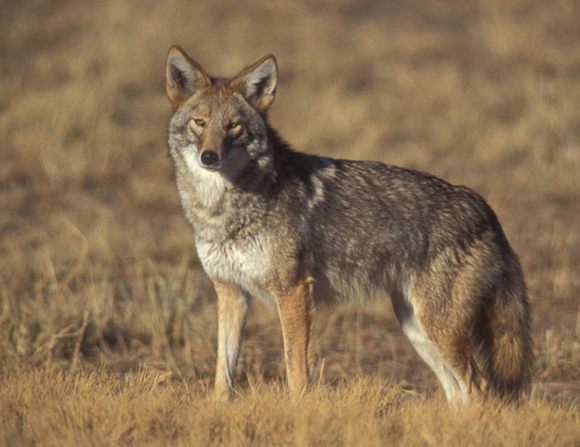 Coyotes are habitat generalists and can be found near large brushpiles, timber and grass fields, and in particular, fields with switchgrass. Photo courtesy of the Iowa DNR.
An expected 10,000 to 15,000 Iowa
hunters will turn their attention to pursuing the state’s top predator after
Jan. 10. That’s when most of Iowa’s hunting seasons close, and coyote hunting
begins in earnest.
Although its season never closes, coyotes
are hunted most often during the winter. The number of Iowa coyote hunters and
harvest has been at a record level for four of the past five years, thanks in
part to predator hunting shows and because coyote fur has held its value as
most other pelt prices have declined.
“Coyote pelts go for anywhere from $15-$30 per
pelt depending on the quality and Iowa’s pelts are considered average. Last
year’s average price was $17. The top pelts come from the Dakotas, Montana, and Saskatchewan
and Alberta, Canada,” said Vince Evelsizer, state furbearer biologist with the
Iowa Department of Natural Resources. Coyote fur is used as trim for hoods and
coats in foreign markets.
Coyote population is distributed
fairly well across the state with the highest population in western Iowa. Coyotes
are habitat generalists and can be found near large brushpiles, timber and
grass fields, and in particular, fields with switchgrass.
Hunters prefer a fresh layer of snow
for tracking and the white background makes coyotes easier to see from a long
distance. Wind is critical to coyote hunters because it impacts where and how they
set up for calling and pursuing coyotes as coyotes have a keen nose and are naturally
wary. Wearing snow colored camo is often effective to avoid detection.
Hunters can use predator calls, hunt
day or night, use rifles, may hunt over bait and use groups of hunters and or
hounds to round them up. There is no bag limit and coyotes can be hunted on a
hunting or furharvester license.
“We receive complaints from the public
about coyotes’ impact on young deer, turkeys and rabbits; harass pets, and
farmers’ loss of livestock. So in that respect, hunters provide an important
service by hunting coyotes,” Evelsizer said. “That being said, they’re a very
wary game animal worthy of respect. We don’t allow the use of artificial light
for night hunting on purpose because we encourage fair chase and it could increase
the incentive to misuse the technology to poach deer and other wildlife.”
Coyote trapping is allowed, but it
must be done during the trapping season.
Coyote
hunting dos & don’ts
Hunters are reminded that the way they
hunt reflects on all hunters.
“With our coyote hunters, we
especially want to emphasize respect for landowners and their property lines.
Take the extra time to close their gates, obey the laws for safe shots, and thank
the landowner – keep your interaction with folks while out hunting positive,”
Evelsizer said.
Most coyote hunting takes place on
private land, and occasionally hunters will cross property boundaries which
lead to trespassing complaints. Hunters
cannot pursue coyotes using a snowmobile, aircraft or with the aid of
artificial light, regardless of light color.
- Be sure to close all gates that were opened, not
trespass where permission was not given and to follow fair chase principles
- Don’t shoot over any road right-of-way, gravel or
paved
- If running dogs, be sure to have permission from
all landowners in the area where the hunt will take place
- Be sure of the target – make sure it’s a coyote
and not a dog
Identification
Coyote hunters need to be aware of the
possibility – however remote – that the animal they see through their scope is
not a coyote but a wolf passing through the state.
“We’ve had a slight increase in the
number of reported wolf sightings over the years, and had four wolves shot by
coyote hunters during the last three years. They were likely members of the
Great Lakes population from Wisconsin or Minnesota that were wandering through,”
he said.
Wolves are protected in Iowa and there
is no open season. Shooting a wolf has the potential to bring state and or
federal fines.
“Hunters want to do the right thing. One
of the first rules in safe hunting practices is to positively identify your
target and what is behind your target before taking a shot. Wolves are two to
three times the size of a coyote. If what you see is larger than the average coyote,
it is definitely worth another look before pulling the trigger,” Evelsizer said.
Evelsizer said other than the obvious
size difference – coyotes typically weigh 25-40 pounds, while wolves typically weigh
70-110 pounds – there are other characteristics to help determine the identity
of the canine.
Coyotes have a pointed snout and their
ears are larger proportionally in to their body. Wolves are taller than coyotes,
have long front legs and a heavier, squarer frame. There is more detailed information on coyote
and wolf characteristics at www.iowadnr.gov/hunting
and scroll to the bottom then click on Iowa’s Occasional Wildlife Visitors.
Media Contact:
Vince Evelsizer, Furbearer Wildlife Biologist, Iowa Department of Natural
Resources, 641-357-3517.
The annual Christmas bird count begins
across Iowa with volunteers working with count coordinators from the Iowa
Ornithologists Union to identify one day between Dec. 14 and Jan. 5 to count
every bird – seen or heard – in their designated area.
The Christmas bird count began in
1900, and has been called the original citizen scientist project. In fact, enough
data has been captured over the years that various scientific organizations
have been using the results to document changes in bird populations.
“This has become a winter tradition
for hundreds of birders,” said Bruce Ehresman, wildlife biologist with the Iowa
Department of Natural Resources Wildlife Diversity Program. “When the weather
is good and we have open water, volunteers often document more birds, including
one year when more than 100 different species were documented at the
Saylorville count area.”
Last year, there were 35 different
areas in Iowa where Christmas bird counts were run. Each count is held during one complete day between
Dec. 14 and Jan. 5, 2018. Interested volunteers should visit http://www.iowabirds.org/Connections/CBC.aspx
to find an area and then contact the count coordinator.
Media Contact: Tyler Harms, Wildlife Bureau, Iowa Department
of Natural Resources, 515-432-2823 ext 112.
|





