|
Seventeen
lakes across Iowa are gearing up to receive trout this fall. The Iowa
Department of Natural Resources (DNR) will release between 1,000 to 2,000 rainbow
trout at each location as part of its cool weather trout program that brings
trout to areas that cannot support them during the summer months.
“Grab your neighbors, friends and kids and try
trout fishing this fall,” said Joe Larscheid, chief of the Iowa DNR Fisheries
Bureau. “It’s time well spent. The fish
are here, easy to catch and good to eat.”
The fall urban trout stockings are a great place
to take kids to catch their first fish. A small hook with a nightcrawler or
corn under a small bobber or small simple spinners such as a panther martin or
mepps is all you need to get in on the fun.
Bringing
trout to cities and towns offers a “close to home” option for Iowans who might
not travel to northeast Iowa to discover trout fishing. A family friendly event
is often paired with the stocking to help anglers have success and fun while
fishing.
The
popular program is supported by the sales of the trout fee. Anglers need a
valid fishing license and pay the trout fee to fish for or possess trout. The
daily limit is five trout per licensed angler with a possession limit of
10.
Children
age 15 or younger can fish for trout with a properly licensed adult, but they
must limit their catch to one daily limit. The child can purchase a trout fee
which will allow them to catch their own limit.
2017 Fall Urban Trout Stocking Schedule
Oct.
14, Lake of the
Hills,
Davenport, 10:30 a.m.
Oct.
20, Sand Lake,
Marshalltown, Noon
Oct.
26, Banner Lake
(South),
Summerset State Park, Indianola, 11 a.m.
Oct.
26, Big Lake, Council
Bluffs, 2 p.m.
Oct.
27, Ottumwa Park
Pond,
Ottumwa, 11 a.m.
Oct.
27, Lake Petocka, Bondurant,
Noon
Oct.
28, Discovery Park, Muscatine,
10 a.m.
Oct.
28, Heritage Pond, Dubuque, 10
a.m.
Oct.
28, Wilson Lake, Fort
Madison, Noon
Nov.
1, Bacon Creek, Sioux City,
1:30 p.m.
Nov.
2, North Prairie
Lake,
Cedar Falls, Noon
Nov.
2, Moorland Pond, Fort Dodge,
Noon
Nov.
16, Ada Hayden
Heritage Park Lake,
Ames, Noon
Nov.
17, Prairie Park
(Cedar Bend),
Cedar Rapids, 10 a.m.
Nov.
17, Terry
Trueblood Lake,
Iowa City, 11 a.m.
Nov.
18, Scharnberg
Pond,
Spencer, Noon
Nov.
22, Blue Pit, Mason City,
11 a.m.
Find
more information about trout fishing in urban lakes on the DNR trout fishing webpage.
Media
Contact: Mike Steuck, Regional Fisheries Supervisor,
Northeast Iowa, Iowa Department of Natural Resources, 563-927-3276.
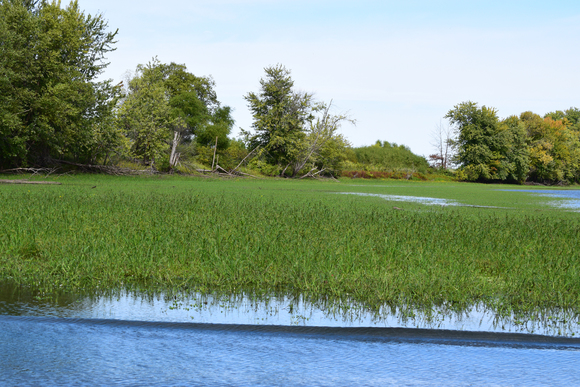 The water level at Lake Odessa is managed to mirror Mother Nature. Summer drawdowns expose mudflats which immediately vegetate with moist-soil plants. Water is allowed to gradually return to the newly established vegetation creating a buffet for migrating birds. Photo courtesy of the Iowa DNR.
Sitting along the west bank of the
Mississippi River in Louisa County, Lake Odessa, with its network of islands, waterways
and hidden sloughs, might be the wildest place in Iowa.
It may be the only place in the state
where diamondback and copperbelly water snakes are still found. It’s home to
red eared sliders, softshell, painted and common snapping turtles, otters,
beaver, turkeys and deer and is a popular refueling station for pelicans and
bald eagles along with ducks and geese by the thousands.
The Mighty Mississippi is the water
source that floods the refuge and wildlife area as planned, and occasionally
floods the entire area when not planned.
The responsibility for managing Lake
Odessa falls to Andy Robbins, wildlife biologist the Iowa Department of Natural
Resources.
“No two years have been the same here
because of the constantly changing water levels on the Mississippi river,” he said.
“We can have a drought like this year resulting in some productive habitat
management, or a major flood resulting in a levee break. But that’s what makes
this system so dynamic.”
Battling the influence of the river is
not a recent issue.
A century ago, this area hosted multiple
farms and homes, a sawmill and businesses in the floodplain. The residents
built canals with a pumping station to try to drain the wet soils to the point where
they could farm it. A sand levee standing between them and the mighty river
would occasionally give way during high water.
Once the lock and dam system was constructed
on the Mississippi and the water level rose, it became too expensive to pump.
In the 1930s, the US Army Corps of Engineers began to acquire the parcels that
would become Lake Odessa. Over time, the buildings have vanished leaving few
visible markers of their existence.
While those buildings are gone, the
sand levee remains and serves as an important protective barrier for the
existing wildlife habitat. As a result
of this levee protection, Odessa has been able to maintain one of the most
diverse floodplain forests remaining on the upper Mississippi River.
Robbins’ water level management plan attempts
to mirror Mother Nature. In the summer, he draws it down to expose mudflats
which immediately vegetate with a variety of moist-soil plants. In the fall, he
gradually puts water into the newly established vegetation creating a buffet
for migrating birds.
“The birds really respond to that in a
big way in the fall. They go right to that freshly flooded vegetation,” he
said.
A duck
hunting destination
Every point and pond on Odessa has a
name - Round Pond, Phil’s Pond, Taylor Pond, The Nightmare, Dynamite Ditch, the
list goes on and on. Some names go back to when the area was still called
Muscatine Slough, long before it was open to the public.
Duck hunting is a lifestyle and more
and more of the 150 cabins and duck shacks on the lake have been converted into
year round residences. Those homes generally overlook the area where hunters
will literally stake out the parking spot where their boat will be positioned
for the dash to their honey hole at midnight on opening day.
It draws well over 1,000 hunters each
year from the Quad Cities, Cedar Rapids, Muscatine, Burlington, Washington, and
is a second home to the sportsmen of Louisa County. If out-of-towners want to
blend in, they should use tumbleweed and pin oak branches on their duck blind.
Using any other material is a clear signal that you’re not from around here.
Year Round
Recreation
Lake Odessa Wildlife Area and the
adjacent Port Louisa National Wildlife Refuge is a nearly 7,000-acre complex
built to attract waterfowl and other migratory birds during their annual
migration. But it’s much more than just that.
It has an extensive water trail for
paddlers to explore. For those who may be apprehensive about tackling the area,
the Louisa County Conservation Board hosts paddling events on the lake,
including offering a moonlit paddle. There is a lot of interest in bird watching
and while the area can be somewhat difficult to navigate, the diversity and
numbers is worth the effort.
The area also has a quality deer herd and
excellent hunting opportunities for most woodland species.
The Mississippi River is the water
source that fills Lake Odessa through an inlet gate on Pool 17. When opened,
the inlet is often the best place to fish in the county. “When the inlet is
open people are fishing there all day every day,” he said.
Commitment
to Odessa
Levee breaks and major floods have impacted
the management of Odessa for decades, but in recent years have been far too
regular for Robbins liking. Odessa’s
forest is showing signs of the major flooding and more trees are lost with each
major flood.
In the last 10 years, about $20 million
has been invested by the U.S. Army Corps of Engineers as part of a Habitat Rehabilitation
and Enhancement Project (HREP) in improving Odessa’s levees and fish and
wildlife habitat. That project was completed last spring with a formal
rededication ceremony with Iowa’s congressional delegation, the U.S. Army Corps
of Engineers, U.S. Fish and Wildlife Service and the Iowa DNR.
Media
Contact: Andy Robbins, Wildlife Biologist,
Iowa Department of Natural Resources, 319-551-8459.
|





