|
Waterfowlers have waited all year for
this: for the next three weekends in Iowa, there will be an opening day for
duck and goose hunting. The north zone opens on Sept. 23, the south zone opens
on Sept. 30 and the Missouri River zone opens on Oct. 7.
As in most years, scouting improves
the chance for hunter success and this year, with the drought conditions over
much of the state, it has added significance.
“Wetland conditions are variable
across the state. Hunters who hunt shallow marshes would be wise to check marsh
conditions before leaving home rather than finding out opening day at 4 a.m. at
the boat ramp that there’s not enough water to float their boat,” said Orrin
Jones, state waterfowl biologist for the Iowa Department of Natural Resources.
The Iowa DNR has a wetland conditions
survey and weekly migration report online at www.iowadnr.gov/hunting.
“There are pros and cons to hunting in
drought years,” Jones said. “Cons are there’s not as many wetlands with water
and it could be more difficult to access certain areas. The pros are that the
birds are more concentrated. But when weather conditions and birds come
together, we could have the opportunity for a good season. It’s really up to
Mother Nature. It’s hard to predict what’s in store.”
Duck populations are strong and that’s
good news for hunters. There are few changes to the duck bag limits from last
year – pintail daily bag has dropped to one and back duck daily bag has risen
to two.
Goose Season
The opening of the Canada goose season
coincides with the opening of duck season.
“There are a lot of young birds this
year which usually means our goose hunters should have a great opening segment,”
Jones said.
Iowa’s Canada goose population is
usually highest in December with the peak occurring a little earlier in north
and a little later in the south. Goose abundance is primarily influenced by
weather in states to the north.
The daily bag limit for Canada geese
is two. On Nov.1, the daily bag limit increases to three.
More information and season dates and
bag limits is available in the 2017-18 Iowa Hunting, Trapping and Migratory
Game Bird Regulations and online at www.iowadnr.gov/hunting.
Youth Season
The youth waterfowl season for the
south zone is Sept. 23-24 and in the Missouri River Zone it’s Sept. 30-Oct. 1. Youth
hunters in the north zone had their two day season last weekend.
“This is an opportunity for kids to
hunt ducks on our premier marshes with a lot of birds on them and little
competition,” Jones said. The bulk of the waterfowl in Iowa currently is blue
wing teal, wood ducks and mallards.
Youth hunters during this special
season are allowed to harvest Canada geese, if the opportunity presents itself,
which is a change from last year.
“This is a great opportunity for our
youth hunters to find success with Canada geese,” Jones said.
The bag limits during the youth season
are the same as during regular season.
Waterfowl
band
Reporting banded waterfowl changed in
July when the toll free phone number printed on the bands was discontinued. The
U.S. Geological Survey is responsible for the bird banding program and canceled
the call center due to federal budget constraints.
The only way to reported banded ducks
and geese is by logging on to www.reportband.gov.
“Even if the bird band has a phone
number on it, the only way to report it is via the website,” Jones said. “It’s
a fast and easy way to report.”
Season Dates
North Zone
Ducks, Mergansers, Coots: Sept. 23 to Oct. 1, and
Oct. 14 to Dec. 3
Canada Geese, Brant, White-fronted Geese: Sept.
23-Oct. 8, and Oct. 14-Jan. 1, 2018
South Zone
Ducks, Mergansers, Coots: Sept. 30-Oct. 4, and
Oct. 21-Dec. 14
Canada Geese, Brant, White-fronted Geese: Sept.
30- Oct. 8, and Oct. 21-Jan. 15, 2018
Missouri
River Zone
Ducks, Mergansers, Coots: Oct. 7-8, and Oct.
21-Dec. 17
Canada Geese, Brant, White-fronted Geese: Oct.
7-15, and Oct. 21-Jan. 15, 2018
Media
Contact: Orrin Jones, State Waterfowl
Biologist, Iowa Department of Natural Resources, 641-357-3517.
Step back in time, to life in the
1840s, Sept. 23-24 at the Annual Fort Atkinson Rendezvous.
The event takes place at the historic
Fort Atkinson State Preserve, in Winneshiek County.
This year’s rendezvous will focus on
the powder magazine or house, located in the southeast corner of the fort used
to store gun and cannon powder in the 1840s.
Weekend activities begin with a 5K
run/walk at 8:30 a.m. Race day registration begins at 7:30 a.m. The
fort and rendezvous open to the public Saturday at 9:30 a.m.
Throughout the weekend, visitors can
experience cannon drills, anvil shoots, period instruments and music, a flint
and steel contest, primitive bow shoot, 1840s kid’s games, cooking contest,
melodrama and a bullwhip contest.
All participants wear clothes and
uniforms of the 1840s and have trade blankets on display with thousands of
period artifacts such as guns, tomahawks, knives, cannons, furs and supplies.
Period crafts of all types are demonstrated throughout the weekend.
The fort closes Saturday at 4:30
p.m. and reopens Sunday at 9 a.m. with similar activities. The
weekend event closes at 3:30 p.m. on Sunday.
Fort Atkinson was an active military
post for the expanding United States from 1840 to 1849. The purpose of the fort
was to keep the Ho-Chunk (Winnebago) tribe on neutral ground in the Iowa
Territory and to keep peace on the frontier between the Ho-Chunk, Sioux, Sauk
and Meskwaki tribes and Euro-American settlers.
The fort was acquired by the State of
Iowa in 1921 and the Fort Atkinson State Preserve Historic District was placed
on the National Register of Historic Places in 2013.
For more information about the
rendezvous and history of the fort, visit www.fortatkinsoniowa.com/rendezvous-days.html.
The weekend rendezvous activities are sponsored by the Friends of Fort Atkinson
and the Iowa DNR and are free and open to the public.
The rendezvous will host local school
children and the media on Sept. 22.
This year may be a good one for leaf
viewers, according to Jeff Goerndt, state forester with the Iowa Department of
Natural Resources (DNR).
“I think we’re going to have a decent
fall color year because of the weather we’re currently having,” Goerndt says. “You
get the best and brightest colors when you’ve got the kind of fall weather we
are currently having with sunny days and crisp, cool nights. The only problem
we might see is the recent drought may cause some premature leaf drop in some
areas."
Typically, the best fall colors are
in northeast Iowa, but there are some good areas in central Iowa too, says
Goerndt.
Leaves will change across northern
Iowa between the last week of September and the second week of October. Central
Iowa will see leaves changing from the first to third weeks of October.
Southern Iowa will see leaves change from the second week to the end of
October.
What changes where is subject to
weather. How vivid and how long leaves remain is also determined by weather,
and the leaf-watching season can be cut short by strong wind events.
As days get shorter, trees release a
chemical called phytochrome. This chemical slows chlorophyll production and
allows the tree go dormant. The loss of chlorophyll (which is green) allows the
other colors of the leaves to show.
Leaf pigment is also influenced by
the amount and acidity of sap in the trees. More acidic sap gives trees more
reds and brighter colors. Less acidic saps gives trees duller and more yellow
colors.
The DNR provides a weekly fall color
report each Monday afternoon. Updates are available by calling the DNR fall
color hotline at 515-233-4110 and online at www.iowadnr.gov/fallcolor or, have the report
sent directly to your email by subscribing to the Iowa Fall Colors weekly
report at the same webpage.
Media Contact: State Forest Nursery, 515-233-1161.
Deer
hunters in western Iowa take note – chronic wasting disease (CWD) has shown up
on your doorstep. Five deer harvested in
southeast Nebraska in 2016 have tested positive for CWD.
The
Iowa Department of Natural Resources (DNR) will increase surveillance sampling of
deer from Woodbury to Fremont County beginning this fall.
The
Iowa DNR has scheduled two meetings to discuss the status of CWD in Iowa and
how deer hunters can help. Meetings are scheduled at 6:30 p.m., Sept. 25, in
the Lewis and Clark State Park Visitor Center, three miles
west of Onawa, and 6:30 p.m., Sept. 26, at the public library, 420 East Huron
St., in Missouri Valley.
Terry
Haindfield, wildlife biologist for the Iowa DNR who is leading the effort to
combat CWD, will coordinate the meeting. He hosted a series of meetings in
northeast Iowa last year that drew crowds of up to 300 and hopes to have
similar turn out in western Iowa.
“We
want people to come to these meetings, ask their questions, hear the concerns
from other hunters,” Haindfield said. “Deer hunting is an important tradition
and, for some, a large part of their identity. It is also important to us and
we need to work together to combat this disease. Our goal is to provide quality
deer hunting for future generations.”
The
DNR will present information on CWD, inform the public about increased
surveillance in western and southwestern counties, and request help from deer
hunters for tissue samples during the upcoming fall and winter deer seasons.
After
the initial CWD positive wild deer was found in Allamakee County in 2013, the
DNR, with the help of cooperative hunters, increased its surveillance in
proximity to where the positive deer was harvested to help determine the extent
of the disease. To date, 18 deer have
tested positive for CWD in northeast Iowa; 17 in Allamakee County and one in
Clayton County, discovered last year.
There
are several things hunters can do to stop or slow the spread of CWD, Haindfield
said.
“The
first and most important is to allow sampling of hunter harvested deer,” he
said.
The
Iowa DNR’s wildlife staff sets an annual goal of collecting 4,500 samples.
Since testing began in 2002, more than 62,500 tissue samples have been
collected and tested looking for the presence of CWD in Iowa’s wild deer herd.
The effort has focused on portions of northeast and eastern Iowa near Wisconsin,
Illinois, and south-central Iowa near Missouri, where CWD has been detected.
Additional testing has been conducted in Pottawattamie, Cerro Gordo and Davis counties,
following positive tests from captive facilities. All counties have at least 15
samples taken to check for CWD. The
disease has been found in every state around Iowa.
CWD is a neurological disease belonging to the
family of diseases known as transmissible spongiform encephalopathies (TSEs) or
prion diseases. It attacks
the brain of infected deer and elk causing the animals to lose weight, display
abnormal behavior, lose body functions and die. It is always fatal to the
infected animal.
The
Iowa DNR has more information about CWD and other infectious disease online at www.iowadnr.gov/cwd.
Media
Contact: Terry Haindfield, CWD
Coordinator, Iowa Department of Natural Resources, 563-546-7960 or Doug Chafa,
Wildlife Biologist, Iowa Department of Natural Resources, 712-420-2437.
SPIRIT LAKE - Recommendations to manage the invasive curlyleaf
pondweed at East Okoboji Lake and Lower Gar Lake will be presented at a public
meeting at 6:30 p.m., Sept. 28, at the Sami Bedell Center
for the Performing Arts on the Spirit Lake High School campus.
A team, made up of leaders from the county, local cities, lake
associations, drinking water utilities, Iowa Lakeside Lab and the Iowa
Department of Natural Resources (DNR) have been working together over the past
few months on a plan to manage an invasive aquatic plant that has caused water
access and navigation issues for many Iowa Great Lakes residents and lake
users. Team members will be on hand at the meeting to answer questions and take
comments on the proposed plan.
“Curlyleaf pondweed has been in our lakes since the middle of the
last century, but under mild winter weather conditions it can gain a foothold
growing to form dense mats impacting recreation and access,” said Mike Hawkins,
Iowa DNR fisheries biologist.
Terry Wilts, with the East Okoboji Lakes Improvement Corporation,
helped spearhead this effort and explains that there are no easy options to
solve this problem.
“This plant impacts hundreds of acres. As a team, we realize
that we can’t treat all of it, but should prioritize our funds and efforts.“
Wilts adds, “Our team is made up of folks on each side of this complex issue.
The proposed plan is a measured compromise we can all support.”
The proposed management plan includes working to at least double
the number of acres harvested mechanically in 2017. To do this, a larger
commercial harvesting system will be brought in on loan from the residents of
Carter Lake near Council Bluffs. This harvester is not currently in use, and
will give the community a chance to try out a bigger machine. Harvest should
increase significantly with this bigger harvester working alongside the
commercial unit used in 2017.
Treating two 10-acre test areas with an approved aquatic herbicide,
Aquathol K, is another treatment option recommended by the team. The use of
herbicides to control aquatic plants is common in other lakes, but has never
been tried in the Iowa Great Lakes. The use of herbicides has been
controversial in the Iowa Great Lakes for many reasons, but the team plans to
show how it can be used safely and effectively as a part of the overall plan.
The two test areas, one in the extreme northern end of East Okoboji Lake and
the other in Lower Gar Lake, will be monitored to determine effectiveness.
Water samples will also be taken to confirm the herbicide doesn’t move
outside the treatment area.
The team hopes to increase efforts to educate the community about
treatment options and the level of control that is possible. They will work
with the DNR and other agencies to increase awareness and help stop the illegal
use of herbicides.
Eric Stoll, with Milford Utilities which supplies drinking water
for thousands of customers in the region states, “We can’t tolerate lakeshore
residents illegally applying herbicides. Only the DNR has the authority to put
these chemicals in the lake. Everyone living or vacationing in this area gets
their drinking water from our lakes. Not following the law endangers that
precious resource.”
Funding for the project will come from local contributions to the
East Okoboji Lakes Improvement Corporation and the DNR’s Marine Fuel Tax Fund
which is dedicated to improving boater access in Iowa.
The 2018 proposed management plan is available online at https://sites.google.com/a/dnr.iowa.gov/igl-curlyleaf-pondweed/
Written comments can be sent by e-mail to michael.hawkins@dnr.iowa.gov or mailed to the
Iowa DNR, 122 252nd Ave, Spirit Lake, IA 51360.
Any person attending the public meeting and has special
requirements such as those related to mobility or hearing impairments should
contact the DNR or ADA Coordinator at 515-725-8200, Relay Iowa TTY Service
800-735-7942, or Webmaster@dnr.iowa.gov, and advise of specific needs.
Media Contact: Mike Hawkins, Fisheries Biologist,
Iowa Department of Natural Resources, 712-336-1840.
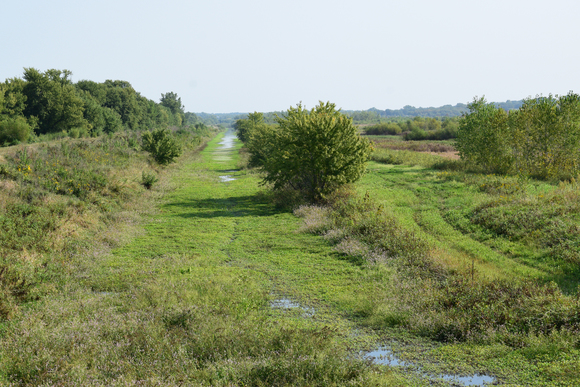 Looking northeast on the Jensen tract of the Riverton Wildlife Area as water fills the marsh on Sept. 13. Given the large amount of smartweed available, state wildlife experts predict this area is set up for a good duck season. Photo courtesy of the Iowa DNR.
Riverton, Iowa - Hunters for generations have
called the Riverton Wildlife Area home each fall. This high quality marsh in
central Fremont County has been a magnet for ducks since the 1950s and 60s,
when farmers finally quit trying to produce a crop from its wet soil.
Dikes
once built to hold water out are still here today, allowing the Iowa Department
of Natural Resources (DNR) the ability to direct water to specific sites by way
of two large pumps and 37 water control structures.
This
part of the state attracts more than just fowl. Studies have identified 128
different bird species nesting here, with another 154 species passing through,
which is the most observed anywhere in the state. Of these 282 bird species, 92
are species of greatest conservation need.
“Bird
watching is really an underutilized activity here,” said Matt Dollison,
wildlife biologist with the Iowa DNR. Dollison has been the area biologist for
Riverton since 2013.
“We’ve
had sandhill cranes nesting here since 2014; trumpeter swans nested just west
of the area since 2015. That drew a lot of attention,” he said.
The
Riverton Wildlife Area is managed to provide high quality habitat for wildlife
across the spectrum. It has hundreds of acres of diverse prairie and thousands
of acres of wetlands. From deer to ducks and dragonflies to butterflies, the
Riverton Wildlife Area is an outdoor paradise waiting to be discovered.
Waterfowl juggernaut
Arguably
one of the top waterfowl destinations in Iowa, Riverton has a loyal following
among duck hunters for sure. The marsh covers 2,200 acres that is huntable from
waders or boat. It’s hard to beat Riverton when the teal blow through, and
later in the year hunters can have high rates of success, with a little
breathing room after other hunters turn to chasing deer and pheasants. In
drought years like 2017, Riverton will have water.
The
ducks come to Riverton because it has what they want – water and food. That
doesn’t just happen by accident; it’s part of a plan to make Riverton too good
to pass up.
Dollison
said the goal is to have a good crop of annual plants, like barnyard grass and
smartweed that produce high value seeds. Ideally, the marsh will dry completely
in the early summer, allowing the annuals to germinate, grow and produce seed
ahead of Aug. 15 when the pumps are turned on.
As
the temperature drops in the later part of the duck season, the annual plants die
back and provide open water roosting for mallards that feed in the surrounding
crop fields. Some perennial species like river bulrushes and cattails remain to
provide hunter concealment.
Once
the wetlands reach pool, water is held through the spring snow goose migration
to provide a refuge for the geese and hunters an opportunity to hunt them as
part of the special conservation order. It is common to have more than 100,000
snow geese on Riverton during this time. This provides a site to be seen for
hunters and bird watchers alike. Once the migration moves north, the marsh is
dewatered.
This
process happens every year.
“We
have a really good thing going here,” Dollison said. “We’re known for hunting,
but we can easily support more bird watching, kayaking, hiking and fishing.”
As
Iowa’s most southwest county, Riverton is about 150 miles from a population of
more than 4 million people. Once the word gets out, it might be difficult to
get a table at the nearby Waterfowl Café.
More than just webfoots
Riverton
draws hunters from beyond the local communities to Council Bluffs, Omaha and
Des Moines. While it is well known for ducks and geese, Riverton also offers
quality dove, deer, pheasant and quail hunting.
The
prairie area has been developed to provide a diverse plant mix to attract bugs
for young birds to eat, especially young pheasants and quail.
This
prairie diversity also benefits pollinators, especially the monarch butterfly.
Walk on the wild side
Riverton’s
network of dikes provides more than 20 miles of mowed or surfaced lanes, giving
a unique experience to hikers looking for something new.
Dikes
in the refuge portion of the area are off limits to everyone from Sept. 1
through the end of duck season each year to provide migrating birds a quiet
layover on their way south.
Be
sure to remember the bug spray.
Media Contact: Matt
Dollison, Wildlife Biologist, Iowa Department of Natural Resources,
712-350-0147.
Enjoy
Iowa’s natural landscapes fishing Iowa’s rivers and streams this fall. A unique
angling challenge is hidden around every bend.
“You
are never far from one of Iowa’s many rivers,” said Greg Gelwicks, Iowa DNR interior
rivers research biologist. “Fall is a great time to give them a try.”
Fish
become more active as the stream temperature drops. “Look for actively feeding
fish where riffles enter pools or rocky areas,” Gelwicks said. “They can sit
there out of the current and wait for food to come by.”
Find
catfish, walleye, sauger and bass close to natural or manmade habitat features
such as riffles, log-jams or rock.
Smaller fish like shiners and minnows are attracted to hiding and
resting spaces found within habitat features and predators feed around these
features.
Small
“up-river” segments of interior rivers can be fantastic for walleye and
smallmouth bass in early fall. Use crankbaits and spinners to catch smallmouth
bass and crankbaits or jigs with crawlers for walleye. Try the upper
Wapsipinicon River (Buchanan and Linn counties) or upper Cedar River (Black
Hawk and Bremer counties) for smallmouth bass. The Shell Rock River (Butler and
Bremer counties) or upper Cedar Rivers (Black Hawk or Bremer Counties) are a
great choice for walleye.
“The
Missouri and Mississippi rivers boast some of the best flathead catfishing in
the Midwest,” said Jon Christensen, DNR natural resources technician. The Missouri River’s swift current,
rocks and snags are good habitat and food is abundant for these predatory
catfish. Use
live fish as bait; green sunfish and bullheads tend to survive best on the
hook.
“Blue
catfish are becoming more common in the Missouri River,” said Christensen. Several
state record fish have been caught on the Missouri River, including the blue
catfish (101 pounds) and channel catfish (38 pounds 2 ounces).
An
extensive list of Iowa’s rivers, with information on access points and native
species, is available on the DNR website at fishing.iowadnr.gov.
MEDIA CONTACT: Greg Gelwicks, Interior Rivers Research Biologist, Iowa Department of
Natural Resources, 563-927-3276.
The deadline for
the 2017 Volunteer Fire Assistance Grants is Oct. 17.
The grant provides assistance
for funding wildfire suppression equipment, slide-in units, hoses, nozzles,
adapters, portable tanks and pumps, personal protective equipment and
communications equipment. Additionally, if a fire department has a
special need that can be tied directly to wildfire suppression, allowances can
be made.
The grant provides
50 percent reimbursement for wildland fire equipment with a maximum
reimbursement grant of $3,500 per department.
Fire departments
were mailed information about the Volunteer Fire Assistance Grant in mid-June.
The grant application package and the wildland fire report form are also
available online at www.iowadnr.gov/fire.
This grant
opportunity is a result of the Iowa DNR forestry section's fire program working
with the US Forest Service to aid Iowa’s rural fire departments in suppressing
wildfires.
For more information, contact Gail
Kantak at gail.kantak@dnr.iowa.gov, 515-233-8067 or
515-233-1161.
|





