|
The
upper Cedar River was the focus of this year’s annual research project to
inventory and map the distribution of Iowa’s mussels, often called clams.
More than 50 biologists, students and volunteers collected 18 species of freshwater
mussels in the Cedar River during the three day event held each August since
2005.
“We
had excellent participation from our conservation partners, volunteers and
county naturalists with this year’s survey,” said Scott Gritters, fisheries biologist with the Iowa Department of Natural Resources (DNR).
Live
mussels were inventoried, measured for growth; and then returned to the water.
Most of the mussels were found using a technique known as pollywogging, as
researchers and volunteers crawl along a stream bed, probing the bottom with
gloved hands.
“These
studies help us learn more about mussels and the areas where they live and
thrive,” said Gritters. “We knew this area is biologically diverse, but we
wanted to study the impact of the many dams on this stretch of the Cedar River.
We are also working with the Minnesota Department of Natural Resources to
determine the best methods to restore some lost mussels or declining mussel
species in our respective stretches of the Cedar River.”
The
Iowa DNR, the U.S. Fish and Wildlife Service and the
U.S. Army Corps of Engineers started researching the disappearance of native
fresh-water mussels in Iowa 12 years ago, including the federally
endangered Higgins-eye pearly mussel. Once ranging across most of the upper
Midwest, this species has been eliminated from most of the river systems it
once thrived in.
"Historically,
there were maybe 54 species of native mussels in Iowa,” Gritters said. “Now,
it's about 42. Of those, nine are endangered. Another six are threatened and several
more species are very hard to find any more in Iowa.”
Over
the past several years, stretches of the Cedar, Wapsipinicon and Iowa rivers
have been stocked with walleyes and bass whose gills had been injected with the
mussels’ larvae.
“Stocking
fish, something we commonly do anyway, is one way to reintroduce mussels into
our rivers,” he said. “We stock a lot of fish for our anglers and
this way we can ‘double dip’, so to speak.”
This
year’s Mussel Blitz documented some very rich and diverse mussel beds, mostly
in the free flowing and wild stretches of the Cedar River. Mussels (and fish) flourish in this type of
habitat.
Native
mussels do not do well in soft substrates in our rivers, he said. The stretches immediately above the low head
dams were nearly empty of native mussels. Impoundments block migrating fish,
which are the main way native mussels move (hitchhiking) and the habitat above
dams usually has silt and sand.
Mussels
are a good indicator of the health of a river. The better the water quality,
the more mussels there are in that water. Mussels compact the algae they filter
then kick out the crushed pellet to waiting fish; much like how fish are fed at
a fish hatchery.
Many
of the major fish spawning areas are in mussel beds on the Mississippi
River. That may hold true on the Cedar
River as well. The abundant crayfish populations observed were using old dead
remnant mussel shells for their homes. Crayfish
are a vital food source for predatory fish including smallmouth bass.
“The
whole river ecosystem runs better with native mussels living in it. Fish and mussels have ‘co-evolved.’ They
depend on each other,” said Gritters. “Our fish populations, water quality and
the opportunities people have to enjoy the water improve with more mussel
species in Iowa waters.”
Media Contact: Scott Gritters, Fisheries
Biologist, Iowa Department of Natural Resources, 563-872-4976.
A celebration of the monarch’s journey from Canada, through
Iowa, to Mexico, will be held Sept. 17, from Noon to 4 p.m., at Blank Park Zoo,
in Des Moines.
“Each fall, the iconic monarch butterfly sets it sights on
the mountains of Mexico. They travel, en masse, through our state on a journey
that can be over 2,000 miles long. We are honored to partner with the Latino
Heritage Festival, to highlight the importance of this butterfly to our two
countries,” said Jessie Lowry, conservation manager, Blank Park Zoo.
In
Iowa, the Iowa Department of Natural Resources (DNR), Iowa State University and
the Iowa Department of Agriculture and Land Stewardship have been looking at
ways to help the local monarch population and to improve and expand the
refueling areas for monarchs migrating through.
The
Iowa DNR will have monarch experts available at the festival.
"We are excited to partner with Blank Park Zoo to
bless the monarch butterflies on their long journey to Mexico. According to
local legend, the monarchs arriving in Mexico this time of year are believed to
be the souls of our ancestors returning home," said Joe Gonzalez,
executive director, Latino Resources (oversees Latino Heritage Festival).
This year, a giant “Chinese dragon” style caterpillar will
appear in the Festival’s signature BUG PARADE at 2 p.m.
Monarch Festival Activities:
- Fourth Annual Children’s BUG PARADE! Come dressed as your
favorite insect, wear your wings, your orange and black, antennae or make your
costume at the Zoo. There will be special prizes for First and Second place
BEST COSTUMES.
- Polk County Conservation will be leading Insect Hunts and
Monarch Tagging. They will demonstrate how to safely catch monarch butterflies
to attach a tag. If these special monarchs are found in Mexico, they can help
scientists track the migration.
- Numerous Plant.Grow.Fly. partners will be represented at
the Festival offering hands-on activities, demonstrations and crafts for the
whole family.
- Los Ninos del Tepeyac - Danza Folklorica is a dance group
dedicated to learning and teaching about the Mexican culture through dance.
This group will be performing at the Festival.
- Spend time exploring our Butterfly Garden and experience
traditional Mexican music by Mariachi Azteca.
- Families and kids of all ages will be encouraged to take
part in an interactive performance workshop called FOLLOW THAT MONARCH! by
Carol Taylor's Patchwork Puppets.
- There will be a limited supply of free milkweed seeds
available provided by Blank Park Zoo and People for Pollinators for festival-goers.
- The Latino Heritage Festival is Sept 24 and 25 in Des
Moines
The Blank Park Zoo Monarch Festival is sponsored and
supported by Wit’s End Gardens, Blooming Prairie Nursery, Art Junkie and the
Latino Heritage Festival.
For
more information contact:
Jessie Lowry, Blank Park Zoo, 515-490-4370, jrlowry@blankparkzoo.org
Ryan Bickel, Blank Park Zoo, 515-988-9485, rpbickel@blankparkzoo.org
Photos and video can
be found here: https://drive.google.com/open?id=0B9hof5afS1qBQmI2LXRabXItREE
Iowa’s Resource
Enhancement and Protection (REAP) assemblies will begin next month, giving all
Iowans an opportunity to discuss what their vision is for Iowa’s outdoor
recreation, soil and water enhancement, historical resources and land
management and more.
REAP assemblies are
locally led meetings where issues can be brought forth and voted upon. Iowans
can discuss the program, recommend changes and discuss impacts in their area.
Delegates may also be selected from the local meeting to attend the REAP
congress in January at the State Capitol in Des Moines.
Each assembly
represents a region of counties and participants are required to attend the
region for the county in which they reside. Meetings are held in the evening
and last approximately 90 minutes. A list of REAP assembly locations is
available online at http://www.iowadnr.gov/Conservation/REAP/REAP-Public-Participation/REAP-Regional-Assemblies.
“These
individual meetings are a great opportunity for us to meet with Iowans
one-on-one and hear their ideas for their parks, trails, museums and other
amenities,” said Chuck Gipp, director of the Iowa Department of Natural Resources
(DNR). “Participation from community members is essential for all of us to
work together to enhance our recreational opportunities in our state.”
Each year, REAP
provides funding for local projects through a grant process and each year, the
requests for city and county grants exceed the amount available by two or three
times. Since the program debuted in 1989, more than $330 million has been
awarded to more than 15,000 projects.
“REAP benefits every single county every year
in one way or another, either through improved water quality, by preserving our
historical assets or providing outdoor recreation,” said Tammie Krausman, coordinator
for REAP with the Iowa DNR. “It has and will continue to have a significant
impact on the quality of life for all Iowans.”
MEDIA
CONTACT: Tammie Krausman, REAP Coordinator,
Iowa Department of Natural Resources, 515-402-8763.
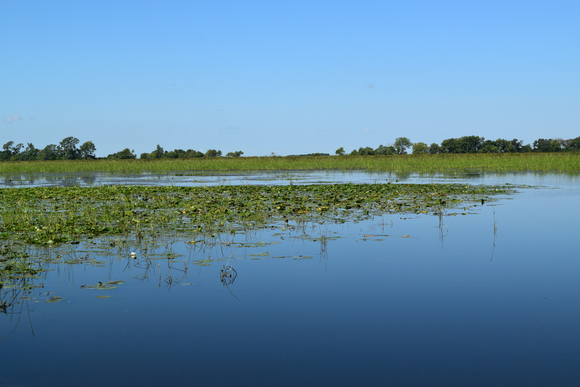 Big Wall Lake is a naturally functioning, natural shallow system, with acres of wild rice growing off of the main boat ramp. Its network of canals through the vegetation provides duck hunters with plenty of cover, and paddlers a day’s worth of adventure. Photo courtesy of the Iowa DNR.
CLARION, Iowa - Big Wall Lake has
character.
Once home to a small resort and an occasional
source of ice used for consumption, the area has 30 or so duck hunting cabins
on the southeast side and acres of wild rice growing in the marsh.
This natural wetland in north central
Iowa is unlike anywhere else.
Big Wall Lake Wildlife Area is nearly
two miles long covering just less than 1,000 acres. It is an important stopover
for migrating waterfowl and shorebirds before they make the jump to the central
Iowa reservoirs.
The area went through an extensive
renovation from 2006 to 2008 that improved the water quality and overall health
of the marsh.
“If someone is looking for a true,
naturally functioning natural shallow system, this is it,” said TJ Herrick,
wildlife biologist for the Iowa Department of Natural Resources (DNR).
Big Wall Lake has an extensive network
of channels going off in different directions through the vegetation used by
duck hunters to hide in. Paddlers could easily spend a full day exploring those
channels.
“This area captures a pretty good
portion of the state that doesn’t have access to large natural marshes,”
Herrick said.
While Big Wall’s history goes back
more than 100 years, the system is experiencing a growth spurt of sorts today.
In 2016, the Iowa DNR, along with
partners from the USDA Natural Resources Conservation Service (NRCS), the Iowa
Natural Heritage Foundation (INHF), the James and Patricia Dinsmore family and
others secured and transferred a multi generation family farm on the west
shore.
The Maxons worked with NRCS, INHF and the
DNR to conserve their property, Herrick said. A part of the property had been
farmed since the 1920s after a dike was installed to contain the lake. Two ag
drainage wells were drilled down more than 180 feet with a direct connection to
the local aquifer, and the land was tiled to remove water and make it farmable.
Since the acquisition, the wells have
been closed, tile broken and the land used to build the dike has gone back to
the hill from which it came. Over the years, a thick mat of dead cattails had settled
along the old dike forming a temporary dam, but at some point this 30-acre area
will be reconnected to the lake. Water is already percolating through the ground,
reclaiming this section of old lake bed.
“This will be the deepest spot on the
lake,” Herrick said.
The remaining 225 acres will be seeded
to prairie and managed as an upland area without trees. It will protect the
lake water quality and water level by filtering the runoff and keeping the rain
in the watershed rather than draining to the well.
While that acquisition has closed, a
345-acre acquisition adjacent to the northwest corner of the lake is being held
by INHF and is being restored through the NRCS.
This property was divided among several
members of the Frye family who had a goal of keeping the land in habitat,
including a 25-acre wetland basin waiting to be restored.
In north central Iowa, Big Wall Lake
is a habitat oasis in a sea of highly productive farmland.
In addition to ducks and geese, the
marsh has a huge population of bullfrogs and leopard frogs, has attracted sandhill
cranes, American bitterns, black terns, Blandings turtles and yellowlegs.
The area already has good pheasant and
deer hunting, but as the prairie grasses expand and mature, it will get even
better.
Summer
storm hammers Big Wall
Last summer, a storm with winds
reaching 100+ mph moved through the area, knocking down trees and limbs, and blocking
the road to the cabins.
“The peak winds hit around 3 a.m., and
it looked like a war zone. Absolutely insane,” Herrick said.
However, not all news was bad. The
cleanup benefited one of the permanent cabin residents with many years’ worth
of free firewood.
Rice
grows wild
Big Wall Lake has acres of wild rice
growing off of the main boat ramp.
Wild rice requires clean water to grow
and Big Wall Lake is among systems in five Iowa counties where it’s growing.
“Some people don’t want it here, but
its incredible duck food,” Herrick said. “It’s not something we’re managing for
or against; it’s just here.”
And it’s available to anyone who wants
to harvest it.
The Big Wall wild rice is similar to that
grown in Minnesota and Canada that sells from $6-$10 per pound.
Media Contact: TJ Herrick, Wildlife
Biologist, Iowa Department of Natural Resources, 641-829-3285.
Fall is a great time to be outdoors
with family and friends. The air is cool, the views are picturesque, lakes are
less crowded and the fish are easy to catch.
“Fall fishing is one of Iowa's best
kept secrets,” said Joe Larscheid, chief of the Iowa Department of Natural
Resources (DNR) Fisheries Bureau. “Fantastic fishing opportunities await both
new and expert anglers. Get out and enjoy them.”
Cooler
temperatures and shorter daylight times trigger fish to actively search for
food
to build energy reserves to survive the long winter. These predictable
movements make them easier to find.
“Yellow perch, muskies, crappies,
walleyes, largemouth and smallmouth bass go on a feeding frenzy before winter,”
explained Larscheid.
The fall bite in lakes and ponds shifts
to the main part of the day. Fish are more active during the day and will be
close to shore. Target areas of a lake where the water is warmer, mostly in shallow
water bays along the north shore.
“Use live bait, particularly minnows,
small tackle and fish slowly when fishing in cooler water,” Larscheid said.
Look for panfish schools in open water
near structure like a brush pile, underwater hump, drop-offs and rock reefs.
Largemouth bass will be close to some type of structure during the fall like
underwater brush piles, old road beds, rock reeks or weed lines. Quickly find fish
structure locations with the online fishing atlas or download structure
location maps from the DNR’s Where to
Fish website.
Fish in streams start to move to their
wintering areas in October. Stream flow is often lower in the fall; allowing
better angler access. Channel catfish will move downstream from smaller streams
to the deepest holes they can find in larger streams. Walleyes will move to the
next deepest holes and pike to the next deepest.
Find
tips for catching yellow perch, crappie, walleye, bass and catfish on the DNR
website at www.iowadnr.gov/fishing. Check the weekly fishing report to find out what is biting
where.
Media Contact:
Joe Larscheid, Chief of Fisheries, Iowa Department
of Natural Resources, 515-201-3376.
The Iowa deer hunting tradition will be
passed on to about 10,000 youths who will participate in the youth deer hunting
season, which opens on Sept. 16. This
season provides an opportunity to teach deer hunting, wildlife behavior, and
safe hunting practices to resident youths while they are under the watchful eye
of a licensed adult.
“This
season is all about creating a positive experience for the hunter. It’s a
learning season where mentors work one on one with the youth teaching hunting
ethics and woodsmanship skills,” said Jim Coffey, forest wildlife research
biologist for the Iowa Department of Natural Resources.
The goal of the hunt should be an enjoyable
and ethical experience, and harvesting a deer should be considered a bonus, not
define the success of the hunt.
Coffey said during late September,
hunters should set up near movement areas, like between bedding sites and food
sources, along known deer paths and by acorn producing white oak trees.
The youth season coincides with the
disabled hunter deer season for hunters who meet eligibility criteria. Both seasons runs Sept. 16 through Oct. 1.
Youth hunters must be under direct
supervision of an adult mentor, with a valid license and habitat fee (if
required). The youth license is valid
statewide.
In addition, an unfilled youth season
tag is valid for use during the early or late muzzleloader season or one of the
two shotgun seasons. That youth must follow all other rules specified for each
season. However party hunting with a youth tag is not allowed. A deer must be
harvested by the youth with the tag. Youth hunters are also allowed to obtain
deer tags for other season, just as any other hunter can do.
The youth deer season can bring mild
temperatures and biting insects. Hunters
should be prepared for success by talking to the meat locker ahead of time and
bringing frozen water jugs and/or bags of ice to cool the deer cavity. They may
want to bring a protective cover like cheese cloth to help keep bugs off the fresh
harvest as well.
All deer taken must be reported using
the harvest reporting system before midnight the day after the deer is
recovered. Harvest reporting is a very important part of the deer management
program in Iowa, playing a vital role in managing deer populations and hunting
opportunities. Hunters have three
options for reporting their harvested deer, the DNR website at www.iowadnr.gov, by calling the toll free reporting number 1-800-771-4692,
or at any license vendor.
Media Contact: Jim
Coffey, Forest Wildlife Biologist, Iowa Department of Natural Resources,
641-774-2958.
Iowa hunters will have a new option
this fall while hunting deer during the youth season, disabled hunter season
and both shotgun seasons – rifles that are capable of shooting straight walled
cartridges.
The new straight wall cartridge law
was passed without dissent by the Iowa Legislature, and then signed by then Governor
Terry Branstad on April 13. It was enacted to allow for a lower recoil option
for older and younger hunters, but is available to all hunters in those four
seasons.
The law allows for straight wall
ammunition that was previously approved for pistol hunting to be used in rifles.
The list of acceptable calibers is in the Iowa Hunting and Trapping Regulations
(p. 31, www.iowadnr.gov/hunting) along
with criteria for similar sized ammunition not on the list.
Depending upon the caliber, some
straight wall cartridges will be effective up to 100 yards, but most will be
effective to around 50 yards.
The new law requires individuals
caught with a rifle capable of shooting ammunition not on the approved list while
hunting deer to have their hunting privileges suspended for two years and
receive a $250 fine.
DES MOINES – Iowa Secretary of
Agriculture Bill Northey and Chuck Gipp, director of the Iowa Department of
Natural Resources, are encouraging Iowa hunters to follow proper field-dressing
and handling procedures this hunting season to ensure they are able to enjoy
safe and high-quality meat.
“The Iowa Department of Agriculture
and Land Stewardship oversee the local locker plants that provide processing
for many hunters throughout the season. Following best practices in the field
can help make sure you are able to enjoy safe, high-quality meat,” Northey
said.
“Iowans look forward to hunting each
year and the sport continues to gain great traction,” said Gipp. “We hope that
hunters will heed these practices to ensure safety and enhance quality of their
game.”
Best
practices:
Plan ahead
– If a hunter is planning to take a deer or other game to a locker or other
facility for processing, it is recommended they call or talk to the processor
beforehand to ask how they prefer to receive the meat. Many processors prefer to receive the whole,
hide-on, field-dressed carcass as the hide protects the meat during transport. Hunters should take their deer to the locker
as soon as reasonably possible for best safety and quality.
Act quickly
– It is important to field-dress game promptly after harvest, ideally within a
half-hour. A game animal's body begins to decompose within one to two hours of
death, especially if temperatures are unseasonably warm (above 40 degrees).
Proper
equipment – Wear disposable gloves and use
clean knives and utensils, both to keep the meat clean and to protect you from
the animal's blood. (There are several
illnesses which hunters can acquire from the blood of an infected game animal).
Proper
containers – If you will be boning out the
carcass yourself, be sure to use food-safe containers to store or transport the
meat. Clear plastic, “zipper-lock” style
bags (found in the food-storage section of most grocery stores) are food-safe,
available in large sizes, and will not leech chemicals or cause off-odors or
flavors. Do NOT use plastic garbage bags or other containers not designed and
approved for food-storage to store your meat.
Plastic garbage bags are NOT food-safe and may have been treated with
scents, deodorants, or other compounds meant to reduce odors and discourage
pests. These compounds can leech into
your meat and cause off odors, off flavors, or safety issues. Processors are well within their rights to
refuse game meat delivered in unsafe containers.
Disposal
– Iowa law allows lawfully taken game carcasses and waste from home meat
processing to be disposed with other residential waste, although your solid
waste hauler may have some restrictions regarding the maximum size or weight of
an individual bag. The waste should be sealed in plastic bags in lots that are
similar in size and weight to a typical bag of residential waste.
No Dumping
– Dumping a game carcass in a road ditch or on other public property creates a
nuisance and is subject to enforcement under Iowa’s littering laws.
More information and a guide to proper
field-dressing can be found at https://extension.psu.edu/proper-field-dressing-and-handling-of-wild-game-and-fish
Media Contacts: Dustin Vande Hoef, Iowa Department of Agriculture and Land Stewardship, 515-281-3375; or Alex Murphy, Iowa Department of Natural Resources, 515-725-8219.
Hunter
Education Classroom courses are offered by knowledgeable and certified
volunteer instructors and Iowa Department of Natural Resources Conservation
Officers. Classroom courses are typically 12-15 hours in length and are held
over 2 to 3 sessions (days). In order to receive certification, a student must
attend all sessions and pass the final exam.
Iowa
law requires that anyone born after January 1, 1972 must be certified in hunter
education before they are eligible to purchase an Iowa hunting license.
Upcoming
Hunter Education Classes
Sept. 13, Exira, Audubon County Conservation Board
Sept. 13, Independence, Buchanan County Wildlife
Association
Sept. 14, Tipton, Cedar County Conservation Board
Office
Sept. 14, Peosta, Northeast Iowa Community College
Sept. 16, St. Charles, St. Charles Lions Hall
Sept. 16, Mt. Pleasant, Henry County Nature Center
Sept. 18, Clarinda, American Legion
Sept. 19, Dubuque, EB Lyons Interpretive Center –
Mines of Spain
Sept. 19, Ames, North Grand Christian Church
Sept. 21, Iowa City, Fin and Feather
Sept. 23, Montrose, Lee County Conservation Board
Sept. 23, Williamsburg, Farm Bureau Building
Sept. 23, Mt. Ayr, Dragoon Trace Nature Center
Sept. 23, Lovilia, Lake Miami
Sept. 25, Grimes, Grimes Community Complex
Sept. 26, Toddville, Wickiup Hill Learning Center
Sept. 29, Davenport, Adventure Church
Sept. 30, Mt. Vernon, Mt. Vernon City Hall
Sept. 30, Palo, Palo Outdoors
Oct. 2, Sioux City, Elk’s Lodge #112
Oct. 2, Kalona, Kalona Middle School
Oct. 5, Greenfield, Adair County Conservation
Board – Greenfield Public Library
Oct. 7, Davenport, Izaak Walton League
Oct. 7, Fairfield, Southeast Iowa Skeet Club
Oct. 10, Osceola, Clarke Elementary School
Oct. 14, Waterloo, Hawkeye Community College
Oct. 14, Keswick, Keswick Fire Station
Oct. 16, Polk City, Butch Olofson Shooting Range
Oct. 17, Nevada, Gates Hall
Oct. 23, Polk City, Butch Olofson Shooting Range
Oct. 24, Ottumwa, Izaak Walton League
Oct. 31, Bellevue, Bellevue State Park Lodge
Nov. 13, Polk City, Butch Olofson Shooting Range
For
more information on these and other hunter education opportunities, go to www.iowadnr.gov/huntered
The best way to prevent the spread of
oak wilt is to not prune any oak tree during the growing season. For that
reason, the Iowa Department of Natural Resources (DNR) suggests to not start
any pruning until at least the first frost.
“The risk of transmitting oak wilt
through a pruning wound this time of year is low,” says Tivon Feeley, with the
Iowa DNR’s forest health program. “However, to reduce the risk even further, it
is best to wait until the first hard frost to start pruning.”
Oak wilt is caused by a fungus and has
been present in Iowa for many years. A
healthy oak tree can be infected by the fungus that causes this disease two
different ways. The first is through open wounds during the growing season,
when the fungus is carried from a diseased tree to a healthy tree with an open
wound by a small beetle.
The second form of infection is
through root grafts between oak trees of the same species. For example, if a
red oak is infected and there is another red oak within 50 to 100 feet there is
a good chance that the roots of these trees are grafted and the fungus can move
from the diseased tree to the healthy tree.
The trees in Iowa most commonly
impacted by this disease are species such as red, black and pin oaks, but white
and bur oaks can be infected as well. If
black, pin or red oaks are infected by the fungus that causes this disease they
usually die within the same year they are infected. White oak and bur oak can
often take a number of years before they succumb to this disease.
Feeley says symptoms to look for on
infected trees usually include leaves turning a bronzed brown along the outer
margins of the leaves. These leaves can often still have some green on them as
they fall from the tree. The defoliation tends to start at the top of the tree.
Feeley recommends that if a tree is
wounded from storm damage or pruning is required during the growing season,
treat the wounds immediately with a wound dressing such as acrylic paint. Do not purchase pruning paints/sealants. Those products slow the tree’s ability to
seal over the wound, he said.
More information on oak wilt
prevention and control can be found here http://na.fs.fed.us/pubs/howtos/ht_oakwilt/identify_prevent_and_control_oak_wilt_print.pdf.
Media
Contact: Tivon Feeley, Forest Health Program,
Iowa Department of Natural Resources, 515-725-8453.
|





