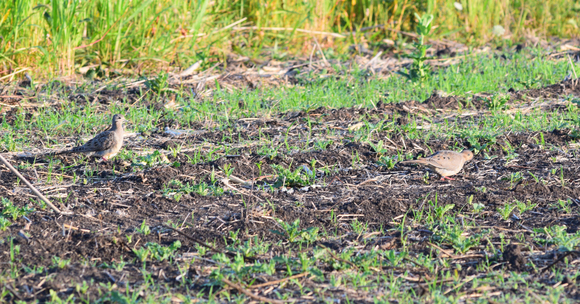
 Mourning doves are the most popular game bird in the country. Last year, 13,800 Iowa hunters harvested an estimated 131,000 doves. Season opens on Sept. 1. Photo courtesy of the Iowa DNR.
Iowa’s dove hunting season is just
around the corner and hunters getting ready to pursue the country’s most
popular game bird are encouraged to visit the areas they plan to hunt before
opening day.
“Investing some time in preseason
scouting will benefit the hunter by seeing which fields the doves are using,
and what condition the field is in,” said Todd Bogenschutz, upland wildlife
research biologist for the Iowa Department of Natural Resources. “Just because
the area had a food plot on it last year, doesn’t necessarily mean that it will
again this year.”
The Iowa DNR has a listing of state-managed
public wildlife areas with food plots specific to doves at www.iowadnr.gov/doves.
Each area is linked to a downloadable and printable pdf that includes a map,
any special regulations, and the local contact name and phone number. Hunters may also want to visit the Hunting
Atlas at www.iowadnr.gov/hunting
when looking for areas to hunt.
If hunters are planning to try dove
hunting on private land, they should look for grazed pastures with a pond, feedlots,
or harvested crop fields, seed corn or small grain fields, basically any area
with abundant bare ground, he said.
“There can be some good opportunities
on these private areas, if hunters have permission to access them,” he said.
While most of the hunting takes place
in early morning, it’s not the only time when doves fly.
“There are good opportunities to hunt
in the evening, but be sure to be out there a few hours before sunset because
the flight is usually over at sundown,” Bogenschutz said.
There are other benefits to hunting
late afternoon, like significantly few hunters vying for the same spot.
“Doves provide a lot of excitement for
hunters of all skill levels and are a great way to bring in new or young
hunters. It’s easy to do and there are no special decoys or camouflage
necessary,” he said. “Anecdotally, we are seeing doves here in good numbers,
and I expect hunters will have similar success as last year.”
Hunters are required to have a valid
hunting license and habitat stamp to hunt doves. Iowa does not require a
migratory game bird fee. Dove season is Sept. 1 to Nov. 29, with a daily bag
limit of 15 doves, and possession limit of 45. Legal shooting hours are from
one-half hour before sunrise to sunset. Shotguns must be plugged to hold no
more than three shells at a time.
Last year, 13,800 hunters harvested an
estimated 131,000 doves.
Hunters will need to register with Harvest
Information Program before hunting doves and other migratory birds. Go to www.iowadnr.gov
and click on Buy a Hunting or Fishing License link then follow the prompts to
get to the screen with a link to register to hunt doves.
Media Contact: Todd Bogenschutz, Upland
Wildlife Research Biologist, Iowa Department of Natural Resources, 515-432-2823
ext 111.
The Iowa Department of Natural Resources (DNR) is watching Carter Lake
after juvenile zebra mussels were recently found in a water sample collected by
Nebraska Game and Parks Commission (NGPC) staff. Although veligers were
detected, intensive sampling the past week did not find any adult zebra
mussels.
Carter Lake, a border water, is jointly managed by the Iowa DNR and NGPC.
The Iowa DNR and NGPC collect water samples and deploy settlement samplers in
lakes across each state every summer to monitor for the invasive zebra mussel.
Water samples have been collected twice a month in Carter Lake since
May. Additional samples are waiting to
be analyzed. The DNR and NGPC will
closely monitor Carter Lake this summer and fall to determine if it has an
established population of zebra mussels.
“Finding zebra mussel veligers indicates to us that zebra mussels have
been introduced into Carter Lake,” said Kim Bogenschutz, the Iowa DNR’s Aquatic
Invasive Species Program coordinator. “But, it’s too early to tell if there is
an established population in the lake.”
Zebra mussels look like small, D-shaped clams that have alternating
light and dark bands. Most are less than one inch long. They are filter feeders
that can form dense clusters as they attach to hard underwater surfaces. Large infestations may interfere with aquatic
food chains, kill native mussels, clog water intakes, increase algae blooms,
and cover beaches with dead shells.
There is no effective treatment to control zebra mussels once they have
infested a lake.
The Missouri River has an expanding zebra mussel population along its
entire length downstream of Gavins Point Dam.
Other known populations within Iowa include Clear Lake, the Okoboji
chain of lakes, and the Mississippi River.
Zebra mussel veligers are microscopic and can be unintentionally
transported with water in bilges, live wells or bait buckets. Adult zebra mussels can attach to boats,
trailers and aquatic vegetation. Boats using both the Missouri River and Carter
Lake are a probable source of introduction.
It is illegal to possess or transport prohibited aquatic invasive
species, such as zebra mussels, in Iowa. Boaters must also drain all water from
boats and equipment before they leave a water access and must keep drain plugs
removed or opened during transport.
“Boaters and anglers can unintentionally spread zebra mussels and other
aquatic invasive species if they do not take the proper precautions - clean,
drain, dry - after each time out on the water,” said Bogenschutz.
- CLEAN any plants, animals or mud from boat and equipment before you
leave a water body.
- DRAIN water from all equipment (motor, live well, bilge, transom well,
bait bucket) before you leave a water body.
- DRY anything that comes into contact with water (boats, trailers,
equipment, boots, clothing, dogs). Before you move to another waterbody either:
- Spray your boat and trailer with hot, high-pressure water; or
- Dry your boat and equipment for at least 5 days.
- Never release plants, fish or animals into a water body unless they
came out of that water body and empty unwanted bait in the trash.
Find more information about aquatic invasive species and a list of
infested waters in the 2017 Iowa Fishing Regulations booklet.
If you see a zebra mussel, please note its location and contact your
local fisheries office or the Aquatic Invasive Species Program in Boone.
Media Contact: Bryan Hayes,
Cold Springs Fisheries Office at 712-769-2587 or Kim Bogenschutz, Boone
Wildlife Research Station at 515-432-2823.
Licenses to pursue Iowa’s world class
deer herd go on sale Aug. 15 at more than 700 license sales agents statewide and
online at www.iowadnr.gov.
Resident Iowa hunters may purchase one
any deer license for a gun season, one any deer license for archery season and
one county specific antlerless deer only license.
The number of county specific license
quotas for antlerless deer only has changed for 22 counties – 11 counties
quotas increased and 11 counties quotas decreased. Hunters may purchase one
antlerless only deer license until Sept. 15, then as many as they want until
the season ends or quotas fill.
The price of an Iowa deer license is
$28.50. Excluding fees for license vendors and required $1 fee to fund Help Us
Stop Hunger, the price of an Iowa deer license has remained the same since 1991.
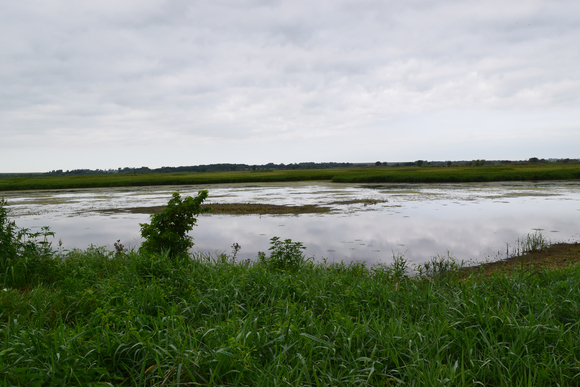 The 6,700-acre Big Marsh Wildlife Area has a mix of native prairies, timber stands and wetlands but the main feature is the three connected wetland segments. When at crest, Big Marsh can hold 1,200 acres of water. Photo courtesy of the Iowa DNR.
Parkersburg,
Iowa - The Big Marsh Wildlife Area is a working example of the benefits of taking
wet farmland where crops struggle 70 percent of the time and creating a large
public area with expansive wetlands and prairies attractive to waterfowl and
waterfowl hunters, snakes, shorebirds, pheasants, deer, turkeys and even endangered
wood turtles.
This 6,700-acre complex along the West
Fork of the Cedar River, north of Parkersburg, is the end product of a vision
held by the Iowa Conservation Commission when it began assembling the pieces in
the late 1940s.
The decision by the Conservation
Commission to locate the marsh along the West Fork of the Cedar River has
proven to be a good one. The West Fork has a mile-wide flood plain at this
location where even a 50 year flood can flood out a large area.
Helping
landowners and growing the marsh
Twice in the last 20 years, the
Wetland Reserve Program (WRP) was instrumental in significant acquisitions for
Big Marsh – 1998-99 and 2012.
In 1998-99, the WRP was used to acquire
five properties in the floodplain covering 700 acres. The acquisition paused
until 2012, when the Iowa Department of Natural Resources (DNR) received a grant
that provided $3.8 million for WRP in the Cedar River and the West Fork of the
Cedar River watersheds.
Jason Auel, wildlife biologist for Big
Marsh, knew there was high demand for WRP by landowners in the area with flood
prone land after three properties were purchased from flood of 2008.
When the $3.8 million became available
in 2012, Butler County had 14 landowners on the waiting list. The money was
gone in six weeks, adding nearly 1,500 acres to Big Marsh.
“It was crazy – it was like people were
knocking down my door asking about WRP and that was when corn was $7 a bushel,”
he said.
To broker so many deals so quickly
took partnerships with the Iowa Natural Heritage Foundation and the Natural
Resources Conservation Service (NRCS). The NRCS would talk to landowners about WRP
and then the Heritage Foundation would purchase the land until the DNR had
funding available.
Today, when at crest, Big Marsh can
hold 1,200 acres of water.
“There’s a lot of support for WRP in
the area and for acquiring the parcels for public use,” he said. “Landowners
are getting rid of property that’s not great for farming and using the payments
to buy land that doesn’t flood and gets crops every year.”
A few landowners who did not get in
during 2012 have since enrolled in their land in WRP which was then purchased
for prairie and wetland development.
Auel is currently working with a
landowner from Texas who is in enrolling 460 acres into the WRP.
“He had this property as an investment
and was only going to enroll it in WRP after he was assured the state would
purchase it for the public to use,” he said.
That acquisition includes a 320-acre
field adjacent to Hwy. 3 and next to Dumont that will be developed as a
showcase for how the partnerships work, including a water control structure
that will be added to create a 100-acre wetland.
“This will be a pretty impressive area
right here on Hwy. 3 after it’s finished,” he said.
Once all the land deals have been
finalized and purchased, Big Marsh will be about 7,600 acres
“A person could almost walk from Hwy.
14 at C51 all the way to Dumont on public land,” Auel said.
Maintaining
the marsh
Managing a wild area of any size takes
effort. Managing a wild area approaching 7,000 acres takes a lot of effort.
“We have to fight succession to keep
the unwanted plants out,” Auel said.
It’s a constant battle using aerial
spraying, burning, haying, grazing and regular spraying to keep the cottonwoods
and willows out of the marsh and keep the reeds canary grass in check.
For the canary grass, the battle plan includes
mowing and haying, with a dose of spraying after the canary grass greens up
knocks back the aggressive invader.
“That works pretty well. The following
year we get smartweed and arrowhead bidens (bootjacks and pitchforks) and other
plants that ducks want. That lasts about three years until the canary grass
comes back and we have to do it again,” he said.
The area has habitat management leases
providing 200 acres of food plots and cover crops. “If we don’t ‘farm’ it, it
will be big fields of reeds canary grasses or willows,” Auel said.
The fields are planted with sorghum
for pheasants and turkeys and millet to attract ducks and August makes or
breaks the planting success. If the weather is right, the plants will have huge
heads exploding with seeds.
Big Marsh
has a big following
Big Marsh has a strong local following
and a large contingent of users from the Waterloo-Cedar Falls area. It also pulls
hunters from as far away as the Lake Red Rock and Des Moines.
The area has a mix of native prairies,
timber stands and wetlands but the main feature is the three connected wetland
segments: Upper Pool, Middle Pool and Lower Pool.
The pools are each about three feet
deep, with some deeper pockets where material was removed to construct the
dikes. There is one ramp that provides access to the upper and middle pools.
Only the southern third of the middle pool is open to hunting; the rest of it
is a refuge.
On opening weekend of duck season,
there’ll be 60-plus vehicles filling the parking lots and any available space
including and along the access road out to the highway.
“It gets extremely busy,” Auel said.
Dove hunting continues to increase in
popularity and Big Marsh has 100 acres of dove fields. Every dove field will
have hunters on it, regardless if the season opens on a weekend or during the
week. One of the most popular dove fields had 50 cars parked alongside it on
the road for opening day.
The marsh does not support fish but
the West Fork of the Cedar River does. Secret fishing tip: For a week or two in
August after the dam is installed, the northern pike fishing just below the dam
can be excellent.
Big Marsh hosts birding groups out of
Waterloo regularly and is a popular destination for dog trials after the
nesting season.
When fur prices tic up, trapping
activity increases. Big Marsh is home to a population of mink with a reputation
for having high quality fur.
Wood turtles
Wood turtles are a state endangered
species and are being considered for federal listing as early as 2020. These
rare turtles are drawing a lot of attention from researchers.
A professor from the University of
Northern Iowa has been monitoring wood turtles on the area annually from May to
August, since 2010. A group of researchers from other states are coming to Big
Marsh to learn about the Iowa turtles.
Iowa received a State Wildlife Grant
from the U.S. Fish and Wildlife Service to learn more about wood turtle needs,
and it learned that wood turtles need more open riverine woodland habitat to
survive. Big Marsh has a forestry
management plan to promote, in part, better wood turtle habitat. Auel has been
incorporating tree cutting and other management practices to benefit wood
turtles.
Filing the
Marsh
When Big Marsh first began to hold
water in the mid-1950s, upstream and downstream neighbors began to complain
that the marsh was flooding their property. Their complaint was taken to court
where a judge ruled that the marsh couldn’t be responsible for causing both
upstream and downstream flooding at the same time, and ordered the parties to
work out a solution.
The result was a court order that says
the Iowa DNR cannot begin filling the marsh before Aug. 15, and must begin
de-watering the marsh on the first working day after duck season closes in
December.
A large metal plate installed on the
bottom of the river anchors a series of Kevlar bags that inflate with the help
of a compressor located in a nearby building creating a bladder dam.
“People think we should be holding
water higher throughout the year, but we can’t start until Aug. 15 because of
this order,” Auel said. “We can control what we can control. Our goal is to
create the best habitat for wildlife and provide a place for our users to go.
We would love to have tens of thousands of ducks on the area but weather and flooding
throughout the year impacts on the quality of habitat in the fall.”
One benefit of the court order is the
ability to dry out the marsh which grows vegetation that is a food source to
attract and hold ducks in the fall. The mudflats attract migrating shorebirds
too.
Media Contact: Jason Auel, Wildlife
Biologist, Iowa Department of Natural Resources, 319-882-4252.
|





