|
The end of summer is the worst time for underwater dwellers. When temperatures
are high and oxygen levels are low, fish and other water critters are
particularly vulnerable.
“We
have received several reports of small summer fish kills at many lakes, ponds
and a few streams throughout Iowa,”said Chris Larson, fisheries supervisor for
the DNR in southwest Iowa. “We have also had some fish kills caused by
pollutants.”
Seeing
fish swim erratically and aquatic plants or algae dying are signs that a
natural summer fish kill could occur. As
aquatic plants die and decay, they remove dissolved oxygen from the water.
“These
partial summer kills rarely kill all fish in the pond or lake and in a couple
of years it will be back in balance,” said Larson. Usually large fish are more likely
to die from low oxygen. However some small fish can be affected.
In the hot days of summer, even small
amounts of polluted runoff can cause problems for fish and other aquatic
organisms.
“Historically
we see more fish kills in August and September,” said Ken Hessenius, supervisor
at DNR’s Spencer field office. “We’ve investigated four fish kills in the last
two weeks. So we want to encourage farmers, pesticide and manure applicators,
and homeowners to be extra careful when applying chemicals, fertilizers and
manure.”
Take these simple precautions to protect
your waters:
- Avoid
applying chemicals and fertilizers before it rains.
- In
town, remember storm drains go right to a stream – past spills have been caused
by draining home swimming pools and rinsing chemical containers.
- Follow
pesticide labels for application rates and disposal. Some pesticides are toxic
to fish at concentrations of less than one part per billion.
Call the
nearest DNR field office or the
24-hour spill line at 515-725-8694 as soon as possible to report a fish kill.
Quick reporting can help DNR staff identify the cause of a fish kill and
potentially stop a fish kill in progress.
MEDIA
CONTACT:
Ken Hessenius at 712-262-4177 or Kenneth.Hessenius@dnr.iowa.gov
or Chris Larson at 712-769-2587 or chris.larson@dnr.iowa.gov.
The
Iowa Department of Natural Resources (DNR) is planning a repeat of a successful
restoration effort on Diamond Lake in Dickinson County. The DNR will lower the
water level in the lake through this fall and winter to eliminate problem fish.
The
DNR has relaxed fishing regulations on Diamond Lake from now until April 1,
2018, to allow anglers to more freely harvest game fish before the lake is
renovated this fall. Anglers may take fish from Diamond Lake using
alternative methods such as nets. The use of explosives, chemicals, or
stupefying substances is prohibited. Access to the lake will become
increasingly difficult with receding water levels and dense aquatic vegetation.
Diamond
Lake was one of Iowa’s first shallow lake restoration projects.
Beginning
in 2006, water levels in this six feet deep natural lake were lowered to encourage
aquatic plant growth and to eliminate problem fish species that can negatively
impact water quality and habitat. In 2009, the lake was refilled with water and
native fish species were restocked. Waterfowl use increased nearly 40 fold and
northern pike and perch numbers quickly boomed in the clear productive waters. Other
wildlife species also took advantage of the newly created habitat and improved
water quality.
Since
2009, common carp and bullhead numbers have increased and some indicators of
water quality are diminishing. The DNR will repeat efforts made a decade ago to
maintain Diamond Lake’s health. The project should move much more quickly this
time with fish restocking and water levels returning in 2018.
“All
of the partners that worked initially on this project knew we would need to
repeat it in the future,” said Mike Hawkins, DNR fisheries biologist. “We
were hoping for 8-10 years between resets, and it looks like that estimate was
very close.”
DNR
wildlife biologist, Chris LaRue, agreed.
“Some
of the water quality parameters we examine to track the health of the lake are
showing signs of trouble. The dry weather we’ve been experiencing this summer
is giving us a window and we will try to take advantage of the low water
conditions,” LaRue said.
Hawkins
said despite knowing the draw down is necessary, the decision to renovate was a tough one.
“We
know there are some quality northern pike in the lake and a few anglers have
been taking advantage of this resource. But, if we wait too long to act,
habitat and water quality will crash with many species of wildlife experiencing
loss,” Hawkins said. “After restocking in 2018, fish growth will be extreme
with northern pike growing up to 19 inches in the first year and yellow perch
exceeding eight inches by the second growing season.”
Hawkins
said he plans to add additional fish species to help control bullhead numbers.
Media Contact: Mike
Hawkins, fisheries biologist, Iowa Department of Natural Resources,
712-336-1840.
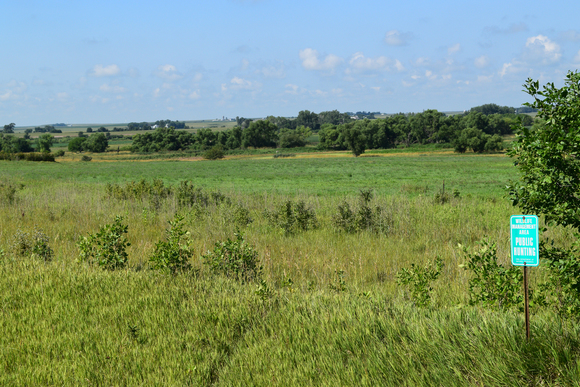 The view looking southwest from Quincey Avenue toward County Road M68, this 1,260-plus-acre public area in southern Sac County has a mix of marshes, reclaimed gravel pits, timber, prairie and food plots pieced together like a large puzzle stretching 2.5 miles south of Lake View. Photo courtesy of the Iowa DNR.
Lake View,
Iowa - Lake View is a small town with a big outdoors reputation. Case in point:
the Black Hawk Marsh Wildlife Management Area (WMA).
This 1,260-plus-acre public area in
southern Sac County has a mix of marshes, reclaimed gravel pits, timber,
prairie and food plots pieced together like a large puzzle stretching 2.5 miles
south of town.
Looking southwest from Quincey Avenue
toward County Road M68, the size and scale of Black Hawk Marsh is impressive.
“We have something here for everyone,”
said Clint Maddix, wildlife biologist for the Iowa Department of Natural
Resources. “If you can’t find a spot to recreate on a busy weekend, you aren’t
trying hard enough.”
The marsh is a stopover on the
migration route for ducks and geese, with some shorebirds mixed in in the
spring. A bald eagle has built a nest overlooking the marsh that is visible
when the leaves are off the trees. Black Hawk Marsh is on the birding trail and
rare wildlife, like Blanding’s turtles, call it home.
Black Hawk Marsh benefits from a maze
of water canals created by sand and gravel exploration. A network of unmarked gravel
lanes snakes through the area providing access to hidden boat ramps and secret
fishing spots. There’s an equestrian trail which follows the Game Road through
the Game Reserve, as the old timers call it, which is an access road that a
many people enjoy just driving to feel close to nature. During morel mushroom
season, the Game Road will be dotted with vehicles parked off to the side while
their drivers search the timber for the highly prized fungi.
“The Game Road gets a lot of use, but
some locals may not even know it’s here,” Maddix said.
One of the largest abandoned quarries
- the narrow, mile long Arrowhead Lake - received game fish collected from
nearby Black Hawk Lake before the fish population was eliminated in 2012. Arrowhead
Lake has protected and secluded water that is popular with paddlers and paddle
boaters.
The west side of Black Hawk Marsh is
adjacent to the Sauk Rail trail; a paved 33-mile long recreation trail
connecting Swan Lake, southeast of Carroll, to Black Hawk Lake, at Lake View, giving trail users an unobstructed view
of the area and the wildlife and people who use it.
Hitting
Reset on the Lake and Marsh
Black Hawk Lake, the southernmost
glacial lake in Iowa, had been suffering from poor water quality, a carp and
buffalo dominated fishery and its adjacent marsh was filled with silt and void
of vegetation.
In 2012, Iowa was experiencing a
significant drought that dried the marshes and lowered the lake level to the
point where the DNR believed it could successfully eliminate the remaining fish
population and start over.
Restoring Black Hawk Marsh – Inlet
Bay, a natural water filter for the lake – was identified in a pre-renovation
study as key for the project to succeed. The study predicted that dredging the
inlet could reduce the phosphorus delivery to the lake by up to 60 percent.
To get the marsh to function properly,
it would need to have the silt removed and vegetation restored so water flowing
through it could be slowed, silt allowed to settle out and the nutrients used
by the vegetation.
Dredging began in 2017 and is about 40
percent complete.
Plans call for the dredge to work back
to where Carnarvon Creek enters the inlet on the south end to allow the boat
ramp to be useable by hunters and paddlers. The ramp allows hunters quick
access to kayak the inlet and creek channel to hunt wood ducks in remote areas
of the marsh. Maddix said these areas hold a lot of wood ducks and if hunters
are willing to try something different, they can potentially take home a limit of
woodies about any time during the season.
With the rough fish gone, cattails have
returned stretching up 6-10 feet above the marsh bottom.
“We have the ability to conduct annual
water drawdowns on State Marsh and DU Marsh which allows the marsh to
revegetate, provides waterfowl food and escape cover, sequesters nutrients and
prevents the resuspension of bottom materials,” he said.
The project has been supported by local
community volunteers who help with brush removal and clean-ups, and the Lake Protection
Association and City of Lake View, who are interested in urban conservation
practices and watershed work.
“Many watershed improvements have been
made on private property with the help of TJ Lynn, the Black Hawk Lake
watershed coordinator whose position is funded through a 319 Watershed
Improvement Grant,” Maddix said.
New
acquisitions
That restoration mindset also applies
to newer acquisitions at the marsh. Land that had been row crops for
generations are being converted back to wetlands and prairies. Some areas have
food plots; some are being converted from crop land and seeded to prairie as
part of a 10 year plan. Several shallow water excavations are planned that will
add additional wetland acres to the area.
“We want to lead by example,” Maddix said.
“Ground that may not be best suited for growing crops is great at growing
wildlife habitat.”
Timber
invaders
The forested areas at Black Hawk Marsh
are home to the unwanted invasive plants honeysuckle and buckthorn.
Maddix and staff are battling the tree
and brush pests through a combination of spraying and grinding. Occasionally,
he will get a call from someone who saw the dead trees and shrubs and wants to
know what’s going on.
“Once we explain what we are doing and
why, their complaint usually goes away,” he said.
Media Contact: Clint Maddix, Wildlife
Biologist, Iowa Department of Natural Resources, 712-657-2639.
FAYETTE – Archers from all
over Iowa and other parts of the Midwest will visit Volga River State
Recreation Area in northeast Iowa, Aug. 18-20 for the Rinehart R100.
Considered “the best archery shoot in
the world,” the Rinehart R100 is returning to Volga River State Recreation Area
for its third year. Echo Valley Archers, the local archery club, hosts the
event in partnership with the Iowa Department of Natural Resources.
“We had 600 plus shooters each of our
first two years, and both those years were rainy,” says Jeff Hildebrand, park
ranger for the state recreation area. “This year we hope to skip the rain and
welcome more than 1,000 participants to the event.”
The two archery courses, one North
American and one African, together cover nearly two miles in the recreation
area and have a total of 100 different life-sized 3D targets to challenge bow
hunters and archery enthusiasts.
“We have had shooters from as far
away as Ontario and Tennessee,” says Hildebrand. “We love to showcase our
natural area, and of course it’s a great economic opportunity for the
surrounding community.”
Iowa is one of 20 Rinehart shoots
held around the country this year. For more information about the event and to
pre-register visit www.R100.org
MEDIA CONTACT: Jeff
Hildebrand, Volga River State Recreation Area park ranger, 563-425-4161
or jeff.hildebrand@dnr.iowa.gov
Pond plants are necessary for a
healthy pond, but too many can upset a fishing pond’s balance and become a
nuisance. Many pond owners struggle with how to control the amount of aquatic
plants, without completely removing all plants, so they can enjoy their pond.
Herbicides can be used to kill
underwater weeds, but their growing season is almost over this time of year.
Pond rakes or cutters, although more
labor intensive, are perfect for controlling aquatic plants in small areas to
create fishing lanes, swimming areas and dock access.
Pond rakes tear plants from the bottom
and let you remove them from near shore or around docks. Attach a float to the rake to let it skim and
remove plants and moss or algae from the surface.
Cutters sink to the bottom and cut the plant stems
as it is dragged back, making the plants float to the top. The pond plants are
often carried away by the wind or can be picked up with a floating rake.
Use a long-handled rake or cutter with
a reach of 10 feet or more that you can throw and pull back. You can use these handy tools for many years,
and they cost less than a gallon of some aquatic herbicides. Local hardware or pool stores may carry
these, or try an online search for “pond rake or cutter.”
A
few tips to remember:
- Many
plants spread by fragmentation, so if growth is not throughout the pond, do not
use these methods.
- Once
out of the water, let the plants dry out before moving them too far. This will
greatly lighten your load.
- Obey
State Law. Don’t haul the plants off your property; you cannot transport
aquatic vegetation in Iowa. Once out of the water, leave the plants to dry and
compost onshore or move dried plants to your garden where they make excellent
mulch.
- Lakeshore
property owners on a public lake can physically remove a 15 foot wide path of
vegetation for navigation to the main lake without a permit; you cannot use
herbicides to remove the aquatic plants in a publicly-owned lake. Contact
the DNR fisheries office in your area if you have questions.
Learn more
about aquatic plants in ponds at www.iowadnr.gov/pondplants.
Media Contact: Darcy Cashatt, Fisheries
Biologist, Iowa Department of Natural Resources, 712-769-2587.
Alliant Energy customers invited to purchase trees for $25
DES MOINES – A popular program
offering landscape quality trees at a deep discount to Alliant Energy customers
will be held at eight locations across Iowa this fall. Residential tree
distributions will take place in Buena Vista, Fayette, Jefferson, Jones, Lee,
Linn, Lucas and Story counties this September and October.
Alliant Energy’s Operation
ReLeaf helps Alliant Energy customers save energy in their homes using
trees to create summer shade and winter windbreaks. For maximum energy
efficiency, shade trees should be planted within 30 feet of the east and
west sides of a house. Evergreens should be planted as a windbreak on the
north and west sides.
Through the program, Alliant Energy
residential customers may purchase high quality landscaping trees for $25 each,
on a first-come, first-served basis. These trees typically retail for
between $65 and $125.
“Planting a diverse mix of trees on
your property and in your neighborhood will reduce the likelihood of losing a
large number of trees to forest health threats,” said Laura Wagner, Operation
ReLeaf coordinator for the Iowa Department of Natural Resources.
Wagner encourages homeowners who do
not intend to treat for emerald ash borer to plant a replacement tree within 30
feet of the existing ash tree.
Foresters have been working with
local partners to create a state tree inventory that will guide future tree
planting efforts to keep a healthy mix of tree species.
Operation ReLeaf has 35
species of trees from which they select 8 to 12 species for each event. The
species are based on the local tree inventory, and will include shade trees,
ornamentals and conifers. Shade trees are 6 to 8 feet tall in 5- to
10-gallon containers and conifers are 3 feet tall.
Just a few of the advantages of yard
trees are:
- Decrease in household heating and cooling costs
- Increase in property values
- Decrease in storm water runoff, which may reduce flooding events
- Beauty and personal enjoyment
“All trees are purchased through a
bidding process to promote local nurseries,” said Wagner. “This is a
great way for homeowners to get a quality tree at an affordable price.”
Customers are encouraged to order
early as these trees sell out quickly. Advance purchase is limited to two trees
per household. In the event there are extra trees available on distribution
day, those trees will be released for purchase at that time. Order
forms are available online at www.alliantenergy.com/releaf.
Workshops lead by DNR foresters
discussing tree planting and care will be held at most tree
distributions. Topics covered will include root flare and proper planting
depth, correcting encircling roots, proper mulching and watering, corrective
pruning to reduce future storm damage, planting around buildings
for energy efficiency and emerald ash borer.
Operation ReLeaf is
administered by the Iowa Department of Natural Resources with assistance from
local partners, like county conservation boards, municipalities and county
extension offices.
Operation ReLeaf participants
must be Alliant Energy residential customers.
For more information, contact Laura
Wagner with the Iowa DNR at 515-822-1031 or laura.wagner@dnr.iowa.gov.
Both Maquoketa Caves and Pikes Peak state parks have been picked as “best Iowa attractions” by USA TODAY for their 10Best Readers’ Choice contest currently underway.
Both state parks are found in northeast Iowa.
Maquoketa Caves, in Jackson County, has more caves to explore than any other state park in Iowa, giving visitors a chance to step back in geologic time. Pikes Peak, in Clayton County, is known for its spectacular views of the Upper Midwest and the mighty Mississippi River, particularly during peak fall color.
“There is no doubt, these are two very popular parks,” says Todd Coffelt, DNR State Parks bureau chief. “And I’m sure this competition will be hotly contested, particularly among the local communities that are such great supporters of these state parks.”
Coffelt said that Iowa is fortunate to have 71 state park and recreation areas which are all unique, with beautiful features and recreational opportunities.
The 10Best Readers” Choice contest ends Aug. 28. Voting is done online at www.10best.com/awards/travel/best-iowa-attraction/ Only one vote per person daily through the end of the contest. Winners will be announced Sept. 1.
|





