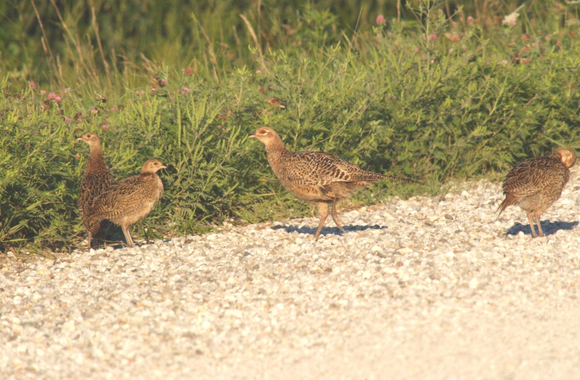
 The August roadside survey is the best measurement of Iowa pheasant population. Surveyors watch for hens moving their broods to the road edges to dry off before starting to look for insects. Photo courtesy of the Iowa DNR.
Iowa’s
15-day annual pheasant population survey begins on Aug. 1, and after a mild
winter and early spring, wildlife experts are cautiously optimistic about what
they hope to find.
“Our
weather this year is nearly identical to what we saw in 2015,” said Todd
Bogenschutz, upland wildlife biologist with the Iowa Department of Natural Resources
who coordinates and collects the data from the 208, 30-mile survey routes.
“Our
spring weather model is pointing toward a status quo population, but in 2015, with
nearly identical data, the statewide pheasant counts increased by 40 percent. The
wet spring suggests counts similar to last year, but we're optimistic that if the
population responds like 2015, it will likely mark our highest statewide
pheasant count since 2006.
“Either
way hunters should have a great fall,” he said.
The
virtual lack of snowfall across much of the state likely resulted in good hen
survival and those extra hens offered great potential for increased numbers
this fall. Pheasants do best during mild winters with less than 30 inches of
snow followed by a warm, dry spring nesting season with less than eight inches
of rain. Iowa’s statewide snowfall average was 20.4 inches. The statewide
spring rain average was 8.7 inches.
“I
had reports from people who were seeing pheasant broods in May, which suggests
early nesting, which is a good omen for the fall,” he said.
The
August roadside survey is the best measurement of Iowa pheasant population. The
30-mile routes are driven at sunrise on gravel roads preferably on mornings
with heavy dew and little wind. Surveyors watch for hens moving their broods to
the road edges to dry off before starting to look for insects.
Surveyors
note the number in the brood, any adult pheasants present and the size of the
chicks, which tells Bogenschutz if this was an initial nest or if the nest was
washed out and this brood was from a second or even third nest attempt. Each
attempt after the first has fewer eggs than the prior attempt.
The
survey also collects data on cottontail rabbits, jack rabbits, quail and Hungarian
partridge.
Data
is collected from the same routes each year. The information will be available
online at www.iowadnr.gov/pheasantsurvey by middle September.
Media Contact: Todd Bogenschutz, Upland
Wildlife Research Biologist, Iowa Department of Natural Resources, 515-432-2823
ext 111.
Start a new family tradition this summer – go fishing
for catfish. Bring along two coolers with ice, one to keep your bait firm and
fresh and another to keep your catch cold and preserve that great taste.
“Catfish are more active in hot
weather,” explained
Joe Larscheid, chief of the Iowa Department of
Natural Resources’ (DNR) Fisheries Bureau.
They are biting in every stream of any size, in all lakes and many farm
ponds.
Catfish have a great sense of smell
and taste. Try prepared dip baits, chicken livers, minnows or chubs, green
sunfish, bluegill, crawdads, frogs, night crawlers or dead, but fresh, gizzard
shad.
Lakes stratify, or form layers, this
time of year, with cool, oxygen-deprived waters sinking to the bottom. Do not
fish in water deeper than 8 to 10 feet.
Look for areas with vegetation, brush
piles or rock. Fish the upper ends of the larger reservoirs where the water is
shallower and baitfish like gizzard shad gather. Use baits fished on the bottom
or suspended off the bottom with a bobber and let current or breeze move the
bait to find active catfish.
Iowa rivers are loaded with catfish.
Look for fish around downed trees and brush piles, but don’t overlook rock
piles or other objects that deflect water and form a current seam. Position
your bait just upstream of brush piles so the scent of the bait is carried
downstream into the structure to draw the catfish out. Anchor the bait with a
heavy weight so it doesn’t drift into snags. If fishing the big rivers, try upstream
and on the tips of wing dykes and wing dams on the Missouri and Mississippi rivers.
Find more tips for catching, cleaning
and cooking catfish on the DNR website at fishing.iowadnr.gov.
Media
Contact: Daniel Vogeler, Fisheries Bureau, Iowa Department of
Natural Resources, 712-336-1840.
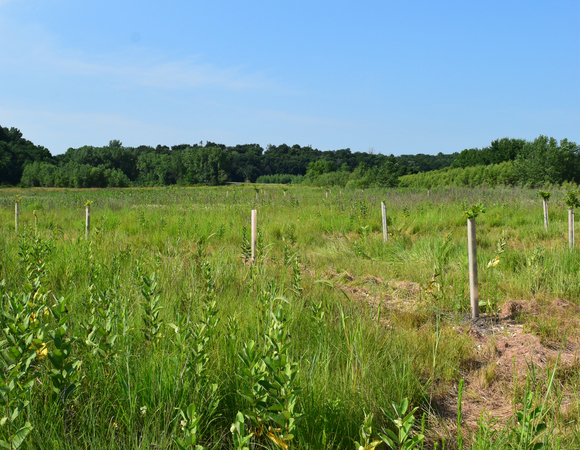 Sections of North Raccoon Wildlife Area have been planted with nut-producing oaks, hickories and walnuts favored by many different wildlife species. Photo courtesy of the Iowa DNR.
The North Raccoon Wildlife Area just
might be the biggest playground in Greene County. But rather than
teeter-totters and swings, this playground offers excellent deer hunting,
turkey, dove and rabbit hunting, river access and sandbar camping, bird
watching, hiking and more.
The area, which originates from the intersection
of the North Raccoon River and Hwy. 30, has as grown from nearly 290 acres to
more than 720 acres since 2012, thanks to local landowners who wanted to share their
piece of paradise.
“We’ve had landowners turn down
multiple offers, waiting for us to buy it because they want to make their land
available for everyone to use,” said Josh Gansen, wildlife biologist with the
Iowa Department of Natural Resources (DNR).
For more than 40 years, the area
consisted of basically the McMahon Access with a narrow strip of public land on
either side of the river around the Hwy. 30 Bridge.
The first land project was the result
of an easement program within the U.S. Department of Agriculture that focused
on improving the water quality in the North Raccoon watershed.
It became a catalyst for other projects
in the area.
The federally endangered Topeka shiner
was living in multiple streams in the North Raccoon River watershed. In 2015,
federal funding became available to purchase specific parcels in the watershed
to protect the minnow.
After the Topeka shiner project
closed, Gansen started to receive calls from neighbors who were also interested
in selling their property.
“Some were recreational landowners and
some were calling from estates,” he said.
The Iowa DNR has been working with the
Iowa Natural Heritage Foundation to purchase land from willing sellers for
appraised value. One family – the Gorsuchs – had used part of their land as
their own private getaway. They had always allowed others to hunt their land,
but now their kids away at college and the getaway wasn’t getting much use.
Another tract was purchased from a sand
and gravel company who had a lot of land that it wasn’t using. It has oak
savannah knobs by the river and an abandoned quarry that offers 8-9 acres of
good fishing.
One section of the parcel had a dove food
plot last year but this year it will have food plots of turnips and winter
wheat attractive to deer and turkeys. The area had just been mowed to prep the
site. Gansen expects it to be green for this fall, once the rain returns.
Across the road, an 80-acre tract will
be allowed to return to forest with nut producing trees and shrubs interspersed
to add diversity.
The latest acquisition – a 65 acre
tract - was just closed on a few weeks ago. Now the work begins.
DNR staff will clean up the old
farmhouse foundation and remove rusting farm machinery and house appliances,
lawn mower and sewing machine, livestock feeders and more. Property signs have
not yet been installed.
“Some of these areas are so new that
we don’t have a lot of history on what flora and fauna is here,” Gansen said.
Management varies by parcel – one
section in a floodplain has a 100-acre prairie and wetland basins built to
flood each spring. Gansen planted sections of the area with nut-producing oaks,
hickories and walnuts favored by many different wildlife species. He opted to
plant larger trees to get them established before the much more wet soils
tolerant but less wildlife beneficial willows, silver maples and cottonwoods
appear.
“We want to be sure there is a hard
mast producing component on the floodplain as the area matures,” he said.
The young prairie wetland area is
alive with grasshoppers, monarchs, swallows, dragonflies darting, zagging and
bombing under the watchful eye of an immature bald eagle. Three young
crow-sized pheasants darted from the mowed area to the safety of the taller
prairie grasses.
Paddlers
finding the area
The North Raccoon Wildlife Area is
bisected by the North Raccoon River giving paddlers, anglers and other river
users the unique opportunity to camp on the sandbars on the public area. If the
river is high, they can move their campsite to the wildlife area.
“These aren’t standard camping sites,
these are remote spots for paddlers looking for a specific experience,” Gansen
said.
Media
Contact: Josh Gansen, Wildlife Biologist, Iowa
Department of Natural Resources, 515- 432-2545.
HAMBURG – The Iowa Department
of Natural Resources (DNR) will discuss its proposed designation of the region that
includes Waubonsie State Park and Riverton and Forney Lake wildlife areas as a
state Bird Conservation Area (BCA) at a public meeting on Aug. 17.
The meeting begins at 6:30 p.m.
at Waubonsie State Park’s Washawtee Lodge on Washawtee Rd., one half mile
northeast of Bluff Rd. (Co. road L44), 4.5 miles north of Hamburg.
“The proposed Lower Loess Hills BCA is especially
unique and contains a wide variety of woodlands, grasslands, and wetlands, providing
habitat for 128 nesting birds and 282 bird species overall, 92 of which are species
of greatest conservation need,” said Bruce Ehresman,
with the Iowa DNR’s Wildlife Diversity Program.
“From large forest birds like
the broad-winged hawk and wood thrush, to savanna species like the barn owl and
red-headed woodpecker, to declining grassland birds like eastern meadowlark and
bobolink, this unique area encompasses a beautiful portion of the Loess Hills,
along with riverine areas along the Missouri and East Nishnabotna rivers,
providing an ideal southwestern Iowa setting for what can become Iowa’s twenty-fourth
Bird Conservation Area.”
The Bird Conservation Area
concept focuses on all-bird conservation at a large landscape scale, and the
program’s success depends upon partnerships between public agencies, private
conservation organizations, and private landowners. Each BCA consists of at least 10,000 acres, with
one or more core areas of permanently protected bird habitat surrounded by
large areas of privately owned land that also provides important habitat for
birds. Core public lands are managed for all wild birds, but especially for
those species experiencing regional or continental population declines.
Wildlife biologists and private
lands specialists work with willing landowners to find ways to improve their
properties for birds. Participation
in this BCA program is completely voluntary, and there are no restrictions or
requirements placed on landowners. The program can result in extra
incentives for landowners to make bird habitat improvements.
Creating Bird Conservation
Areas remains a high priority for the Iowa DNR.
“Establishing a Bird
Conservation Area helps draw attention to the needs of birds that are in
trouble, while it allows the local community and concerned citizens an
opportunity to take action to help these birds,” said Matt Dollison, wildlife management
biologist for the DNR. “Declining species ranging from game birds like northern
Bobwhite and blue-winged teal to nongame species such as whip-poor-will and belted
kingfisher all can benefit from the creation of the Lower Loess Hills Bird
Conservation Area.”
Dollison and Ehresman encourage anyone
interested in bird conservation, bird watching, and improved natural resource
management to join them for this informative public meeting.
Media
Contact: Bruce Ehresman Wildlife Biologist,
Iowa Department of Natural Resources, 515-432-2823 or Matt Dollison, Wildlife
Biologist, Iowa Department of Natural Resources, 712-350-0147.
|





