|
POTTAWATTAMIE
COUNTY, Iowa – Iowa Department of Natural Resources state park rangers have
charged two hunters after a tip was reported by fishermen of shots fired at
Lake Manawa on July 22.
Approximately
12:52 a.m. on July 22, DNR state park rangers conducted a traffic stop on
Gifford Road in Council Bluffs, in reference to the gunshots heard. Sein Ram,
37, and Gungsar Yungtang, 17, both of Omaha, stated they were rabbit hunting
with a flash light from a motor vehicle.
At
that time, both Ram and Yungtang were cited for hunting by artificial
light, hunting without a non-resident hunting license, and illegal attempt to
take game (rabbits). During the traffic stop, a .22 caliber rifle, ammunition
and a flash light were seized.
After
further investigation of the scene, a deceased female whitetail deer was found with
multiple gunshot wounds. The Iowa DNR found a blood trail consistent with being shot
from the roadway. A .22 caliber bullet was recovered from the deer carcass.
Iowa DNR park rangers met with Ram again later that day and charged him with failure to
have a non-resident antlerless deer license, abandonment of dead or injured
wildlife, illegal method of take, shooting a firearm over a roadway, and
trespassing. Ram received warnings for prohibited hunting near an occupied
building, refusal to exhibit catch to an officer, shooting a deer out of
season, use of a motor vehicle for deer hunting, and manner of conveyance for
having a loaded weapon in a vehicle.
Yungtang was fined $450. Ram was fined $3,808.70.
The
public is encouraged to report any suspicious activity through the Iowa DNR Turn In Poachers
(TIP) hotline at 1-800-532-2020.
Note: A criminal charge is merely an accusation
and a defendant is presumed innocent until proven guilty.
Media
contact: Aaron Johnson, DNR Park Ranger at (402) 980-3929
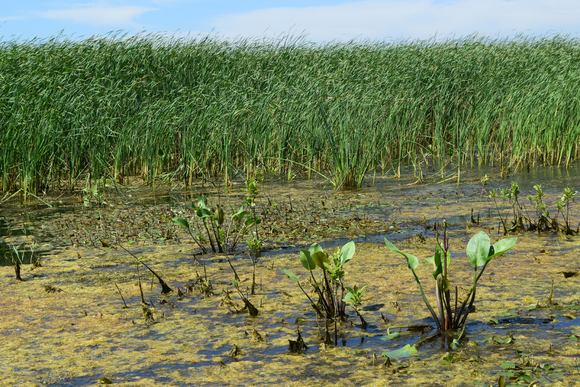 Small, seasonal wetlands have returned to the Eagle Lake area, serving as nesting habitat for ducks and as a filter for water before it enters the lake. Photo by the Iowa DNR.
ESTHERVILLE,
Iowa - Eagle Lake is a survivor.
The 290-acre natural shallow lake on
the Iowa-Minnesota border in northern Emmet County staved off being drained
entirely in the early 1900s by a newly formed drainage district on the lake’s
south side.
While the southern part of the lake
disappeared beneath a mix of annual crops and pasture for 50 years, in the
1950s the Iowa Conservation Commission (the agency that would be merged with
others to become the Department of Natural Resources) began to reassemble it piece
by piece and by 1985, all of the parcels were under public ownership.
Eagle Lake was again a shallow lake
surrounded by a narrow strip of old pasture and crop ground, but something
wasn’t right.
“This was an importing stopover for
migrating water birds but the big thing it was missing was upland nesting cover
and semi-permanent and seasonal wetlands,” said Bryan Hellyer, wildlife
biologist for the Iowa DNR at the Prairie Lakes Wildlife Unit.
That missing piece began to slowly
change in the mid to late 1990s when the U.S. Fish and Wildlife Service
acquired a 98-acre tract on the northwest edge of the lake.
Then in 2007, the development pace shifted
from turtle to teal.
The Iowa Department of Natural
Resources, Iowa Natural Heritage Foundation and the U.S. Fish and Wildlife
Service began adding adjacent parcels from landowners willing to sell.
This was when Eagle Lake potential turned
into Eagle Lake reality.
A newly acquired 465 acres of land included
25 smaller natural seasonal wetlands just waiting to come back. The bulk of the
acquisition was reseeded to native Iowa prairie. Combining the prairie and healthy
wetlands has been a boon for migrating and resident wildlife.
“It’s all about water quality, that’s
what I love about wetlands, they filter water and everything uses them,”
Hellyer said. “We’ve added a buffer nearly around the entire lake that will continue
to improve its water quality. We’re getting the area back to what it once was.”
The 865-acre Eagle Lake Wildlife
Management Area is attractive to more than ducks and pheasants. It brings in
shorebirds, bobolinks, Eastern meadowlarks, goldfinches, tiger salamanders,
prairie skinks, turtles, bees, monarchs, dragonflies, damselflies and more. Six
pairs of Forester’s terns have been seen here. So have multiple adult and young
eared grebes.
“We haven’t scratched our potential
here yet,” Hellyer said. “We started at
a great place with the lake. I’m glad we could add on.”
That potential extends to other uses,
too.
“It’s an excellent area to canoe and
kayak, for birdwatching. It would be a great classroom for school groups,”
Hellyer said. "Pheasant hunting has
increased dramatically, which has benefitted the local sporting goods stores,
hotels, and restaurants.”
Kirk family farm
changes from black dirt to wetlands and prairie
Much of the new prairie and wetlands
had been part of the Jim and Lavonne Kirk farm. After Jim passed, Lavonne sat
down with Hellyer to discuss the possibility of selling their 40 acre pasture
for public use.
She decided to sell the whole farm.
Lavonne Kirk initially enrolled the
farm into the Wetland Reserve Program where it was purchased by the Iowa
Natural Heritage Foundation for its appraised value. A few years later, she
sold the family’s remaining 80 acres along the south edge of the Eagle Lake
complex at auction where the Heritage Foundation bought it.
“Obviously the family has quite a bit
of attachment to the land,” Hellyer said. “She has been out to visit it, to see
the progress. She told me she was happy that we acquired it and to see it
permanently protected.”
Prairie plant diversity is important
and the 865-acre complex is home to rattlesnake master, rough prairie star,
purple coneflower, native indigo, prairie blazing star, butterfly milkweed,
Canada milk vegetation, and much more.
With dickcissels singing in the
background, the seven year prairie old is starting to find itself and
functioning like an ecosystem, Hellyer said.
Pheasants now have a place to rear
their young in the summer, and to escape bad weather in the winter. Ducks can
nest on one of the many small wetlands then move to the larger lake when their
broods are ready.
A young buck lay hidden for as long as
he could suddenly sprang up and bounded west across the marsh to the safety of
the oak savannah.
“You’ll
have all those things on the landscape if you have the water quality,” he said.
“We tend to focus more on ducks and pheasants but
boy we’ve created a pretty cool thing here.”
Media Contact:
Bryan Hellyer, Wildlife Management Biologist, Iowa Department of Natural Resources,
712-330-2563.
Three Keokuk men were charged July 6,
with animal torture after a video appeared online in early May showing the men
with an injured opossum.
Jerry McGee, 19, Austin Salyers, 18,
and Casey Taylor, 19, allegedly found the opossum after it had been hit by a
vehicle. The men were allegedly seen in the video throwing and beating the
opossum while it was still alive. The video generated numerous complaints to
the Iowa Department of Natural Resources, Lee County Attorney’s Office and the
Keokuk Police Department.
The individuals are scheduled to
appear in Lee County court on July 26. Animal torture is an aggravated
misdemeanor.
Media Contact: Ben
Schlader, State Conservation Officer, Law Enforcement Bureau, Iowa Department
of Natural Resources, 319-470-0788.
CEDAR
RIVER – The upper stretch of the Cedar River in north-central Iowa is now 28
tons of trash lighter, thanks to the efforts of 469 volunteers.
This
July, 469 volunteers took part in the 15th annual Project AWARE, paddling 55
miles of the Cedar River through Mitchell and Floyd counties from the
Iowa-Minnesota state line to Howard’s Woods Rec Area near Nashua.
Project
AWARE, which stands for A Watershed Awareness River Expedition, is the Iowa
DNR’s volunteer river cleanup event which involves hundreds of people who spend
anywhere from one to five days exploring Iowa’s rivers and picking up trash.
"Project AWARE was such an
awesome experience and we were truly thankful to be part of it,” said Adam
Shirley, Mitchell County Conservation Board Director. “It was impressive to
watch the volunteers at work and we appreciate all of their hard work to
improve the Cedar River."
Scrap
metal was the heaviest item removed. Mitchell County Conservation and Floyd
County Conservation handled the 15 tons of scrap metal removed during the
event. Volunteers also removed 368 tires. This year, 88 percent of the trash pulled from the river was
able to be recycled.
A
total of 169 volunteers participated all five days of the event, but with some
participating single days, there were about 250 volunteers on the water each
day, ranging in age from 2 to 77. About 15 percent of this year’s participants at
the family-friendly event were under the age of 18. In addition to Iowa,
volunteers hailed from 14 other states. Fifty-one of the volunteers were from Mitchell
or Floyd counties.
“Project
AWARE provided me with the motivation to visit the upper Cedar River and all
the quaint towns that surround it. I never thought it possible that the Cedar River
could be that beautiful! It’s a gem of a river,” said Jodi Gerot, a third-year
volunteer from West Branch.
“I
didn't know anything about Mitchell or Floyd counties and really enjoyed the
scenery and the towns. I would love to go back to this area to paddle. The
river was gorgeous and well-cared for by the locals,” said Rose Danaher, an
eight-year volunteer from Amana.
Photos
from the event can be found on the Project AWARE website at www.iowadnr.gov/aware.
Event sponsors included:
Platinum Paddle Sponsors: Alliant Energy Foundation · Bridgestone’s Tires4ward
Program · Bug Soother · City of Charles City · Firestone Complete Auto Care ·
Flint Hills Resources · Floyd County Conservation · IIHR - Hydroscience & Engineering at The
University of Iowa · Iowa DNR – IOWATER, Rivers Programs · Iowa Flood
Center · Iowa Rivers Revival · ITC · Mitchell County Conservation Board · N-Compass
· State Hygienic Laboratory at The University of Iowa · Zanfel Laboratories,
Inc.
Golden Yoke Sponsors: Ansell Protective Products · Iowa Whitewater
Coalition · Rockwell Collins
Silver Stern Sponsors: Cedar Run Canoe & Kayak Rental · DuPont ·
Hy-Vee, Inc. · Nathan and Jamie Lein · Stine Seed Company · Upper Iowa
University
River Steward Sponsors: B4 Brands · Caterpillar Inc. · Cedar Springs Camp
& Retreat · Connie Struve and Bill Covington · Environmental Advocates · Hawkeye
Fly Fishing Association · Iowa Limestone Producers Association · Mitchell
County Farm Bureau · Mitchell Soil and Water Conservation District · Rapids End
Outfitters · Senator David Johnson · Snyder & Associates, Inc. · Touch the
Earth Outdoor Recreation and Education - University of Iowa · University of
Iowa Office of the State Archaeologist · University of Northern Iowa Outdoor
Recreation Zimmerman Buildings Inc.
River Rescue Sponsors: Allison Boehm · Anonymous Nature Lover · Boy Scout
Troop 242 · Butler Soil and Water Conservation District · Can Shed LLC ·
Casey’s General Stores, Inc. · Cedar Rapids Linn County Solid Waste Agency ·
Cedar Valley Paddlers · Central Iowa Paddlers · Charles City Family YMCA · Charles
City Immaculate Conception Parish · Charles City Senior Center · Chickasaw
County Conservation · City of Ames A.O.C. Resource Recovery System · CrawDaddy
Outdoors · Darrel and Jean Brothersen · Dean and Linda Tjaden · Des Moines Area
Community College · Don Wall · Eaton Corporation’s Community Involvement Team,
Shenandoah Plant · Environmental Professionals of Iowa Eric Boehm · Floyd County Historical Museum
· Floyd County Ikes · Floyd Lions Club · Floyd-Mitchell-Chickasaw Solid Waste
Management Authority · Fossil & Prairie Conservation Foundation · Franklin
Soil and Water Conservation District · Iowa Geological Survey · ISG · Jendro
Sanitation John and Shawnna Larison ·
Kim Watkins · Linda Appelgate · Mark Bohner · Nashua Fire Department · Nick and
Maureen Gaeta · OmniTel Communications · R Campground Inc. · Rick Dietz · Rivers
and Streams LLC · Rod, Ronnie, and Randie Brodigan · Skunk River Paddlers ·
Sqwincher/PMG · St. Ansgar Community Schools · Sunny Brae Golf Course and
Country Club · The Dental Practice · Timothy S. Fox · Tony Geerts · University
of Iowa Research Park · White Pine Group, Iowa Sierra Club · William & Joan
Kauten
Life Jacket Sponsors: Andrew & Maureen Johnson
For more information on this event, visit www.iowadnr.gov/aware.
MEDIA
CONTACT: Lynette Seigley, Iowa
Department of Natural Resources, (319) 351-9393
or Lynette.Seigley@dnr.iowa.gov
Registration is now open for the Oct. 6-8 Becoming
an Outdoors Woman workshop at Dolliver Memorial State Park, near Otho.
While the focus of BOW is primarily for women, the
workshop is an opportunity for anyone 18 years or older to learn outdoor
skills.
Workshop courses include off-highway vehicle safety
and awareness, small game hunting and mentored squirrel hunt, explore
bowhunting, introduction to birding and optics, from field to freezer, basic
fishing, Dutch oven cooking, kayaking, deer hunting, intro to archery, wild
edibles, wilderness navigation – map and compass and more.
Kayte Dunfee, an avid outdoorswoman from Colorado,
will share her journey from animal enthusiast to hunter and how hunting
transformed her vision and process of building an outdoor-centric, sustainable
lifestyle in a session titled Orange is My New Black.
The cost for the workshop is $200 before Sept. 8,
and $230 beginning Sept. 9. The fee includes program materials, equipment,
lodging and meals. Enrollment is limited to 100 participants. A limited number
of scholarships are available that can reduce the fee by $100.
“This workshop is an excellent opportunity to try
activities under the guidance of our top-notch instructors,” said Rachel Ladd,
with the Iowa Departments of Natural Resources. “Our workshop is popular
because we keep our class sizes small and the setting at Dolliver is beautiful,
particularly in the fall.”
Go to www.iowadnr.gov/bow to register,
select classes and for more information on applying for a scholarship.
For more information, contact Rachel Ladd at
515-729-6037 or Rachel.Ladd@dnr.iowa.gov.
The
2017-18 Iowa Hunting, Trapping and Migratory Game Bird Regulations will be
arriving at license vendors across the state in the next few weeks.
Hunters
should note that there is only one regulations book this year instead of the
traditional two.
Changes
with the season setting calendar by the U.S. Fish and Wildlife Service allowed
the duck, goose and other migratory game bird hunting regulations to be included
in with the seasons and regulations for other species. The waterfowl seasons,
zones and bag limits now have their own section.
Hunters
will also notice the general hunting seasons and limits and waterfowl seasons
and limits tri-fold cards are no longer being printed. The cards and
regulations are currently available online to download or print at www.iowadnr.gov/hunting.
Notable
hunting regulation changes include extending the Missouri River Zone for ducks and
geese to include all the land and water west of Interstate 29; and allowing deer
hunters participating in the youth, disabled hunter or either shotgun seasons
the option of using straight walled ammunition allowed for pistol hunting in
rifles.
However;
not all straight walled cartridges are allowed.
The
regulations book includes a list of allowable cartridges and a set of guides
based on rimmed or rimless cartridges if the cartridge isn’t listed.
The
Iowa Department of Natural Resources has included the .375 Winchester, .444
Marlin and .45-70 Govt that was an allowable pistol cartridge prior to the law
change. Cartridges not on the previous
list or that fall outside the guidelines will not be allowed.
|





