Division of Behavioral Health
Opioid Update
The Iowa Department of Public Health (IDPH) offers the Opioid Update to share information about opioid use and Iowa’s efforts to address the national opioid epidemic. Please feel free to submit topics to Madeline Scherb at madeline.scherb@idph.iowa.gov.
In this issue:
- Provider Spotlight
- Department Efforts
- Opioid News
Provider Spotlight:
For the next few editions of the Opioid Update, IDPH will introduce readers to the Opioid Treatment Programs (OTPs) serving the State of Iowa. First, here’s a little information on what an OTP is, as defined by SAMHSA:
In the United States, the treatment of opioid dependence with medications is governed by the Certification of Opioid Treatment Programs, 42 Code of Federal Regulations (CFR) 8. This regulation created a system to accredit and certify opioid treatment programs dispensing Methadone for an opioid use disorder. SAMHSA’s Division of Pharmacologic Therapies (DPT), part of the SAMHSA Center for Substance Abuse Treatment (CSAT), oversees the certification of OTPs. OTPs must be certified by SAMHSA and accredited by an independent, SAMHSA-approved accrediting body to dispense opioid treatment medications. All OTPs also must be licensed by the state in which they operate and must register with the Drug Enforcement Administration (DEA), through a local DEA office.
UCS Healthcare
UCS Healthcare provides behavioral and medical care to patients in a safe, diverse environment with access to a wide variety of health care professionals. Locations include Des Moines, Ankeny, and Knoxville. UCS is an Iowa-based, 501(c)3 non-profit corporation, licensed by IDPH to provide substance use disorder treatment services, including medication assisted treatment. UCS also provides mental health therapy and counseling, primary health care, and outpatient psychiatric care. The current organization was incorporated as United Community Services, Inc. (now dba as UCS Healthcare) on November 11, 1997, and employs approximately 50 professionals in its three locations.
The UCS staff is comprised of certified counselors, licensed mental health therapists, clinical psychologists, physicians, nurses, pharmacists, psychiatrists and patient support specialists. This team of professionals works together using a range of best practices and philosophies to tailor an effective plan for each individual client, as well as family members, in certain cases. Aftercare services are provided along with community resource referrals. Case management services provide financial, job, health, and housing resources to clients. On an annual basis, UCS serves more than 4,000 patients who access at least one or more services. For more information, visit ucsonline.org or call 515-280-3860.
Department Efforts:
Strategic Prevention Framework for Prescription Drugs (SPF Rx) Grant Update
The Strategic Prevention Framework for Prescription Drugs (SPF Rx) grant to help reduce the misuse of prescription drugs has a new media campaign focusing on youth ages 12-17 and young adults ages 18-25.
The campaign will be run throughout the state, with social media as the main vehicle to reach its target audience through:
- Pandora
- YouTube
- website targeted banner ads
- billboards
More information about the SPF Rx grant can be found at https://www.idph.iowa.gov/substance-abuse/programs/spfrx
Opioid News:
PCSS-MAT Releases NP/PA MAT Waiver Training
Providers' Clinical Support System for Medication Assisted Treatment (PCSS-MAT) launched its free 24-hour course specifically developed for nurse practitioners (NPs) and physician assistants (PAs) to treat opioid use disorder (OUD).
PCSS-MAT is jointly providing the course with continuing education by the American Psychiatric Nurses Association (APNA) and American Academy of PAs (AAPA).
The 24 hours of coursework, as mandated by the Comprehensive Addiction and Recovery Act (CARA), is broken up into:
- an eight-hour MAT waiver training, and
- 16 hours of training for treating OUD
Once the 24 hours of training are completed, NPs and PAs may apply to SAMHSA for a waiver to prescribe buprenorphine, one of three FDA-approved medications for the treatment of OUD. For more information, go to the PCSS-MAT waiver instructions website.
Fentanyl and Synthetic Opioids: 5 Things You Need to Know*
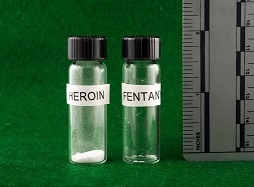 The image above shows two potentially fatal dosages of fentanyl and heroin (photo: New Hampshire State Police Forensic Laboratory via NYT).
The following are the most important things to understand about fentanyl.
-
Fentanyl is 50 to 100 times more potent than heroin or morphine. It is a schedule II prescription drug, typically used to treat patients with severe pain or to manage pain after surgery. It is also sometimes used to treat patients with chronic pain who are physically tolerant to other opioids. In its prescription form, fentanyl is known by such names as Actiq®, Duragesic® and Sublimaze®.
-
It is relatively cheap to produce, increasing its presence in illicit street drugs. Dealers use it to improve their bottom line. According to a report from the Office of National Drug Control Policy, evidence suggests that fentanyl is being pressed into pills that resemble OxyContin, Xanax, hydrocodone and other sought-after drugs, as well as being cut into heroin and other street drugs. A loved one buying illicit drugs may think they know what they’re getting, but there’s a real risk of it containing fentanyl, which can prove deadly.
-
Naloxone (Narcan) will work in case of overdose, but extra doses may be needed. Because fentanyl is far more powerful than other opioids, the standard 1-2 doses of naloxone may not be enough. Calling 911 is the first step in responding to any overdose, but in the case of a fentanyl-related overdose the help of emergency responders, who will have more naloxone, is critical.
-
Even if someone could tell a product had been laced with fentanyl, it may not prevent their use. Some individuals claim they can tell the difference between product that has been laced with fentanyl and that which hasn’t, but overdose statistics would say otherwise. Some harm reduction programs are offering test strips to determine whether heroin has been cut with fentanyl, but that knowledge may not be much of a deterrent to a loved one who just spent their last dollar to get high.
-
Getting a loved one into treatment is more critical than ever.
*This article was adapted from The Partnership for Drug-Free Kids
|




