IN THIS ISSUE
- Second spiny found
- Hummers vs. hurricanes
- Return of the right whales
- Helping marsh sparrows hang on
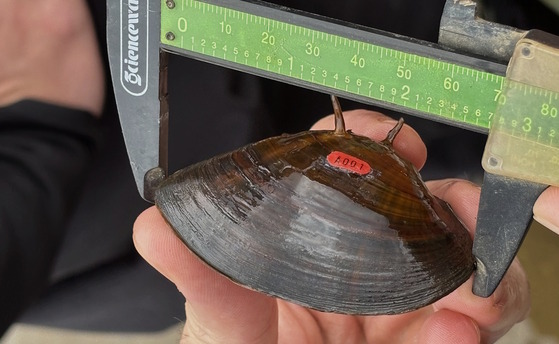 Sizing and tagging a second Altamaha spinymussel on the Ocmulgee River Nov. 4 (Laura Wenk/GaDNR)
DNR Wildlife Conservation Section and University of Georgia researchers searching for endangered Altamaha spinymussels discovered another live one on the lower Ocmulgee River this week. That makes two spinies documented in the same stretch of river near Jacksonville, Ga., since summer.
The Elliptio spinosa found in July ("Find spurs hope," August) was the first live one seen in 15 years. The second, spotted Wednesday 50 yards downriver, will bolster plans to study and save the barbed bivalve endemic to the Altamaha River and its major tributaries.
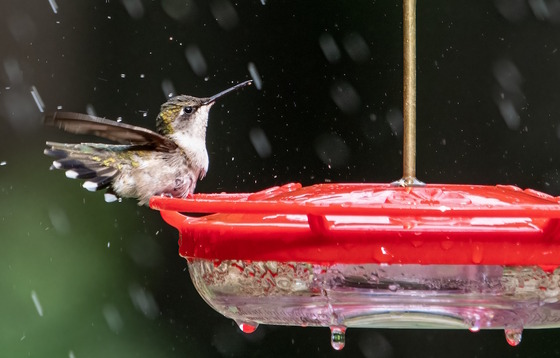 A ruby-throated hummingbird feeding in the rain (Adobe Stock)
By TERRY W. JOHNSON
For me and other hummingbird fans, these flying jewels are an important part of our lives from spring into early fall.
When ruby-throated hummingbirds are here, we do all we can to provide them an abundance of nectar served in feeders and produced by native and ornamental plants. The plants also attract small insects and spiders that offer the birds much-needed protein.
In exchange, hummingbirds give us hours of enjoyment.
But all too soon, ruby-throats embark on their fall migration. When they do, many of us worry that the tiny birds will not survive the perils they face flying to winter homes hundreds of miles away. Last month, that concern deepened when Hurricane Isaias churned across the Gulf, heading to landfall on the Florida Panhandle.
While the fear isn't unfounded, it might may help to know that in such situations hummingbirds have some factors in their favor. ...
Read Terry’s column to see how migrating hummers cope with major storms.
Terry W. Johnson is a retired DNR program manager and a wildlife biologist. Check out past columns and his blog. Permission is required to reprint a column.
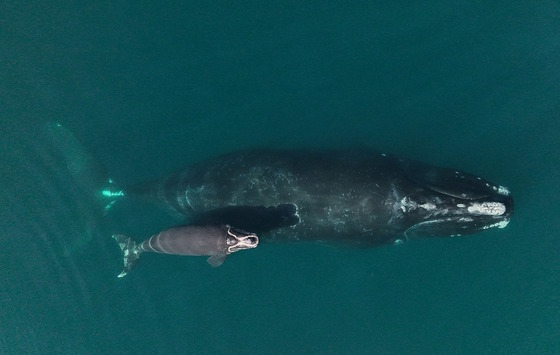 Right whale No. 2642 (Echo) and calf off Little Saint Simons Island last December (GaDNR/NOAA permit 26919)
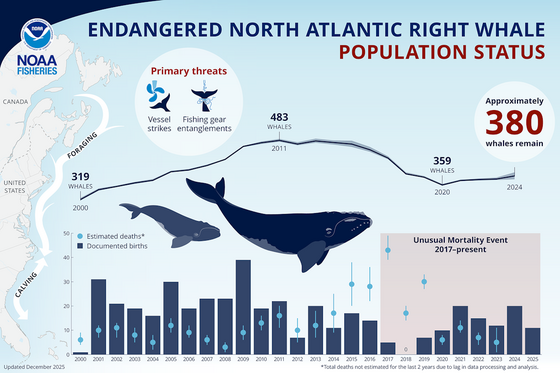
The annual return of North Atlantic right whales to the Southeast is happening. One whale has been spotted as far south as North Carolina. More will follow.
The warm and relatively calm waters off Georgia and north Florida draw right whales in late fall and winter, particularly pregnant females. This area is the core calving ground for the species, one of the world's most imperiled great whales.
For the safety of whales, people and vessels, Georgia boaters are encouraged to go slow and keep watch for the bus-sized animals -- which despite their bulk can be hard to spot and tend to loll at or just under the surface. (Vessels over 65 feet long must go 10 knots or slower in Seasonal Management Areas.)
DNR Wildlife Conservation Section staff who monitor the whales during the winter calving season are gearing up. Senior wildlife biologist Jessica Thompson hopes to see a repeat of last winter's promising calf count, which reached 24.
"And that during the whales' time in the Southeast and when they migrate back north, they remain healthy," Thompson added. "And all in our coastal community know the whales are here and share a sense of stewardship for them."
 GO SLOW, WHALES BELOW
When boating off the Southeast from November until April:
- Post one or more lookouts to keep watch. Look for black objects at the surface, large splashes, recurring whitewater and the V-shaped spout right whales create when they exhale.
- Slow down when boating where right whales may be present. Use the Whale Alert app to know if whales are possibly in the area, and check Whalemap.org for reports over the last 14 days.
- At night and other low-visibility times, use the slowest safe speed to reduce risks. Going slow can provide time to react, sparing vessels, people and whales. (Vessels over 65 feet must heed the ship speed rule: 10 knots or less.)
- If you see a whale, slow further or put your engine in neutral. Assess the scene and slowly leave the area while keeping watch – other whales could be nearby.
- Stay at least 500 yards away (it’s the law) and never pursue a right whale.
- Immediately report sightings. Noting the time, position and number of whales, contact 877-WHALE-HELP (877-942-5343) or the Coast Guard on marine VHF channel 16.
FOR A WHALE OF A TIME
Join DNR's right whale crew this weekend at:
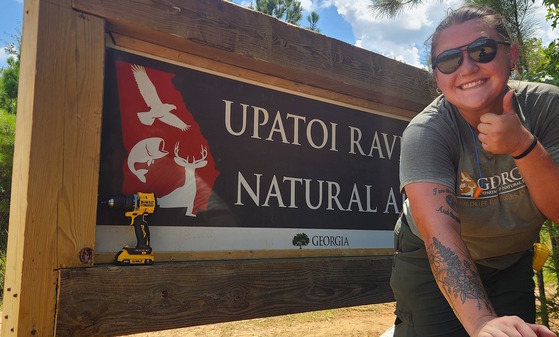 DNR's Paige Dykstra finishes a sign at a Upatoi entrance (Nathan Klaus/GaDNR)
Upatoi Ravines Natural Area has opened to the public, with the 9,500-acre Talbot County site hosting its first quota deer hunt Nov. 20-22. The area just east of Columbus is unique to the Fall Line region, featuring a hilly landscape creased with hardwood ravines and harboring a variety of wildlife, including the state’s largest known stand of federally endangered fringed campion. Befitting the natural area designation, vehicle use is limited: Public access is only by foot, bicycle or e-bike.
Proposed changes to Georgia’s state-protected species list, initially planned for a final review last month, remain in the works. A vote by the Board of Natural Resources is expected in 2027.
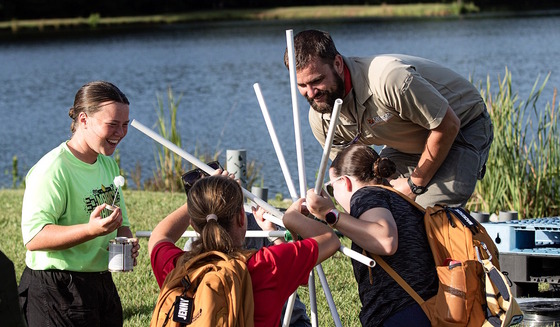 DNR staff lead Career Academy youth in building a fish attractor out of PVC (Jonah Miller/GaDNR)
Applications are being accepted for the 2027 DNR Career Academy. The July 18-24 program will offer rising high school juniors and seniors hands-on experience as they explore career opportunities in the agency's divisions. Apply by Nov. 16.
Three juvenile gopher tortoises released at Alapaha River Wildlife Management Area have quite a history. Raised by the U.S. Fish and Wildlife Service from eggs rescued from a road-kill tortoise near the Ocilla WMA, the young were females by design – higher incubating temperatures set their sex – and held longer than usual for head-started tortoises to gather data on growth rates in captivity.
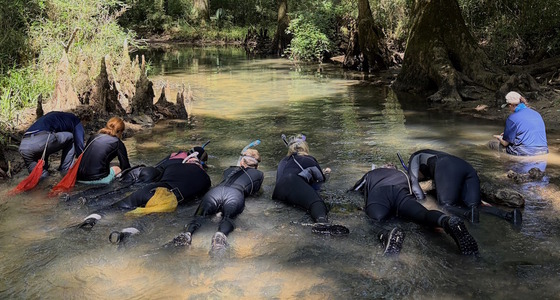 Surveying mussels in southwest Georgia's Chokee Creek (Zach Schumber/GaDNR)
Annual mussel monitoring in Chattahoochee and Flint river tributaries has produced some of the highest numbers seen in the long-term study. For example, Wildlife Conservation Section staff collected double the number of endangered Gulf moccasinshells at Limestone Creek near Lake Blackshear – 725 untagged mussels compared to just over 300 last year.
Also faring well: federally threatened red-cockaded woodpeckers on DNR Safe Harbor Program lands in the Thomasville area. Thanks to conducive forest management on the private lands, from prescribed fire to working with DNR to install nest cavities, the baseline population of the birds in Safe Harbor has grown from 180 groups to over 250 since the year 2000.
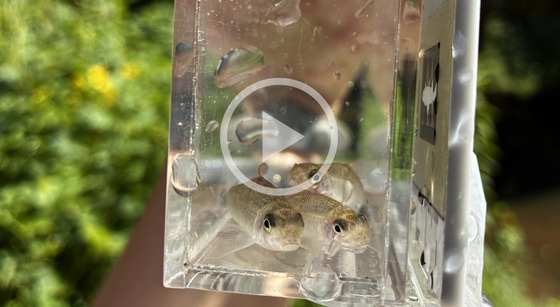 Video shows release of sicklefin redhorse into the Nottely (GaDNR)
Quick hits:
- Make that almost 19,000 sicklefin redhorse fingerlings released in the upper Nottely River, while the federal Warm Springs National Fish Hatchery is growing 1,000-2,000 more to larger sizes before stocking.
- For a look at DNR-led efforts to find and fix northwest Georgia culverts that clog the passage of rare trispot darters and other aquatic wildlife, read “The crossings that count” (including this full PDF version).
- “Rut-roh!” indeed: With bucks in breed-or-bust mode and the time change pushing more commutes into dawn and dusk, drivers should stay alert, slow down and not swerve for deer.
- A frosted flatwood salamanders field tour at Fort Stewart marked the base’s partnership with the Amphibian and Reptile Conservancy that has added sites for the federally listed amphibians.
- A BPI Outdoors donation of rifles and shotguns to DNR’s Outdoors Beyond Barriers program will help with hunting and shooting events aimed at improving accessibility to these sports.
-
Wrapping up Georgia’s record nesting season for loggerhead sea turtles, the nest total is at 4,174, yet many of an additional 107 nests listed as "species unknown" will end up being loggerheads.
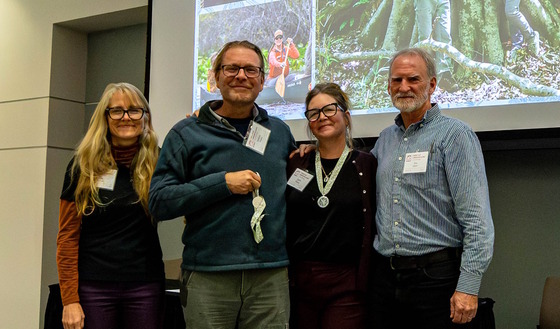 DNR's Lisa Kruse (l-r), honorees Nathan and Joyce Klaus, and Georgia Power's Jim Ozier (Brian Romm/GaDNR)
Names in the news: The Georgia Plant Conservation Alliance honored the husband-and-wife duo of senior Wildlife Conservation Section biologist Nathan Klaus and private conservation biologist Dr. Joyce Klaus with the Tom Patrick Medal at the group’s annual symposium. Named for the late DNR botanist (“Plant champ," June 2019), the award recognized the Klauses’ lifelong commitment to conservation and their contributions to plant conservation and Georgia's botanical community. Red Oaks Plantation is this year's DNR Wildlife Steward of the Year. With nearly 5,000 acres of longleaf pines along the Flint River in Worth County, Red Oaks balances traditional sporting heritage with ecological restoration, hosting trainings, providing youth hunts, conducting prescribed burns and managing longleaf woodlands. The DNR State Parks and Historic Sites Division named Royce Johnson of Jack Hill State Park in Reidsville its Henry Struble Manager of the Year recipient, with Mike Teel (Providence Canyon) and Luke Daniels (Cloudland Canyon) earning the Above and Beyond and Customer Service awards, respectively.
WHAT YOU MISSED ...
In the previous Georgia Wild:
- Pine Log WMA returns
- Wild sandhill beetles
- Big on black walnuts
- Marking Moody's 25th
- Odd eagle is actually OK
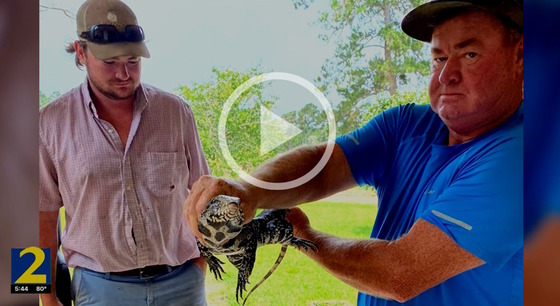 Tattnall County residents with an invasive tegu (WSB-TV)
"Tegu takeover: More giant, exotic lizards spotted in Ga.," WSB-TV (ch. 2, Atlanta). Related: Southern Living.
"Endangered mussel bounces back in Apalachicola River," WFSU-TV (ch. 11, Tallahassee, Fla.)
Bear mouths a trail cam, DNR
(audio) "Inside Look at One of the Last Stands of American Ocelots," Our Wild Lives podcast (The Wildlife Society)
Tracking a radio-tagged eastern red bat over 1,000 miles, Pokagon Band of Potawatomi Indians and Indiana DNR
(audio) "Chesapeake Logperch!" Fish of the Week podcast, U.S. Fish and Wildlife Service
"Peek inside Georgia's record-setting sea turtle nesting season," The Current
"State leads U.S. in permanent forest loss," Savannah Morning News (study in Geography)
"Wind turbines killed 19 million bats in the U.S.," New Scientist (study in Proceedings of the National Academy of Sciences)
"How gutting Endangered Species Act could hurt three iconic Georgia species," WABE-FM (90.1, Atlanta). Related: Public News Service.
"Meet the critically endangered whale that refuses to die," New York Post. Related: "Entangled right whale seen in Gulf of St. Lawrence," Canadian Broadcasting Corp.
"Underwater data centers may be coming in middle of right whale habitat," Scientific American
"DNR accepting wildlife viewing grant proposals," WNEG-FM (93.1, Toccoa) and others
"Brantley encircled with conservation hubs, corridors," The Brantley Beacon
"Fashion show takes over woods at Constitution Lakes Park," Decaturish
"Increasing woody vegetation may boost quail populations," UGA (study in Oecologia)
"DNR encouraging public to be Bearwise," Grice Connect
"Burmese pythons and tegus may be spreading seeds across Everglades," Nature World News (study in Journal of Zoology)
"One of Georgia's largest state parks is a woodland river paradise," Islands
"A whale biologist weighs in on Whalefall," Slate
"Applicants sought for Conservation Teacher of Year grant," Henry Herald (McDonough) and others
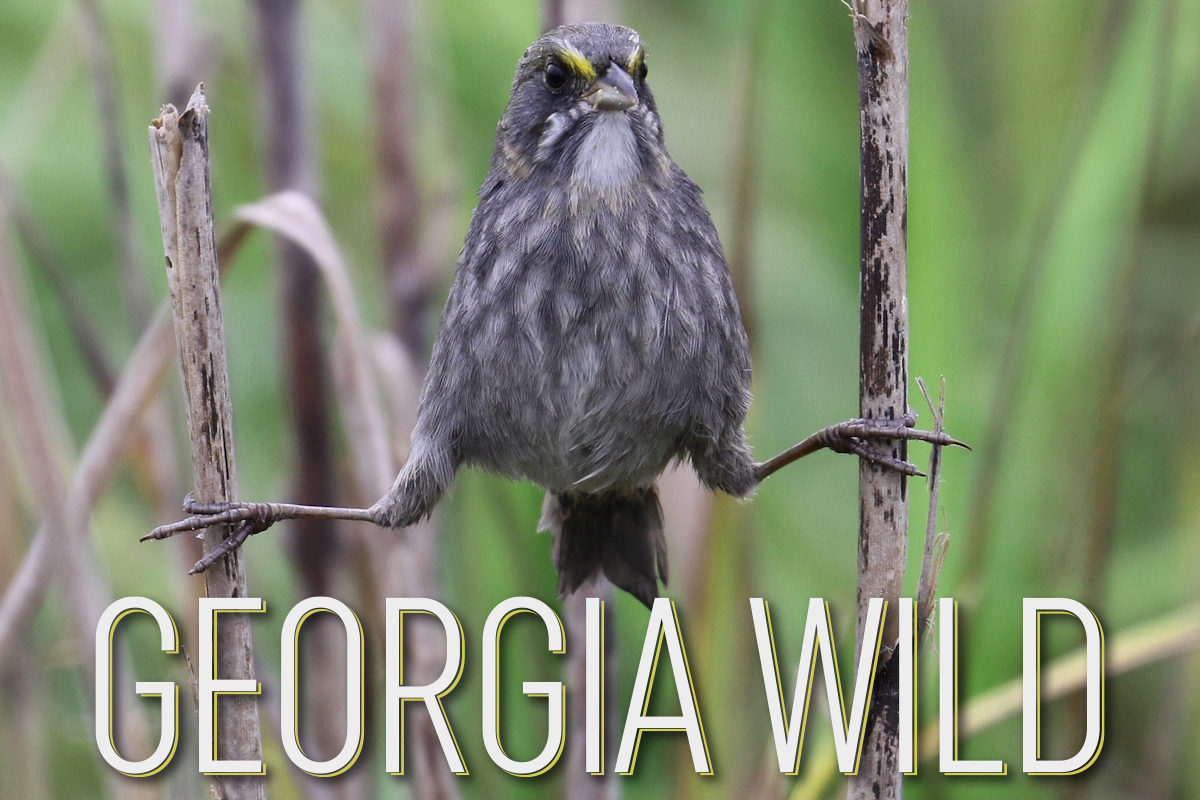
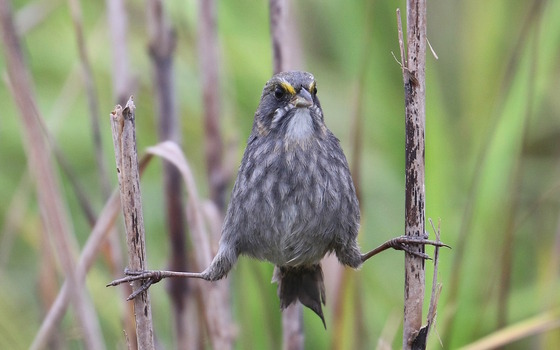 A seaside sparrow straddles stems of smooth cordgrass at a high-tide roost (Tim Keyes/GaDNR)
With rising sea levels and more frequent storms threatening marsh sparrows that winter on the Georgia coast, DNR’s Wildlife Conservation Section is documenting the distribution and populations of these species to better conserve them. Last month, coastal biologists began surveying more than 600 potential high-tide roost sites for seaside, Nelson’s and saltmarsh sparrows. Each is a State Wildlife Action Plan species of greatest conservation. The goal this winter is to assess a range of roost habitats and band sparrows to determine species numbers and mixes. Findings will help define key areas and roost features important to the birds. Project partners include the Atlantic Coast Joint Venture, U.S. Fish and Wildlife Service and U.S. Geological Survey.
Top
|