IN THIS ISSUE
- How to free a manatee
- Wait! Spinies are still here
- The bird heard more than seen
- Readers, unite (for a survey)
- Follow the yellow warbler
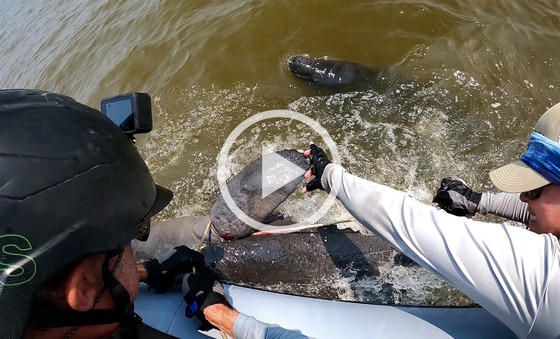 DNR staff work to disentangle an adult manatee, with a calf close by. (photo: GaDNR; video: FWC/USFWS)
DNR’s first documented case of an entangled manatee in Georgia ended well, thanks to the charter captain who reported the animal, the teamwork of trained experts who rallied to respond and the skills and experience represented in that group.
The adult manatee was freed from a snarl of crab trap lines, pot and buoy in a two-day drama last month in the murky tidewaters along St. Simons Island.
For the full story, check this Wildlife Resources Division blog post. Also watch Fox 5's interview with Marine Mammal Program Manager Jessica Thompson.
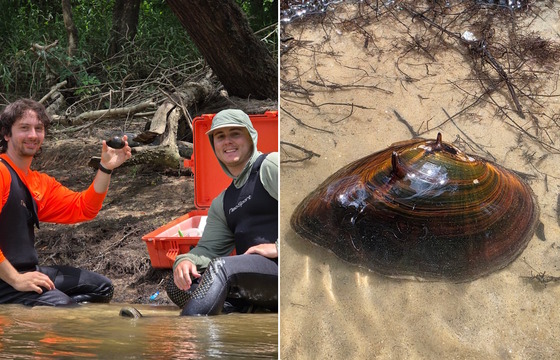 DNR's Zach Schumber and Percy Knight with the first Altamaha spinymussel seen since 2011 (GaDNR)
When Zach Schumber decided to dig his fingers a little deeper into the Ocmulgee River bottom last month, the DNR aquatics biologist didn’t know he’d touch history.
But Schumber dug, felt a large mussel, pulled it loose and nearly spit out his snorkel.
In his hand was a live Altamaha spinymussel, the first one seen in 15 years.
Schumber said he "immediately popped out of the water" to show the survey crew. “Everyone was like, Whoa!”
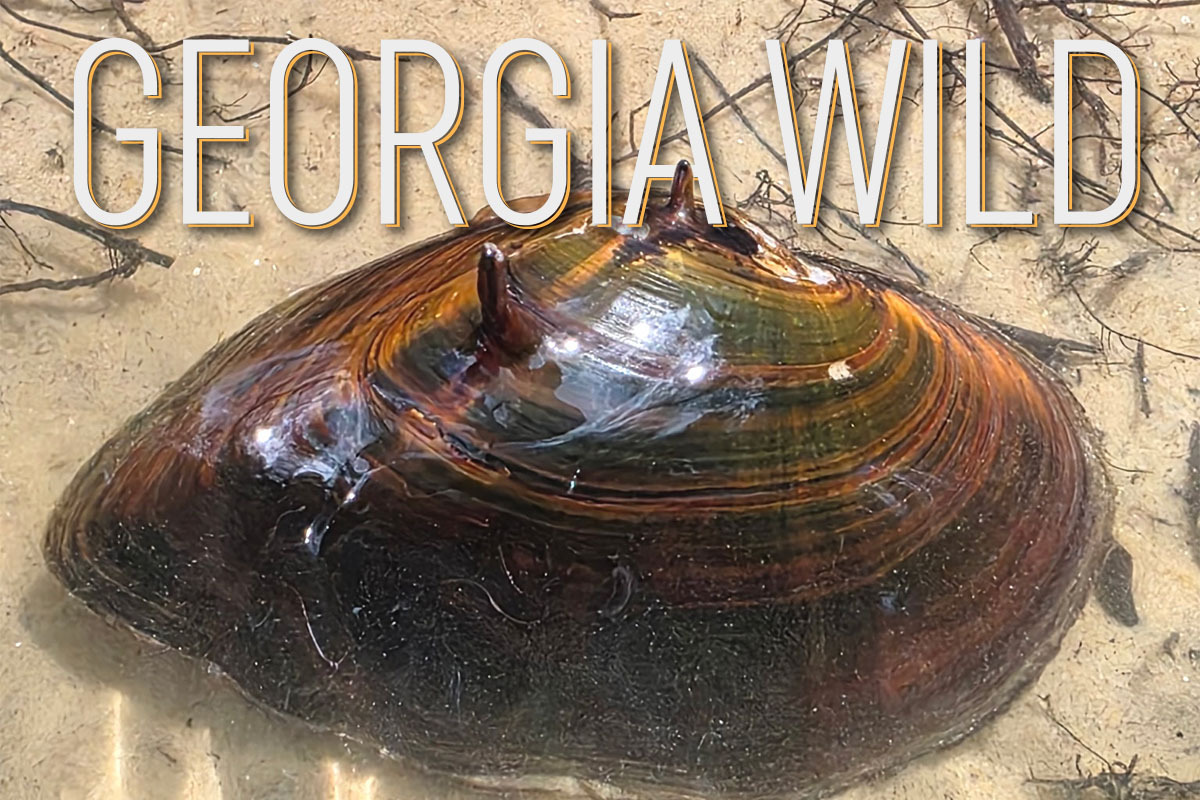
The palm-sized, coffee-colored mussel with four small spikes protruding from its shell was not only one of the continent’s most notable mollusks, it was one many scientists thought was gone.
Matt Rowe leads the DNR Wildlife Conservation Section’s Freshwater Biodiversity Program. “Me and pretty much everybody I talked with was about ready to call them extinct,” Rowe said, chuckling.
MYSTERY MOLLUSK
The Altamaha spinymussel (Elliptio spinosa), named for the short spikes or “spines” that protrude from its shell – spinosa means spiny or prickly – is known only from Georgia’s Altamaha River basin and has been in decline since the late 1970s. Why it's fading is a mystery, Rowe said. But so is most everything about spinies, including which fish they use to spread their young and why they have spikes in the first place.
What is known?
That the last live Altamaha spiny documented before this was found on the Altamaha near Jesup in 2011, the year the species was federally listed.
That even the shells of dead ones, which littered Altamaha sandbars near Jesup in the 1970s and still fill drawers at the Georgia Museum of Natural History, are hard to find in the wild now.
That this species is considered extirpated – locally extinct – in the Oconee and Ohoopee rivers.
ONE MAY LEAD TO MORE
Schumber and technicians Percy Knight, Rachael Byrne and Gina Mondibrown weren’t looking for spinies on July 7. They were surveying the Ocmulgee below Jacksonville in Telfair County as part of an almost 10-year-old agreement with Georgia Power and the U.S. Fish and Wildlife Service to conserve five other mollusk species. (They found two of one of them – Altamaha arcmussel.)
Yet the Ocmulgee from there south to the confluence with the Oconee that forms the Altamaha is considered some of the more promising habitat for spinymussels.
The crew had sampled one site, spotted another where the habitat looked different and thought, why not? Once out of the boat, the packed sand-and-gravel river bottom piqued their interest. Within 10 minutes, they were tagging a species none of them had ever seen.
Rowe said the discovery doesn’t mean Altamaha spinymussels aren’t “functionally” extinct. But it raises hopes that others can be collected and used to learn how to propagate the species and bolster populations.
For Schumber, finding a spiny only months into his job as biologist for Georgia's Atlantic slope waterways sets the bar high. “It’s going to be hard to top that,” he said.
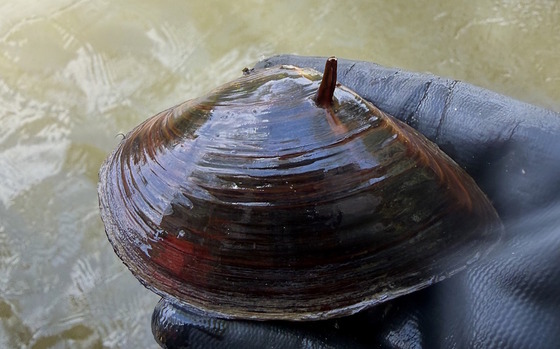 Spinies, like the latest, once populated the Altamaha and lower Ocmulgee, Oconee and Ohoopee rivers. (GaDNR)
MEET SPINOSA
-
Profile: Large mussels usually sporting one to five spikes or “spines,” each no longer than an inch. Spinies seem to be limited to swift-flowing water.
-
Range: First described in the Altamaha River near Darien in 1836, spinies were once found across the Altamaha and into the lower Ocmulgee, Oconee and Ohoopee rivers. They are now extirpated in the Oconee and Ohoopee.
-
Roles: Like other mussels, spinies are filter feeders that improve water clarity (siphoning out pollutants and sediment), help stabilize riverbeds and serve as food for other animals. Their sensitivity to contaminants makes them keen indicators of stream health.
-
Kind not kin: North America’s two other spinies, the Tar River and James spinymussel, are found in North Carolina, Virginia and West Virginia. They are also endangered, but neither is closely related to Altamaha spinies.
-
Reasons: Why spines? DNR's Matt Rowe lists three theories: Spines help 1) young mussels avoid being swallowed, 2) young and old anchor in substrate and 3) boost the mussel's metal persona. “They’re rad,” Rowe adds.
-
Process: The spinymussel found was tagged, measured, checked to see if it was gravid (it wasn't), returned to the river and the location marked.
-
Next steps: More surveys and work on a spinymussel recovery plan.
-
Dig deeper: “To save a mussel, find its fish,” UGA Research (spring 2009)
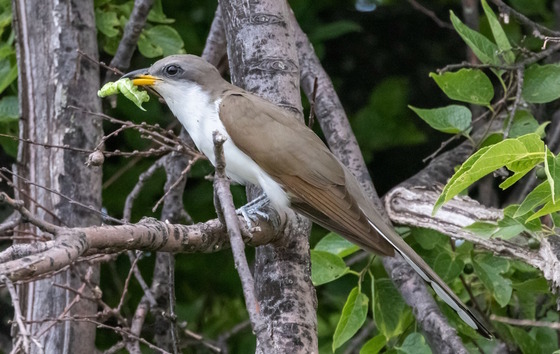 A yellow-billed cuckoo with one of its favored foods (Adobe Stock)
By TERRY W. JOHNSON
The yellow-billed cuckoo is one of Georgia’s most secretive birds. Although it lives here from April into early November, Georgians can go an entire year or more without seeing one.
In fact, this bird is far more often heard than seen.
Many have probably heard the yellow-billed cuckoo's call (listen). Although unusual, it’s one of the sounds of summer in this part of the world.
Yet most folks cannot identify the bird behind the call. …
Read Terry’s column about this elusive bird with a taste for prickly caterpillars.
Terry W. Johnson is a retired DNR program manager and a wildlife biologist. Check out past columns and his blog. Permission is required to reprint a column.
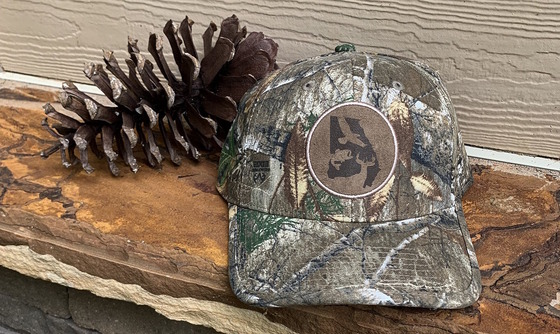 Take the Georgia Wild survey and put your name in the hat for a cap. (GaDNR)
Cicadas are droning. Afternoons are so hot and humid it's almost hard to breathe. ... Yep, that means it's time for the Georgia Wild's annual reader survey.
Taking part is easy. Click the button below. Answer a few questions (the survey takes about 7 minutes). Then, if you like, add your email to a drawing for a DNR cap.
But winning a hat is a bonus. Your feedback helps us improve Georgia Wild, resulting in more of the wildlife news you enjoy hitting your inbox each month.
FYI: The survey closes Aug. 20. We'll email all cap winners by Aug. 26.
Like Georgia Wild? Share it with others! Here's where they can subscribe.
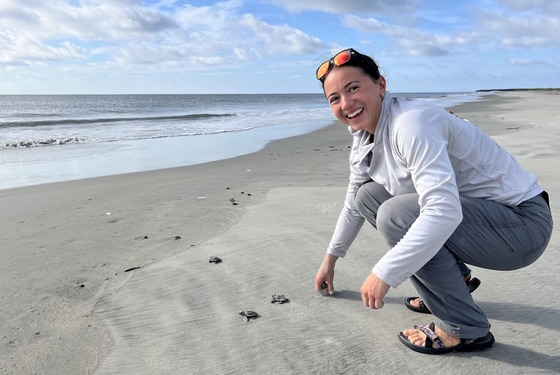 DNR's Jennie Hudson watches hatchlings head to the surf on Little St. Simons Island. (Mark Dodd/GaDNR)
They did it! Loggerhead sea turtles set a Georgia nesting record late last month. And it wasn’t close, with the big, federally threatened turtles topping 4,080 nests July 29 – the previous high was 4,071 in 2022 – and since reaching over 4,130. But as nesting season slows to a crawl, older nests are boiling: The Georgia Sea Turtle Cooperative estimates that more than 100,000 hatchlings have emerged so far.
Hear that buzz? That’s the sound of excitement growing about the 2026 Great Southeast Pollinator Census, set for Aug. 21-22 and easy for families, groups and individuals to help count and conserve pollinators.
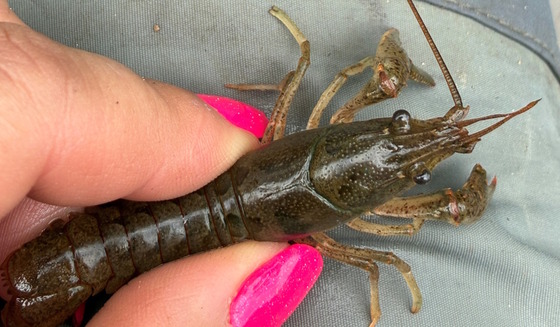 The virile crayfish, an invasive species, discovered in Georgia (Tiffany Penland/GaDNR)
DNR recently found a virile crayfish, an invasives species, in a Lake Lanier tributary. Though there was an unconfirmed sighting in 2015, Georgia’s first documented Faxonius virilis will trigger work to gauge the abundance and spread of the midwestern species. Invasive crayfish can disrupt ecosystems and threaten native wildlife, with virile crayfish introductions tied to declines in aquatic plants, fish and macroinvertebrates. Report sightings, with photographs, to tiffany.penland@dnr.ga.gov.
Although fall is the prime time to spot Joro spiders, this year’s crop of the arachnid interlopers native to Asia is becoming more visible as the spiders and their golden-threaded webs grow. To help document the spread of Joros, report sightings via jorowatch.org or EDDMapS, and join the annual watch contest Oct. 12-18.
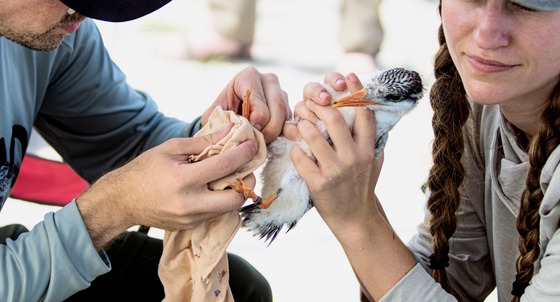 Banding a royal tern chick on Bird Island (Jonah Miller/GaDNR)
After the banding of nearly 800 royal tern chicks at Brunswick Bird Island in July, DNR biologists are documenting banded young that return to the colony as well as previously banded adults – thousands of terns have been banded in recent years – at colonies and roosts along the coast. The data helps determine colony productivity, survival rates and fidelity to breeding sites. Report banded birds.
Despite drought and wildfires that led to burn bans this spring, DNR’s Wildlife Resources Division still applied prescribed fire to more than 68,000 acres in the fiscal year that ended June 30. That focus on this most effective tool for managing habitats for fire-adapted wildlife included high tech, with thousand of acres ignited using drones, and growing-season burns by Interagency Burn Team partners.
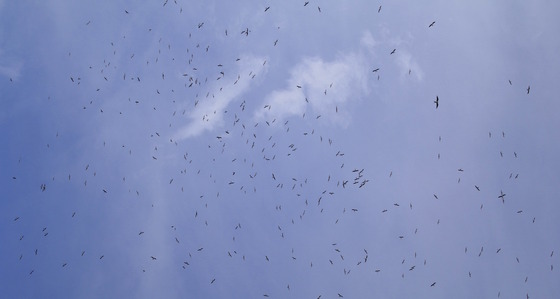 Swallow-tailed kites swirl over a roost on private land in south Georgia (Andy Day/GaDNR)
Quick hits:
Names in the news: Former DNR Commissioner J. Leonard Ledbetter died July 27. Ledbetter began his career with the state of Georgia in June 1965, later serving as Environmental Protection Division director from 1975 to 1990 and DNR commissioner from 1984 to 1990. Current Commissioner Walter Rabon wrote that Ledbetter’s “many years of dedicated leadership left a lasting impact on Georgia’s natural resources and environmental stewardship.”
WHAT YOU MISSED ...
In the previous Georgia Wild:
- Bald eagles still soaring
- Loggerheads are surging
- Purple coneflower power
- Wasp: It's what's for dinner
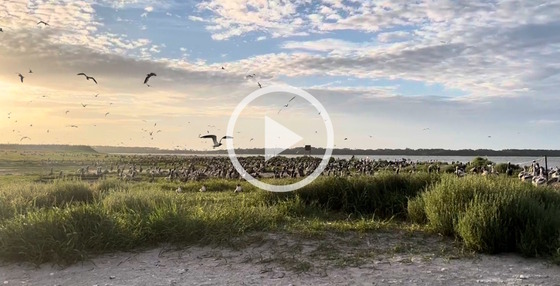 Morning at Bird Island before banding royal tern chicks, DNR
"Invasive Argentine tegu population grows in Georgia," WMAZ-TV (ch. 13, Macon)
(audio) "A new plan to preserve Georgia’s marshes: Give them space to migrate," WABE-FM (90.1, Atlanta)
"Think you know Georgia's nope ropes?" DNR
"Orcas headbutts a sunfish so hard it explodes" (and why), Live Science
"Sea turtles nesting in record numbers, still face challenges," The Brunswick News
"Volunteer loggerhead deep in marsh, setting off rescue," Yahoo!news
(+video) "Hancock seeks answers after snake reports," WJBF-TV (ch. 6, Augusta)
"Manatee swims free after being tangled in crab trap lines," WSAV-TV (ch. 3, Savannah) and others, including WALB-TV (ch. 10, Albany), WJAX/WFOX-TV (chs. 47 and 30, Jacksonville, Fla.) and WAGA-TV (ch. 5, Atlanta)
"$2.9M coming for Ga. longleaf pine restoration," The (Macon) Telegraph
"Conserving a 100,000-acre corridor in Ga., Ala.," The Nature Conservancy
"Okefenokee added to UNESCO World Heritage List," The Associated Press and others. Related: "Inside a deal that saved the Okefenokee," (Inside Climate News).
"DNR: another banner nesting year for bald eagles," The Georgia Virtue and others, including The Current
"Endangered species rule change could leave Ga.’s wild places unprotected," Georgia Recorder and others. Related: "Revisions could affect southwest Georgia," (The Albany Herald).
"Extensive habitat loss projected for rare dragonfly" (found in Fla., Ga.), The Wildlife Society
"Right whales could wait almost decade for new protections," The Associated Press. Related: "House committee advances bill to extend regulatory pause," (National Fisherman).
"Terrapin population study in coastal Ga. to assess decline," The Current
"Fla.’s invasive lizards meet their match: AI," Sun Sentinel, Ft. Lauderdale, Fla.
"Hellbender dads ditch nests when water quality stinks," The Wildlife Society (study in Journal of Zoology)
"Python Challenge winner: 96 snakes, $10k prize," Naples (Fla.) Daily News
"Discover birding in Ga., one walk at a time," The Atlanta Journal-Constitution
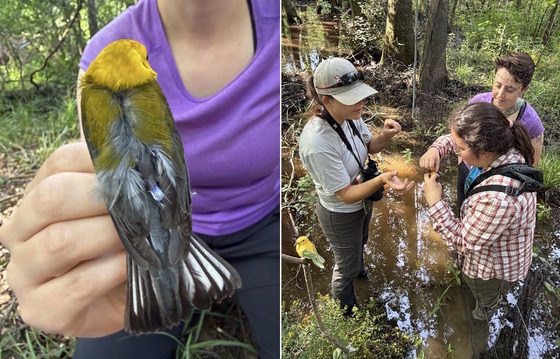 GCSU and DNR researchers fit geolocators on mist-netted prothonotaries (Joe Burnham/GaDNR)
DNR’s Wildlife Conservation Section has been banding and monitoring prothonotary warblers in south Georgia since 2018. But this year staff also banded with Georgia College and State University’s Dr. Michelle Moyer and graduate student Sarah Kennedy to catch and fit the bright yellow birds with small geolocators in south and central Georgia. The goal: Learn more about the warblers' migration to and from their winter homes mostly in South American mangrove swamps. Insights such as routes and timing can help focus conservation efforts.
Prothonotaries, a State Wildlife Action Plan species of greatest conservation need, have been declining for decades, mostly due to habitat loss and changes to the wetlands they depend on. Banding provides data on productivity, survival and site fidelity. But the small, ultralight trackers strapped to 22 prothonotaries at Alapaha River Wildlife Management Area and middle Georgia sites this spring feature barometric sensors that record altitude, flight time and other data – all helpful in mapping locations and movement patterns.
The trick is that the warblers must be caught again to retrieve the locators and download the data. But given that prothonotaries often return to the same place to nest, odds are high for recovering some tags next year. For example, at Alapaha River this spring, staff spotted five birds banded in previous years.
– Joe Burnam, DNR senior wildlife biologist
Top
|