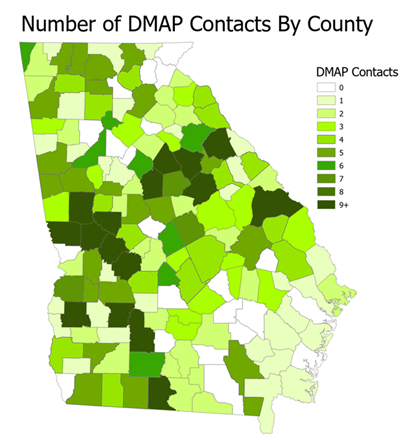
 The Deer Management Assistance Program (DMAP) continues to grow. DMAP Biologists have provided technical assistance to over 587 customers, covering 672,963 acres. Enrollment in the fee-based program has increased to 205 contracts representing 326,339 total contracted acres. The map above shows the number of DMAP contacts per county.
-
Deer Steward Certification Program by the National Deer Association (NDA) is an excellent course for anyone wanting to learn more about managing for deer populations and habitats.
Many hunters and landowners invest significant resources in deer management but often overlook the crucial steps of collecting population and harvest data. This data is essential for making informed decisions about managing deer populations and is a required component of biologically justifying harvest flexibility. Successful deer managers use and study these data trends to make decisions for your property.
Observation surveys are widely accepted and have been used to estimate doe-to-buck ratio, fawn-to-adult doe ratio, and age structure of the buck population. Like camera surveys, observation data cannot determine exact deer densities but rather depict population trends over time.
Collecting observation data in the hunting stand is easy and cost-effective compared to traditional camera survey methods requiring many trail cameras and/or bait. All that is needed are a pencil, data sheet, and binoculars. The process involves recording the number and sex of deer seen, total hunting hours, date, and location. The results will be more meaningful if you have full participation with recording this data. To encourage participation from hunting club members or cooperatives, anonymity can be maintained by keeping the location or hunter's identity confidential until after the season. A drop box can be used to drop off data collection logs or during a predefined observation period. Observation data collected from the first day of archery season until the first day of primitive weapons tends to be most informative.
 The sex ratio is an indicator of the herd dynamics and deer management success. This can be determined by comparing the number of does seen to the number of bucks seen. The buck to doe ratio is a point of emphasis in deer management and we make harvest recommendations to adjust it to maintain a near equal balance. Observational data can sometimes be biased towards younger bucks and adult does since mature bucks tend to be more nocturnal and elusive. Observation data combined with other population surveys can provide a clearer and more representative picture of the site-specific dynamics.
Fawn recruitment is a very important piece of data and is the average number of fawns per adult doe. Recruitment rates are used to prescribe biologically appropriate harvest goals. Recruitment rates can also indicate overall health of breeding age individuals in a population and if predation is having a population level impact on the property. The fawn-to-doe ratio is impacted as nutrition declines or predators increase.
If a deer's sex can't be positively identified, record it as unknown. Guessing can lead to inaccurate results and it is better to have fewer known deer than to introduce uncertainty through misidentification. At the end of the season, DMAP Biologists can calculate sighting rates such as does seen per hour or bucks seen per hour. This information helps to track trends and determine appropriate harvest recommendations to meet the goals of the property. When paired with a drone-based density estimate, hunter observation data may fulfill the demographic monitoring requirements of Georgia’s DMAP. Contact your DMAP biologist, prior to making changes to population surveys to ensure the techniques meet the requirements.
When selecting plants for your food plots, one option to consider is clover. Although various types are readily available at farm and seed stores, we focus on choosing the most suitable variety for each specific plot or situation.
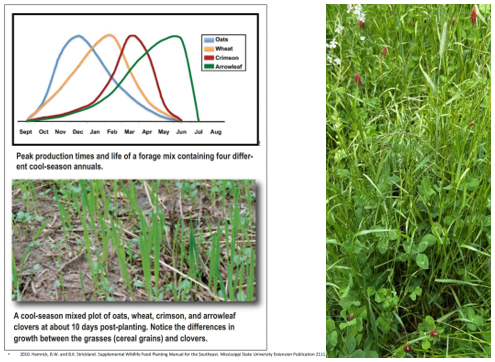
Clover belongs to the Fabaceae family, which means it fixes nitrogen through its roots to improve soil health. Deer favor the young leaves, which contain 12-23% crude protein. The leaves are usually trifoliate, with three leaflets, though their appearance can vary. Clovers can be annual, biennial, or perennial, and many are good reseeders, allowing some annuals to persist for multiple years. While planting a monoculture of a single clover type can be effective as a food plot, mixing two or more varieties and adding a cereal grain can help reduce browse pressure as the clover establishes. When planning, consider the maturation timing of each variety to maximize the period of available food. The benefit for planting a clover mix creates a long window of browse-resistant, readily available food during the cool season with some lasting well into the summer.
Before establishing or planting food plots, it is best to conduct soil tests on each plot and apply lime and fertilizer based on the results. If the plot is overrun with weeds, herbicide the area with glyphosate (1-2 quarts per acre) two weeks before planting. When planting true clover, you need to inoculate the seed beforehand if it isn't already pre-inoculated. Plant the clover at the proper depth, typically between 0.125 and 0.25 inches. Alternatively, you can broadcast the clover and then cultipack to insure a good seed to soil contact. Be sure to check the forecast, you will want to plant before consistent rainfall from mid-September to mid-October depending on the weather.
A few popular varieties:
- Alsike clover is a perennial that has adapted to a cool climate and can handle wet bottomlands.
- Arrowleaf clover is a very common annual that prefers well-drained sandy soils or light clay and acts as a good reseeder.
- Berseem clover is an annual that is not cold-tolerant, but it can tolerate poor drainage, poor reseeding, and is shade-intolerant.
- Crimson clover, an annual, is one of the most common types of clovers available because its adaptable to well-drained sandy loams to heavy clay and is an excellent reseeder.
- Red clover is a drought-tolerant biennial that can adapt to various soils.
- White clover, including Ladino clover, is a perennial that performs well in sandy loam to clay soils.
(Top Left) Peak production times and life of a forage mix containing four different cool-season annual species. (Bottom Left) Photo of a cool-season mix. (Right) Photo of a clover mixture plot (Photo Credits: Ben Peterson, DMAP Biologist)

For years, deer managers and biologists have leaned on a simple assumption: better soils produce better deer. Fertile ground, it was thought, meant more nutritious deer forage, which in turn meant heavier body weights, higher reproductive success, and bigger antlers. But two new studies, led by teams of researchers from several southeastern universities, challenge that assumption and shed new light on what really drives deer nutrition across the eastern United States.
Turner, Harper, Lashley, Wilber, & Gulsby (2025). Plant nutrient concentrations inform white-tailed deer diet limitations. Journal of Environmental Management. — Examined which nutrients limit deer from reaching optimal weight and reproduction.
Average body weight of deer varies greatly across the eastern United States, (75-pound bucks in the Florida Keys, 143-pound bucks along the southern Gulf Coast, and 243-pound bucks in north-central states) because of an individual’s need to either conserve or dissipate body heat. However, within local areas, deer reach their largest size and highest reproductive success when nutritious plants are abundant, allowing them to select the best plants and plant parts. The above research focused on seasons when deer nutrition is most critical—late spring and summer. This is when does are nursing fawns, young deer are putting on body weight, and bucks are growing antlers. By sampling younger and older parts of 131 plant species, commonly eaten by deer in 25 states, researchers found that protein and phosphorus were the two most limiting nutrients. Phosphorus was the least available. Forbs—those broad-leaved plants like ragweed, pokeweed, and clover—consistently outperformed semi-woody vines and woody shrubs and trees. Younger plant parts had the highest nutrient concentrations, while older leaves and stems dropped off in quality. The lesson was clear: deer rely heavily on a diversity of forb species and tender new growth of these plants gets them through their most nutritionally demanding months.
Harper, Strickland, Lashley, Street, Nanney, Chitwood, & Moorman (2025). Soil quality does not predict plant nutrition available to white-tailed deer. Journal of Wildlife Management. — Examined the effect of soil mineral content on plant nutrients.
If fertile ground really was the key, then soil productivity should predict the nutritional quality of deer forage. To test this, researchers sampled 40 common deer food plants across 16 states, linking each plant’s nutrient profile with the soil it grew from. What they discovered was surprising. Soil fertility turned out to be a poor predictor of forage quality. Whether plants grew in nutrient-rich loam or sandy, mineral-poor soils, their nutrient concentrations were strikingly similar. Once again, forbs rose to the top, with young leaves providing the highest levels of protein and phosphorus.
That doesn’t mean soil doesn’t matter. Poor soils may still produce nutritious plants, but fewer of them. When overall forage production is low, fewer deer can be supported in good health — making proactive population management essential. In agricultural landscapes, where soybeans and alfalfa are common and deer densities tend to be lower, body weights often run higher. By contrast, in forested landscapes on poor soils, the same number of deer can quickly overwhelm the available food supply.
Taken together, the two studies rewrite some long-standing assumptions about deer nutrition. It’s not just about the dirt. It’s about the plants that grow from it—and the number of deer competing for them. For managers, the take-home message is both simple and empowering: focus on promoting diverse, forb-rich plant communities and maintain deer densities in balance with the forage base. Even on poor soils, this combination can support healthy herds, productive does, and quality bucks.
In short, the key to better deer management may not lie beneath the soil at all, but in the green leaves above it—and in the choices managers make about promoting a diversity of forbs and properly managing deer numbers.
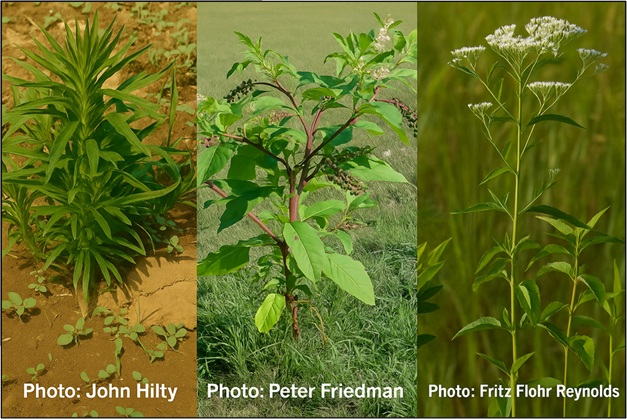 Although native forbs growing in early successional habitats may have high nutrient concentrations, that does not always mean they rank high in a deer’s diet. For example, horseweed (left) and late boneset (right) are low-preference deer forage plants but they provide valuable cover for deer fawns and turkey poults. Pokeweed (center) is a high-preference forage, and it also provides good cover. Deer food plots of cultivated forbs like alfalfa or clover provide nutritious and preferred forage, which may increase the number of healthy deer that a property can support. However, food plots are only a bonus and should not be considered as a replacement for a variety of native forbs.
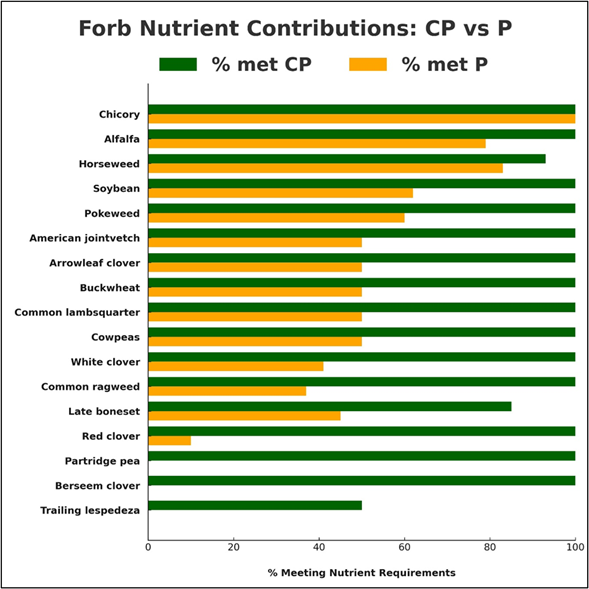 The above graph was compiled from data published in the 25-state deer forage study. Some are common food plot forbs and others are common native forbs. All were collected during late May-early August and ranked by the number of collection sites that provided at least 14% crude protein and 0.3% phosphorus. To maximize deer nutrition, and cover for fawns and turkeys, provide a diversity of forbs and let the deer and turkeys decide which ones best serve them through the year.
Stay in Touch
Our emails will keep you up-to-date about important news. We promise we won't overwhelm you with emails; but if you wish, you can unsubscribe here.
Connect with us
Questions? Give us a call at 1-800-366-2661
Visit us at georgiawildlife.com
Headquarters address:
2067 U.S. Highway 278 SE
Social Circle, GA 30025
|