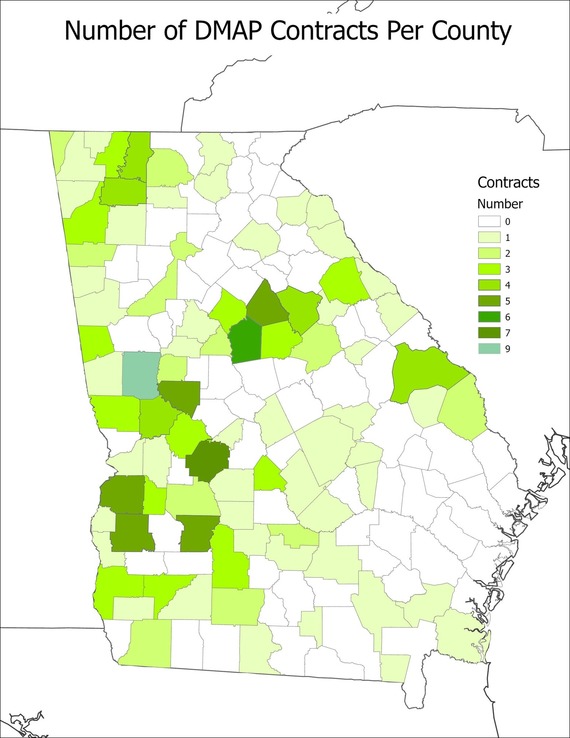
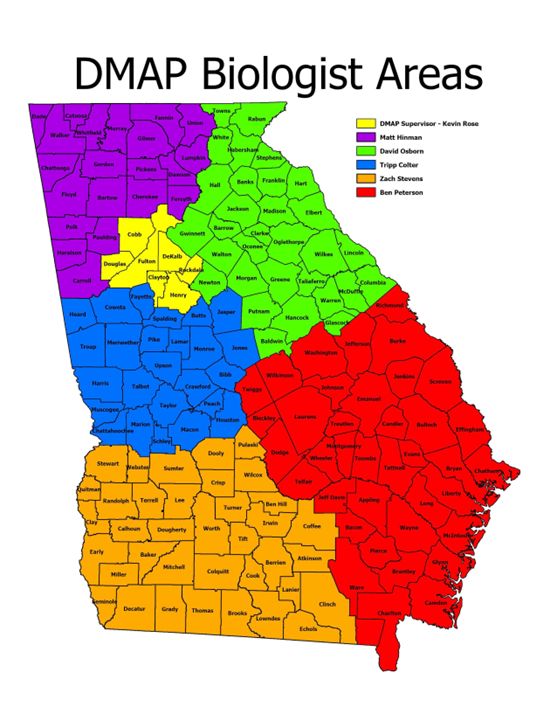
 The Deer Management Assistance Program (DMAP) now has five biologists and one supervising biologist providing technical assistance to over 548 customers covering 629,028 acres. Enrollment in the fee-based program has grown to 175 cooperators representing 301 properties on 283,666 acres. The map above shows the number of DMAP contracts per county.
The Deer Management Assistance Program (DMAP) is now fully staffed since the expansion of the program last year. We are now strategically positioned to better serve our current and future customers. Tripp Colter was hired to fill the West-Central Georgia position, which became vacant when Kevin Rose was promoted to DMAP Supervisor. Ben Peterson was hired to work with landowners in the Southeastern counties. We are beyond excited to have these great additions to our team! More information about Tripp and Ben can be found at Georgia Deer Management Assistance Program (DMAP) | Department Of Natural Resources Division
 |
 |
 |
Although hinge-cutting was discussed in last spring’s newsletter, some new insights have emerged that are worth highlighting. In review, hinge-cutting is a habitat management technique, which can be used to positively affect deer habitat in multiple ways. Trees may be felled using a “face cut” and then simply pushed over without implementing the “back cut” or finishing cut so that they remain attached to the stump. This creates vertical structure by leaving the trunk and lower limbs suspended in the air. Depending on the tree species, hinge-cutting can also encourage stump sprouting or root suckering, providing fresh, leafy browse. Hinge-cutting may be used to feather or soften the edge of a wildlife opening or food plot, or it may be used to convert an otherwise coverless stand of timber into bedding habitat for deer. In both cases, visibility is reduced in the stand and the deer can access the food plot via a transition zone instead of having to step out of the woods from a hard edge. Hinge cutting may also be used to direct the path of deer into a food plot or steer them past a tree stand for hunting purposes.
Dr. Craig Harper and his students at the University of Tennessee recently conducted a study comparing hinge-cut areas with adjacent untreated areas in the same hardwood stands. Their goal for the treated areas was to allow at least 50% of the available sunlight to touch the forest floor and every tree that did not have wildlife or market value was either hinge-cut, felled, or killed with herbicide. Species like hickories, red maple, hackberry, American beech, sweetgum, and less-desirable oaks were hinge cut and allowed to sprout. They also used directional felling to create trails and open areas within their treatment blocks to allow deer to access the stand and have areas for foraging. The 5-acre treatment blocks and control blocks were adjacent to each other.
Students then set up trail cameras in all quadrants of both the treatment and control blocks to monitor deer use. They were looking at average daily camera detections per month before and after the treatment. Trail-camera detections of deer in treatment areas increased 435% in the first month after treatment, 146% in fawning season, and 78% in hunting season. Notably, activity fell in the unmanaged blocks adjacent to the treated blocks by 6% during fawning season and 24% during hunting season. As an added benefit, predator detections fell 41% in the treated areas.
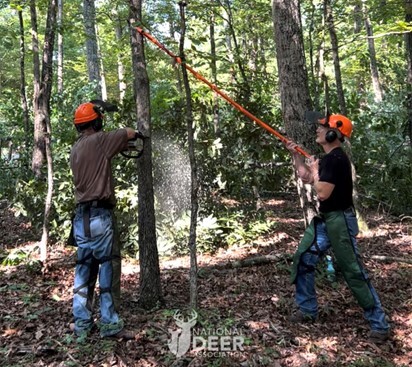 Figure 1. NDA’s Kip Adams (right) uses a push-pole while Dr. Craig Harper makes a hinge cut. Using a push-pole keeps the depth of the cut to a minimum, maximizing the thickness of the hinge – which helps increase tree survival.
In order to conduct this management practice successfully on your property, a working knowledge of native tree species and their wildlife value is needed. For example, in the Piedmont of Georgia, some tree species that would work well as hinge-cut targets are red maple, yellow poplar, water oak, or winged elm, since their young sprouting leaves are favored by deer for browse. Common species that should be killed outright are sweetgum, Chinese privet, or any invasive/exotic species since they will take over and dominate an area especially if given additional sunlight. If these trees are cut, the stumps should be treated with herbicide to prevent sprouting or root suckering. Some overstory and midstory trees that should be allowed to stand are white oak, most red oaks as long as they are not directly competing with white oaks, some hickories, persimmon, dogwood, or black gum. These species have higher wildlife value as standing, fruit or acorn producing trees then they would have as hinge-cut trees or stump sprouts. Land managers should also consider size of their treatment areas. While small treatments could boost forage and cover in a small area for hunting purposes, bedding blocks should be at least 5 acres in size in order to reach the desired effects outlined in the research.
As mentioned in last year’s newsletter, this practice should only be conducted if it can be done safely by someone who is comfortable with operating a chainsaw, felling trees in standing timber, and applying herbicides. Seek out training opportunities to become proficient with these techniques before putting them into practice.
Read more about this research: Do Deer Use Hinge-Cut Bedding Blocks? New Study Results Out
 |
Longleaf pine (Pinus palustris), is considered by many people to be one of the most important trees in the southeast. It gets its name from its uniquely long needles (8-17 inches bundled in fascicles of 3). This tree starts life low to the ground in what we call the “grass” stage where the first 5 years it spends its energy growing its root system instead of growing vertically above ground. Once it does start growing vertically, it can grow upwards of 120+ feet and can live for hundreds of years. Many find longleaf attractive because they are drought, wind, pest, and, most importantly, fire-resistant. It is also preferred for habitat over other pine species because it is slower growing it takes longer to close canopy meaning early successional plants are able to exist much longer providing food and cover for wildlife. Before colonization of the southeastern U.S., its range covered around 92 million acres from southern Virginia to eastern Texas, but it fell to around 3 million in the early 1990s because of overharvest. One of the biggest reasons for the over-harvesting was shipbuilding. Not only for its highly desired lumber, but also for its resin to process it into turpentine, glue, and different rosins, which were very valuable. Unfortunately, longleaf was not planted back and was replaced with loblolly and slash pine because they are much quicker growing.
Longleaf is considered a keystone species, which means it has a disproportionately large impact on its native ecosystem. One of the most important tools for managing longleaf is low-intensity fire. Not only is it fire-tolerant, but it is fire-dependent. Fires remove or limit competition and help expose bare soil for natural regeneration. The thick bark and large root system are to thank for its fire tolerance, even being tolerant and dependent when it is in its young “grass stage”. Highly volatile needles, which are slow to decay, are to be thanked for the continuous low-intensity fire.
This ecosystem, the longleaf pine creates, with natural or man-made fire, is extremely valuable and now rare. It helps create more open areas and sets back succession or vegetation very early in its life stage. With vegetation being set back, you can see an increase of forbs, grasses, and overall, more nutritious or readily available food for our native wildlife. While other pines can be burned Longleaf are able to survive prescribed fire in year one where a common loblolly pine usually doesn't see fire until its around 3-5 inches ground diameter or commonly after first thinning (year 15).
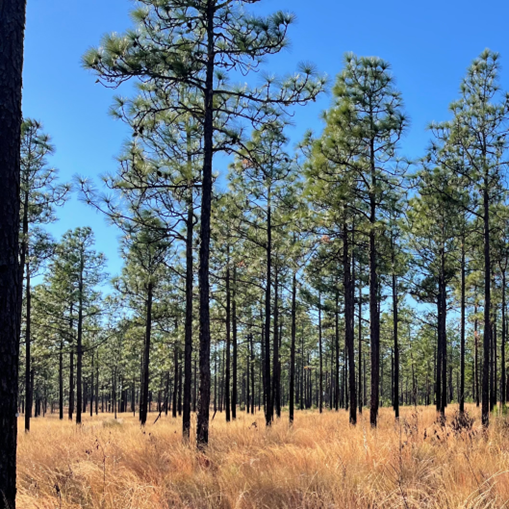
Figure 2. Mature longleaf pine stand with a vegetative understory that is best managed through low-intensity fire on a frequent burn interval.
Deer managers could also see a benefit converting stands from closed canopy loblolly and hardwood to a stand of frequently burned longleaf. In the first 10 years you can expect the frequently burned longleaf stands to provide cover and a variety of early secessional vegetation, many of which are highly preferred by deer and can provide needed nutrients. As the trees get older, they can help deer managers with providing its pine straw which helps the frequent fires set back succession and can prevent too many woody species crowding the canopy. With the slower growth you can expect longleaf to not need a thinning until it is about 30 years old or older depending on spacing.
So, while many of our native wildlife species do not eat any parts of a longleaf pine, a strong majority see a significant benefit of the ecosystem it creates. From deer eating native forbs high in protein and nutrients to many species, including deer, using these native plants as bedding/nesting cover.
 |
|
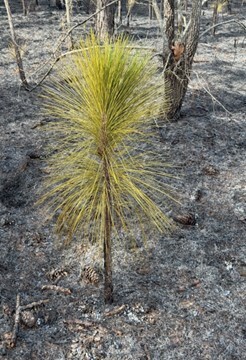
Figure 3. Image of a longleaf pine in the rocket phase after a low-intensity fire. |

Harvest data, which includes body weights and antler sizes, are commonly collected on properties and are valuable tools for assessing wildlife nutritional condition and predicting population responses to habitat management. Nutritional status strongly influences survival, reproductive success, and productivity across various species. However, interpreting these data can be complicated. Male body weights can be affected by breeding season activity and secondary sexual characteristics, like antlers, are an indicator of male nutritional condition.
While antler size is important to many deer managers, using male harvest data, including antler size, to assess population health can be problematic due to potentially skewed samples. Female body weights may be a better indicator of overall herd condition and health since female harvest data are often more numerous than male harvest data. Analysis of female body weight over antler size might provide a more reliable assessment of nutritional condition. The relationship between female body weight and antler size may also vary depending on where you are hunting. This study analyzed data from different locations to investigate the relationship between female body weight and antler size. The study hypothesized that larger female body weight correlates with larger average antler size.
Two datasets were used in this study to see if there is a relationship between female deer body weight and male antler size. The first, encompassing 31 properties across 19 eastern US states, spanned from 2015-2023 had a wide variety of habitat types. The second dataset, from 174 Mississippi hunting clubs and management areas (1991-1994), focused on similar habitat types across the state. The wide range of conditions across the 205 study sites provided detailed information for analysis and management implications.
Researchers collected data on female live weight, carcass weight (or estimated field-dressed weight), and deer age. Average antler scores at maturity for each site were calculated, accounting for age differences in harvests, using measured or estimated Boone and Crockett scores for males aged 3.5, 4.5, and 5.5+ years, and applying correction factors to project antler scores of younger males to maturity. An analysis of antler size in male deer and body weight in female deer across 31 sites in 19 states revealed that a model using only adult female body mass was the best predictor of male antler scores. Importantly, the relationship between female weight and male antler size remained consistent regardless of latitude. An increase of 2.2 lbs. in female body weight was associated with an average increase of 1.73 inches in male antler size. The data from 174 Mississippi sites showed a 2.2 lbs. increase in female mass correlating with 1.85 inches of increased antler size.
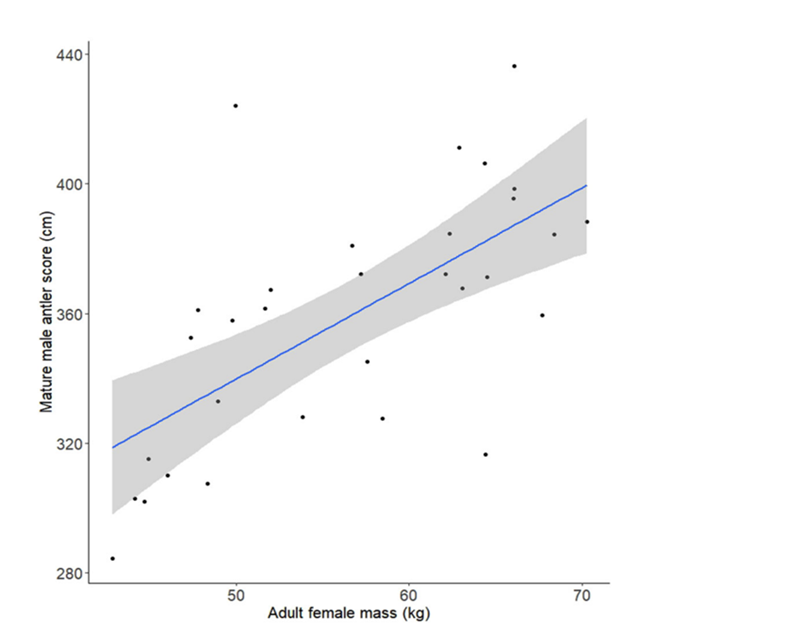 Figure 4. Relationship between property‐specific average mature white‐tailed deer male antler size and adult female body weight collected on 31 sites across 19 states in the eastern United States, 2015–2023. Each point represents a property average and the bands represent a 95% confidence interval.
Results show a consistent relationship across various environmental factors, suggesting that factors affecting both male and female weights and antlers are similar. Using female body weight as a tool for tracking habitat health is preferable to male antler sizes due to potential biases and difficulties in collecting accurate data on male antler size and the inherent trade-offs with female harvest data. This is further supported by the fact that female harvest data is generally more readily available for monitoring purposes compared to male harvest data.
A copy of the original article can be found here: Correlating male white‐tailed deer antler size with female body mass across multiple spatial scales
Stay in Touch
Our emails will keep you up-to-date about important news. We promise we won't overwhelm you with emails; but if you wish, you can unsubscribe here.
Connect with us
Questions? Give us a call at 1-800-366-2661
Visit us at georgiawildlife.com
Headquarters address:
2067 U.S. Highway 278 SE
Social Circle, GA 30025
|