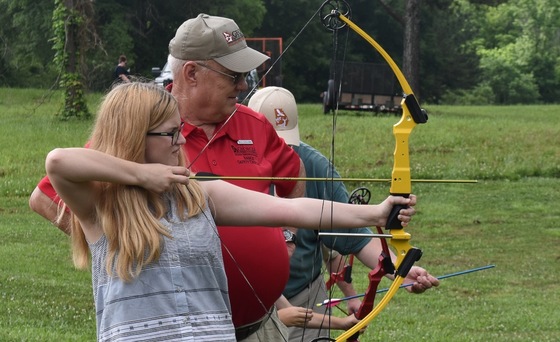
 Fun at the Keeping Georgia Wild festival (DNR)
As we move into the warmer months, WRD is buzzing with activities that promote R3 in the form of community outreach. Our staff is hard at work on a range of youth opportunities including kids fishing events, summer camps and much more.
I want to thank all of you for your efforts toward our WRD mission in these areas. And if you are not already working these events, I strongly encourage you to bring your families to one or more and enjoy some time outdoors.
Here’s a sample of what’s coming up. (Visit gooutdoorsgeorgia.com for the full calendar.)
Kids Fishing Events include:
- April 27 – Troup County Sportsman’s Club (LaGrange) and Tygart Park in Nashville
- May 4 – Southern Pines Pond (Dublin), Williams Family Farm (Lyons) and Rock Creek (Suches)
The Keeping Georgia Wild family festival is May 18 at Charlie Elliott Wildlife Center, Mansfield.
There are Junior Naturalist Day Camps at Charlie Elliott Wildlife Center, including Charlie’s Trackers (ages 7-8) on June 4-7 and Wildlife Rangers (ages 9-10) sessions June 11–14 and June 18–21. There's also a Shooting Sports Camp for ages 14-16 July 8-11. More details on Charlie Elliott camps and registration.
Speaking of family, I would also like to mention some of our WRD youth. Many of you have children who are involved in outdoor programs, including award-winning shotgun clubs and archery competitions. A few next-generation family members making waves in our industry are:
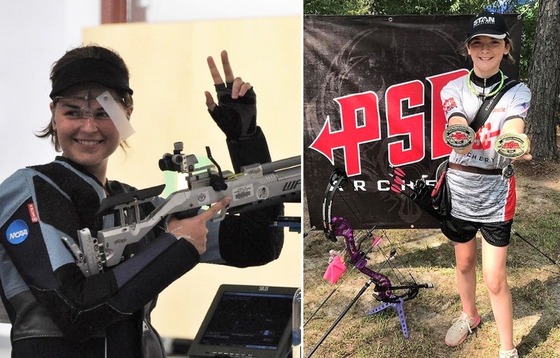
- Rosemary Kramer (left), daughter of WRD's Kevin Kramer and a USA Shooting Team member vying to compete in the 2020 Olympics, set a NCAA record air-rifle score of 599 out of 600 at the NCAA Rifle Championship match on March 9.
- Destrie Vescuso (right), daughter of the agency's John Vescuso, took first place in her division at the 2019 Lancaster Archery Classic.
- Parker and Evan Dowd (left to right below), sons of employee Jamie Dowd, are members of the Lake Oconee Shotgun Team that won the Scholastic Clay Target Program national championship in July, with Evan named the Rookie Division's top shooter in double skeet.
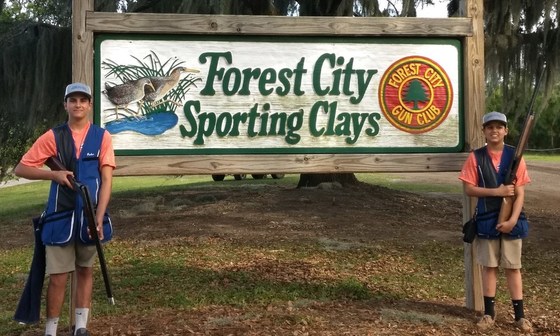 As always, thanks for all you -- and your families -- do to make WRD great!
Top
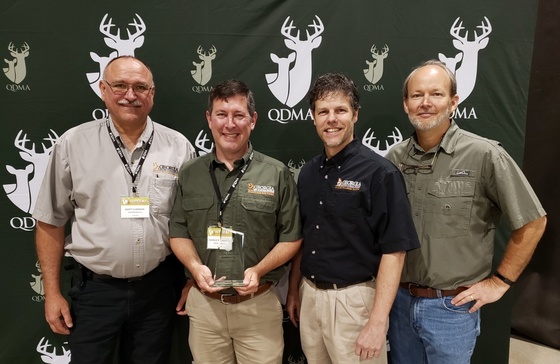 From left, WRD's Rusty Garrison, Charlie Killmaster and John Bowers with Lindsay Thomas Jr. of QDMA
The Quality Deer Management Association has recognized the Wildlife Resources Division as Agency of the Year for its innovative management of white-tailed deer. QDMA is the leading national organization focused on managing whitetails. Some of the WRD accomplishments noted:
National leadership in Hunter Recruitment, Retention and Reactivation efforts. The division was the first agency to develop a state R3 “step-down” plan from the national plan, Learn to Hunt programs and the groundbreaking Field-to-Fork program. All involved creative and successful partnerships with sportsman’s groups and conservation organizations, such as QDMA, the Georgia Wildlife Federation, the National Wild Turkey Federation, Safari Club International and others.
Fifteen-plus years of developing and maintaining a statewide strategic management plan for white-tailed deer and a Chronic Wasting Disease response plan. This has involved inventive approaches to educating non-resident hunters about carcass transport restrictions and pushing regional and national discussions on this important issue.
Setting the bar high in hunter education and resource efforts. WRD highlights include:
- Implementing the Game Check Harvest Reporting system, which uses an online dashboard to provide real-time harvest maps.
- Creating, and hiring additional staff to develop and implement, a statewide Deer Management Assistance Program to help landowners and hunt clubs improve deer and habitat management.
- Developing a bait-free, easy-to-use trail camera survey method in partnership with UGA’s Warnell School of Forestry and Natural Resources.
- Leading efforts to evaluate and determine factors affecting the Appalachian deer decline issue.
Game Management Chief John Bowers said WRD is excited, proud and thankful to be recognized by QDMA for the agency’s deer management – work that is science-based, innovative, customer-oriented and responsive to hunters.
Top
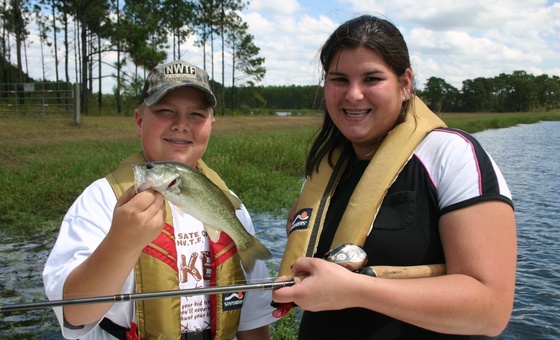 Fisheries Management is partnering with the DNR Parks and Historic Sites Division to promote fishing at state parks in a new program called Gateway to Fishing.
During a recent statewide park rangers conference at Unicoi State Park, the section’s Keith Weaver, Michael Fulghum and Scott Robinson taught more than 100 parks staff members about fishing and fish management, and how to successfully hold Kids Fishing Events and teach fishing to people who are new to angling.
Also as part of the program, Fisheries is increasing management activities and stocking more fish at parks lakes. Everyone wins as WRD helps attract more visitors to state parks and parks staff help provide more fishing opportunities, sell more fishing licenses and hook more people on fishing.
Also see: WRD’s blog post “7 State Parks in Georgia You Have to Fish.”
Top
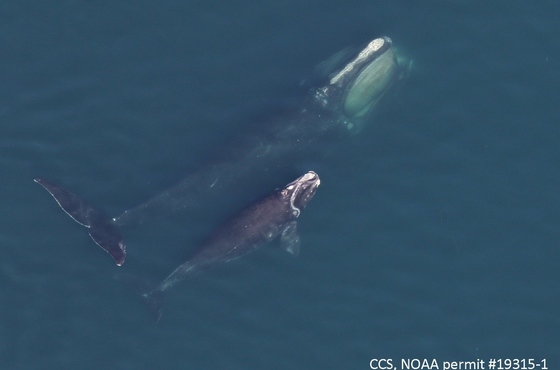 Right whale 1204 with her calf in Cape Cod Bay (Center for Coastal Studies/NOAA permit 19315-1)
The North Atlantic right whales calving season ended last month on a glass half-full/half-empty note.
Did the seven calves seen this winter off the Georgia/northeast Florida coast, the species’ only known calving grounds, signal the start of a comeback for one of Earth’s most imperiled whales?
Or are those seven – fewer than half the number needed to stabilize the population – only a blip in this marine giant’s slide toward extinction?
While it will take a few years to assess this winter’s role in the right whale’s fate, time for this species is running out, said WRD senior wildlife biologist Clay George, who monitors right whales.
“We can’t make more calves, but we can reduce the number of whales dying from human activities. And we need to do that quickly."
The 2018-2019 season obviously topped the previous winter, when no calves were seen, a first in more than 30 years of monitoring. However, 15-20 calves per year are needed for the species to simply break even. The population has shrunk the past five years from estimated 475 whales to about 425.
This season’s calf count will not be final until fall. From spring through summer, scientists will watch feeding grounds in New England and Canada for calves not seen in the Southeast. The three spotted as of mid-April had all been reported in the Southeast. But at least they survived the 1,000-mile migration north.
Another hopeful note: Last year, Canada enacted sweeping shipping and fishing regulations following the death of 12 right whales in the Gulf of St. Lawrence in 2017. No stranded whales have been seen there since. Also, the Atlantic States Marine Fishery Commission has called for changes to lobster regulations to reduce entanglements in U.S. waters.
WHAT’S AT WORK
Why the relatively recent decline in North Atlantic right whales? Scientists point to unprecedented deaths from ship strikes and entanglement in fishing rope, primarily in New England and Canada, and sub-average calving since 2010. They also hypothesize that warming waters in the Gulf of Maine have moved zooplankton food resources north, resulting in leaner females and fewer pregnancies. Longer trips also increase the whales’ exposure to ship traffic and fishing rope.
Another problem is the low number of calving females in the population. Already below 100, the estimated total could fall to 50 by mid-century if conditions don’t improve, according to researchers.
For more: Listen as Clay George describes DNR’s right whale work on GPB.
Top
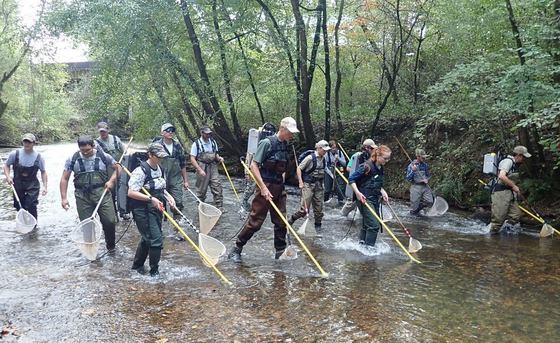 Volunteers help WRD's Stream Team (DNR)
How can someone volunteer with WRD? It’s quick and online, according to Volunteer Coordinator Michael Sellers. Here’s his six-step how-to:
- Go to gooutdoorsgeorgia.com.
- Click "Events and Hunter/Boater Classes & Volunteer."
- Click "Enroll Now.”
- Create an account (add your information and click "Create Customer").
- Click "Events/Volunteering.”
- Create a volunteer application. Once the application is approved, new volunteers can explore volunteer opportunities on the calendar.
Easy peasy. Got questions? Email or call Sellers, (706) 557-3101.
For more: georgiawildlife.com/about/volunteer.
Top
After two and a half weeks, 141 WRD employees have completed the Harassment Prevention Training that fulfills Governor Brian Kemp’s executive order.
That means over the next four weeks, 363 more staff members need to complete the required training by WRD's May 15 deadline.
A word to the wise: Don’t wait. Take the training now.
The six modules are in the DNR Intranet’s Training section. Employees can also reach that site by opening the DNR Intranet, clicking “Human Resources” and then “Training,” and scrolling down to the Sexual Harassment Training Videos section to select the modules.
If you have questions, contact Training Coordinator Lindsey Brown.
Top
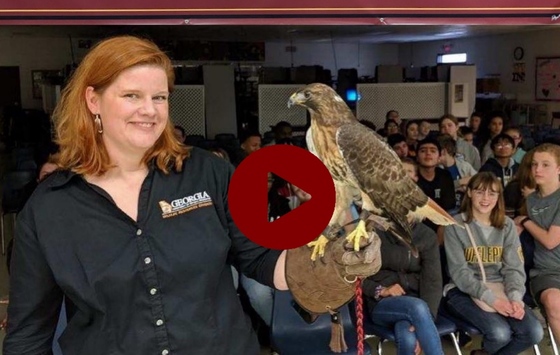 Video submitted by WRD staff and produced by Public Affairs have drawn significant attention in recent weeks. A few examples:
- Nathan Klaus’ video of pines bursting with pollen as he swept past in a helicopter logged nearly 700,000 views on Facebook (plus 5,000 on Instagram) and has been shared on media outlets varying from CNN to USA Today. All of which is nothing to sneeze at. Klaus, a senior wildlife biologist with the Wildlife Conservation Section, took the video during a prescribed burn at West Point WMA.
- A MythBusters-styled look at feral hog control featuring Game Management’s Charlie Killmaster, state deer and feral hog biologist, has fielded more than 14,000 views. (The video also features some nifty free-hand hog sketching by Public Affairs’ Melissa Cummings.)
- A “Women of Georgia Wildlife” video, released as part of Women’s History Month and featuring Linda May in the first installment, received some 4,500 views on Facebook. May is environmental outreach coordinator for Wildlife Conservation.
Stay tuned for more on WRD’s Facebook, Instagram and YouTube pages.
Top
Six wildlife-viewing projects from Pickens County to Jekyll Island have been announced as grant recipients this year by WRD's Wildlife Viewing Grants Program. Learn more about the grants program, including the 2018 projects.
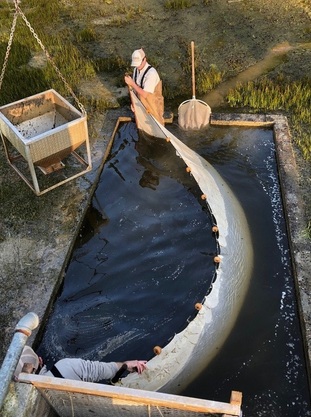
WRD fish hatcheries have stocked more than 500,000 largemouth bass fingerlings and 200,000 black crappie fingerlings in public waters. And that’s just the season’s start for warm-water hatcheries. Once the white bass, walleye, striper and hybrid fingerlings in production ponds are stocked, staff will focus on growing bluegill, redear sunfish, channel cats and lake sturgeon. (What about trout? More than 49,000 are being stocked this week. Check out WRD’s weekly reports.)
It’s a burning question: How does prescribed fire affect nesting by wild turkeys? The take-home, according to this WRD blog post, is that while growing-season burns may destroy a small percentage of nests, benefits to turkey nesting and brood-rearing habitat easily outweigh the loss.
|
Four budding bird artists have been chosen as T-shirt Art Contest winners in WRD’s 14th annual Youth Birding Competition. Selected from a record-setting 272 entries, the overall prize went to 11th-grader Kaichen Guo of Suwanee’s Lambert High for his eye-opening barn owl (see the winning entries). The birding competition is April 26-27.
With bears on the move, please pass along the No. 1 "bearwise" tip: Do not feed or approach bears. Both actions can be unsafe for bears and people. For more on living responsibly with black bears, visit BearWise.org.
Top
Work by the WRD Geographic Information System team – Chris Semerjian, Dylan Severens and Mitch East – has improved management of everything from controlled burns to fish stocking. For example, the GIS crew built applications such as the Fisheries and Game Management map database that details roads, dove fields and scores of other features on WRD properties, and the Georgia Outdoors map layers that point online customers and a quarter-million app users to fishing, boating and hunting opportunities statewide. It’s no surprise, then, that the three members will take home a Special Achievement in GIS award from the 2019 ESRI User Conference in July. The international SAG awards recognize outstanding work with GIS. WRD’s efforts stood out among more than 100,000 ESRI users. ESRI also plans to showcase WRD and its GIS contributions at the San Diego event and online.
WRD will soon have a human resources representative at headquarters in Social Circle. The agency is welcoming Daniel Brown, a nearly six-year DNR employee, to the new position May 1. Currently working as a project assistant in the Real Estate Office, Brown will now be helping WRD employees with topics such as benefits, hiring and other human resource-related issues.
DNR Capt. Ed Watkins retired last month after 18 years with the agency. Having flown helicopters for the U.S. Army, Air Force and Coast Guard, Watkins then spent "countless hours (flying) bald eagle, shorebird, manatee, right whale and sea turtle abundance surveys" for WRD, work that is critical to conserving protected wildlife species, as the Georgia Sea Turtle Cooperative noted.
WRD CHAMPIONS
WRD champions chosen by section chiefs for the previous quarter are:
Fisheries Management
Danny Edwards’ entire 14-year career with WRD has been spent at Summerville Fish Hatchery, where he is assistant manager. In February, Edwards was recognized as the Georgia Chapter American Fisheries Society’s Fisheries Professional of the Year. The award marked his outstanding efforts directing hatchery operations for more than six months while significantly short-handed. Summerville produces 300,000 fingerling rainbow trout for transfer to “grow-out hatcheries” Buford and Burton, while also raising walleye fingerlings. Under Edwards' leadership, fish production goals were met or exceeded, key maintenance and repair projects were completed, a new hatchery manager was taught about Summerville’s cold-water and sturgeon culture “magic,” and morale at the hatchery stayed strong.
Game Management
Following the catastrophic damage from Hurricane Michael in October, forester Michael Staton worked tirelessly to put together salvage sales for four WMAs and a state park, despite being short-staffed for more than a year. The hurricane fallout greatly increased Staton’s workload. Yet he has continued to press forward and get it done. He has seven logging crews operating on three WMAs. This requires running and moving the crews, checking compliance with best management practices, making sure all roads used remain in proper shape for public access, and other related duties. In the face of these responsibilities, Staton is responding to other region requests and helping out where he can.
Wildlife Conservation
Biologist Laci Pattavina’s everyday work is exemplary and critical. Her focus is reviewing potential impacts to high-priority species from transportation and development projects. Yet her recent efforts to help finish a Georgia Department of Transportation survey methodologies manual deserves special recognition. The manual will strengthen transportation planning and pre-construction surveys for priority species. The methodologies cover 50-plus protected animal species and five regional plant guides. Under a tight deadline, Pattavina coordinated review and completion of a large number of methodology documents. She has also led development of WRD’s bats and bridges training (which other states are adopting) and a bats and bridges app, helped refine an environmental review app, and guided efforts to land a DOT grant for bats in culvert research.
Congratulations to all of these employees. Thanks to each for helping WRD excel at customer service and continue to pursue its mission.
Since the last newsletter, there have been no We Are DNR recipients nominated. But we all know there are plenty of staff members who qualify. And remember: We Are DNR awards allow all of us to recognize associates for exemplary work.
So what are you waiting for? Click the button and nominate a deserving employee!
Top
Changes from March through early April (hourly positions not included).
HIRED
- Amy Lynn Fisher, Game Management (Fitzgerald), administrative support 1
- Benjamin John Frank, Game Management (Fort Valley), wildlife technician 1
- Foster Garrett Hartman, Game Management (Fort Valley), wildlife tech 1
- Stacy Anne Moritz, Game Management (Albany), wildlife tech 2
- Richard Lee Payne III, Game Management (Albany), wildlife tech 1
PROMOTED
- Colt Logan Martin, Go Fish Center, fisheries tech supervisor
- Angela Kay Thomas, Game Management (Administration), admin assistant 3
RESIGNED
- William Robert Glisson, Game Management (Sapelo Island) wildlife tech 2
- Jessica Lynn McGuire, Game Management (BQI Program), manager 2
Top
|