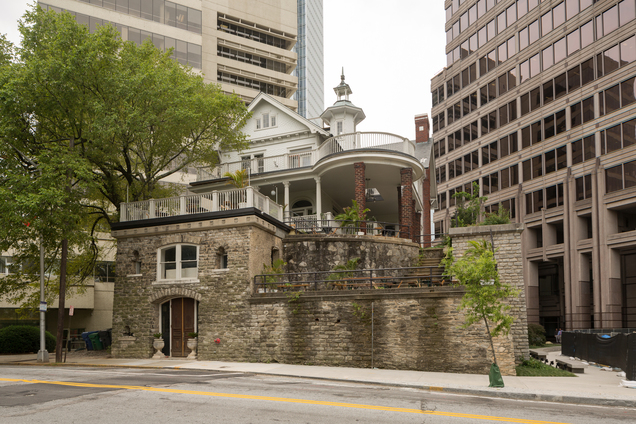
Fort Peace, widely known as The Castle, has been listed in the National Register of Historic
Places. The property is located
at 87 Fifteenth Street NE in Atlanta (Fulton County). The property
owner sponsored the nomination and prepared the nomination materials.
Fort Peace is
located just west of Peachtree Street in midtown Atlanta. Built in 1911, the eclectic
house is one of the last remnants of the many large and architecturally
distinctive houses constructed along Peachtree Street in the years following
the Civil War.
Fort Peace was
listed in the National Register of Historic Places as an excellent and intact
example of an eclectically styled house in Atlanta and one of the few remaining
representations of Peachtree Street’s historic residential development. The
house was designed by Ferdinand McMillan, the original owner, as a retirement
home for himself and his wife, Lucy. McMillan, a Confederate veteran, amateur
inventor, and machinery company owner, but armed with no experience as an
architect or engineer, “built a house which is contrary to all architectural
plans,” according to an article in the Atlanta
Journal in 1913. This departure from norms and inherent eclecticism is seen
in many details of the house, including its layout with its imposing two-story
granite basement and living space perched atop; the installation of wire loops
and cannon barrels into this granite wall through which McMillan intended to
grow vines and roses; the exposed bedrock in the basement, which McMillan
referred to as “the grotto; and the incorporation of eight large state seals
from the Cotton States and International Exposition of 1895 mounted above the
house’s mantels. The house incorporates elements of several styles popular at
the time, such as Queen Anne, Craftsman, and Neoclassical Revival, but it is
clearly the result of McMillan’s whims and fancy, rather than adherent to any one
style. The house retains a high degree of exterior and interior integrity and
was recently rehabilitated following the Secretary of the Interior Standards to
convert the house into a multifunctional restaurant, bar, member’s club, and
hotel suites.
Fort Peace
was also listed in the National Register for its significance in the areas of
art and performing arts as the home and workspace of many young creatives and
as the headquarters of multiple artistic organizations, such as theaters and
writers clubs from the 1930s through the 1960s. It played a prominent role in the Atlanta arts scene during
the mid-20th century, providing affordable studio and living space
for many up-and-coming artists in Atlanta, as well as headquarters, rehearsal,
and performance space for small-scale arts groups. A 1950 article in The
Atlanta Journal and Constitution Magazine referred to Fort Peace as “a
little Greenwich Village of their own” for Atlanta’s artists, writers,
musicians, and actors. This free-spirit scene and abundant creative energy
attracted a wide array of artists to the house, and in the 1950s, dancers, writers,
concert pianists, sculptors, newspaper men, art students, and even two
puppet-makers were living and working there.
The National Register of Historic Places is
our country's official list of historic buildings, structures, sites, objects,
and districts worthy of preservation. The National Register provides formal
recognition of a property's architectural, historical, or archaeological
significance. It also identifies historic properties for planning purposes, and
insures that these properties will be considered in the planning of state or
federally assisted projects. National Register listing encourages preservation
of historic properties through public awareness, federal and state tax
incentives, and grants. Listing in the National Register does not place
obligations or restrictions on the use, treatment, transfer, or disposition of
private property.
# # #
For more information contact National Register and Survey
Program Manager Stephanie Cherry-Farmer at 770-389-7843 and stephanie.cherry-farmer@dnr.ga.gov.
For press inquiries contact Historic Preservation Division Outreach Program Manager Allison Asbrock at 770-389-7868 and allison.asbrock@dnr.ga.gov
The above is a news release from the Historic Preservation Division of the Georgia Department of Natural Resources.
The
Historic Preservation Division (HPD) of the Georgia Department of Natural
Resources serves as Georgia’s state historic preservation office. Its mission
is to promote the preservation and use of historic places for a better
Georgia. HPD’s programs include
archaeology protection and education, environmental review, grants, historic
resource surveys, tax incentives, the National Register of Historic Places,
community planning and technical assistance.
The
mission of the Department of Natural Resources is to sustain, enhance, protect
and conserve Georgia’s natural, historic and cultural resources for present and
future generations, while recognizing the importance of promoting the
development of commerce and industry that utilize sound environmental
practices.
|