Save the date: statewide meeting Jan. 10. (Heidi Ferguson/DNR)
As we all prepare for the holidays, remember that soon after they’re over, we’ll gather for our statewide division meeting at Charlie Elliott Wildlife Center. The time and date: 10 a.m.-2 p.m. Wednesday, Jan. 10.
Like this year’s meeting, we will cover the latest division news, answer questions and recognize many of you who went above and beyond the call of duty in 2017. Of course, we’ll also enjoy a great meal together.
While our offices will need minimal staffing, for all not designated to be part of that office staff attending the meeting is mandatory. Check with your supervisor before registering (here’s the form, due by Jan. 2). We should have a vast majority of the division at this important meeting!
Also, I hope you all have a wonderful Christmas and New Year’s. Please take time to enjoy family, friends and some much-needed days off.
For my part I am grateful for the blessings your dedication, skills and integrity have meant to WRD. Your work has benefited our state’s wildlife and other natural resources and our customers – fellow Georgians and people who come from other states and countries to enjoy these resources.
Thank you for all you do to make our division and our state great. See you next month at Charlie Elliott.
P.S.: Remember that the deadline to register is Jan. 2. Sign up here.
Back to top.
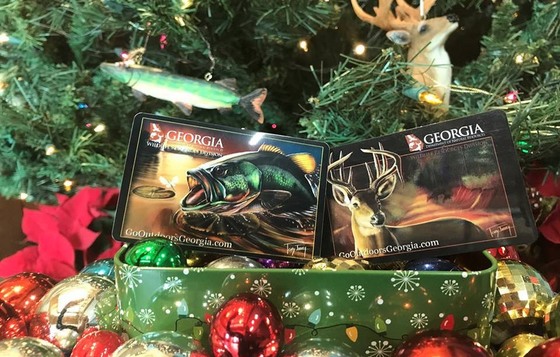 Put a license under the tree.
As all in WRD know, the perfect gift for that hunter and angler anyone's list is a hunting and fishing license! But we need you to help spread the word.
Licenses are truly the gift that keeps on giving. Not only are the fees used to support the outdoor resources and activities that license-holders enjoy, the sale of paid licenses is a key measure in determining how much each state receives in federal excise taxes paid on sporting equipment.
This federal funding from the Wildlife and Sport Fish Restoration Program returns much more than the license fees to manage fish and wildlife and provide recreational opportunities – more than $14 billion nationwide since the program’s creation 80 years ago. Uses in Georgia vary from funding public fishing areas to managing the state’s 1 million-strong deer herd.
Buying a hunting and fishing license benefits all outdoor lovers and the wildlife and wild places they love.
Find out more or buy a license online at www.gooutdoorsgeorgia.com.
BUYING GUIDE
A youth license, lifetime license or an annual hunting or fishing license are great examples of how to give access to the great outdoors and provide support for Georgia wildlife and state-managed lands.
But here’s something you might not know: Any Georgia resident younger than 16 is eligible for a Youth Sportsman’s License, not only those ages 12-15. Younger children also qualify for the $15 license that provides a hard card (deer or bass design) and sportsman’s hunting and fishing privileges during the holder’s 16th year – a $70 value. Age 16 is the first year a hunting or fishing license is required.
Back to top.
 This lake sturgeon is being tagged before stocking. (DNR)
The role that WRD fish hatcheries play in enhancing Georgia’s sport fisheries is well known. But the role of these hatcheries in conserving and restoring fish species? Not so much.
These efforts include lake sturgeon, smallmouth and shoal bass, American and Alabama shad, striped bass, and walleye. Here’s a quick look at our work involving some of these species.
Lake sturgeon eggs were once prized for caviar, a demand that led to overfishing of the species and decreased reproduction. Lake sturgeon have a long life span and do not sexually mature until their teen years. Because of that slow maturation, conserving this species requires a long-term commitment.
The Fisheries Section has raised and stocked lake sturgeon for 17 years and is committed to the program for at least eight more years. The goal is to establish a reproducing population in the wild. We stock sturgeon about 4-6 inches long each fall. Some are held at the hatchery until they’re about 15 inches. These are injected with a PIT (Passive Integrated Transponder) tag to help track survival, growth rates and movement.
More lake sturgeon are being seen by anglers and DNR field staff each year.
American and Alabama shad are anadromous: They're born in freshwater rivers, migrate to the ocean and return as adults to the rivers to spawn. Both species have been affected by dams built on spawning rivers and by commercial fishing. WRD spawns shad in our hatcheries and takes great care to stock fry in the rivers where the broodstock was collected, a practice to protect the genetic integrity of wild populations.
Smallmouth bass are one of newest additions to the hatchery program. In their native range, smallmouth face significant competition from invasive spotted bass. Our objective: Stock smallmouth in Blue Ridge and Chatuge to tilt the species mix of these lakes back to the native smallmouth.
As humans continue to affect the aquatic environment, including illegal moving of species between water bodies, it will be even more important for WRD hatcheries to help Georgia’s native fishes thrive.
Back to top.
THE ABCs OF KFEs
Now let's turn to a segment of hatchery work that is more widely recognized. This fall, WRD’s warm-water hatcheries provided about 20,000 6- to 10-inch channel catfish to support Kids Fishing Events statewide.
WRD co-sponsors the events – we call them KFEs – by supplying channel cats to improve fishing, plus educational materials for participants and guidance for sponsors. KFEs offer many young anglers the chance to catch their first fish, and in a family friendly setting with other children and family members.
The Cordele and McDuffie hatcheries produce the catfish fry and they and other of our warm-water hatcheries raise them during summer. The fish are harvested from hatchery ponds in the fall and stocked at WRD and private ponds for events in spring or summer. Co-sponsors feed the stocked fish, aiming to grow them to 12 inches or longer before the KFE.
KFE calendar plus other places and tips for taking kids fishing.
Back to top.
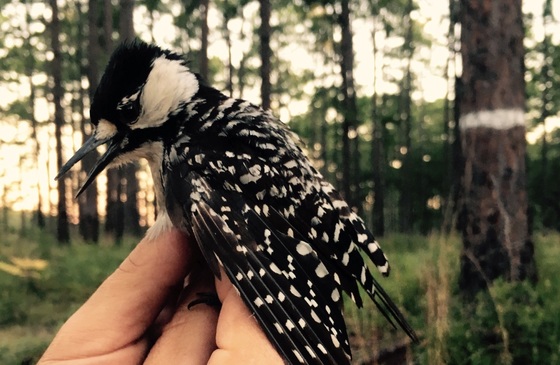 Red-cockaded woodpecker translocated to River Creek (Joe Burnam/DNR)
Red-cockaded woodpeckers have returned to River Creek.
The Nongame Conservation Section teamed with partner organizations Oct. 19-20 to capture and move eight of these small, endangered woodpeckers from Apalachicola National Forest in Florida to River Creek, the Rolf and Alexandra Kauka WMA near Thomasville.
The species has not been a resident at River Creek for some 30 years. The four males and four females were released in pairs (video). “The idea is they stick around and establish breeding pairs, and throughout time build the population up,” DNR biologist Joe Burnam said.
If so, the property bought in 2005 in part to restore these woodpeckers will be only DNR’s third WMA with them, including Silver Lake and Moody Forest.
WRD has made strides in conserving red-cockaded woodpeckers, a high-priority species in Georgia’s State Wildlife Action Plan. Woodlands have been restored with prescribed fire. Nest cavities have been installed. Populations have been monitored and landowners given technical assistance through a state habitat conservation plan developed in 1999, the nation’s first for the species.
Moving, or translocating, birds has been key. Led by the U.S. Fish and Wildlife Service and the Southern Range Translocation Cooperative, translocation uses sites such as Apalachicola National Forest where the birds are more numerous to jumpstart or boost populations at other sites with suitable habitat.
Explore translocation in “The woodpecker’s journey,” a Fish and Wildlife Service blog post and video.
Back to top.
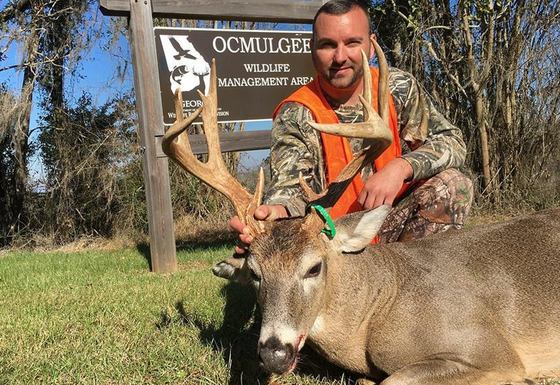 A wallhanger taken at Ocmulgee WMA. (Special to DNR)
How has your deer season gone? See harvest photos from around the state, on public and private lands, on WRD’s Facebook page. Also check out updated harvest results by county and WMA at gamecheckresults.gooutdoorsgeorgia.com.
WRD’s Wildlife Viewing Grants Program has been revived, thanks in part to a Georgia Natural Resources Foundation grant, and is seeking to support projects that help Georgians enjoy and better understand animals, plants and habitats emphasized in the State Wildlife Action Plan. Details on how and when to apply.
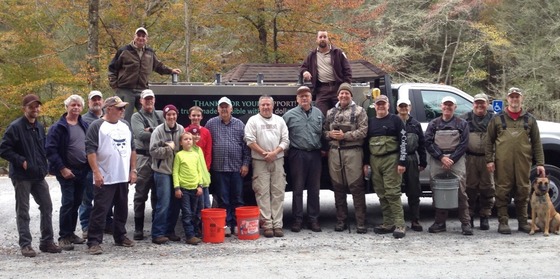 Delayed-harvest trout stocking crew on the Toccoa River (DNR)
To kick off the delayed harvest trout season Nov. 1, Region 1 Fisheries teamed with the U.S. Fish and Wildlife Service and about 30 volunteers from three Trout Unlimited chapters to stock 15,000 trout – many hauled in 5-gallon buckets up- and downstream from regular stocking sites. Stocking updates.
A new archery and air rifle range is open at Georgia Veterans State Park and Lake Blackshear Resort near Cordele for archers, shooting enthusiasts, bow hunters and others interested in honing their target skills. The range is one of 36 available on public lands in our state.
Ocmulgee PFA re-opened to fanfare and a flow of anglers Oct. 27. The PFA and its 106-acre lake near Hawkinsville had been closed since fall 2012 due to issues with the lake bed. WRD anticipates up to 20,000 anglers a year at Ocmulgee, which, like all PFAs, is open seven days a week sunrise to sunset.
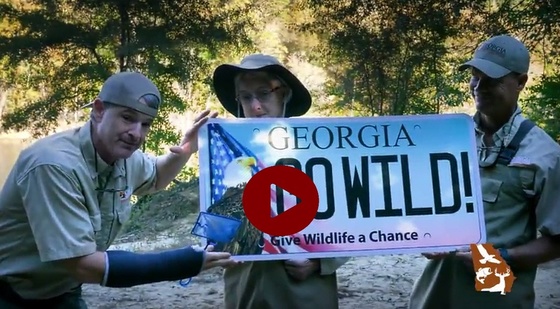 Watch: banking on license plates. (Heidi Ferguson/DNR)
What's the rap on DNR's nongame tags? Listen in as Dr. Bre (aka nongame Program Manager Brett Albanese) puts his spin on the importance of license plate sales and annual renewals. More on the key role DNR tags play.
Hunting mentors and those they’re mentoring can both win big in the Georgia Mentor Competition, with mentors possibly taking home a firearm and mentees a lifetime license. While WRD staff aren't eligible to enter, please tell others about this initiative by DNR and other organizations to increase hunting participation and raise awareness of hunting’s conservation role. How to enter.
An Acworth teacher’s proposal to create a pollinator garden at her school earned a $1,000 grant from Nongame Conservation and TERN, the agency’s friends group. Karen Garland of Clark Creek Elementary STEM Academy will receive the 2017 Conservation Teacher of the Year grant.
Back to top.
Fisheries Chief John Biagi retired at the end of October, capping a 27-year career with WRD, including the last 10 serving as chief. Longtime outdoors writer Bill Baab profiled Biagi's work and accomplishments in this article in The Augusta Chronicle. Former Assistant Fisheries Chief Matt Thomas has been promoted to chief of the section.
Baab also wrote recently about Spud Woodward, who once worked for WRD but is best known for serving as Coastal Resources Division director since 2009. Woodward retires Jan. 1 and DNR Commissioner Mark Williams has announced the appointment of CRD Policy Director Doug Haymans as the next CRD director.
WE ARE DNR RECOGNITION
WRD We Are DNR recipients for late October through early December include the following, plus some of the comments from those nominating them:
Yvonne Grovner, interpretive specialist, Sapelo Island National Estuarine Research Reserve – Yvonne has led comprehensive tours for the public at Sapelo for 20-plus years, educating more than 45,000 people with her interpretation and visits to historical and ecologically significant sites. Yvonne also was a key player in getting SINERR back on its feet after hurricanes Matthew and Irma. She was one of the first to show up with a chain saw to help clear roads, and when put in charge of cleaning the flooded research lab, she had that building back in working order within a week. Hardworking, resourceful and always ready to lend a hand, she is an incredible example of DNR working hard to help conserve, enhance and promote Georgia's natural and cultural resources.
Katie Jones, Game Management Region 2 (Gainesville) – (Editor’s note: Katie is the first We Are DNR recipient nominated by four people, meaning the following comments are truly a combination!) Katie has remarkable internal and external customer-service skills. She is the voice of our region, answering the phone, greeting walk-ins and handling more than 1,000 nuisance animals calls this year alone. She resolved many of those calls on the phone without requiring a visit from field staff, a huge cost savings for the department. She is a quick learner and always willing to help, even working WMA hunts. Katie tags gators and bears and can notch a coyote ear like a champion. She is blessing to this region and a real asset to WRD.
Congratulations to Yvonne and Katie. Thank you both for helping WRD excel at customer service and continue to pursue its mission.
We Are DNR awards allow all WRD employees to recognize associates for exemplary work. Just click the button below and answer the brief questions.
Back to top.
Changes for August through November (hourly positions are not included).
HIRED
- Kevin Christopher Thomas, Fisheries Management (North Region 1 Operations), fisheries technician 2
- Owen Todd Jenkins, Game Management (Albany), wildlife tech 1
- Emily Ann Ferrall, Nongame Conservation (Wildlife Resources Conservation Center), wildlife tech 2
- Lauren Frances Long, Fisheries Management (Region 1, DJ Expansion), administration support 1
PROMOTED
- Amanda Rae Hrubesh, Public Affairs (Headquarters), webmaster 1
- Scott A. Bardenwerper, Game Management (Gainesville), manager 2
- Aubrey Lynn Pawlikowski, Public Affairs (Headquarters), marketing specialist 1
- Matthew Earle Thomas, Fisheries Management (Headquarters), senior manager 1 (section chief)
- Suzanne VanParreren, Game Management (Sapelo National Estuarine Research Reserve and Visitors' Center), marine biologist 2
RESIGNED
- Jessie Brion Kriner, Fisheries Management (Southeast Region III Operations), fisheries tech 2
RETIRED
- John G. Biagi, Fisheries Management (Headquarters), senior manager 1 (section chief)
Back to top.
|