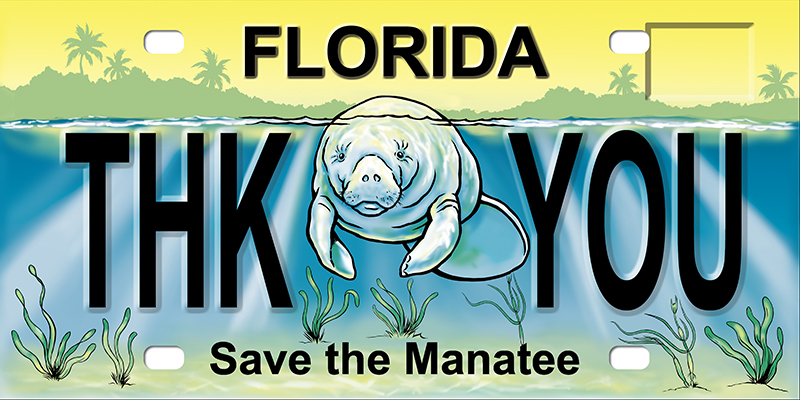
Help support manatee conservation by purchasing your own Florida manatee license plate!
The fee collected during the purchase of your manatee license plate goes directly into the Save the Manatee Trust Fund (Trust Fund). The Trust Fund is a key source of funding for the State's manatee-related research, rescue, and conservation activities. Through the long-term public support of the Trust Fund, critical information gained from the FWC’s research, rescue, and monitoring efforts continues to provide conservation managers and the public with timely, science-based information needed to guide current and future conservation actions.
There are two ways you can purchase a manatee license plate:
- Renew your existing manatee plate online through the Florida Department of Highway Safety and Motor Vehicles
- Visit your local Tax Collector’s office in person to get your very own manatee license plate
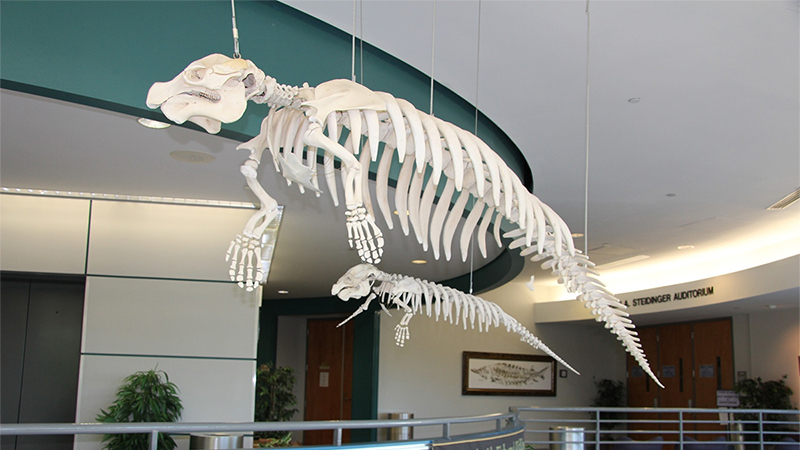 Amazing Manatee Bone Facts
Six neck bones instead of seven (6-7 😄). Because of this, manatees cannot turn their heads sideways, so they rotate their entire body to look behind them.
Small pelvic bones. These are not attached to its skeletal frame, and they are remnants of a time when manatee ancestors lived on land.
Solid rib bones. Their ribs contain no marrow; manatees make red blood cells in their sternum, where there is marrow.
Hyoid bones in the neck. These bones are similar to the Adam’s apple in humans, and there is no known use for them today.
Pectoral flippers with “finger bones”. Inside each flipper are bones similar to those found in a human hand. A manatee uses flippers to move through the water, pulls itself along the bottom when in shallow water, and brings food to its mouth.
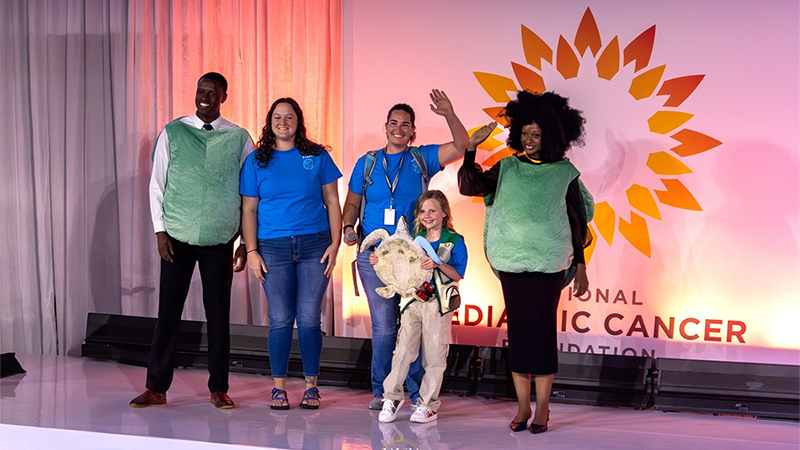 FWRI at Fashion Funds the Cure
Earlier this year, members of our sea turtle team had the privilege of participating in Fashion Funds the Cure, a charitable fashion show that celebrates the strength, courage, and dreams of pediatric cancer patients.
As part of the celebration, each child shares what they want to be when they grow up, modeling their dream for the future during a second walk. Kennedy wants to be a sea turtle biologist when she grows up, and was joined on stage by two biologists from our turtle team!

Tangled & Released: A Successful Rescue in the Field
In September, FWRI freshwater fisheries biologists performing an electrofishing survey came across an alligator snapping turtle trapped in old, unattended trotline.
Researchers moved quickly to bring the turtle onto the boat, and carefully cut the main line wrapped around its leg.
After close examination, the turtle was deemed releasable and only suffered minor injuries. Staff observed that after a short rest, the turtle swam off on its own.
 YouTube Spotlight:
Black Crappie Community Science Program
Do you fish for black crappie at Tenoroc?
FWC is launching a new community science program, and we need your help collecting fin clip samples from Tenoroc’s crappie.
Your participation directly supports research and helps us manage and improve the fishery for everyone. Getting started is easy. Sign up with FWC to receive your free sample box, which includes everything you need, plus simple step-by-step instructions.
This is your chance to give back to the fishery you love and play a direct role in shaping its future.️
New on MyFWC.com/Research
We hope you enjoy these articles that have been recently added/updated on our website:
Red Tide Current Status
Red Tide-Related Hotlines and Information Sources
2025 Manatee Mortalities
Annual Rescue Summaries [Manatee]
Coastal Habitat Integrated Mapping and Monitoring Program (CHIMMP)
CHIMMP Workshops and Resources
Cooperative Land Cover, Version 4.0 - Published November 2025
New Publications
Our Mission
Through effective research and technical knowledge, we provide
timely information and guidance to protect, conserve, and manage
Florida's fish and wildlife resources.
|