|
October 1. 1pm-3pm. Volusia Partnership Meeting. In person. Contact Jennifer Winters
October 2. 9am-12pm. Timucuan Partnership Meeting. In person. Contact Blair Hayman, Hailey Dedmon, or Chris Farrell
October 2. 11am-1pm. Suncoast Partnership Meeting. Zoom call. Contact Beth Forys or Kara Durda
October 6. 9am-12pm. St. Johns/Flagler Partnership Meeting. In person. Contact Hailey Dedmon, Chris Farrell, or Alex Kropp
October 9. 12pm-3pm. Collier-Lee-Charlotte Partnership Meeting. Teams Meeting. Contact Megan Hatten or Jacob Wozny
October 10. 9am-11am. Treasure Coast Partnership Meeting. Team Meeting. Contact Niki Desjardin
October 17. 9am-12pm. Space Coast Partnership Meeting. In person. Contact Hailey Dedmon, Amanda Hipps, or Yagen Gutierrez
October 20. 10am-1pm. Southeast Partnership Meeting. Teams Meeting. Contact Natasha Warraich
October 20. 1pm-2:30pm. Keys Partnership Meeting. Teams. Contact Barbara Overton or Suzy Roebling
October 22. 10am-3pm. Panhandle Partnership Meeting. In person and Zoom. Contact Nick Vitale, or Col Lauzau
October 23. 1pm-3pm. Nature Coast Partnership Meeting. Teams Meeting. Contact Taylor Bell, or Blair Hayman
|
Waterbird Society Meeting
The Waterbird Society will host its 2025 meeting September 29 to October 3 in Traverse City, Michigan.
For more information check their website:
Annual Meeting – The Waterbird Society
|
|
 |
Red Knots are Back!
Fall migration is happening once again and some familiar species have reappeared on our shores. Red knots breed in the Arctic. They migrate through and winter in Florida. By this time of year, they can be found along U.S. coasts. Some individuals travel up to 9,000 miles during one migration route, roughly three times the length of the continental U.S.
Red knot populations have been declining worldwide, and they are federally listed as Threatened in the U.S. As such, there have been significant efforts to better understand their migration routes and population. Florida Shorebird Alliance Partners resight and report banded individuals across Florida. This contributes to better understanding of migratory and wintering site fidelity, as well as their movement patterns.
In March 2010 at Shell Key in Pinellas County, researchers banded a red knot with a light green flag with the black code 9JK. Thanks to the resighting efforts by partners, 9JK has been spotted 73 times during the last 15 years, mostly in Florida, with some band resights in Georgia. Its favorite wintering locations are around Fort DeSoto, in Pinellas County, but it has also been seen around Captiva Island, about 100 miles south in Lee County
One of the first red knots banded as part of a research project in Florida was on North Captiva Island in 2006. It wears a light green flag with the code VYP. This individual has been resighted mainly around Sanibel Island and Fort DeSoto, as well as in Northeast Florida and Georgia. VYP is estimated to be approximately 20 years old. Perhaps some of our readers may be surprised at VYP’s age, but many shorebirds are relatively long-lived when compared to songbirds. Maybe you will be lucky enough to spot 9JK and VYP this year.
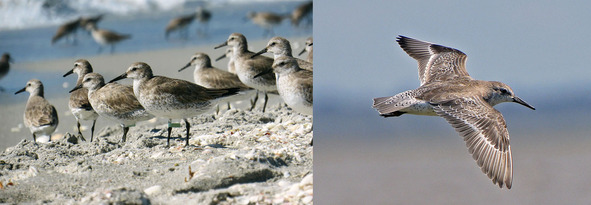 When red knots arrive in the fall, most have lost the vivid colors from the breeding season, adopting a gray back and white belly instead of the reddish cinnamon on their face, chest and wings. Photos by Caity Reiland-Smith (left) and Patrick Leary (right)
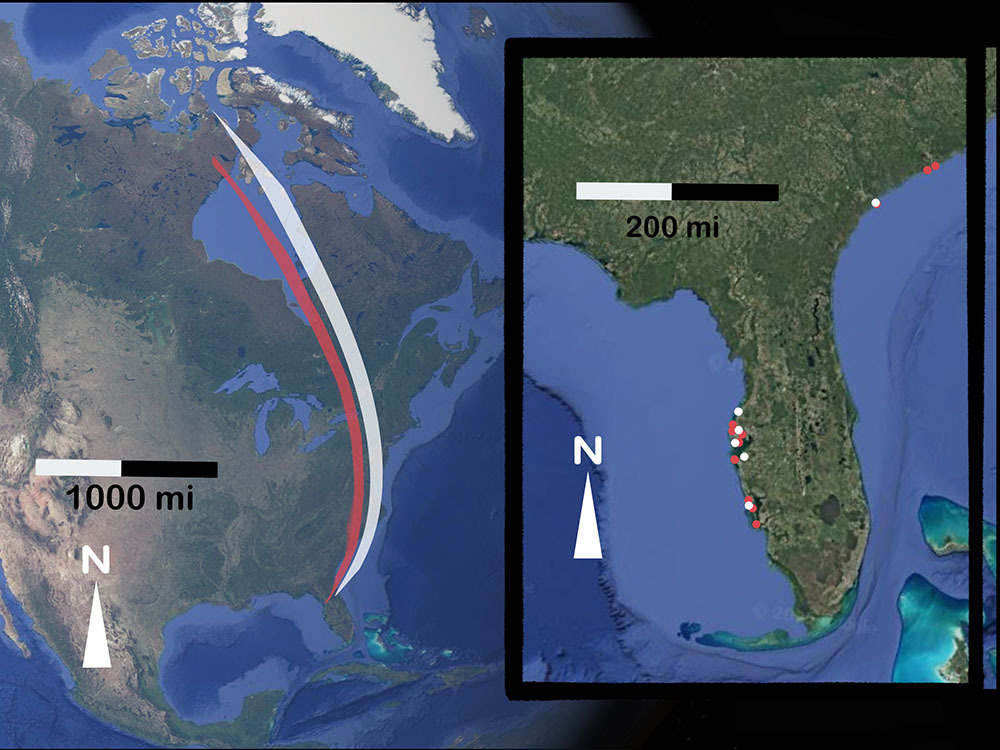 This map depicts the migrations undertaken by JK9 (red) and VYP (white). The map on the right shows the locations where these individuals have been resighted in Florida and Georgia.
Skimmers Find New Nesting Grounds at Anastasia State Park
Beaches in Florida are highly sought after for development and tourism, leaving little remaining suitable habitat for coastal-dependent birds. Coastal habitats, however, are naturally dynamic environments and can undergo dramatic changes after storms. Shores can vanish as easily as they can appear, and sometimes this becomes an opportunity for nesting seabirds.
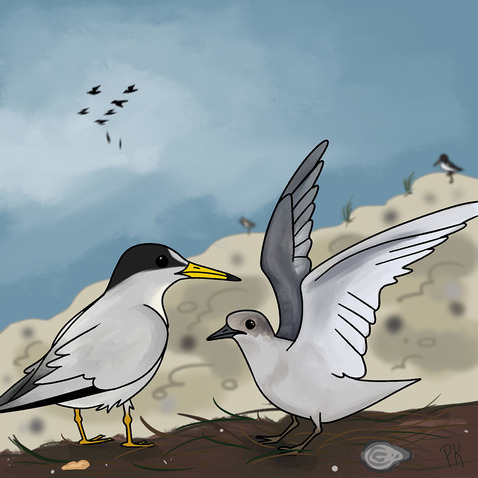
FSA partners have documented birds shifting to new habitats created by the 2024 storms at many sites in Florida, including Anastasia State Park, with newly created banks along its northern section. Due to limited access points, this end of the park is less likely to experience human disturbance, so black skimmers figured out that this area was prime real estate. After many years without any significant nesting activity, they settled in at the park for the 2025 breeding season. What resulted was a boom in successful nesting at the park. The black skimmer colony there produced 32 fledglings, and they were joined by least terns that produced 150 fledglings, despite the presence of predators. This may seem like a small number for black skimmers, but it is worth noting that this is only one of the two ground colonies on the entire Florida Atlantic coast for this species. Black skimmers tend to have a high degree of nesting site fidelity, so they will likely attempt next year if this newly created habitat remains.
Insights from the Field: Barge Canal Islands after Helene
The landscape looked significantly changed at the Marjorie Harris Cross Florida Barge Canal Spoil Islands after the 2024 hurricane season. The largest of the seven islands hosts the greatest number of breeding American oystercatchers, Wilson’s plovers and least terns in the Southern Nature Coast, and the species nesting there are constantly competing for space. FSA partners collaborate with site managers to reduce threats to breeding birds at this high-priority site, but creating more space for them is difficult and costly. In a matter of hours; however, Hurricane Helene altered the islands in ways that human intervention would have taken years to achieve.
The changes were dramatic. Much of the woody vegetation on the islands was inundated and swept away, creating large expanses of suitable habitat favored by nesting birds. Typically, the islands have limited numbers of nesting least terns that are unsuccessful due to a combination of threats and limited space to nest. The fewer adults in a colony, the less they are able to defend nests and chicks from crows or other avian predators. This year, however, the habitat created by Hurricane Helene enabled them to form two large colonies side by side on one of the spoil islands. Many least tern chicks survived to fledge.
The larger least tern colonies also contributed to chick survival for other nesting species. On more than one occasion, least terns were observed chasing off crows from areas where Wilson’s plovers and American oystercatchers nested in close proximity. Thus, inadvertently protecting all three species from crow predation.
Artwork by Peyton Kerry.

The Florida Shorebird Database is now closed for data entry for the 2025 season. All data entered into the FSD are reviewed to ensure that the dataset is internally consistent. In the coming months, the FSD quality control team will continue to review records across the state and will be reaching out for clarification as needed.
It’s possible that you’ve already heard from an FSD data reviewer. Please know that this is a normal part of the quality control process, and these conversations ensure your data will most effectively guide conservation, research, and management of these species. Additionally, partners can help to give us site-specific context regarding the shorebirds & seabirds that are breeding within a given region. This is invaluable information! Thank you in advance to all partners involved in this process.
If you have any questions, need assistance, or have additional information to provide about the data you’ve entered for 2025, please email us at FLShorebirdDatabase@MyFWC.com.
Thank you for being an essential partner in the shorebird monitoring program!
Shorebirds and seabirds nesting at Sanibel Causeway have had a great year. To learn more about their success, check out the press releases below!
Seven snowy plover chicks fledge on Sanibel - SANIBEL-CAPTIVA - Island Reporter, Islander and Current
SCCF: Highest success for terns on causeway since 1990s - SANIBEL-CAPTIVA - Island Reporter, Islander and Current
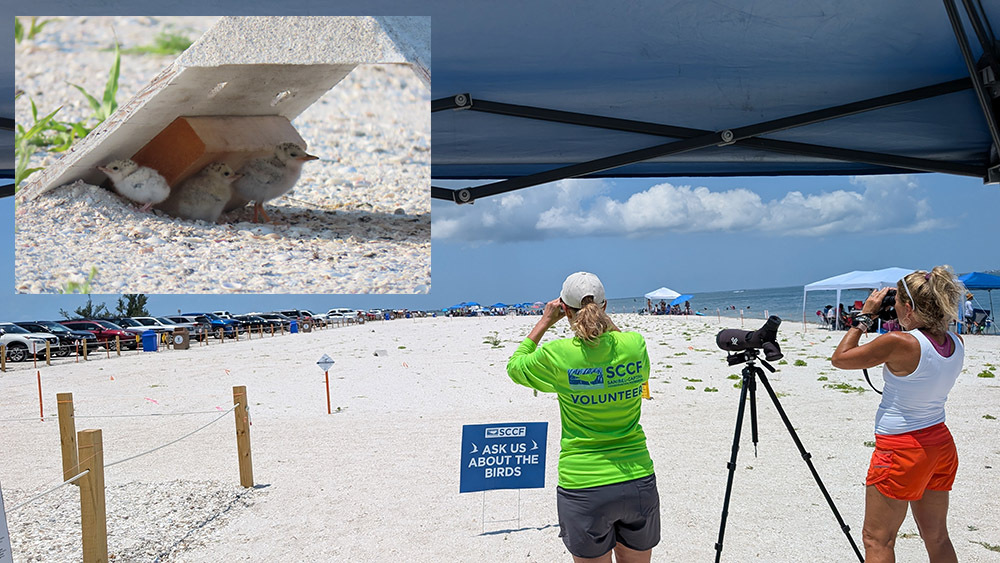 Images kindly provided by Audrey Albrecht
|