|
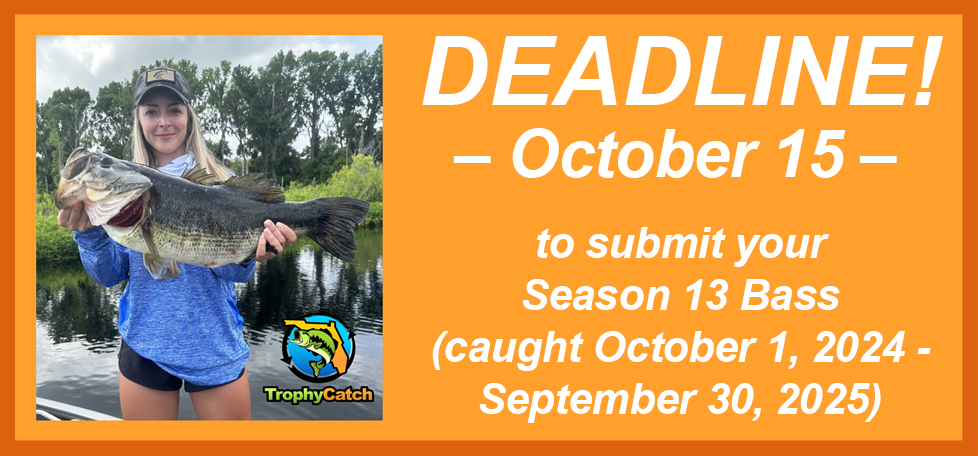
TrophyCatch Season 13 drew to a close September 30! If you still have bass photos from October 1, 2024 - September 30, 2025 make sure you submit them by the October 15 deadline. This has been another stellar season. We are already excited about the upcoming Phoenix Boat drawing and new promotions already being planned for Season 14. Stay tuned for upcoming news on those events!
- 13,148 Lunker Club (8-9.9 lbs.)
- 3,321 Trophy Club (10-12.9 lbs.)
- 166 Hall of Fame (13+ lbs.)
- 16,635 TOTAL approved submissions to date
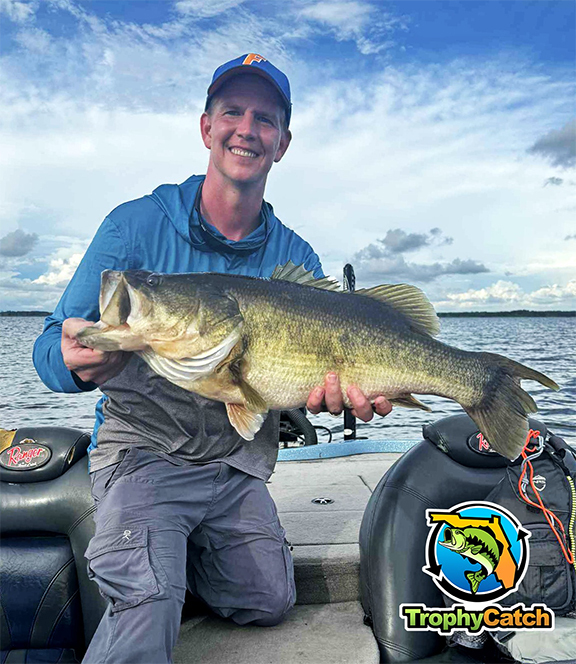
Derick Simpers’ 10-pound Alachua County catch captured what it’s all about: “As you can tell from the pure happiness on my face. These are the days that we live for as anglers. This is my first double digit bass. Also my second PB this year. So how exciting is that?!! I released her to make more babies for future anglers!"
Register for TrophyCatch or view approved angler catches to help plan your next fishing trip at TrophyCatch.com. Follow TrophyCatch on Facebook and Instagram for featured big bass, program updates and partner highlights.
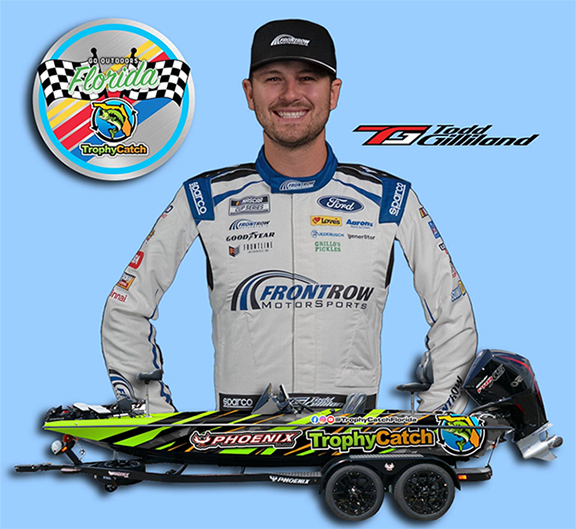
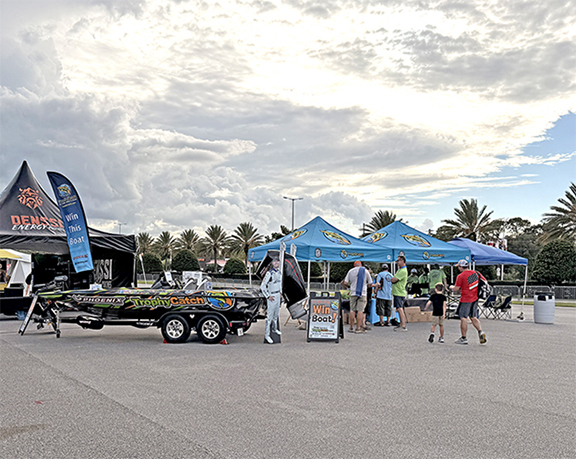
As part of a multi-tiered sponsorship, a recent and unique outreach event provided the opportunity for FWC staff to expand promotion of the Go Outdoors Florida licensing website and the TrophyCatch program to a national audience. The FWC collaborated with Front Row Motorsports at the NASCAR Coke Zero 400 race at Daytona International Speedway in August.
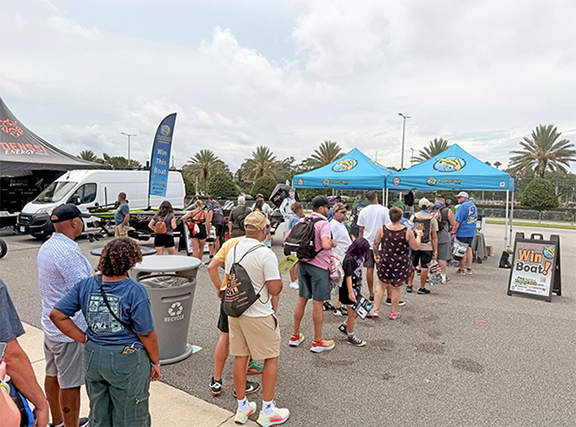
The main attraction was the TrophyCatch Phoenix bass boat package, powered by Mercury, guided by Lowrance, and anchored by Power-Pole Total Boat Control. It dominated the FWC booth. Racing and bass fishing are two southern sports that enjoy a widely overlapping audience, and racing enthusiasts flocked to the FWC booth both race days until well after the nighttime races were underway. Visitors had a chance to spin the wheel to win hats, challenge coins, koozies, lures, and other prizes.
FWC staff interacted with hundreds of racegoers asking about the Phoenix boat, TrophyCatch, and fishing in Florida. Many of YOU, our TrophyCatch participants, also stopped by to brag about your catches and received in-person heartfelt TrophyCatch team thanks for your participation!
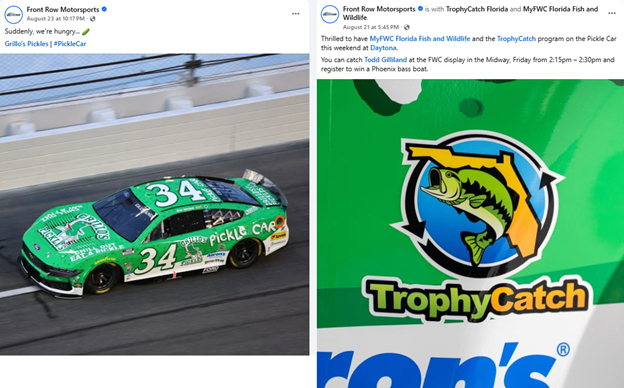
The FWC team was watching the Front Row Motorsports #34 car driven by Todd Gilliland. The appropriately green “Grillo’s Pickle Car” sported the TrophyCatch logo as it roared its way around the track for 400 miles at speeds over 130 mph. Todd (and TrophyCatch) finished a very respectable 11th place despite a spinout early in the race that drew a collective gasp from staff. The day before his race, Todd dropped by the TrophyCatch booth to meet fans and staff and autograph everything from TrophyCatch hats to #34 Matchbox cars.
And it’s not over yet! Stay tuned for even more exciting racing news coming in Season 14!
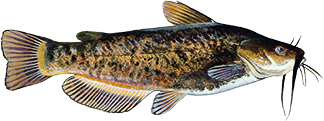
Size: The state record is 7.02 pounds. The Big Catch minimum qualifying sizes are 2.00 pounds or 16 inches for adults, and 1.50 pounds or 12 inches for youth (see BigCatchFlorida.com).
Identification and similar species: The barbells make this fish easy to identify as a catfish. Chin barbels on browns are dark-pigmented, not whitish as with yellow bullhead. The sides of brown bullheads have a distinct, irregular brownish mottling over a light background. The belly is creamy white. They have square tails.
Angling qualities: Fair fighters, they are easy to catch with baits such as worms, minnows, shrimp, chicken or beef liver, and commercial stinkbaits. They bite throughout the day, but fishing is best at night. Summer is an ideal catfishing time — just add a beach umbrella, lawn chair, and jug of tea or lemonade to your equipment checklist for a few hours of relaxing fun!
Where to catch them: Brown bullheads are common throughout the entire state. They generally inhabit still or slow-flowing warm waters in ponds, lakes, reservoirs, large rivers and sluggish streams.
Interesting facts: They are primarily bottom feeders, feeding mostly at night. Highly sensitive barbels enable them to smell a wide variety of food such as insects, plant material, carrion, small fish, snails, crayfish, worms and leeches.
|
Fish images by Duane Raver, Jr. and/or Diane Rome Peebles
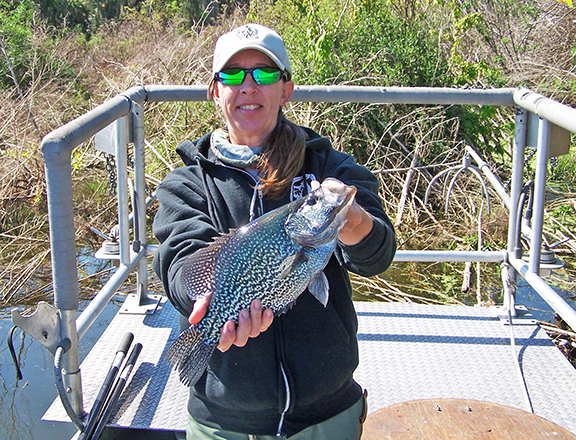 FWC is launching a new community science program, and we need your help collecting fin clip samples from Tenoroc’s crappie. To learn more visit https://www.facebook.com/share/v/1Bpw6Uv8BH/.
Your participation directly supports research and helps us manage and improve the fishery for everyone.
Getting started is easy. Sign up with FWC to receive your free sample box, which includes everything you need, plus simple step-by-step instructions.
Email: Blackcrappietenoroc@myfwc.com or call us at 352-800-5012 to enroll today. This is your chance to give back to the fishery you love and play a direct role in shaping its future.
There are many reasons to bank fish. The most obvious is not owning a boat due to cost or storage space. Many waters don’t have ramps or are only accessible by foot. And you don’t always have the time to load up, launch, and retrieve a boat. But whether your boat-lessness is permanent or temporary, most anglers will find themselves working their feet instead of a trolling motor at least some of the time. Here’s how to take advantage of those times.
Footwear
Tennis shoes are probably the most readily available bank and wading shoes — you probably already own a pair. With our mild Florida climate, “sneakers” can be quite comfortable, even when wet. But that’s their main problem: they’re not waterproof, and even during warmer weather having to change out of wet socks and shoes is inconvenient. During cooler weather, wet sneakers can be downright cold. No matter how hard you try to stay dry, it always seems like your sneakers still end up getting wet.
You might think that the extremely popular modern sandals come next. They’re great on the boat or when kayaking (which definitely involves some wading). However, the open design is simply not safe for many fishing terrains. For beaches and the tamest of shorelines, yes — but for partly-wooded lake shores, rocky canal banks, and brushy pond edges, no.
|
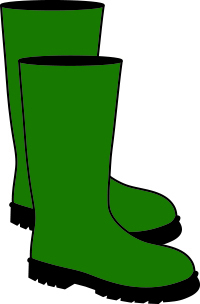
Rubber work boots are the next step up. They are dirt cheap, and you can even wade a bit into water almost a foot deep, while still staying dry! When you are limited to a brushy bank, being able to step out even a little bit into the water will often allow you to cast around or past bushes or other shoreline vegetation. You can also edge a little closer to offshore vegetation or cover that might be harboring big bass just out of reach of someone stuck on the bank. The disadvantages of plain rubber work boots, however, are several. They’re hot. They’ll fill with water like a pair of five-gallon buckets if you go too deep. They don’t fit your feet very tightly, which can leave a boot behind in deep mud, or cause heel blisters when covering harder terrain.
|
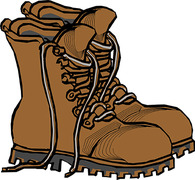
If you heed the unanimous advice of dozens of outdoors writers, you’ll eventually end up with a quality pair of waterproof outdoors boots. There are numerous options available, but I prefer knee-high, form-fitting rubber boots that lace up. If you also duck hunt, then odds are high that you already own a pair. The close-fitting ankles and lacing on these boots make sure they stay put, even when sucking a foot back out of two-foot-deep mud. For less muddy or shallower use, most anglers will be more comfortable in waterproof leather boots which are cooler than rubber with more breathability. These usually have rubber soles, with leather uppers of various heights (you’ll pay more for taller boots, as I did for my knee-highs). Normal rubber soles with a deep tread will handle most lakeside terrain; felt or studded soles designed for northern rocky lakes and rivers are useless down here. While definitely easier on the feet, these boots require some maintenance, mainly of the leather uppers to keep them waterproof and supple. Even with care, they will eventually start to leak. Be aware that many boots come insulated or lined against the cold of northern climates; Florida sportsmen will want to make sure they buy uninsulated versions.
|
Caution - Alligators
Due to the potential presence of alligators in any of Florida’s waters, anyone near water should stay alert and exercise due caution at all times. For more tips on staying safe, see FWC’s Alligators page.
Other Equipment
Unless you’re fishing obstruction-free waters, medium to heavy rather than light tackle will be best-suited for bank angling. In a boat, you’re usually working fish away from cover out into open water, but from shore you’ll often have unavoidable obstructions to deal with. Longer rods provide more reach and better control when you don’t have the option of dashing from one side of the boat to the other.
You’ll need some way to carry your lures and other fishing gear. A small tackle box works well for a start; you can transfer a basic selection of lures for whatever you’re after from your main tackle box into your “carry” box. However, a roomy waist tackle pack is hands-free and much more convenient. Spacious fishing vests are also available — but hotter to wear. A water bottle holder or clip on your tackle pack or vest is a lifesaver for long treks from the car.
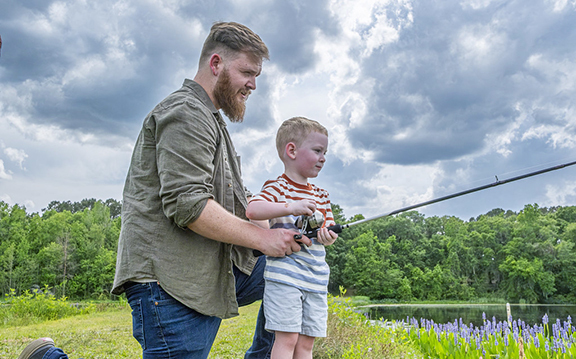
No boat needed to make lifetime memories! Bank fishing can be as simple or advanced as you want to make it.
Tactics
Most of these principles will apply equally to bank or boat fishing. You’ll be targeting obvious structure, and ideally you’ll try to line up your casts so that your lure spends more time in the strike zone than it does in dead water. However, the latter can be hard to accomplish from shore. Wading out slightly past shoreline brush, or closer to the far edge of shoreline weeds, will often help you place a cast parallel to the shoreline that will cover likely territory. Bank anglers also need to keep stealth in mind, keeping a low profile and walking softly in order to get close to their quarry without spooking it.
Weedless lures are even more of a necessity when bank fishing. Shoreline structure and trees will be harder to avoid. And if you snag one, you’ll have a better chance of getting a weedless lure back than one with multiple treble hooks.
Playing a large fish will be more challenging from shore, because there will usually be more obstructions to deal with. Again, a longer rod will give more control, allowing you a bit more leeway in steering fish around or away from vegetation or shoreline brush. On the other hand, wading can put you closer to the action, and it can be quite exciting to have a large fish boiling the water right next to you before you manage to land it. A word of caution, however: yet another reason to make all your hooks barbless is the possibility of having a large fish brush you with a mouth full of trebles.
So whether you always fish from shore, or you’re just giving the bass boat a break, bank angling can provide some great rewards. These tips should help you to make the most of the experience!
The Apalachicola River is one of many northwest Florida rivers that offer both outstanding scenery and fishing.
Location: Calhoun, Franklin, Gadsden, Gulf, Holmes, Jackson, Leon, Liberty, Walton, and Washington counties
Description: The rivers of northwest Florida provide unique fishing opportunities for freshwater anglers wanting to catch trophy-sized catfish. All northwest Florida rivers offer great angling opportunities, and some rivers present unique opportunities depending on the desired target species.
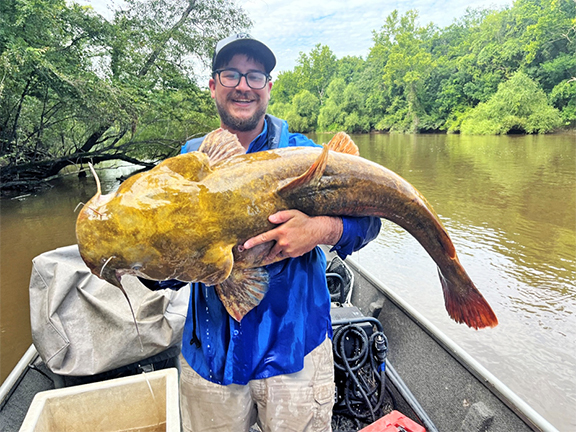
FWC biologist holding a 58-pound flathead catfish sampled during an electrofishing survey.
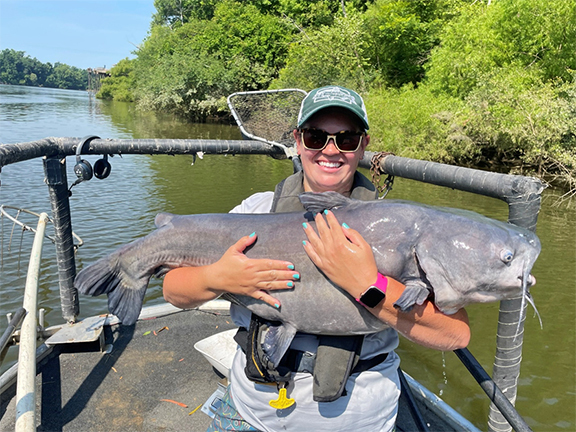
The Apalachicola River offers a nice fishery for flathead, blue, and channel catfish. Launching at Chattahoochee or Ocheesee Landing is recommended for targeting these species. Large flatheads (20 lbs.) can be found throughout the river, and the upper river has trophy-sized blue catfish and high catch rates for channel catfish. While conducting electrofishing surveys, biologists collected a blue catfish that weighed 49 lbs. in the summer of 2025.
FWC biologist holding a 49-pound blue catfish sampled during an electrofishing survey.
If you are targeting trophy flathead catfish, the Choctawhatchee River provides excellent angling opportunities. Launching at either Curry Ferry or Caryville Landing is recommended. In the summer of 2024, our biologists collected a flathead catfish that weighed 58 lbs. while conducting electrofishing surveys.
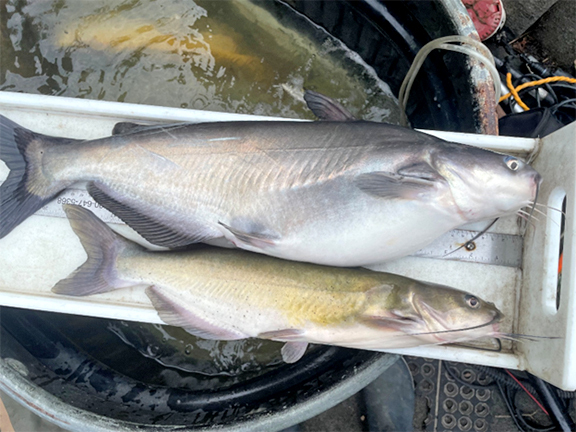 Side-by-side comparison of blue catfish (top) and channel catfish (bottom).
The Ochlockonee River has high catch rates for flathead catfish. It is recommended to launch at the Hwy 90 boat ramp or Jack Langston Landing. In the summer of 2024, biologists collected a flathead catfish that weighed 48 lbs. in the Ochlockonee River during sampling.
Fishing for catfish is best during spring and summer months. They tend to be most active during dawn, dusk, and night. If targeting flathead catfish, anglers should try fishing on the bottom or targeting deep holes containing woody debris. It is recommended to use heavy tackle, with live bait such as bluegill. (Note that bluegill may be used as bait for sportfishing by the angler who legally caught them.) Blue catfish provide an excellent fight on rod and reel as one of the strongest freshwater fish. Anglers should try bottom fishing with cut bait rigged on large hooks with heavy lead sinkers. While targeting channel catfish, anglers should use baits with strong odors such as chicken liver, shrimp, cut mullet or commercial stink baits.
How often do you see people or businesses wanting to be taxed and happy about it? You may not realize how much it has benefited you, but the Federal Aid in Sportfish Restoration (SFR) program has proven for more than half a century to be one of the best “user-pays, user-benefits” initiatives anywhere.
In 1937, President Franklin D. Roosevelt signed the Federal Aid in Wildlife Restoration Act. Between 1941 and 1950, sport-fishing businesses paid a federal excise tax that was deposited in the general treasury of the United States but did not directly benefit manufacturers or anglers. In 1950, sportsmen and businesses teamed with conservation-minded policy makers to redirect these existing federal excise taxes to the Restoration Program.
The concept was to restore sportfish populations and improve public access, so more people can enjoy fishing and so fishing sales would increase. Sport Fish Restoration (SFR) came about as a result of anglers wanting to see more money directed toward restoring the nation’s recreational fisheries, and ensuring better fishing opportunities for themselves and future generations.
|
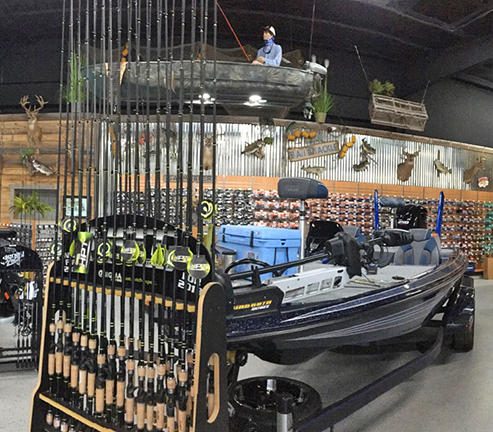
Federal excise taxes collected on the sale of fishing reels and other fishing tackle, as well as a motor boat fuel tax, provide a remarkable annual return on investment for manufacturers of outdoor equipment. These excise taxes are paid up front by the outdoor recreation industry (such as fishing tackle and boating manufacturers). Although these costs are of course passed on to anglers, the share paid by the individual consumer is very small. However, the accumulated return to outdoors enthusiasts and the outdoors industry as a group are dramatic. For example, one study determined that for excise taxes paid on fishing equipment like rods, reels, and lures, the return on investment was an average of 2,100 percent over 51 years (1955-2006). In plain English, for every $1 paid by the sporting goods industry in federal excise taxes that support fishing programs, those industries made $21 back in fishing equipment sales.
|
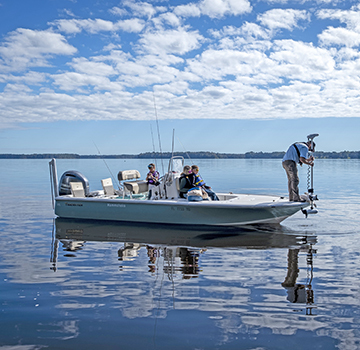
In Florida, SFR provides millions of dollars to support boating access and freshwater fisheries conservation, which helps to support fisheries that provide $1.7 billion in economic benefit to the State — as well as providing 46 million days of outdoor recreation enjoyment annually! The FWC uses this money to improve fisheries habitat, stock fish, conduct research and manage fish populations. The FWC also conducts aquatic education programs and provides valuable fishing and conservation information to anglers. The next time you go fishing, remember SFR — three important letters that make fishing better!
|
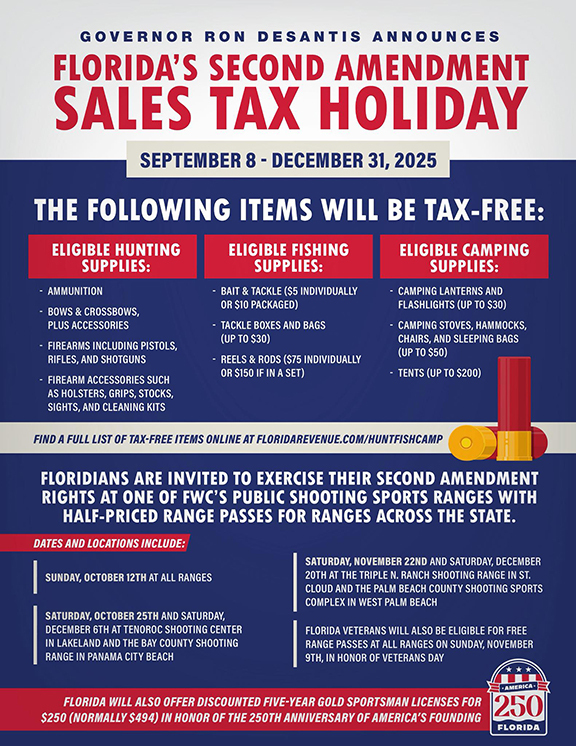
The Second Amendment Sales Tax Holiday suspends collection of sales tax on the retail sale of items needed for hunting, fishing, or camping in Florida’s great outdoors. It allows Floridians to save money on supplies needed to celebrate their Second Amendment rights, and also allows Floridians to save money on supplies needed for other sportsman activities such as camping or fishing, including items such as rods and reels, bait and tackle, and tackle bags and boxes. See the Second Amendment Sales Tax Holiday news release for details.
To contact The Florida Freshwater Angler, email John Cimbaro. Fish illustrations by Duane Raver, Jr. and Diane Rome Peebles.
|